Iran and world powers could be weeks away from reviving the 2015 nuclear accord that could lift punishing trade restrictions in exchange for the resumption of UN nuclear inspections aimed at verifying whether Tehran is restricting its nuclear programmes to civilian research.
EU diplomats said on Monday that 16 months of negotiations had now come to an end and that the text of a potential agreement had been finalised in a 25-page draft document.
All that remained, they said, was for US President Joe Biden and Iranian President Ebrahim Raisi to sign off on the deal, adding that there were “weeks” left to complete this final step.
But several highly contentious issues remain, which have been stumbling blocks in recent months.
Chiefly, these are claims by the UN’s nuclear watchdog, the International Atomic Energy Agency, that Iran has obstructed an investigation into traces of enriched uranium at three sites where Tehran said no nuclear research was being conducted.
There has also been conflicting information from Iranian state media and officials involved in the talks on whether the removal of sanctions on the Islamic Revolutionary Guard Corps should be lifted as part of a deal.
Last week, Iranian negotiators said the demand had been dropped, but have also said they are in favour of separate negotiations on IRGC sanctions, once the current deal is approved.
The US accuses the IRGC of sponsoring a network of terrorist groups across the Middle East, which have attacked energy infrastructure in the Gulf, killed American and coalition soldiers in Iraq and committed numerous human rights abuses in the region.
The organisation is linked to a number of state-owned Iranian companies, which have been placed under sanction by Washington.
On Monday, Iranian Foreign Minister Hossein Amirabdollahian said that “the final text of the agreement must fulfil Iran's interests and guarantee the lifting of the sanctions”.
But there will be concern in Washington that Iran’s interests cannot be met until the outstanding issues are resolved. One of these involves the IAEA’s assertion that Iran is not fulfilling requirements to adhere to what it calls safeguard agreements.
The agency describes such agreements as requiring “activities by which the IAEA can verify that a state is living up to its international commitments not to use nuclear programmes for nuclear-weapons purposes”.
Behrouz Kamalvandi, spokesman for the Atomic Energy Organisation of Iran, said the safeguard issues were discussed in the latest round of talks.
So how serious are the remaining issues?
Uranium particles and cameras
In 2018, the IAEA began investigating four sites where it said particles of enriched uranium had been found. It said Iran had not declared the areas as nuclear research facilities.
As a result, suspicions mounted that Iran was hiding nuclear activity and breaching its commitment to the safeguard agreement. The IAEA gave Iran until March 20 to explain the presence of the uranium in writing.
Amid the initial investigations at the sites, Iran was in the process of stepping up enrichment of uranium beyond limits agreed under the 2015 nuclear deal. Tehran purposely took this action after the Trump administration unilaterally withdrew from the agreement and imposed the toughest sanctions to date on Tehran.
“Iran has not provided explanations that are technically credible in relation to the agency’s findings at those locations,” the IAEA said in March, when the deadline passed.
Meanwhile, a row has escalated over the reactivation and reinstallation of 40 cameras put in place by the agency to monitor Iran’s uranium enrichment at three sensitive sites — an arrangement that began under the previous 2015 deal.
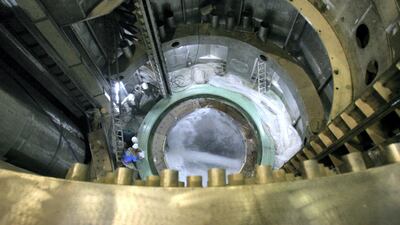
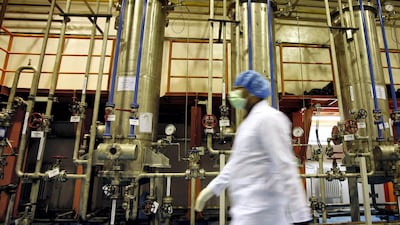
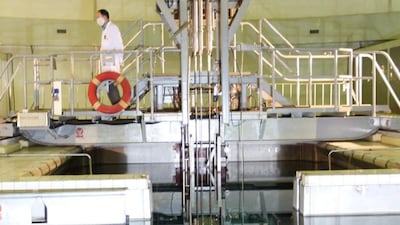
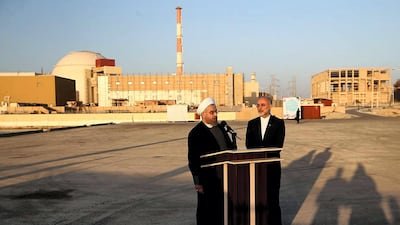
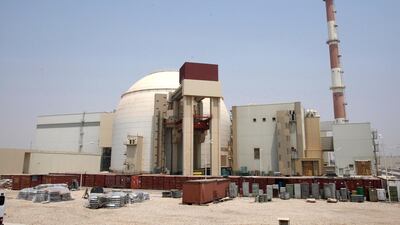
Iran's nuclear sites in pictures
At several locations, Iran has admitted to using advanced centrifuges, specifically for speeding up uranium enrichment.
The IAEA has requested that Iran hand over data in the cameras, which it said is vital for verifying what Iran is working on. IAEA director general Rafael Grossi has said his organisation had been left “flying blind” in the absence of the footage.
But Iran has also said it has stepped up uranium enrichment to 60 per cent, moving the nuclear programme closer to the 90 per cent level required for a nuclear weapon. Iran has also said it has enough nuclear material for a bomb, but said no decision had been made to start a military atomic programme.
What to do with the existing enriched uranium, which is highly radioactive, has become another technical question in the final draft of the deal. Most likely, it would be shipped out of Iran under a new accord.
Iran’s IRGC terrorist designation
Another potential issue is Iran’s request that sanctions against the IRGC must be dropped before any deal can be reached.
For now, Iranian negotiators say they have put the issue to one side so that the nuclear deal has a better chance of being approved in Washington.
But Mohammad Marandi, who has advised Iran's negotiating team, has claimed delisting was “never was a prerequisite for a deal” and the terrorist designation was a “badge of honour” for the IRGC.
Iran’s state-run Irna news agency reported last week that some members of the country's negotiating team did support delisting the IRGC as part of a deal, but no sources were named for the claim.
The Donald Trump administration designated the IRGC as a Foreign Terrorist Organisation in 2019, meaning that businesses the group are involved in face highly stringent controls on foreign trade.
The EU has also put senior members of the IRGC under sanction, but has done so with a narrow focus, accusing the organisation of human rights abuses during a crackdown on protesters in Iran in 2019.
Mr Biden has ruled out delisting the organisation as part of a renewed accord.
MATCH INFO
Uefa Champions League, last-16, second leg (first-leg scores in brackets):
PSG (2) v Manchester United (0)
Midnight (Thursday), BeIN Sports
Company%20profile
%3Cp%3E%3Cstrong%3EName%3A%3C%2Fstrong%3E%20Belong%3Cbr%3E%3Cstrong%3EBased%3A%3C%2Fstrong%3E%20Dubai%3Cbr%3E%3Cstrong%3EFounders%3A%3C%2Fstrong%3E%20Michael%20Askew%20and%20Matthew%20Gaziano%3Cbr%3E%3Cstrong%3ESector%3A%3C%2Fstrong%3E%20Technology%3Cbr%3E%3Cstrong%3ETotal%20funding%3A%3C%2Fstrong%3E%20%243.5%20million%20from%20crowd%20funding%20and%20angel%20investors%3Cstrong%3E%3Cbr%3ENumber%20of%20employees%3A%3C%2Fstrong%3E%2012%3C%2Fp%3E%0A
The specs
Engine: 2.9-litre twin-turbo V6
Power: 540hp at 6,500rpm
Torque: 600Nm at 2,500rpm
Transmission: Eight-speed auto
Kerb weight: 1580kg
Price: From Dh750k
On sale: via special order
The years Ramadan fell in May
BMW M5 specs
Engine: 4.4-litre twin-turbo V-8 petrol enging with additional electric motor
Power: 727hp
Torque: 1,000Nm
Transmission: 8-speed auto
Fuel consumption: 10.6L/100km
On sale: Now
Price: From Dh650,000
Results
6.30pm: Baniyas (PA) Group 2 Dh195,000 1,400m | Winner: ES Ajeeb, Sam Hitchcock (jockey), Ibrahim Aseel (trainer)
7.05pm: Maiden (TB) Dh165,000 1,400m | Winner: Al Shamkhah, Royston Ffrench, Sandeep Jadhav
7.40pm: Handicap (TB) Dh190,000 1,200m | Winner: Lavaspin, Richard Mullen, Satish Seemar
8.15pm: Maiden (TB) Dh165,000 1,200m | Winner: Kawasir, Dane O’Neill, Musabah Al Muhairi
8.50pm: Rated Conditions (TB) Dh240,000 1,600m | Winner: Cosmo Charlie, Pat Dobbs, Doug Watson
9.20pm: Handicap (TB) Dh165,000 1,400m | Winner: Bochart, Richard Mullen, Satish Seemar
10pm: Handicap (TB) Dh175,000 2,000m | Winner: Quartier Francais, Fernando Jara, Ali Rashid Al Raihe
UAE SQUAD
Khalid Essa (Al Ain), Ali Khaseif (Al Jazira), Adel Al Hosani (Sharjah), Mahmoud Khamis (Al Nasr), Yousef Jaber (Shabab Al Ahli Dubai), Khalifa Al Hammadi (Jazira), Salem Rashid (Jazira), Shaheen Abdelrahman (Sharjah), Faris Juma (Al Wahda), Mohammed Shaker (Al Ain), Mohammed Barghash (Wahda), Abdulaziz Haikal (Shabab Al Ahli), Ahmed Barman (Al Ain), Khamis Esmail (Wahda), Khaled Bawazir (Sharjah), Majed Surour (Sharjah), Abdullah Ramadan (Jazira), Mohammed Al Attas (Jazira), Fabio De Lima (Al Wasl), Bandar Al Ahbabi (Al Ain), Khalfan Mubarak (Jazira), Habib Fardan (Nasr), Khalil Ibrahim (Wahda), Ali Mabkhout (Jazira), Ali Saleh (Wasl), Caio (Al Ain), Sebastian Tagliabue (Nasr).
Getting%20there%20
%3Cp%3E%3Ca%20href%3D%22https%3A%2F%2Fwww.thenationalnews.com%2Ftravel%2F2023%2F01%2F12%2Fwhat-does-it-take-to-be-cabin-crew-at-one-of-the-worlds-best-airlines-in-2023%2F%22%20target%3D%22_self%22%3EEtihad%20Airways%20%3C%2Fa%3Eflies%20daily%20to%20the%20Maldives%20from%20Abu%20Dhabi.%20The%20journey%20takes%20four%20hours%20and%20return%20fares%20start%20from%20Dh3%2C995.%20Opt%20for%20the%203am%20flight%20and%20you%E2%80%99ll%20land%20at%206am%2C%20giving%20you%20the%20entire%20day%20to%20adjust%20to%20island%20time.%20%C2%A0%3C%2Fp%3E%0A%3Cp%3ERound%20trip%20speedboat%20transfers%20to%20the%20resort%20are%20bookable%20via%20Anantara%20and%20cost%20%24265%20per%20person.%20%C2%A0%3C%2Fp%3E%0A
THE 12 BREAKAWAY CLUBS
England
Arsenal, Chelsea, Liverpool, Manchester City, Manchester United, Tottenham Hotspur
Italy
AC Milan, Inter Milan, Juventus
Spain
Atletico Madrid, Barcelona, Real Madrid
Killing of Qassem Suleimani
Plan to boost public schools
A major shake-up of government-run schools was rolled out across the country in 2017. Known as the Emirati School Model, it placed more emphasis on maths and science while also adding practical skills to the curriculum.
It was accompanied by the promise of a Dh5 billion investment, over six years, to pay for state-of-the-art infrastructure improvements.
Aspects of the school model will be extended to international private schools, the education minister has previously suggested.
Recent developments have also included the introduction of moral education - which public and private schools both must teach - along with reform of the exams system and tougher teacher licensing requirements.
Election pledges on migration
CDU: "Now is the time to control the German borders and enforce strict border rejections"
SPD: "Border closures and blanket rejections at internal borders contradict the spirit of a common area of freedom"
Countries recognising Palestine
France, UK, Canada, Australia, Portugal, Belgium, Malta, Luxembourg, San Marino and Andorra
Results
%3Cp%3E%3Cstrong%3EStage%207%3A%3C%2Fstrong%3E%3Cbr%3E1.%20Adam%20Yates%20(GBR)%20UAE%20Team%20Emirates%20%E2%80%93%203hrs%2029min%2042ses%3Cbr%3E2.%20Remco%20Evenepoel%20(BEL)%20Soudal%20Quick-Step%20%E2%80%93%2010sec%3Cbr%3E3.%20Geoffrey%20Bouchard%20(FRA)%20AG2R%20Citroen%20Team%20%E2%80%93%2042sec%3Cbr%3E%3Cstrong%3EGeneral%20Classification%3A%3C%2Fstrong%3E%3Cbr%3E1.%20Remco%20Evenepoel%20(BEL)%20Soudal%20Quick-Step%3Cbr%3E2.%20Lucas%20Plapp%20(AUS)%20Ineos%20Grenaders%20%E2%80%93%2059se%3Cbr%3E3.%20Adam%20Yates%20(GBR)%20UAE%20Team%20Emirates%20%E2%80%9360sec%3Cbr%3ERed%20Jersey%20(General%20Classification)%3A%20Remco%20Evenepoel%20(BEL)%20Soudal%20Quick-Step%3Cbr%3EGreen%20Jersey%20(Points%20Classification)%3A%20Tim%20Merlier%20(BEL)%20Soudal%20Quick-Step%3Cbr%3EWhite%20Jersey%20(Young%20Rider%20Classification)%3A%20Remco%20Evenepoel%20(BEL)%20Soudal%20Quick-Step%3Cbr%3EBlack%20Jersey%20(Intermediate%20Sprint%20Classification)%3A%20Edward%20Planckaert%20(FRA)%20Alpecin-Deceuninck%3C%2Fp%3E%0A
Quick pearls of wisdom
Focus on gratitude: And do so deeply, he says. “Think of one to three things a day that you’re grateful for. It needs to be specific, too, don’t just say ‘air.’ Really think about it. If you’re grateful for, say, what your parents have done for you, that will motivate you to do more for the world.”
Know how to fight: Shetty married his wife, Radhi, three years ago (he met her in a meditation class before he went off and became a monk). He says they’ve had to learn to respect each other’s “fighting styles” – he’s a talk it-out-immediately person, while she needs space to think. “When you’re having an argument, remember, it’s not you against each other. It’s both of you against the problem. When you win, they lose. If you’re on a team you have to win together.”
65
%3Cp%3E%3Cstrong%3EDirectors%3A%20%3C%2Fstrong%3EScott%20Beck%2C%20Bryan%20Woods%3C%2Fp%3E%0A%3Cp%3E%3Cstrong%3EStars%3A%20%3C%2Fstrong%3EAdam%20Driver%2C%20Ariana%20Greenblatt%2C%20Chloe%20Coleman%3C%2Fp%3E%0A%3Cp%3E%3Cstrong%3ERating%3A%20%3C%2Fstrong%3E2%2F5%3C%2Fp%3E%0A
THE DETAILS
Director: Milan Jhaveri
Producer: Emmay Entertainment and T-Series
Cast: John Abraham, Manoj Bajpayee
Rating: 2/5
Ten tax points to be aware of in 2026
1. Domestic VAT refund amendments: request your refund within five years
If a business does not apply for the refund on time, they lose their credit.
2. E-invoicing in the UAE
Businesses should continue preparing for the implementation of e-invoicing in the UAE, with 2026 a preparation and transition period ahead of phased mandatory adoption.
3. More tax audits
Tax authorities are increasingly using data already available across multiple filings to identify audit risks.
4. More beneficial VAT and excise tax penalty regime
Tax disputes are expected to become more frequent and more structured, with clearer administrative objection and appeal processes. The UAE has adopted a new penalty regime for VAT and excise disputes, which now mirrors the penalty regime for corporate tax.
5. Greater emphasis on statutory audit
There is a greater need for the accuracy of financial statements. The International Financial Reporting Standards standards need to be strictly adhered to and, as a result, the quality of the audits will need to increase.
6. Further transfer pricing enforcement
Transfer pricing enforcement, which refers to the practice of establishing prices for internal transactions between related entities, is expected to broaden in scope. The UAE will shortly open the possibility to negotiate advance pricing agreements, or essentially rulings for transfer pricing purposes.
7. Limited time periods for audits
Recent amendments also introduce a default five-year limitation period for tax audits and assessments, subject to specific statutory exceptions. While the standard audit and assessment period is five years, this may be extended to up to 15 years in cases involving fraud or tax evasion.
8. Pillar 2 implementation
Many multinational groups will begin to feel the practical effect of the Domestic Minimum Top-Up Tax (DMTT), the UAE's implementation of the OECD’s global minimum tax under Pillar 2. While the rules apply for financial years starting on or after January 1, 2025, it is 2026 that marks the transition to an operational phase.
9. Reduced compliance obligations for imported goods and services
Businesses that apply the reverse-charge mechanism for VAT purposes in the UAE may benefit from reduced compliance obligations.
10. Substance and CbC reporting focus
Tax authorities are expected to continue strengthening the enforcement of economic substance and Country-by-Country (CbC) reporting frameworks. In the UAE, these regimes are increasingly being used as risk-assessment tools, providing tax authorities with a comprehensive view of multinational groups’ global footprints and enabling them to assess whether profits are aligned with real economic activity.
Contributed by Thomas Vanhee and Hend Rashwan, Aurifer
German intelligence warnings
- 2002: "Hezbollah supporters feared becoming a target of security services because of the effects of [9/11] ... discussions on Hezbollah policy moved from mosques into smaller circles in private homes." Supporters in Germany: 800
- 2013: "Financial and logistical support from Germany for Hezbollah in Lebanon supports the armed struggle against Israel ... Hezbollah supporters in Germany hold back from actions that would gain publicity." Supporters in Germany: 950
- 2023: "It must be reckoned with that Hezbollah will continue to plan terrorist actions outside the Middle East against Israel or Israeli interests." Supporters in Germany: 1,250
Source: Federal Office for the Protection of the Constitution
Section 375
Cast: Akshaye Khanna, Richa Chadha, Meera Chopra & Rahul Bhat
Director: Ajay Bahl
Producers: Kumar Mangat Pathak, Abhishek Pathak & SCIPL
Rating: 3.5/5
A Bad Moms Christmas
Dir: John Lucas and Scott Moore
Starring: Mila Kunis, Kathryn Hahn, Kristen Bell, Susan Sarandon, Christine Baranski, Cheryl Hines
Two stars
%20Ramez%20Gab%20Min%20El%20Akher
%3Cp%3E%3Cstrong%3ECreator%3A%3C%2Fstrong%3E%20Ramez%20Galal%3C%2Fp%3E%0A%3Cp%3E%3Cstrong%3EStarring%3A%3C%2Fstrong%3E%20Ramez%20Galal%3C%2Fp%3E%0A%3Cp%3E%3Cstrong%3EStreaming%20on%3A%20%3C%2Fstrong%3EMBC%20Shahid%3C%2Fp%3E%0A%3Cp%3E%3Cstrong%3ERating%3A%20%3C%2Fstrong%3E2.5%2F5%3C%2Fp%3E%0A
Scores
New Zealand 266 for 9 in 50 overs
Pakistan 219 all out in 47.2 overs
New Zealand win by 47 runs
In-demand jobs and monthly salaries
- Technology expert in robotics and automation: Dh20,000 to Dh40,000
- Energy engineer: Dh25,000 to Dh30,000
- Production engineer: Dh30,000 to Dh40,000
- Data-driven supply chain management professional: Dh30,000 to Dh50,000
- HR leader: Dh40,000 to Dh60,000
- Engineering leader: Dh30,000 to Dh55,000
- Project manager: Dh55,000 to Dh65,000
- Senior reservoir engineer: Dh40,000 to Dh55,000
- Senior drilling engineer: Dh38,000 to Dh46,000
- Senior process engineer: Dh28,000 to Dh38,000
- Senior maintenance engineer: Dh22,000 to Dh34,000
- Field engineer: Dh6,500 to Dh7,500
- Field supervisor: Dh9,000 to Dh12,000
- Field operator: Dh5,000 to Dh7,000