A rocket engine caught fire on Monday at the SaxaVord Spaceport in Scotland, during tests at western Europe’s first fully licensed vertical launch spaceport.
An engine testing campaign was under way on the launch stool at the site in Unst, the UK’s northernmost inhabited island, before a planned launch in autumn.
German manufacturer Rocket Factory Augsburg, or RFA, said no one was injured in the incident at SaxaVord Spaceport on the remote island.
Video of Monday's test launch showed the engine exploding on the launchpad, with the entire structure engulfing in flames and thick smoke.
The spaceport recently received its licenses from the Civil Aviation Authority and is designed for small rockets delivering payloads into low earth orbit. It is billed as western Europe's only fully-licensed vertical rocket launch port.
RFA was running tests there ahead of holding the UK's first vertical rocket launch into orbit this autumn.
SaxaVord spaceport - in pictures
-
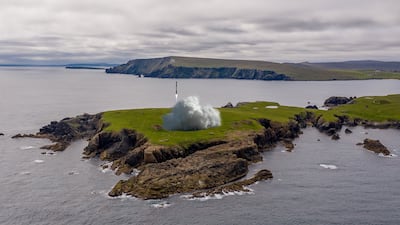
An illustration of a mock rocket taking off from Lamba Ness in Unst, one of Scotland's Shetland Islands. PA -
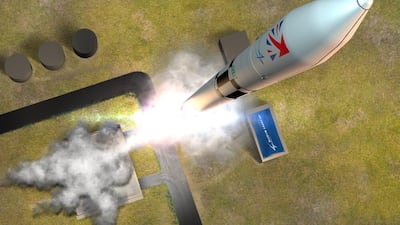
An illustration of the UK Pathfinder Rocket launch. Photo: Lockheed Martin -
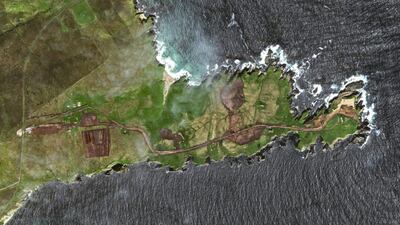
An aerial view of the SaxaVord site in the Shetland Islands. Photo: SaxaVord -

Former British prime minister Boris Johnson walks around the stall for SaxaVord during a visit to the Farnborough International Airshow in July. PA -
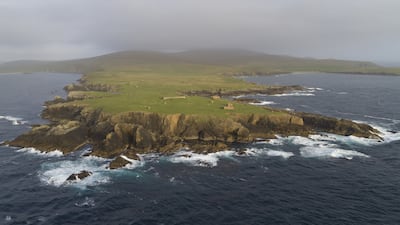
Lamba Ness in Unst. PA


German companies Rocket Factory Augsburg and HyImpulse hope to carry out launches from SaxaVord in 2024.
Satellites in polar orbits include those that monitor Earth’s environment, such as remote-sensing satellites and some weather satellites, as well as some military surveillance satellites, according to experts.
Owners, husband and wife Frank and Debbie Strang, took over the former RAF base in 2004. They also have plans for a hotel and visitor centre at SaxaVord.
The spaceport includes three launch pads and a hangar for assembling rockets.
SaxaVord Spaceport formally opened in May after receiving its Spaceport and Range licences from the Civil Aviation Authority in December 2023 and April this year.
The company was granted permission to host up to 30 launches a year for companies requiring satellites in polar orbit.
Ahead of being granted a licence, SaxaVord was assessed by the space regulator as meeting appropriate safety, security and environmental criteria, as well as having suitable infrastructure, equipment and services to accommodate vertical space launches.
The site is working with several companies, including Edinburgh-based rocket company Skyrora, in addition to Rocket Factory Augsburg and HyImpulse, and Lockheed Martin ABL Space Systems.
The spaceport licence puts Scotland at the centre of the European launch market, with Scottish satellites already in space, and home-grown rocket companies breaking new ground.
There are launch operators from around the world developing rockets to launch from SaxaVord, who are at various stages of the assessment process with the Civil Aviation Authority.
The not-too-distant future could see Scottish-built rockets launching Scottish satellites from a Scottish spaceport.
SaxaVord's licence is the 352nd space activity approved by the UK Civil Aviation Authority since becoming Britain's space regulator in July 2021.
The regulator now monitors more than 750 different satellites, has licenced two spaceports, a launch from Cornwall, and OneWeb, which is the second biggest satellite constellation in orbit.
While Spaceport Cornwall became the UK's first licenced spaceport, SaxaVord's licence allows it to host vertical launches rather than horizontal, where rockets are carried by aircraft.