

Three decades ago, I was on a US Embassy-sponsored speaking tour in Yemen before its 1993 national election. After giving a lecture at a university in Sanaa, I met leaders of the various political parties – at their offices or at afternoon “ghat sessions". At each meeting, I heard complaints about repressive and anti-democratic behaviours of the then governing party. Some were alleged human rights violations; others were seemingly petty but still threatening in a fragile, new democracy – “they're tearing down our signs", “they're passing out money to buy support", or “they’re harassing our volunteers".
To these latter complaints, I would respond that “we’ve had that problem in Michigan” or “we call it ‘walking around money’ and we’ve seen that in Philadelphia” or “we faced that kind of harassment from the [Democratic] party establishment during the 1984 Jesse Jackson campaign".
At one point, when my US Embassy escort asked why I was saying these things, I responded: “Because they’re true. I’m not going to pretend that we’re perfect. If I do, why would anyone ever think they could emulate us?” I went on to note that while we’re not perfect, we do have a system that provides us the opportunity to hold violators accountable, allowing us to correct our errors and rectify abuses.
I don’t think I could say it today.
While some Americans still cling to the belief that we are “the shining city on the hill", the model for emerging democratic republics worldwide, what’s becoming disturbingly clear is our political system is in danger.
We project to the world that free and fair elections and protection of personal and political rights are the foundations of a democratic order. And we judge other countries by the extent to which they provide for both. But while these may be the foundations, it’s accountability and mutual respect between winners and losers that are the mortar that hold these building blocks in place. Without them, the entire edifice is at risk of crumbling. Sadly, the corrosive effects of the lack of accountability and comity are taking their toll on the US today.
Examples abound: the administration of George W Bush fabricated the reasons for the war in Iraq and passed laws and executive orders that violated fundamental rights of both legal immigrants and citizens after the horrific 9/11 terror attacks. They also prepared “legal” documents legitimating the use of torture. There was no accountability for the fabrications, lies or use of torture.
And, of course, the January 6, 2021 insurrection and the criminal acts of incitement that preceded it (and continue) cry out for accountability. Yet, a divided Congress rejected a full bipartisan investigation, forcing Democrats to proceed with just a few brave Republicans who risked their careers to join the effort to uncover the truth about this unprecedented threat to American democracy. What might have been a unified quest for accountability is now challenged by Republicans as a mere partisan ploy.
Leading Republicans continue to maintain that the 2020 election was stolen, and their acolytes are running and winning elections for sensitive posts that will oversee future elections. In addition, with new legislation in many states that will make it more difficult to vote, free and fair elections may be at risk.
If the absence of accountability poses a threat to the democratic order, the polarisation of politics is equally damaging. There was a time when the parties, despite their differences, would unite to pass legislation in the national interest and to defer to the White House on presidential appointments. Some Republicans supported civil rights and health and safety legislation and passed budgets, while Democrats supported Republican presidents Ronald Reagan’s and George HW Bush’s tax cuts and educational reforms. Both sides approved appointments and nominations to high office by presidents of the opposing party.
-
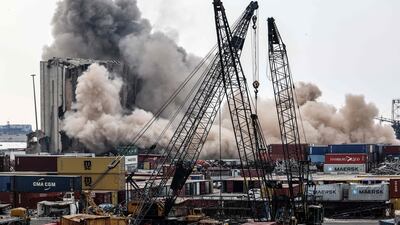
A cloud of smoke and dust rises after part of the grain silos at Beirut's port collapsed on Sunday, days before the country marked the second anniversary of a deadly explosion at the site. AFP -

The collapse was due to a fire that has been burning since the beginning of July. AP -
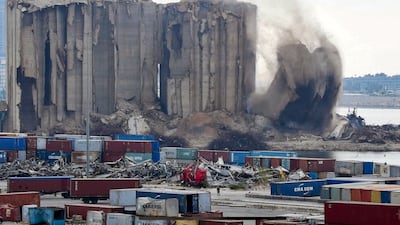
The grain silos were severely damaged in the 2020 explosion at the port that killed at least 190 people. EPA -

There were no reports of deaths or injuries after the partial collapse. EPA -

Other parts of the silos that remain standing are at risk of collapsing. Reuters -

Lebanese activists confront soldiers guarding the entrance of the country's parliament building during a demonstration in Beirut on Thursday. AFP -

An activist raises her hands during a protest in Beirut on Thursday. EPA -
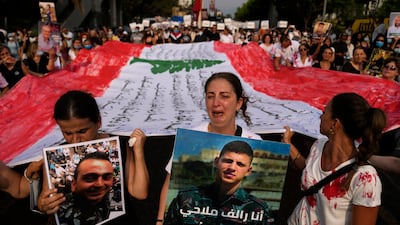
Relatives of the victims of the deadly 2020 Beirut port explosion mark the second anniversary of the blast in Beirut, Lebanon. AP -
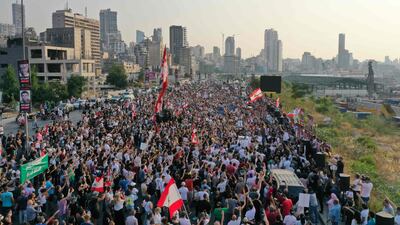
Protesters and relatives of the victims of the blast hold up Lebanese flags as they march in Beirut's port area on Thursday. AFP -
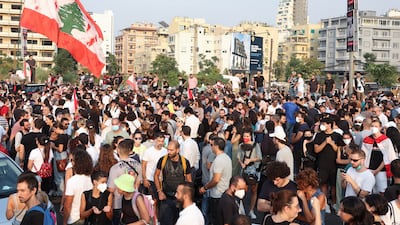
Demonstrators gather as Lebanon marks the second anniversary of the Beirut port explosion. Reuters -

People hold the Lebanese flag during a march to the Beirut port. EPA -
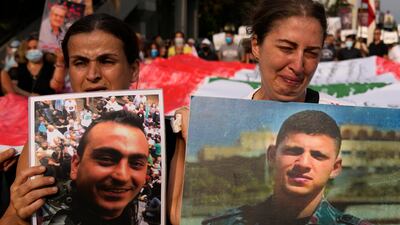
People hold portraits of loved ones who died in the explosion. AP -
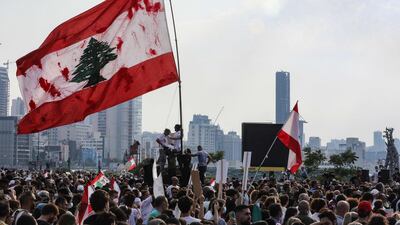
Activists and relatives of the victims raise a national flag smeared with red paint during the protest. AFP -

Activists and relatives of the victims carry makeshift coffins as they march in Beirut. AFP -
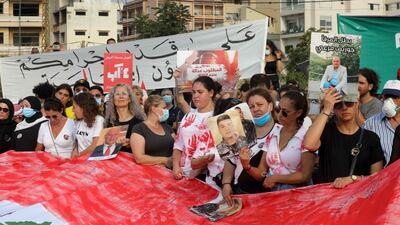
On August 4, 2020, the dockside blast of haphazardly stored ammonium nitrate killed more than 200 people. AFP -

Lebanese national flags fly at half-mast outside the presidential palace as Lebanon marks the two-year anniversary of the August 2020 Beirut port explosion, in Baabda, Lebanon. Reuters -
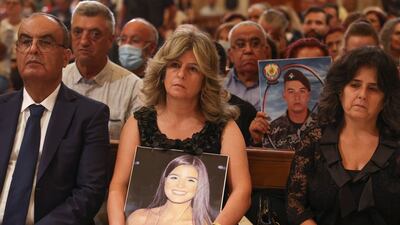
Families of victims of the August 2020 Beirut port explosion attend a mass held by Maronite Patriarch Bechara Boutros Al-Rai as Lebanon marks the two-year anniversary of the explosion, in Beirut Lebanon. Reuters -

Families of victims of the August 2020 Beirut port explosion attend a mass held by Maronite Patriarch Bechara Boutros Al-Rai as Lebanon marks the two-year anniversary of the explosion, in Beirut Lebanon. Reuters


Newt Gingrich’s becoming speaker of the House of Representatives in 1993 began a new order in American politics. Congress became a partisan club used to pummel the administration of Bill Clinton, harassing him for six years, inventing scandals to investigate before finally succeeding in impeaching him for lying about a sexual encounter with a White House intern.
This partisan dysfunction has only grown uglier over time – today reaching such disastrous proportions that Congress is unable to muster the votes needed to pass an appropriation to provide vaccines to protect against new variants of the coronavirus.
Instead of a “city on the hill", we have become a lesson in what can happen without accountability and political comity. Our dysfunctions mimic those of Lebanon, where sectarianism blocks accountability for a prime minister’s assassination or a deadly explosion in Beirut’s port. Or like Israel, where a former prime minister on trial for corruption and influence-peddling stymies legislation favoured by his supporters to prevent giving his opponents a victory. Or like Iraq, where the losing parties block the winners from forming a government and the frustrated winners seize parliament, demanding a new election.
We’re not yet like some countries where criminal behaviour goes unpunished, ideological divisions create paralysis, and the lack of comity results in chaos. But unless we take a long hard look in the mirror, recognise the crisis facing us, and take corrective measures, that’s where we are heading.

