

While a significant breakthrough was made at the G20 summit in New Delhi, the week gone by has proved to be a challenging one for both Russia and Turkey.
On Monday, Russian President Vladimir Putin hosted Turkish President Recep Tayyip Erdogan in Sochi for talks to refloat the cancelled grain deal involving Ukraine. But the leaders failed to reach an agreement that would have allowed the resumption of Ukrainian grain shipments and eased food prices around the world.
The impact of this setback on the war in Ukraine and the frozen conflict in Syria is yet uncertain.
The rhythm of alliances today follows the tempo of the war in Eastern Europe, which appears to have dislodged Russia from the ranks of the major powers that also include the US and China.
Washington has redoubled efforts to push Moscow to the margins, the latest example of which has been its announcement of a $600 million aid package for Ukraine to boost its counteroffensive.
It is, meanwhile, actively engaged in diplomatic efforts with key Asian countries, including Japan, South Korea and Vietnam, as part of its attempts to counter China’s influence in the continent. On Sunday, US President Joe Biden arrived in Hanoi to meet Vietnam’s paramount leader, Nguyen Phu Trong, in his bid to boost ties with the South-East Asian country.
-
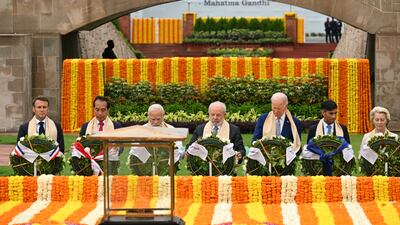
From left, French President Emmanuel Macron, Indonesian President Joko Widodo, Indian Prime Minister Narendra Modi, Brazilian President Luiz Inacio Lula da Silva, US President Joe Biden, British Prime Minister Rishi Sunak and European Commission President Ursula von der Leyen visit Raj Ghat memorial. Reuters -
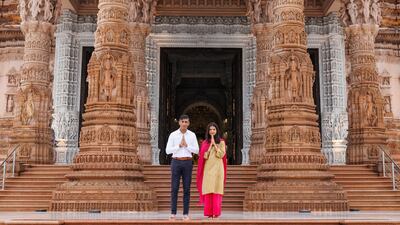
British Prime Minister Rishi Sunak and his wife Akshata Murty visit the Akshardham Hindu Temple in New Delhi. Getty Images -
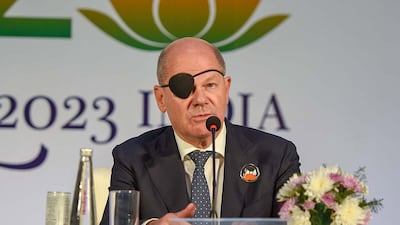
German Chancellor Olaf Scholz addresses a press conference during the G20 Summit in New Delhi. EPA -
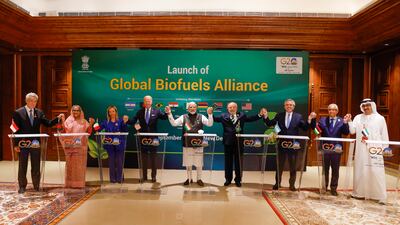
From left, Singaporean Prime Minister Lee Hsien Loong, Bangladeshi Prime Minister Sheikh Hasina, Italian Prime Minister Giorgia Meloni, US President Joe Biden, Indian Prime Minister Narendra Modi, Brazilian President Luiz Inacio Lula da Silva, Argentinian President Alberto Fernandez, Mauritius Prime Minister Pravind Kumar Jugnauth and UAE Minister of Foreign Affairs Sheikh Abdullah bin Zayed attend the launch of the Global Biofuels Alliance at the G20 summit in New Delhi. AP -
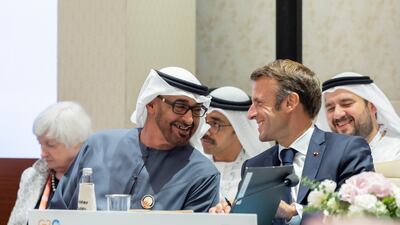
UAE President Sheikh Mohamed and French President Emmanuel Macron attend the India-Middle East-Europe Economic Corridor on the sidelines of the G20 Summit in New Delhi. Photo: UAE Presidential Court -

From left, Indian Prime Minister Narendra Modi, Indian President Droupadi Murmu and UAE Minister of Foreign Affairs Sheikh Abdullah bin Zayed at the G20 summit in New Delhi. AFP -
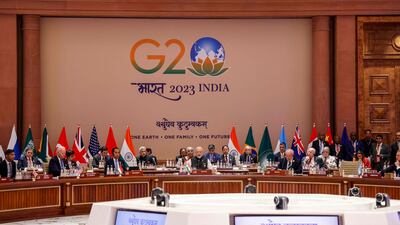
India's Prime Minister Narendra Modi addresses the G20 Leaders' Summit at the Bharat Mandapam in New Delhi. AFP -
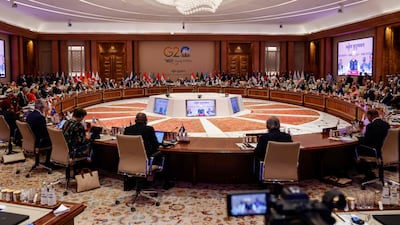
The 18th G20 Summit between 19 countries and the European Union, and now the African Union, is the first to be held in India and South Asia. AFP -
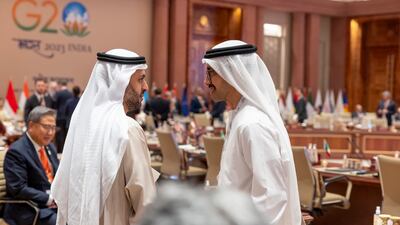
Sheikh Mohamed bin Hamad, Private Affairs Advisor in the Presidential Court, left, and Sheikh Abdullah bin Zayed, UAE Minister of Foreign Affairs, attend the first session of the G20 Summit. UAE Presidential Court -
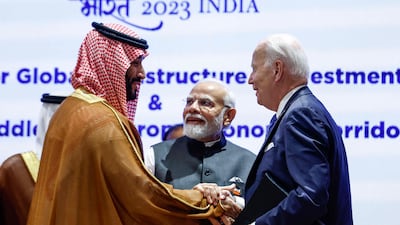
Saudi Arabia's Crown Prince and Prime Minister Mohammed bin Salman, India's Prime Minister Narendra Modi and US President Joe Biden attend a session as part of the G20 Leaders' Summit at the Bharat Mandapam in New Delhi. AFP -
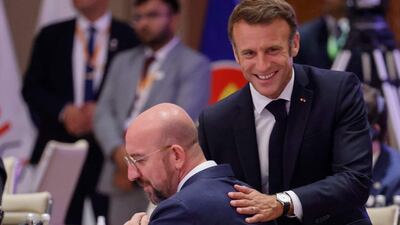
France's President Emmanuel Macron greets European Council President Charles Michel before the start of the second working session. AFP -
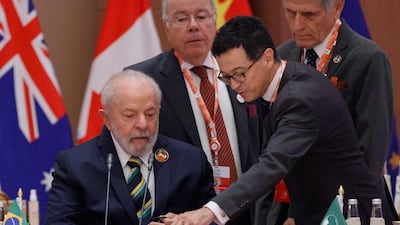
Brazil's President Luiz Inacio Lula da Silva speaks with his advisors before the start of the second working session. AFP -
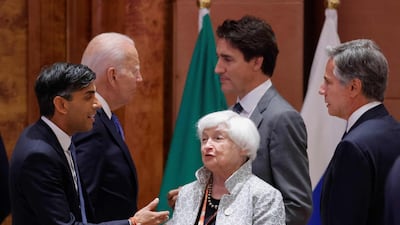
Britain's Prime Minister Rishi Sunak, US Treasury Secretary Janet Yellen, US President Joe Biden, Canada's Prime Minister Justin Trudeau and US Secretary of State Antony Blinken speak before the start of the second working session. AFP -
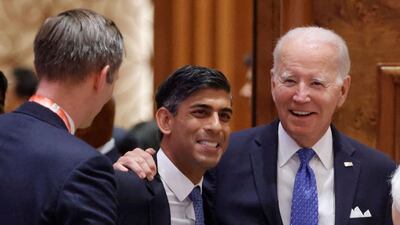
US President Joe Biden greets Britain's Prime Minister Rishi Sunak. AFP -
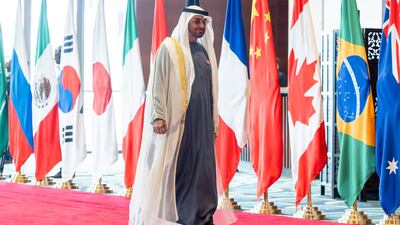
Sheikh Mohamed arrives at the IECC Convention Centre. Photo: UAE Presidential Court -
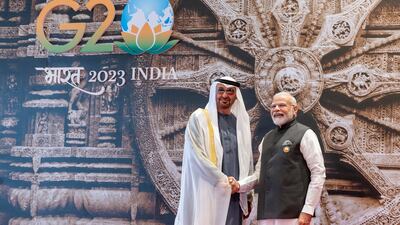
Sheikh Mohamed is greeted by India's Prime Minister Narendra Modi. UAE Presidential Court -
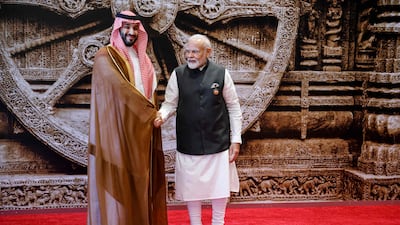
India's Prime Minister Narendra Modi welcomes Saudi Arabia's Crown Prince and Prime Minister Mohammed bin Salman to the G20 summit. AFP -
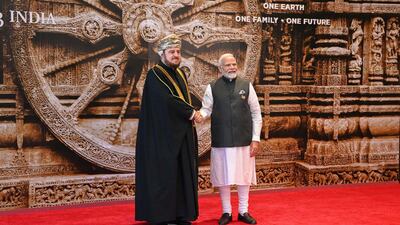
India's Prime Minister Narendra Modi welcomes Oman's Deputy Prime Minister Sayyid Asaad bin Tariq. Oman News Agency -
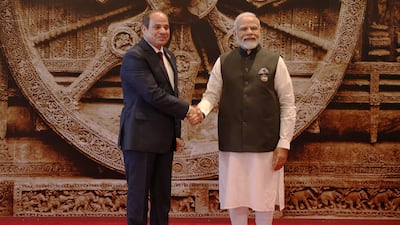
India's Prime Minister Narendra Modi with Egyptian President Abdel Fattah El Sisi at the G20 summit. Getty -
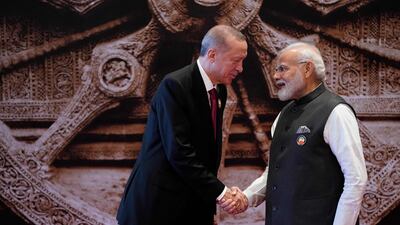
India's Prime Minister Narendra Modi greets Turkey's President Recep Tayyip Erdogan. AFP -
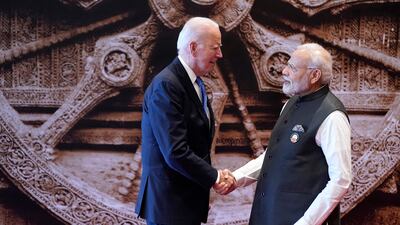
India's Prime Minister Narendra Modi welcomes US President Joe Biden to the G20 summit. AFP -
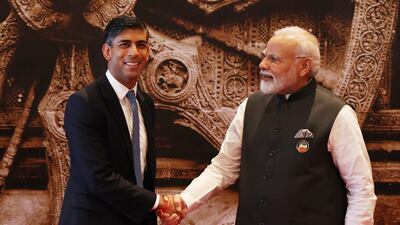
India's Prime Minister Narendra Modi with UK Prime Minister Rishi Sunak. Getty -
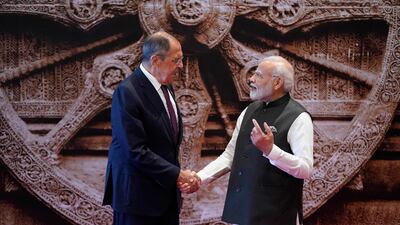
India's Prime Minister Narendra Modi greets Russian Foreign Minister Sergey Lavrov on the opening day of the G20 summit. AFP -

India's Prime Minister Narendra Modi and Canada's Prime Minister Justin Trudeau. AFP -
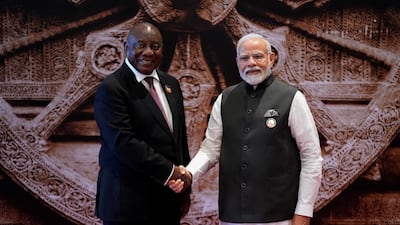
Indian Prime Minister Narendra Modi welcomes South Africa President Cyril Ramaphosa to the G20 summit, three weeks after the leaders were together at the Brics summit in Johannesburg. Reuters -
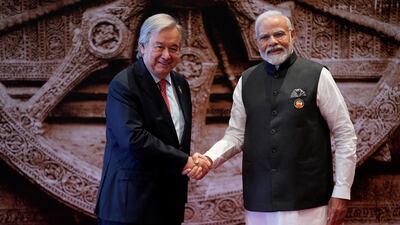
Indian Prime Minister Narendra Modi greets UN Secretary General Antonio Guterres. Reuters -
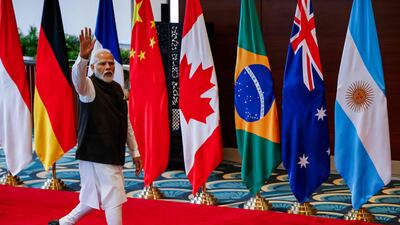
India's Prime Minister Narendra Modi arrives to host the G20 Leaders' Summit in New Delhi. AFP


As in the case of the recently concluded Brics summit in Johannesburg, South Africa, Mr Putin was forced to skip the G20 summit in India. And with another world leader, Chinese President Xi Jinping, also choosing to stay away from New Delhi, Mr Biden took centre stage at the summit, helping to secure a landmark deal on Saturday.
A multibillion-dollar India-Middle East-Europe Economic Corridor was announced, which includes the UAE, Saudi Arabia, India, Jordan, Israel and the EU, and is expected to enhance connectivity and integration between participating countries. In the coming weeks and months, details regarding the creation of a railway network linking India to the maritime routes in the Middle East, as well as connecting the Arab Gulf countries and the Levant, will be ironed out.
Mr Biden specifically thanked President Sheikh Mohamed for his key role in securing the deal. “I do want to say thank you, thank you, thank you,” he said at an event to unveil the initiative. “I don’t think we’d be here without you.”
Such important and pioneering breakthroughs are what New Delhi sought to reveal at the summit, where disputes were expected to intensify due to differing positions between the West and the Brics countries leaning more towards “non-alignment” between the US and China, as well as between Nato member states and Russia.
Turkey has attempted to play a distinctive role within Nato, of which it is a member, and in which it sees itself as enjoying a unique position as both a Middle Eastern and a European country.
Mr Erdogan succeeded in recent times in solidifying Ankara’s importance in Nato and acted as a mediator between Russia and Ukraine and secured the grain deal last year, until Russia decided to not renew it unless western countries provided financial guarantees.
Unfortunately, neither side could secure the old deal, or a new one, on Monday.
There have been misgivings between the two countries in recent months. There was, for instance, disappointment in Moscow in April when Ankara struck an agreement with Kyiv to supply Bayraktar TB2 armed drones to it. Turkey’s realignment within the Nato alliance has also not sit well with the Kremlin.
In Sochi, agreements over other issues were, therefore, hard to secure. These included oil pipeline projects, initially intended to somewhat replace the German Nord Stream 2, the Russian-financed nuclear reactor project in Turkey, and the conflict in Syria.
Moscow has been disconcerted by Ankara’s support for Ukraine, with the Turkish government continuing to not recognise the Russian annexation of Crimea. The Kremlin has also sought Ankara’s normalisation of ties, and engagement, with the Assad regime, with a view to resolve the Syrian refugee crisis and other issues.
There are several reasons for the restlessness being felt in Russian diplomacy today, especially amid a series of disappointing summits for Russia, which risks exacerbating its international isolation. The next stop for the leadership in Moscow is the UN General Assembly later this month, where it intends to test the loyalties of many of its old friends, and not just Turkey.
As for Ankara, it faces challenges on the domestic front. The collapse in the Turkish lira’s value is worrying, as is the crisis of the approximately four million Syrian refugees still living in the country. That the talks in Sochi did not yield the desired results will add to the list of troubles that the leadership in Turkey has to grapple with.
Syria will be a significant arena reflecting the consequences of Sochi. How this will precisely pan out, only time will tell.

