As the Biden administration ramps up its effort to revive the nuclear deal with Iran, all the indications suggest that Tehran has little interest in making the compromises necessary for easing tensions with Washington.
On the contrary, Iran’s recent conduct points to a hardening of Tehran’s position, as it seeks to increase pressure on the Biden administration to make concessions, rather than the other way around. And, to judge by the delicate diplomatic arrangements set in place for this week’s resumption of talks in Vienna, the Iranians are already dictating the terms of the agenda.
Consequently this has raised concerns that US President Joe Biden is about to repeat the same mistakes made by the Obama administration when it helped negotiate the original 2015 deal, the Joint Comprehensive Plan of Action (JCPOA), by making too many concessions to Iran.
The fact that the JCPOA did not cover other aspects of Iran's suspected nuclear weapons programme – such as ballistic missiles and detonators, as well as the regime's refusal to provide adequate explanations for traces of weapons-grade material discovered at numerous nuclear installations – resulted in former US president Donald Trump withdrawing from the agreement in 2018. But since taking office, Mr Biden has made clear his desire for the US to rejoin the JCPOA.
Initially, the new administration suggested that it wanted to take a more robust approach to the negotiations, suggesting that Washington wanted to include other controversial aspects of Iran’s nuclear activities, and not focus solely on the narrow issue of nuclear enrichment.
To this end Mr Biden said he wanted Iran to cease its violations of the JCPOA, including its acceleration of uranium enrichment to 20 per cent in recent months – just below the threshold required for producing weapons-grade material – before he was prepared to re-enter negotiations. In response, Iran insisted that the punitive economic sanctions imposed by the Trump administration must first be lifted before talks could resume.
But, as events in Vienna this week made clear, it is the Biden administration – and not Iran – that has been obliged to make the first concessions, suggesting that Mr Biden, like Mr Obama whom he served as vice president, will be prepared to capitulate to Iran's demands in his desperation to secure a deal.
For a start, Washington has so far made no move to lift sanctions but already made a number of concessions designed to send a signal to Tehran that it wants better relations.
The decision to remove the terrorist designation applied to Yemen's Houthi rebels, which are backed by Iran, was the first gesture. Since then the White House has been accused of helping secure the release of $7 billion in frozen Iranian assets held by South Korea. The funds were released in February to Iran following consultations with the US.
In addition, the White House has been accused of trying to sidestep legally required Congressional approval to funnel more money to Iran and through a new International Monetary Fund programme, "special drawing rights" (SDRs). According to a recent report in The Wall Street Journal, this would enable Iran to receive an additional $4.5bn, funds that could be used both to strengthen domestic repression and intensify regional adventurism.
By contrast, rather than making any goodwill gestures of its own to Washington, Tehran has persisted with its uncompromising approach on a number of important issues, such as encouraging the Houthis not to engage with the recent Saudi initiative to resume peace talks aimed at ending Yemen's long-running civil war.
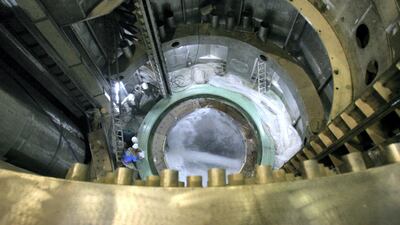
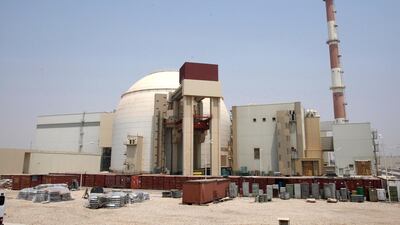
Russian contractors work at the Bushehr nuclear reactor site in 2007. The plant opened four years later. Bloomberg
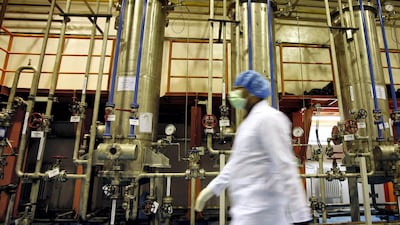
An Iranian technician at the International Atomic Energy Agency inspects the country's Isfahan plant in 2007. Tehran is no longer co-operating with the agency at nuclear sites across the country. EPA
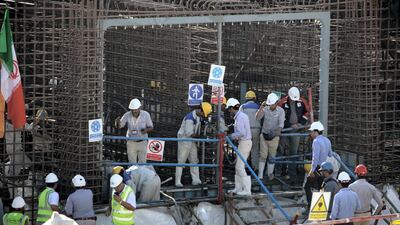
Workers wait to begin constructing a second reactor at the Bushehr nuclear power plant in 2019. AFP
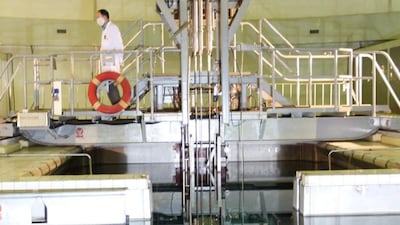
A metal-encased rod with 20 per cent enriched nuclear fuel is inserted into a reactor in Tehran in 2012. AFP
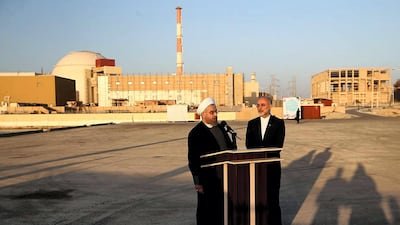
Fomer Iranian President Hassan Rouhani and the country's Atomic Energy Organisation chief Ali Akbar Salehi speak at the Bushehr nuclear site in 2015. AFP
Iran's Bushehr nuclear plant has been restarted. EPA
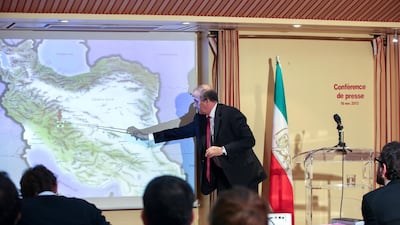
Mehdi Abrichamtchi, chairman of the Peace and Security Committee at the National Council of Resistance of Iran, shows journalists the location of a secret nuclear site in Iran in 2013. AFP
Workers prepare to begin the construction of a second reactor at the Bushehr site. AFP
Iran has also adopted a more aggressive stance towards the UN inspection teams responsible for monitoring its nuclear sites – in violation of its obligations under the JCPOA. It has also failed to respond to a request made by Rafael Grossi, the Director General of the International Atomic Energy Agency, for Iran to "come clean about recent findings of undeclared uranium to revive the 2015 nuclear agreement".
Recent reports received by western intelligence indicate Iran has also resumed efforts to conceal key elements of its nuclear programme from the inspection teams.
Some of this equipment is said to be stored in 75 shipping containers regularly moved to different locations in Iran. It includes machinery, pumps and spare parts for centrifuges, the sophisticated machines that can be used to enrich uranium to weapons grade. Materials such as carbon fibre, which can be used in the production of advanced centrifuges, are being stored at secret sites administered by the Islamic Revolutionary Guard Corps, which has overall responsibility for Iran’s nuclear programme.
Kazem Gharib Abadi, Iran's governor to the International Atomic Energy Agency, leaves after the nuclear talks in Vienna this week. Getty Images
Tehran has persisted with its uncompromising approach on a number of important issues
Iran’s disinclination to make any significant concessions to Washington was evident when talks resumed in Vienna this week, when it became clear that Tehran – and not Washington – was dictating the agenda.
Although both the Iranian and American negotiating teams were present in the Austrian capital, at Iran’s insistence there were no direct negotiations between the two delegations. Instead, officials from European countries that are signatories to the JCPOA – Britain, France and Germany – were required to indulge in a form of shuttle diplomacy, passing messages between the two camps.
It is not the first time that Tehran has delivered a diplomatic snub to Washington. In March, it declined to join a meeting of JCPOA parties hosted by the EU because US officials would be attending.
And, so long as the Biden administration allows Tehran to call all the shots, the more likely it is that any new deal over Iran’s nuclear programme will be to the regime’s advantage.
Con Coughlin is a defence and foreign affairs columnist for The National
IF YOU GO The flights: FlyDubai offers direct flights to Catania Airport from Dubai International Terminal 2 daily with return fares starting from Dh1,895. The details: Access to the 2,900-metre elevation point at Mount Etna by cable car and 4x4 transport vehicle cost around €57.50 (Dh248) per adult. Entry into Teatro Greco costs €10 (Dh43). For more go to www.visitsicily.info
Where to stay:Hilton Giardini Naxos offers beachfront access and accessible to Taormina and Mount Etna. Rooms start from around €130 (Dh561) per night, including taxes.
Ten tax points to be aware of in 2026
1. Domestic VAT refund amendments: request your refund within five years
If a business does not apply for the refund on time, they lose their credit.
2. E-invoicing in the UAE
Businesses should continue preparing for the implementation of e-invoicing in the UAE, with 2026 a preparation and transition period ahead of phased mandatory adoption.
3. More tax audits
Tax authorities are increasingly using data already available across multiple filings to identify audit risks.
4. More beneficial VAT and excise tax penalty regime
Tax disputes are expected to become more frequent and more structured, with clearer administrative objection and appeal processes. The UAE has adopted a new penalty regime for VAT and excise disputes, which now mirrors the penalty regime for corporate tax.
5. Greater emphasis on statutory audit
There is a greater need for the accuracy of financial statements. The International Financial Reporting Standards standards need to be strictly adhered to and, as a result, the quality of the audits will need to increase.
6. Further transfer pricing enforcement
Transfer pricing enforcement, which refers to the practice of establishing prices for internal transactions between related entities, is expected to broaden in scope. The UAE will shortly open the possibility to negotiate advance pricing agreements, or essentially rulings for transfer pricing purposes.
7. Limited time periods for audits
Recent amendments also introduce a default five-year limitation period for tax audits and assessments, subject to specific statutory exceptions. While the standard audit and assessment period is five years, this may be extended to up to 15 years in cases involving fraud or tax evasion.
8. Pillar 2 implementation
Many multinational groups will begin to feel the practical effect of the Domestic Minimum Top-Up Tax (DMTT), the UAE's implementation of the OECD’s global minimum tax under Pillar 2. While the rules apply for financial years starting on or after January 1, 2025, it is 2026 that marks the transition to an operational phase.
9. Reduced compliance obligations for imported goods and services
Businesses that apply the reverse-charge mechanism for VAT purposes in the UAE may benefit from reduced compliance obligations.
10. Substance and CbC reporting focus
Tax authorities are expected to continue strengthening the enforcement of economic substance and Country-by-Country (CbC) reporting frameworks. In the UAE, these regimes are increasingly being used as risk-assessment tools, providing tax authorities with a comprehensive view of multinational groups’ global footprints and enabling them to assess whether profits are aligned with real economic activity.
Contributed by Thomas Vanhee and Hend Rashwan, Aurifer
Produced by: Reliance Entertainment with Chalk and Cheese Films
Director: Tushar Hiranandani
Cast: Taapsee Pannu, Bhumi Pednekar, Prakash Jha, Vineet Singh
Rating: 3.5/5 stars
UAE currency: the story behind the money in your pockets
Hometown: Birchgrove, Sydney Australia Age: 59 Favourite TV series: Outlander Netflix series Favourite place in the UAE: Sheikh Zayed Grand Mosque / desert / Louvre Abu Dhabi Favourite book: Father of our Nation: Collected Quotes of Sheikh Zayed bin Sultan Al Nahyan Thing you will miss most about the UAE: My friends and family, Formula 1, having Friday's off, desert adventures, and Arabic culture and people