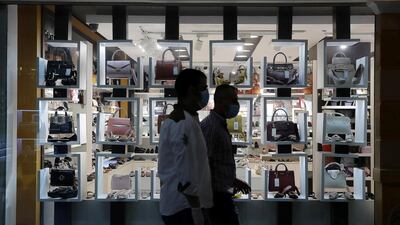
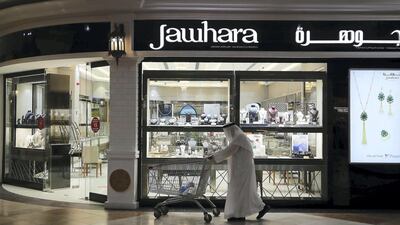
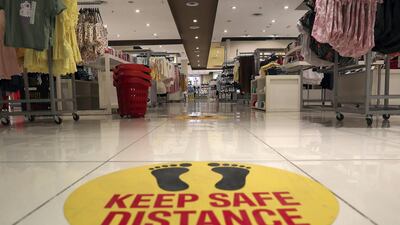
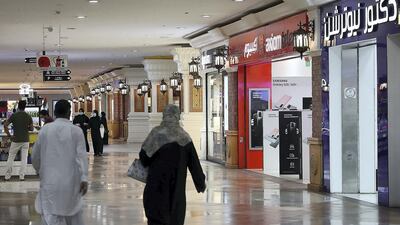
Over the past month, each trip I have taken to the supermarket has been a personal exercise in risk management. What day to go, what time to go, which supermarket? Chain A is busier, but chain B is better at enforcing physical distancing.
Once I am there, I calculate the risks associated with buying big versus getting in and out quickly. I even find myself speculating as to which aisle might be the most or least infectious. I read somewhere that customers spend the longest time in the hair and skincare section of supermarkets. Still, my intuition tells me that, during times of crisis, the confectionary aisle is the highest risk – I pick quickly and go. Once back home, there is the issue of what is the lowest-risk way to clean the shopping, and how and where to best store the reusable shopping bags?
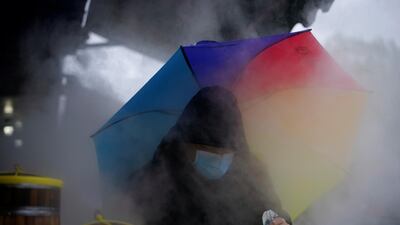
Passengers wearing face masks are seen as the train stops at a railway station in Macheng, in China’s central Hubei province on March 27, 2020. AFP
A customer buys food from a steamed food stall in Jingzhou, after the lockdown was eased in Hubei province. Reuters
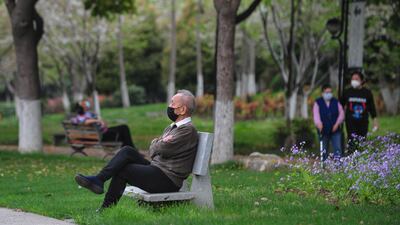
A man sits on a bench at a park in Wuhan, in China's central Hubei province on March 26, 2020. AFP
People wearing face masks ride on a motorised tricycle along a street in Huanggang, in China’s central Hubei province. AFP
A waitress carries meals out of the kitchen at a restaurant in Macheng in China’s central Hubei province on March 25, 2020. AFP
People wearing face masks walk through an ancient city wall in Jingzhou on March 26, 2020. Reuters
A man selects apples inside a supermarket in Wuhan on March 26, 2020. Reuters
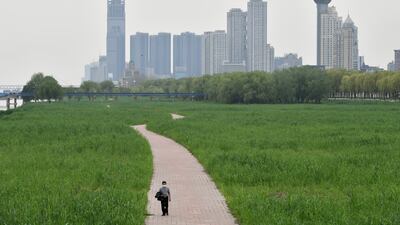
A man walks at a riverside park in Wuhan on March 26, 2020. Reuters
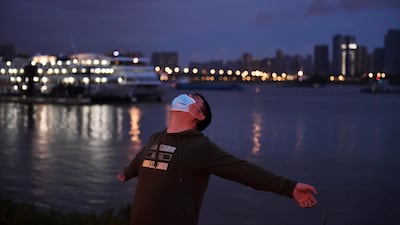
A man exercises at a riverside park by the Yangtze River in Wuhan on March 26, 2020. Reuters
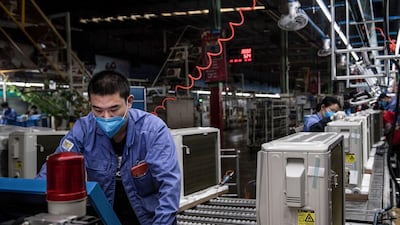
An employee works on an air conditioner production line at a Midea factory in Wuhan in China's central Hubei province on March 25, 2020. AFP
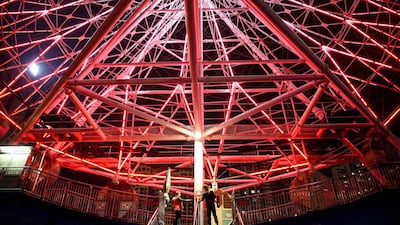
People prepare to ride on a ferris wheel at a theme park in Macheng on March 25, 2020. AFP
With an unseen adversary like a virus, uncertainty is heightened. The novel coronavirus responsible for Covid-19 is, as the name suggests, new, which further ramps up the uncertainty. We do not yet know everything about the illness, and occasionally we may need to get by on educated best-guesses. The British philosopher/psychologist, Dylan Evans, terms this kind of educated guesswork, risk intelligence: "a special kind of intelligence for thinking about risk and uncertainty".
Research has shown that risk intelligence is distinct from what we traditionally call general intelligence, or IQ. We can have a sky-high IQ but be dangerously low in RQ – or risk intelligence.
Similarly, if the emotionally intelligent can read the room, gauging how others are feeling, then those blessed with risk intelligence can estimate probabilities accurately while assessing the limits of their own knowledge. Knowing that we do not know can prevent us from becoming dangerously overconfident. One upshot of developing our risk intelligence – it can indeed be enhanced – is that it allows us to have a more functional relationship with uncertainty.
We know, however, from decades of research in cognitive psychology, that human decision-making under conditions of uncertainty is not great. We make systematic errors, often as a result of prioritising ease over effort and speed over accuracy. Such biases can be helpful in life-and-death situations: is it a stick or a venomous snake? However, given that most of us no longer live alongside venomous reptiles, our quick decisions frequently and unintentionally increase our risk of harm.
A passenger wears a mask while boarding a United Airlines flight at George Bush Intercontinental Airport last Sunday. AP Photo
A classic example of this irrational risk blindness occurred after the 9/11 attacks. For a year after the atrocity, Americans took to their cars for fear of flying. Driving, of course, is way riskier than flying. According to International Air Transport Association, there was just one major accident for every 5.4 million flights in 2018. And yet, blinkered to the relative risks of driving, US citizens took to the roads after 9/11 in higher numbers than previous years. Consequently, the number of road deaths increased that year. German research psychologist, Gerd Gigerenzer, puts the figure at an additional 1,595 road traffic-related deaths.
The thing is, many of us are now so focused on Covid-19 that the prospect of other harm befalling us has vanished from consciousness.
A youth jumps into the Mediterranean Sea at Al Manara ledge during a sunny day, in Beirut, Lebanon. EPA
Consider that each year 320,000 people drown. When being concerned about returning to public beaches or swimming pools, the risk intelligent would also be mindful of drowning risk. When returning to work, the risk intelligent will also be conscious of road traffic accident risk. This is not to, in any way, negate or diminish the risks associated with Covid-19. Still, it highlights how our intuitive risk assessments can become one-sided, biased and sub-optimal.
According to Statistica, a US-based provider of market and consumer data, around 5,084 people in the US choked to death on food in 2018. The odds of this happening are approximately one in 2,696, making eating food riskier than air travel. We do not fear food, nearly as much as air travel. But we do not really have a choice about eating, we do have a choice about air travel.
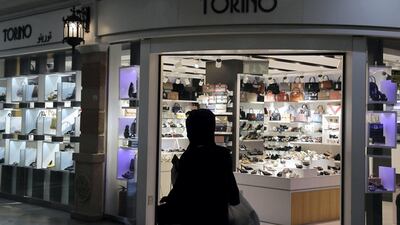
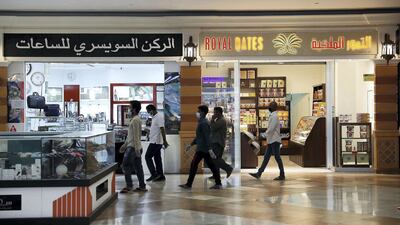
People wearing protective face masks a at the Al Naeem City Center in Ras Al Khaimah. UAE government lift the coronavirus restriction for the residents around the country. Pawan Singh / The National
The Ras Al Khaimah Department of Economic Development has unveiled reopening procedures in line with other emirates that have relaxed stay-home orders and lifted curbs on trade and travel to bolster the economy. Pawan Singh / The National
Malls will operate from 10am to 8pm at 30 per cent capacity, but will deny entry to visitors aged above 60 or below 12.
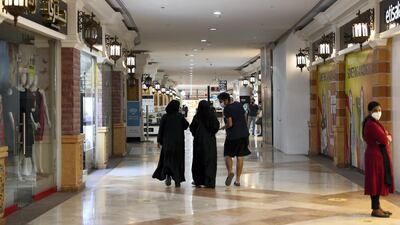
RAK, UNITED ARAB EMIRATES , May 28 – 2020 :- People wearing protective face mask as a preventive measure against the spread of coronavirus at the Al Naeem City Center in Ras Al Khaimah. UAE government lift the coronavirus restriction for the residents around the country. (Pawan Singh / The National) For News/Online/Stock/Instagram.
Cinemas, gyms, entertainment venues, common seating areas and prayer rooms within malls will remain closed.Pawan Singh / The National
Restaurants have also been told to operate at 30 per cent of their capacity, while tables must be spread apart with only four people allowed on one table. Pawan Singh / The National
Visitors must wear protective masks and gloves and are encouraged to bring their own bags. Pawan Singh / The National
Shoppers will be encouraged to use credit or debit cards to pay instead of cash and leave elevators for people with special needs. Only two people are allowed into lifts at a time. Pawan Singh / The National
RAK Services Department said people visiting beaches should wear masks and gloves, and keep a minimum distance of two meters from one another. Pawan Singh / The National
Gatherings of more than five people will not be allowed, even if they belong to a single family. Smoking, campfire and barbecues will be prohibited on the beaches. Pawan Singh / The National
This throws up another critical variable: personal responsibility. Often, what we fear more than an adverse outcome is being responsible for that outcome. I fear becoming ill with Covid-19, but I also hate the idea that I get it because of my own negligence or bad decision-making.
As many of us begin to return to work, we are going to need to deal with massive uncertainty. In some situations, we may need to gather further information from reliable sources and recalibrate our personal risk assessments. Keep the office door open or closed? Eat from the canteen or bring our own lunch? Use the elevator or stairs?
This involves weighing up multiple aspects of a situation. There will not be a one-size-fits-all formula. However, thinking about risk and how to reduce it, in each case, can help us keep ourselves and each other as safe as possible.
Justin Thomas is a professor of psychology at Zayed University

Mercer, the investment consulting arm of US services company Marsh & McLennan, expects its wealth division to at least double its assets under management (AUM) in the Middle East as wealth in the region continues to grow despite economic headwinds, a company official said.
Mercer Wealth, which globally has $160 billion in AUM, plans to boost its AUM in the region to $2-$3bn in the next 2-3 years from the present $1bn, said Yasir AbuShaban, a Dubai-based principal with Mercer Wealth.
“Within the next two to three years, we are looking at reaching $2 to $3 billion as a conservative estimate and we do see an opportunity to do so,” said Mr AbuShaban.
Mercer does not directly make investments, but allocates clients’ money they have discretion to, to professional asset managers. They also provide advice to clients.
“We have buying power. We can negotiate on their (client’s) behalf with asset managers to provide them lower fees than they otherwise would have to get on their own,” he added.
Mercer Wealth’s clients include sovereign wealth funds, family offices, and insurance companies among others.
From its office in Dubai, Mercer also looks after Africa, India and Turkey, where they also see opportunity for growth.
Wealth creation in Middle East and Africa (MEA) grew 8.5 per cent to $8.1 trillion last year from $7.5tn in 2015, higher than last year’s global average of 6 per cent and the second-highest growth in a region after Asia-Pacific which grew 9.9 per cent, according to consultancy Boston Consulting Group (BCG). In the region, where wealth grew just 1.9 per cent in 2015 compared with 2014, a pickup in oil prices has helped in wealth generation.
BCG is forecasting MEA wealth will rise to $12tn by 2021, growing at an annual average of 8 per cent.
Drivers of wealth generation in the region will be split evenly between new wealth creation and growth of performance of existing assets, according to BCG.
Another general trend in the region is clients’ looking for a comprehensive approach to investing, according to Mr AbuShaban.
“Institutional investors or some of the families are seeing a slowdown in the available capital they have to invest and in that sense they are looking at optimizing the way they manage their portfolios and making sure they are not investing haphazardly and different parts of their investment are working together,” said Mr AbuShaban.
Some clients also have a higher appetite for risk, given the low interest-rate environment that does not provide enough yield for some institutional investors. These clients are keen to invest in illiquid assets, such as private equity and infrastructure.
“What we have seen is a desire for higher returns in what has been a low-return environment specifically in various fixed income or bonds,” he said.
“In this environment, we have seen a de facto increase in the risk that clients are taking in things like illiquid investments, private equity investments, infrastructure and private debt, those kind of investments were higher illiquidity results in incrementally higher returns.”
The Abu Dhabi Investment Authority, one of the largest sovereign wealth funds, said in its 2016 report that has gradually increased its exposure in direct private equity and private credit transactions, mainly in Asian markets and especially in China and India. The authority’s private equity department focused on structured equities owing to “their defensive characteristics.”
What sanctions would be reimposed?
Under ‘snapback’, measures imposed on Iran by the UN Security Council in six resolutions would be restored, including:
An arms embargo
A ban on uranium enrichment and reprocessing
A ban on launches and other activities with ballistic missiles capable of delivering nuclear weapons, as well as ballistic missile technology transfer and technical assistance
A targeted global asset freeze and travel ban on Iranian individuals and entities
Authorisation for countries to inspect Iran Air Cargo and Islamic Republic of Iran Shipping Lines cargoes for banned goods
1. Domestic VAT refund amendments: request your refund within five years
If a business does not apply for the refund on time, they lose their credit.
2. E-invoicing in the UAE
Businesses should continue preparing for the implementation of e-invoicing in the UAE, with 2026 a preparation and transition period ahead of phased mandatory adoption.
3. More tax audits
Tax authorities are increasingly using data already available across multiple filings to identify audit risks.
4. More beneficial VAT and excise tax penalty regime
Tax disputes are expected to become more frequent and more structured, with clearer administrative objection and appeal processes. The UAE has adopted a new penalty regime for VAT and excise disputes, which now mirrors the penalty regime for corporate tax.
5. Greater emphasis on statutory audit
There is a greater need for the accuracy of financial statements. The International Financial Reporting Standards standards need to be strictly adhered to and, as a result, the quality of the audits will need to increase.
6. Further transfer pricing enforcement
Transfer pricing enforcement, which refers to the practice of establishing prices for internal transactions between related entities, is expected to broaden in scope. The UAE will shortly open the possibility to negotiate advance pricing agreements, or essentially rulings for transfer pricing purposes.
7. Limited time periods for audits
Recent amendments also introduce a default five-year limitation period for tax audits and assessments, subject to specific statutory exceptions. While the standard audit and assessment period is five years, this may be extended to up to 15 years in cases involving fraud or tax evasion.
8. Pillar 2 implementation
Many multinational groups will begin to feel the practical effect of the Domestic Minimum Top-Up Tax (DMTT), the UAE's implementation of the OECD’s global minimum tax under Pillar 2. While the rules apply for financial years starting on or after January 1, 2025, it is 2026 that marks the transition to an operational phase.
9. Reduced compliance obligations for imported goods and services
Businesses that apply the reverse-charge mechanism for VAT purposes in the UAE may benefit from reduced compliance obligations.
10. Substance and CbC reporting focus
Tax authorities are expected to continue strengthening the enforcement of economic substance and Country-by-Country (CbC) reporting frameworks. In the UAE, these regimes are increasingly being used as risk-assessment tools, providing tax authorities with a comprehensive view of multinational groups’ global footprints and enabling them to assess whether profits are aligned with real economic activity.
Contributed by Thomas Vanhee and Hend Rashwan, Aurifer
TOP 5 DRIVERS 2019
1 Lewis Hamilton, Mercedes, 10 wins 387 points
2 Valtteri Bottas, Mercedes, 4 wins, 314 points
3 Max Verstappen, Red Bull, 3 wins, 260 points
4 Charles Leclerc, Ferrari, 2 wins, 249 points
5 Sebastian Vettel, Ferrari, 1 win, 230 points
Abu Dhabi GP weekend schedule
Friday
First practice, 1pm
Second practice, 5pm
Saturday
Final practice, 2pm
Qualifying, 5pm
Sunday
Etihad Airways Abu Dhabi Grand Prix (55 laps), 5.10pm
Wicked: For Good
Director: Jon M Chu
Starring: Ariana Grande, Cynthia Erivo, Jonathan Bailey, Jeff Goldblum, Michelle Yeoh, Ethan Slater
Rating: 4/5
Lexus LX700h specs
Engine: 3.4-litre twin-turbo V6 plus supplementary electric motor
Power: 464hp at 5,200rpm
Torque: 790Nm from 2,000-3,600rpm
Transmission: 10-speed auto
Fuel consumption: 11.7L/100km
On sale: Now
Price: From Dh590,000
Test
Director: S Sashikanth
Cast: Nayanthara, Siddharth, Meera Jasmine, R Madhavan
Star rating: 2/5
UAE currency: the story behind the money in your pockets
Spending an excessive amount of time on the phone.
Neglecting personal, social, or academic responsibilities.
Losing interest in other activities or hobbies that were once enjoyed.
Having withdrawal symptoms like feeling anxious, restless, or upset when the technology is not available.
Experiencing sleep disturbances or changes in sleep patterns.
What are the guidelines?
Under 18 months: Avoid screen time altogether, except for video chatting with family.
Aged 18-24 months: If screens are introduced, it should be high-quality content watched with a caregiver to help the child understand what they are seeing.
Aged 2-5 years: Limit to one-hour per day of high-quality programming, with co-viewing whenever possible.
Aged 6-12 years: Set consistent limits on screen time to ensure it does not interfere with sleep, physical activity, or social interactions.
Teenagers: Encourage a balanced approach – screens should not replace sleep, exercise, or face-to-face socialisation.
Source: American Paediatric Association
The biog
Name: Abeer Al Shahi
Emirate: Sharjah – Khor Fakkan
Education: Master’s degree in special education, preparing for a PhD in philosophy.
Favourite activities: Bungee jumping
Favourite quote: “My people and I will not settle for anything less than first place” – Sheikh Mohammed bin Rashid.
Cast: Loujain Adada, Zeina Khoury, Farhana Bodi, Ebraheem Al Samadi, Mona Kattan, and couples Safa & Fahad Siddiqui and DJ Bliss & Danya Mohammed
Rating: 1/5
Muslim Council of Elders condemns terrorism on religious sites
The Muslim Council of Elders has strongly condemned the criminal attacks on religious sites in Britain.
It firmly rejected “acts of terrorism, which constitute a flagrant violation of the sanctity of houses of worship”.
“Attacking places of worship is a form of terrorism and extremism that threatens peace and stability within societies,” it said.
The council also warned against the rise of hate speech, racism, extremism and Islamophobia. It urged the international community to join efforts to promote tolerance and peaceful coexistence.
- At 9.16pm, three suicide attackers killed one person outside the Atade de France during a foootball match between France and Germany - At 9.25pm, three attackers opened fire on restaurants and cafes over 20 minutes, killing 39 people - Shortly after 9.40pm, three other attackers launched a three-hour raid on the Bataclan, in which 1,500 people had gathered to watch a rock concert. In total, 90 people were killed - Salah Abdeslam, the only survivor of the terrorists, did not directly participate in the attacks, thought to be due to a technical glitch in his suicide vest - He fled to Belgium and was involved in attacks on Brussels in March 2016. He is serving a life sentence in France
- Dh300 million set aside to train 18,000 jobseekers in new skills
- Managerial jobs in government restricted to Emiratis
- Emiratis to get priority for 160 types of job in private sector
- Portion of VAT revenues will fund more graduate programmes
- 8,000 Emirati graduates to do 6-12 month replacements in public or private sector on a Dh10,000 monthly wage - 40 per cent of which will be paid by government