

Sheikh Dr Sultan bin Muhammad Al Qasimi, Ruler of Sharjah, is to donate the emirate's share of federal housing loans to the Northern Emirates, to ensure Emirati families are well catered for.
Families in Ajman, Ras Al Khaimah, Umm Al Quwain and Fujairah will benefit as a consequence.
Sheikh Dr Sultan told Sharjah's government-owned radio station that the emirate's locally funded housing programme of grants and loans will continue.
“We have the Sharjah Housing Programme which began in 2012 and it's enough,” Sheikh Dr Sultan told the Sharjah radio programme Al Khat Al Mubasher — Arabic for The Direct Line.
UAE Minister of Energy and Infrastructure Suhail Al Mazrouei thanked the Ruler for his gesture and said it was an example of “integration and joint action” in government to ensure the best for citizens, Wam reported.
Last week, the minister unveiled an expansion of the Sheikh Zayed Housing Programme, which since 1999 has worked to ensure every Emirati family has access to quality housing.
It works using a system of grants and loans to allow families to buy a house that is adequate for their needs.
The federal funding largely goes to the four Northern Emirates. Abu Dhabi and Dubai have their own housing programmes.
Sheikh Dr Sultan is a regular listener of the programme, a popular platform for residents in the emirate to share concerns with government officials.
“In the past 10 years, the Sharjah housing programme has processed almost 9,608 applications, of which 5,058 were grants and 4,550 loans. Nearly Dh3.5billion ($952.8 million) was given out as loans and another Dh4bn for grants,” Sheikh Dr Sultan said.
Applicants eventually do have to pay back a loan.
Sheikh Dr Sultan said by the end of this year, the total amount given as loans and grants in the past decade will reach Dh8bn, benefiting 10,000 families.
Last week, Mr Al Mazrouei said 13,000 Emirati families living in the Northern Emirates would be able to receive interest-free home loans under a new government plan.
The plan will facilitate loan amounts of Dh10.4 billion in total for select families who submit requests to the Ministry of Energy and Infrastructure.
To be eligible, the main earning member of the household should have a monthly income of at least Dh15,000. Those eligible can apply for a loan of up to Dh800,000 but the monthly loan instalment should not exceed 16 per cent of the applicant’s salary.
Several local banks will disburse the loans, though it is not currently known which are on the list.
Borrowers pay the principal loan amount of Dh10.4 bn but the government will cover the interest rate of Dh1.1bn.
Approved designs for Emirati homes — in pictures
-

-

The Abu Dhabi Housing Authority has released 58 new housing designs for Emirati housing loan recipients to choose from. Illustration courtesy Abu Dhabi Housing Authority -
![The designs were released as part of the Bayti [my home] initiative, to simplify the process of buying and building homes for Emiratis. Illustration courtesy Abu Dhabi Housing Authority](https://www.thenationalnews.com/resizer/v2/KIDZWUZFROBPTBITX37JJICSFE.jpg?smart=true&auth=b3b026cad4afefce4f12b7d4dae849a8abe335245ad461c7a157d9053ecd740e&width=400&height=225)
The designs were released as part of the Bayti [my home] initiative, to simplify the process of buying and building homes for Emiratis. Illustration courtesy Abu Dhabi Housing Authority -

Homes will be available in Abu Dhabi, Al Ain and the Western Region and can be built within two years. Illustration courtesy Abu Dhabi Housing Authority -
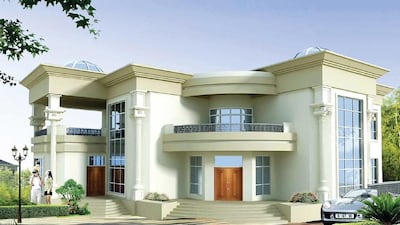
Costs depend upon the design. For example, a 715-square-metre two-storey five-room house with terrace is priced at Dh1.9 million and a 1,024 sq m two-storey six-bedroom house is Dh3m. Options are also available for those who wish to build a house to their own design. Illustration courtesy Abu Dhabi Housing Authority


![The designs were released as part of the Bayti [my home] initiative, to simplify the process of buying and building homes for Emiratis. Illustration courtesy Abu Dhabi Housing Authority](https://www.thenationalnews.com/resizer/v2/KIDZWUZFROBPTBITX37JJICSFE.jpg?smart=true&auth=b3b026cad4afefce4f12b7d4dae849a8abe335245ad461c7a157d9053ecd740e&width=800&height=450)



