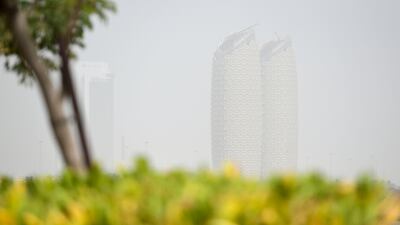
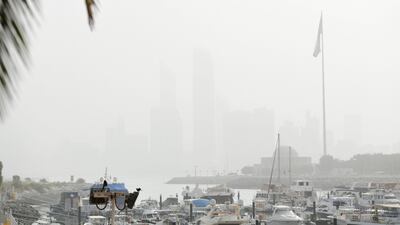
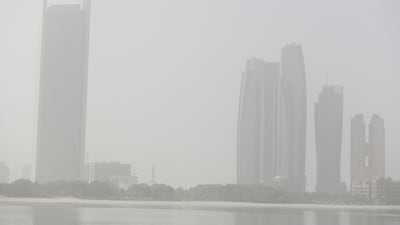
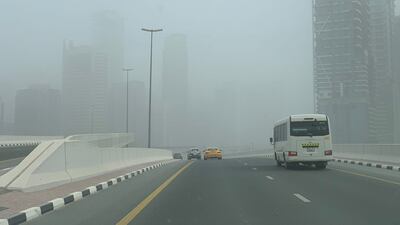
Drivers have been urged to be vigilant during dusty weather. Khushnum Bhandari / The National

UAE weather: Dust storm warning as winds hit 45kph


Salam Al Amir
  • English
  • Arabic

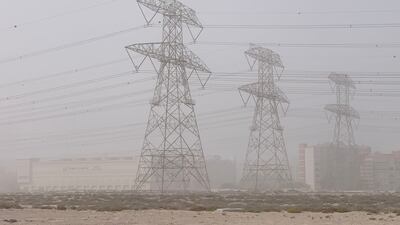
A dust storm warning was issued to motorists on Tuesday as winds of up to 45kph swept across the country.

The National Centre of Meteorology said challenging weather was expected to last until at least 8pm.

A yellow alert, which calls for the public to “be aware” when outdoors, is in place for large parts of the country.

An amber notice, which asks people to “be prepared during “hazardous weather events”, covers Al Ruwais, in the western region of Abu Dhabi, and in Al Ain.

The NCM said people should follow instructions from authorities during periods of poor visibility.

The weather centre also advised against unnecessary outings on the water due to rough seas.

Abu Dhabi Police asked motorists to exercise caution during bouts of low visibility.

Drivers were told to remain focused behind the wheel and avoid taking pictures or videos of the unsettled weather.

“Abu Dhabi Police urges drivers to be cautious due to low visibility during high winds and dust,” said a tweet. “For your safety and for the safety of others on the road, please do not be distracted by taking any videos or using your phone.”

At 11.31am, the police warned motorists of traffic congestion and delays on Sweihan Road from Nahil towards Abu Dhabi.

Another tweet posted by the Ministry of Interior warned of low visibility and urged drivers to be careful on the road.

“Due to the low in visibility and formation of dust, the Ministry of Interior calls on drivers to be cautious while driving,” it said.

The UAE is set for further rain and more dusty conditions in the days ahead.

The National Centre of Meteorology forecast downpours in Fujairah and Ras Al Khaimah, plus light rain for Dubai, on Wednesday.

In its latest five-day bulletin, the centre said rain on Wednesday would be accompanied by “a significant decrease in temperatures”.

It said there was a prospect of more dusty weather on Thursday, with rough seas continuing throughout the week.

Dust storms in the UAE — in pictures

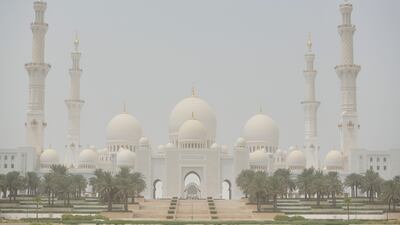
  • Sheikh Zayed Grand Mosque in Abu Dhabi is shrouded on Monday as dusty conditions linger on. Khushnum Bhandari / The National
    Sheikh Zayed Grand Mosque in Abu Dhabi is shrouded on Monday as dusty conditions linger on. Khushnum Bhandari / The National
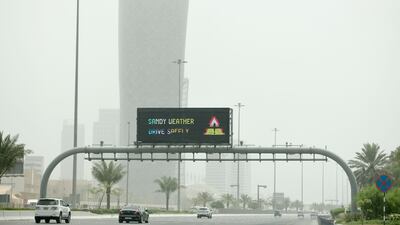
  • A road sign cautions over sandy weather in Abu Dhabi. Khushnum Bhandari / The National
    A road sign cautions over sandy weather in Abu Dhabi. Khushnum Bhandari / The National
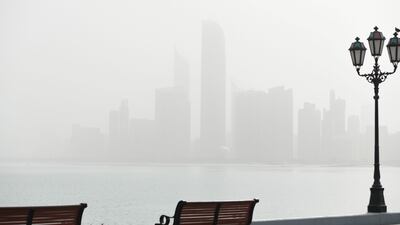
  • A hazy start to the day on the Corniche in Abu Dhabi. Khushnum Bhandari / The National
    A hazy start to the day on the Corniche in Abu Dhabi. Khushnum Bhandari / The National
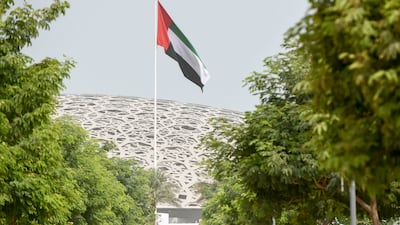
  • Louvre Abu Dhabi on an unsettled morning in the capital. Khushnum Bhandari / The National
    Louvre Abu Dhabi on an unsettled morning in the capital. Khushnum Bhandari / The National
  • Abu Dhabi faced more dusty weather on Monday. Khushnum Bhandari / The National
    Abu Dhabi faced more dusty weather on Monday. Khushnum Bhandari / The National
  • Poor visibility along Sheikh Khalifa Bridge, Abu Dhabi. Khushnum Bhandari / The National
    Poor visibility along Sheikh Khalifa Bridge, Abu Dhabi. Khushnum Bhandari / The National
  • Sand storms reduced visibility in Abu Dhabi, with large buildings barely visible in the thick haze. Khushnum Bhandari / The National
    Sand storms reduced visibility in Abu Dhabi, with large buildings barely visible in the thick haze. Khushnum Bhandari / The National
  • Reduced visibility along the Corniche, Abu Dhabi. Khushnum Bhandari / The National
    Reduced visibility along the Corniche, Abu Dhabi. Khushnum Bhandari / The National
  • A sandstorm reduces visibility in the capital. Khushnum Bhandari / The National
    A sandstorm reduces visibility in the capital. Khushnum Bhandari / The National
  • Sandstorm affecting visibility in the capital. Khushnum Bhandari / The National
    Sandstorm affecting visibility in the capital. Khushnum Bhandari / The National
  • Qasr Al Watan covered in dust, Abu Dhabi. Khushnum Bhandari / The National
    Qasr Al Watan covered in dust, Abu Dhabi. Khushnum Bhandari / The National
  • Dust storm in Dubai. Pawan Singh / The National
    Dust storm in Dubai. Pawan Singh / The National
  • Dust storm in Dubai. Pawan Singh / The National
    Dust storm in Dubai. Pawan Singh / The National
  • Reduced visibility during a dust storm in Dubai. Pawan Singh / The National
    Reduced visibility during a dust storm in Dubai. Pawan Singh / The National

Mercer, the investment consulting arm of US services company Marsh & McLennan, expects its wealth division to at least double its assets under management (AUM) in the Middle East as wealth in the region continues to grow despite economic headwinds, a company official said.

Mercer Wealth, which globally has $160 billion in AUM, plans to boost its AUM in the region to $2-$3bn in the next 2-3 years from the present $1bn, said Yasir AbuShaban, a Dubai-based principal with Mercer Wealth.

Within the next two to three years, we are looking at reaching $2 to $3 billion as a conservative estimate and we do see an opportunity to do so,” said Mr AbuShaban.

Mercer does not directly make investments, but allocates clients’ money they have discretion to, to professional asset managers. They also provide advice to clients.

“We have buying power. We can negotiate on their (client’s) behalf with asset managers to provide them lower fees than they otherwise would have to get on their own,” he added.

Mercer Wealth’s clients include sovereign wealth funds, family offices, and insurance companies among others.

From its office in Dubai, Mercer also looks after Africa, India and Turkey, where they also see opportunity for growth.

Wealth creation in Middle East and Africa (MEA) grew 8.5 per cent to $8.1 trillion last year from $7.5tn in 2015, higher than last year’s global average of 6 per cent and the second-highest growth in a region after Asia-Pacific which grew 9.9 per cent, according to consultancy Boston Consulting Group (BCG). In the region, where wealth grew just 1.9 per cent in 2015 compared with 2014, a pickup in oil prices has helped in wealth generation.

BCG is forecasting MEA wealth will rise to $12tn by 2021, growing at an annual average of 8 per cent.

Drivers of wealth generation in the region will be split evenly between new wealth creation and growth of performance of existing assets, according to BCG.

Another general trend in the region is clients’ looking for a comprehensive approach to investing, according to Mr AbuShaban.

“Institutional investors or some of the families are seeing a slowdown in the available capital they have to invest and in that sense they are looking at optimizing the way they manage their portfolios and making sure they are not investing haphazardly and different parts of their investment are working together,” said Mr AbuShaban.

Some clients also have a higher appetite for risk, given the low interest-rate environment that does not provide enough yield for some institutional investors. These clients are keen to invest in illiquid assets, such as private equity and infrastructure.

“What we have seen is a desire for higher returns in what has been a low-return environment specifically in various fixed income or bonds,” he said.

“In this environment, we have seen a de facto increase in the risk that clients are taking in things like illiquid investments, private equity investments, infrastructure and private debt, those kind of investments were higher illiquidity results in incrementally higher returns.”

The Abu Dhabi Investment Authority, one of the largest sovereign wealth funds, said in its 2016 report that has gradually increased its exposure in direct private equity and private credit transactions, mainly in Asian markets and especially in China and India. The authority’s private equity department focused on structured equities owing to “their defensive characteristics.”

Updated: January 10, 2023, 10:10 AM