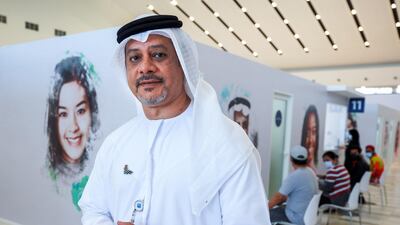
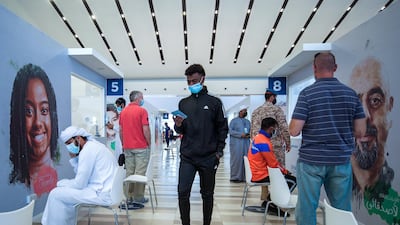
Sultan and Hamdan Al Hammadi, 19, devote up to six hours a day volunteering at an Abu Dhabi vaccination centre. Khushnum Bhandari for The National

Emirati twin volunteers 'privileged' to support UAE's vaccination drive


  • English
  • Arabic

Emirati twin brothers have told of a shared goal to help their country win the fight against the Covid-19 pandemic.

Sultan and Hamdan Al Hammadi, 19, juggle their studies at Zayed University with volunteer work at a vaccination centre in Abu Dhabi.

They spend up to six hours a day ensuring hundreds of people are immunised, helping the UAE reach its target of inoculating half of its population by the end of next month.

Sultan deems it an honour to lend his support at such a challenging time.

"I am doing this for my country. I want to give back to my country who has given me everything. This is actually a privilege," said Sultan, who also has seven other siblings.

UAE forges ahead with immunisation campaign:

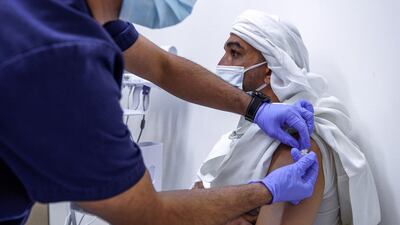
  • Abu Dhabi resident Abdulaziz Karmastaji gets vaccinated at Seha's cruise ship terminal facility in January
    Abu Dhabi resident Abdulaziz Karmastaji gets vaccinated at Seha's cruise ship terminal facility in January
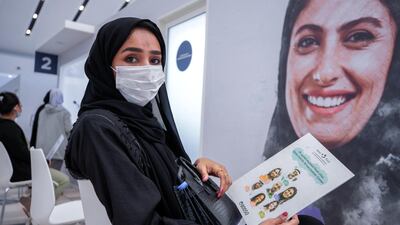
  • Abu Dhabi resident Shaikha Al Dheiri waiting to get vaccinated.
    Abu Dhabi resident Shaikha Al Dheiri waiting to get vaccinated.
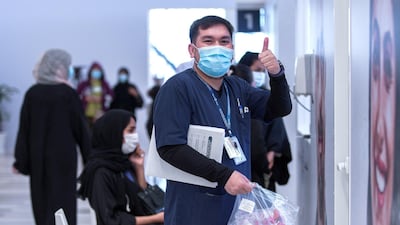
  • A healthcare worker smiles for the cameras.
    A healthcare worker smiles for the cameras.
  • Nearly 20,000 people are vaccinated daily at the centre.
    Nearly 20,000 people are vaccinated daily at the centre.
  • Mohamed Hawas Al Sadid, chief executive of Seha, said nearly 20,000 people are getting shots every day.
    Mohamed Hawas Al Sadid, chief executive of Seha, said nearly 20,000 people are getting shots every day.
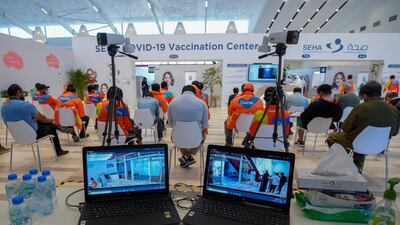
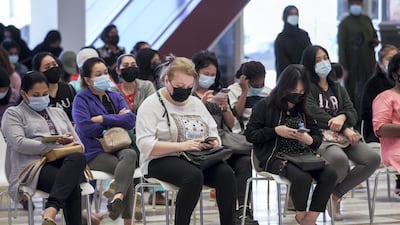
  • People in the waiting room.
    People in the waiting room.
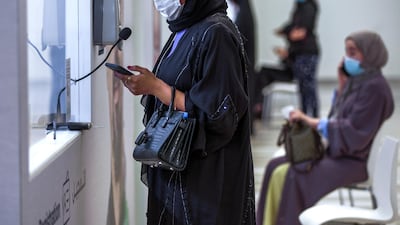
  • An Emirati waits for her turn to get the vaccine.
    An Emirati waits for her turn to get the vaccine.
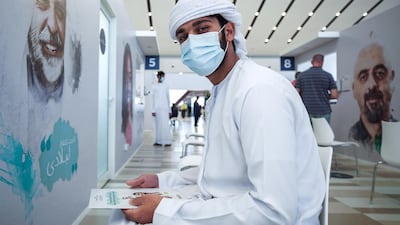
  • A young Emirati at the vaccination centre at the Abu Dhabi Cruise Terminal area.
    A young Emirati at the vaccination centre at the Abu Dhabi Cruise Terminal area.
  • Aya, 24, and Jana, 18, after receiving the vaccine. The Sinopharm vaccine is available across the country without charge at dozens of hospitals, vaccination centres, majlis and clinics.
    Aya, 24, and Jana, 18, after receiving the vaccine. The Sinopharm vaccine is available across the country without charge at dozens of hospitals, vaccination centres, majlis and clinics.
  • The Covid-19 vaccination drive is the country's largest to date. The health authorities aim to inoculate half the population by the end of the first quarter.
    The Covid-19 vaccination drive is the country's largest to date. The health authorities aim to inoculate half the population by the end of the first quarter.
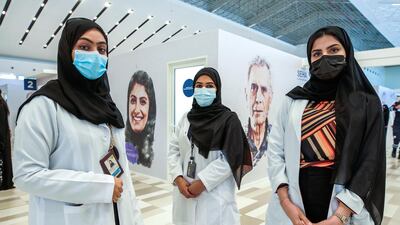
  • (L to R) - Emirati healthcare workers, Mouza Al Beshr, Khadija Al Nuaimi and Za,zam Al Naqbi at the Seha vaccination centre.
    (L to R) - Emirati healthcare workers, Mouza Al Beshr, Khadija Al Nuaimi and Za,zam Al Naqbi at the Seha vaccination centre.

The brothers study Information Security at Zayed University.

They have been volunteering at the Seha Vaccination Centre at Abu Dhabi Cruise Terminal for three weeks, fitting in volunteer shifts after they end their university classes at about 2pm.

Sultan helps with day-to-day operations while Hamdan assists with registration.

They help about 400 people navigate the vaccination process each day, from labourers to the elderly.

Hamdan said his work at the vaccination centre was a valuable learning experience for him and still left him plenty of time for his academic studies.

“There is a lot of time. I have time after 8pm to catch up on my school work," he said.

“This experience has taught me the magnitude of Covid. It is more serious than many of us know.”

He said dealing with blue collar workers from different nationalities was initially a challenge because of the language barrier.

“I have picked up a few words of their language and do ask for the assistance of an interpreter but I like dealing with people and helping them," he said.

"There is nothing better than hearing the words 'thank you' at the end of the day. This is the drive that keeps us going.”

The brothers strictly follow precautionary measures in order to stay safe while they are in close proximity with hundreds of people each day.

"We do keep safe and as soon as we go home and before getting into contact with anyone we sanitise ourselves," said Hamdan.

The brothers called on other members of the community to volunteer as the national inoculation campaign intensifies.

"The UAE and the world needs our help to fight this pandemic. Our community needs us to be safe,” Sultan said.

The UAE has administered more than 5 million doses of vaccine in the past two months and ranked second only to Israel in global immunisation rates.

Mercer, the investment consulting arm of US services company Marsh & McLennan, expects its wealth division to at least double its assets under management (AUM) in the Middle East as wealth in the region continues to grow despite economic headwinds, a company official said.

Mercer Wealth, which globally has $160 billion in AUM, plans to boost its AUM in the region to $2-$3bn in the next 2-3 years from the present $1bn, said Yasir AbuShaban, a Dubai-based principal with Mercer Wealth.

Within the next two to three years, we are looking at reaching $2 to $3 billion as a conservative estimate and we do see an opportunity to do so,” said Mr AbuShaban.

Mercer does not directly make investments, but allocates clients’ money they have discretion to, to professional asset managers. They also provide advice to clients.

“We have buying power. We can negotiate on their (client’s) behalf with asset managers to provide them lower fees than they otherwise would have to get on their own,” he added.

Mercer Wealth’s clients include sovereign wealth funds, family offices, and insurance companies among others.

From its office in Dubai, Mercer also looks after Africa, India and Turkey, where they also see opportunity for growth.

Wealth creation in Middle East and Africa (MEA) grew 8.5 per cent to $8.1 trillion last year from $7.5tn in 2015, higher than last year’s global average of 6 per cent and the second-highest growth in a region after Asia-Pacific which grew 9.9 per cent, according to consultancy Boston Consulting Group (BCG). In the region, where wealth grew just 1.9 per cent in 2015 compared with 2014, a pickup in oil prices has helped in wealth generation.

BCG is forecasting MEA wealth will rise to $12tn by 2021, growing at an annual average of 8 per cent.

Drivers of wealth generation in the region will be split evenly between new wealth creation and growth of performance of existing assets, according to BCG.

Another general trend in the region is clients’ looking for a comprehensive approach to investing, according to Mr AbuShaban.

“Institutional investors or some of the families are seeing a slowdown in the available capital they have to invest and in that sense they are looking at optimizing the way they manage their portfolios and making sure they are not investing haphazardly and different parts of their investment are working together,” said Mr AbuShaban.

Some clients also have a higher appetite for risk, given the low interest-rate environment that does not provide enough yield for some institutional investors. These clients are keen to invest in illiquid assets, such as private equity and infrastructure.

“What we have seen is a desire for higher returns in what has been a low-return environment specifically in various fixed income or bonds,” he said.

“In this environment, we have seen a de facto increase in the risk that clients are taking in things like illiquid investments, private equity investments, infrastructure and private debt, those kind of investments were higher illiquidity results in incrementally higher returns.”

The Abu Dhabi Investment Authority, one of the largest sovereign wealth funds, said in its 2016 report that has gradually increased its exposure in direct private equity and private credit transactions, mainly in Asian markets and especially in China and India. The authority’s private equity department focused on structured equities owing to “their defensive characteristics.”