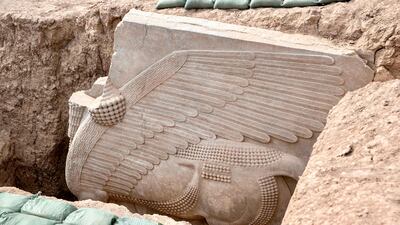
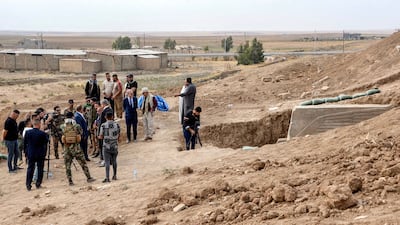
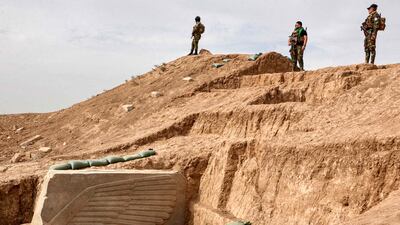
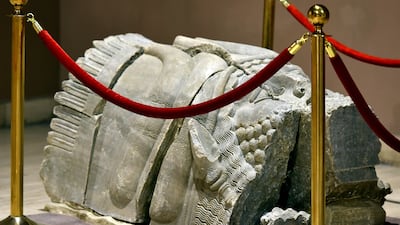
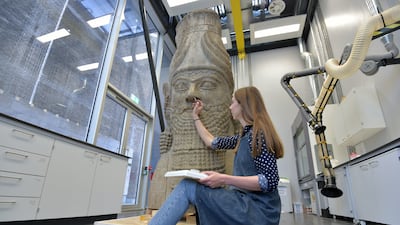
A team of French archaeologists last month unearthed a long-buried Assyrian winged bull, otherwise known as a lamassu, in Mosul, north Iraq, that dates back to the reign of King Sargon II from 722-705BC.
The priceless carving now exposed to the atmosphere and at risk of erosion won’t have to contend with the weather for too long because the Louvre has promptly, much to the chagrin of many Iraqis, vacated a spot to accommodate the piece.
As an Assyrian, the relationship I have with my ancient heritage can be conflicting. Growing up in the UK, the British Museum is like a second home. I have lost count of the number of times I’ve traipsed down the Assyrian galleries, with their depictions of war, lion hunts and eagle-headed winged genies. The contents are as close as I can physically get to my homeland.
Each visit would fill me with a combination of awe, and amusement at the uncanny similarity of the alabaster faces to that of my grandad's. Underlying these emotions is the sorrow of how they got there in the first place. Many miles from where they were found, ancient Assyrian heritage mirrors the modern Assyrian diaspora, scattered predominantly in the western world, and severed from their native land.
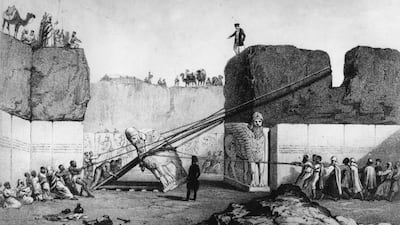
The official line is that the British Museum obtained its collection legitimately. Austen Henry Layard, a diplomat, was the first to excavate Nineveh and Nimrud in what was Mesopotamia in the mid-19th century. He swiftly received sponsorship and then embarked on a mammoth journey by ship, transporting the huge carved stone reliefs to England. Layard’s visit inspired other Europeans to follow and swell their public – as well as private – collections of treasures.
The region, under Ottoman rule, granted permission for removal of the antiquities although there is scant information about the nature of the transactions, and it appears highly improbable that locals were consulted in the process.
While I ultimately believe that these items belong in the land where they originated, I have several reservations about repatriation. Circumstances over the past few decades have made it challenging for Iraq to manage its antiquities. My mother recalls a trip to the aqueduct of Sennacherib in Jerwan in the late 1960s. The site, dating back to the seventh-century BC, was crawling with security guards, one of whom scolded her for attempting to reach out to touch a pebble.
Now it is unattended, which is sadly an all-too-common observation at similar archaeological sites. Last year, Chatham House published research detailing the extent to which Iraqi institutions lacked the funding to deliver the security and conservation gravely needed for these areas.
The recently found winged-bull sculpture in Mosul is, in fact, incomplete. The head was stolen during a previous excavation that was abandoned at the start of the Gulf War. The conflict and subsequent sanctions shattered the country economically and prompted an illegal trade in the trafficking of ancient goods.
This continued during the 2003 invasion when occupying troops setting up bases at historically significant grounds inflicted considerable damage, and peaked with the horrendous looting of the museum in Baghdad. Some of the artefacts found their way on to eBay; an example that stood out was an invaluable cuneiform slab being sold for $10 as a “coaster”.
It is thought that, in all, Iraq has lost hundreds of thousands of cultural objects. While some have been recovered, the occasional glimpse of others in private collections has sparked controversy. Perhaps most notable was a 3,000-year-old panel of gypsum depicting a deity called Apkallu sold at auction by Christie's New York in 2018. It had been acquired by an American Episcopal seminary in 1859 through Dr Henri Byron Haskell, a US missionary who was intrigued by artefacts with biblical relevance.
The auction provoked restitution claims from the Iraqi ministry of culture, with officials petitioning Unesco and Interpol to intervene, but to no avail. Christie's addressed Iraq's position, putting out proof of provenance of the item. It added it had contacted law enforcement authorities before publishing details of the sale to ensure the documentation for the alabaster relief met “applicable laws governing its sale”.
That piece went under the hammer to an anonymous buyer for $31 million – three times the estimated value – arguably because of ISIS taking a pneumatic drill to monuments of a similar era at the palace of Ashurnasirpal II in Nimrud a few years earlier.
What ISIS did not destroy they traded on the black market, generating millions of dollars. Little coverage was given to the fact that, at the same time the statues were being demolished, the descendants of those who built them were being systematically massacred by the very same terrorist organisation.
That disconnect between modern and ancient Assyrians within the narrative about Iraq is not coincidental. At no stage in Iraq’s history has the constitution acknowledged us as an ethnic group, still less our indigeneity. Our direct lineage to ancient Assyrians, despite linguistic, cultural, geographic and genetic evidence, is often questioned.
The Arab nationalist policies of Baathism reclassified Assyrians as “Arab Christians”, but that didn’t stop Saddam Hussein fashioning himself as king Nebuchadnezzar in murals across the country nor his somewhat problematic restoration of Babylon, where he ensured his name was inscribed on every brick.
In May, Iraq's president requested the return of approximately 6,000 artefacts that were “borrowed” in 1923 for “academic purposes”. Given the British Museum’s track record of declining previous calls to repatriate items, it is interesting that this request was granted unchallenged.
In Baghdad, a lavish ceremony took place to mark the occasion with President Abdul Latif Rashid at the helm, a man who has been an instrumental member of the Patriotic Union of Kurdistan party. The party’s core ideology is establishing a state with a singular Kurdish identity.
With that in mind, seeing a politician salivate over our cultural heritage, proclaiming the goods as symbolic of national unity, was stomach turning. More so if you are aware of the role the party has had in marginalising Assyrian communities.
Dig a few inches down in Iraq and you will more than likely stumble upon something a few thousand years old. That’s exactly what happened to journalist Hormuz Mushi in the town of Fayda in 2019. After alerting the relevant authorities of his accidental find, Mushi was assaulted and detained by Kurdish security forces.
The bizarre response makes sense when understanding the objectives of the Kurdish Regional Government (KRG) which presides over that part of Iraq. Such discoveries are viewed as a threat to the pursuit for Kurdish independence that has partially relied on discrediting Assyrian indigeneity.
The KRG are famed for co-option of Assyrian material heritage, adopting historical revisionism as a key tactic. A report by the Assyrian Policy Institute described disturbing examples, such as incorrect labelling of museum exhibits, frequent vandalisation of archaeological sites as well as tangible heritage being torn down altogether – or, as was the case with the Khinnis rock reliefs, being renovated into an outdoor swimming pool.
I can’t help but feel that Assyrian history is the one aspect of Mesopotamia’s back story that appears to belong to everyone but Assyrians. I laughed when my grandad first snorted “I could do with my portrait back” before a trip I made to the British Museum as a child. Now, as I remember those words, there is a poignancy to them that emphasises the lack of ownership we possess over our own past.
Michael Rakowitz, an American artist, wrote a letter to the British Museum in January requesting repatriation of a lamassu to Iraq. In exchange, he offered the Tate a contemporary version of the sculpture he had created.
To many Assyrians, this seemed like nothing more than a gimmick. If he succeeded, he would have achieved what no one else had done before, as well as immortalise himself with an artwork in a world-renowned gallery.
The recent thefts at the British Museum have been an unexpected twist in the timeline of the institution. In August, the museum reported that a number of items, including gold jewellery and precious stones, appeared to be missing or damaged. The incident, under investigation by police, led to the museum director Hartwig Fischer resigning. It emerged that concerns about possible thefts first raised by an art historian more than two years ago had gone unheeded. It has been suggested that inadequate cataloguing and lapses in security may have contributed to the losses. Fischer quit after accepting responsibility for the museum's failure to properly respond to warnings about the suspected thefts of thousands of objects as far back as 2021.
Until this point, I had always maintained that Assyrian artefacts were best placed where they are, in the British Museum. Iraqi authorities, on the other hand, have repeatedly failed to guard our physical heritage and are yet to realise the need to protect our modern communities, the numbers of which are continually dwindling. Until they can prove otherwise, I can’t help but feel that these relics are far safer underground.
Jenan Younis is a comedian and BBC New Voices Winner based in London. Her next show IRAQNOPHOBIA is at the Harrison Theatre, Bloomsbury, on Saturday, December 16.
COPA DEL REY
Semi-final, first leg
Barcelona 1 (Malcom 57')
Real Madrid (Vazquez 6')
Second leg, February 27
Company%20profile
%3Cp%3E%3Cstrong%3ECompany%20name%3A%20%3C%2Fstrong%3ETwig%20Solutions%20(with%20trade%20name%20Twig)%3Cbr%3E%3Cstrong%3EStarted%3A%20%3C%2Fstrong%3E2021%3Cbr%3E%3Cstrong%3EFounders%3A%20%3C%2Fstrong%3EChafic%20Idriss%2C%20Karam%20El%20Dik%20and%20Rayan%20Antonios%3Cbr%3E%3Cstrong%3EBased%3A%20%3C%2Fstrong%3EUAE%3Cbr%3E%3Cstrong%3ESector%3A%20%3C%2Fstrong%3EFinTech%3Cbr%3E%3Cstrong%3EInitial%20investment%3A%20%3C%2Fstrong%3Ebootstrapped%20(undisclosed)%3Cbr%3E%3Cstrong%3ECurrent%20number%20of%20staff%3A%20%3C%2Fstrong%3E13%3Cbr%3E%3Cstrong%3EInvestment%20stage%3A%20%3C%2Fstrong%3Epre-seed%20%E2%80%94%20closing%20the%20round%20as%20we%20speak%3Cbr%3E%3Cstrong%3EInvestors%3A%3C%2Fstrong%3E%20senior%20executives%20from%20the%20GCC%20financial%20services%20industry%20and%20global%20family%20offices%3Cbr%3E%3Cbr%3E%3C%2Fp%3E%0A
What is graphene?
Graphene is extracted from graphite and is made up of pure carbon.
It is 200 times more resistant than steel and five times lighter than aluminum.
It conducts electricity better than any other material at room temperature.
It is thought that graphene could boost the useful life of batteries by 10 per cent.
Graphene can also detect cancer cells in the early stages of the disease.
The material was first discovered when Andre Geim and Konstantin Novoselov were 'playing' with graphite at the University of Manchester in 2004.
Our family matters legal consultant
Name: Hassan Mohsen Elhais
Position: legal consultant with Al Rowaad Advocates and Legal Consultants.
The advice provided in our columns does not constitute legal advice and is provided for information only. Readers are encouraged to seek independent legal advice.
5 of the most-popular Airbnb locations in Dubai
Bobby Grudziecki, chief operating officer of Frank Porter, identifies the five most popular areas in Dubai for those looking to make the most out of their properties and the rates owners can secure:
• Dubai Marina
The Marina and Jumeirah Beach Residence are popular locations, says Mr Grudziecki, due to their closeness to the beach, restaurants and hotels.
Frank Porter’s average Airbnb rent:
One bedroom: Dh482 to Dh739
Two bedroom: Dh627 to Dh960
Three bedroom: Dh721 to Dh1,104
• Downtown
Within walking distance of the Dubai Mall, Burj Khalifa and the famous fountains, this location combines business and leisure. “Sure it’s for tourists,” says Mr Grudziecki. “Though Downtown [still caters to business people] because it’s close to Dubai International Financial Centre."
Frank Porter’s average Airbnb rent:
One bedroom: Dh497 to Dh772
Two bedroom: Dh646 to Dh1,003
Three bedroom: Dh743 to Dh1,154
• City Walk
The rising star of the Dubai property market, this area is lined with pristine sidewalks, boutiques and cafes and close to the new entertainment venue Coca Cola Arena. “Downtown and Marina are pretty much the same prices,” Mr Grudziecki says, “but City Walk is higher.”
Frank Porter’s average Airbnb rent:
One bedroom: Dh524 to Dh809
Two bedroom: Dh682 to Dh1,052
Three bedroom: Dh784 to Dh1,210
• Jumeirah Lake Towers
Dubai Marina’s little brother JLT resides on the other side of Sheikh Zayed road but is still close enough to beachside outlets and attractions. The big selling point for Airbnb renters, however, is that “it’s cheaper than Dubai Marina”, Mr Grudziecki says.
Frank Porter’s average Airbnb rent:
One bedroom: Dh422 to Dh629
Two bedroom: Dh549 to Dh818
Three bedroom: Dh631 to Dh941
• Palm Jumeirah
Palm Jumeirah's proximity to luxury resorts is attractive, especially for big families, says Mr Grudziecki, as Airbnb renters can secure competitive rates on one of the world’s most famous tourist destinations.
Frank Porter’s average Airbnb rent:
One bedroom: Dh503 to Dh770
Two bedroom: Dh654 to Dh1,002
Three bedroom: Dh752 to Dh1,152
APPLE IPAD MINI (A17 PRO)
Display: 21cm Liquid Retina Display, 2266 x 1488, 326ppi, 500 nits
Chip: Apple A17 Pro, 6-core CPU, 5-core GPU, 16-core Neural Engine
Storage: 128/256/512GB
Main camera: 12MP wide, f/1.8, digital zoom up to 5x, Smart HDR 4
Front camera: 12MP ultra-wide, f/2.4, Smart HDR 4, full-HD @ 25/30/60fps
Biometrics: Touch ID, Face ID
Colours: Blue, purple, space grey, starlight
In the box: iPad mini, USB-C cable, 20W USB-C power adapter
Price: From Dh2,099
UK%20record%20temperature
%3Cp%3E38.7C%20(101.7F)%20set%20in%20Cambridge%20in%202019%3C%2Fp%3E%0A
How to apply for a drone permit
- Individuals must register on UAE Drone app or website using their UAE Pass
- Add all their personal details, including name, nationality, passport number, Emiratis ID, email and phone number
- Upload the training certificate from a centre accredited by the GCAA
- Submit their request
What are the regulations?
- Fly it within visual line of sight
- Never over populated areas
- Ensure maximum flying height of 400 feet (122 metres) above ground level is not crossed
- Users must avoid flying over restricted areas listed on the UAE Drone app
- Only fly the drone during the day, and never at night
- Should have a live feed of the drone flight
- Drones must weigh 5 kg or less
Our legal columnist
Name: Yousef Al Bahar
Advocate at Al Bahar & Associate Advocates and Legal Consultants, established in 1994
Education: Mr Al Bahar was born in 1979 and graduated in 2008 from the Judicial Institute. He took after his father, who was one of the first Emirati lawyers
CONFIRMED%20LINE-UP
%3Cp%3EElena%20Rybakina%20(Kazakhstan)%3Cbr%3EOns%20Jabeur%20(Tunisia)%3Cbr%3EMaria%20Sakkari%20(Greece)%3Cbr%3EBarbora%20Krej%C4%8D%C3%ADkov%C3%A1%20(Czech%20Republic)%3Cbr%3EBeatriz%20Haddad%20Maia%20(Brazil)%3Cbr%3EJe%C4%BCena%20Ostapenko%20(Latvia)%3Cbr%3ELiudmila%20Samsonova%3Cbr%3EDaria%20Kasatkina%3Cbr%3EVeronika%20Kudermetova%3Cbr%3ECaroline%20Garcia%20(France)%3Cbr%3EMagda%20Linette%20(Poland)%3Cbr%3ESorana%20C%C3%AErstea%20(Romania)%3Cbr%3EAnastasia%20Potapova%3Cbr%3EAnhelina%20Kalinina%20(Ukraine)%3Cbr%3EJasmine%20Paolini%20(Italy)%3Cbr%3EEmma%20Navarro%20(USA)%3Cbr%3ELesia%20Tsurenko%20(Ukraine)%3Cbr%3EEmma%20Raducanu%20(Great%20Britain)%20%E2%80%93%20wildcard%3C%2Fp%3E%0A
Key figures in the life of the fort
Sheikh Dhiyab bin Isa (ruled 1761-1793) Built Qasr Al Hosn as a watchtower to guard over the only freshwater well on Abu Dhabi island.
Sheikh Shakhbut bin Dhiyab (ruled 1793-1816) Expanded the tower into a small fort and transferred his ruling place of residence from Liwa Oasis to the fort on the island.
Sheikh Tahnoon bin Shakhbut (ruled 1818-1833) Expanded Qasr Al Hosn further as Abu Dhabi grew from a small village of palm huts to a town of more than 5,000 inhabitants.
Sheikh Khalifa bin Shakhbut (ruled 1833-1845) Repaired and fortified the fort.
Sheikh Saeed bin Tahnoon (ruled 1845-1855) Turned Qasr Al Hosn into a strong two-storied structure.
Sheikh Zayed bin Khalifa (ruled 1855-1909) Expanded Qasr Al Hosn further to reflect the emirate's increasing prominence.
Sheikh Shakhbut bin Sultan (ruled 1928-1966) Renovated and enlarged Qasr Al Hosn, adding a decorative arch and two new villas.
Sheikh Zayed bin Sultan (ruled 1966-2004) Moved the royal residence to Al Manhal palace and kept his diwan at Qasr Al Hosn.
Sources: Jayanti Maitra, www.adach.ae
How Beautiful this world is!
Specs
Engine: 51.5kW electric motor
Range: 400km
Power: 134bhp
Torque: 175Nm
Price: From Dh98,800
Available: Now
The biog
Favourite film: Motorcycle Dairies, Monsieur Hulot’s Holiday, Kagemusha
Favourite book: One Hundred Years of Solitude
Holiday destination: Sri Lanka
First car: VW Golf
Proudest achievement: Building Robotics Labs at Khalifa University and King’s College London, Daughters
Driverless cars or drones: Driverless Cars
Sarfira
Director: Sudha Kongara Prasad
Starring: Akshay Kumar, Radhika Madan, Paresh Rawal
Rating: 2/5
KILLING OF QASSEM SULEIMANI
GOLF’S RAHMBO
- 5 wins in 22 months as pro
- Three wins in past 10 starts
- 45 pro starts worldwide: 5 wins, 17 top 5s
- Ranked 551th in world on debut, now No 4 (was No 2 earlier this year)
- 5th player in last 30 years to win 3 European Tour and 2 PGA Tour titles before age 24 (Woods, Garcia, McIlroy, Spieth)
The specs
AT4 Ultimate, as tested
Engine: 6.2-litre V8
Power: 420hp
Torque: 623Nm
Transmission: 10-speed automatic
Price: From Dh330,800 (Elevation: Dh236,400; AT4: Dh286,800; Denali: Dh345,800)
On sale: Now
Frankenstein in Baghdad
Ahmed Saadawi
Penguin Press
Company%C2%A0profile
%3Cp%3ECompany%3A%20Zywa%3Cbr%3EStarted%3A%202021%3Cbr%3EFounders%3A%20Nuha%20Hashem%20and%20Alok%20Kumar%3Cbr%3EBased%3A%20UAE%3Cbr%3EIndustry%3A%20FinTech%3Cbr%3EFunding%20size%3A%20%243m%3Cbr%3ECompany%20valuation%3A%20%2430m%3C%2Fp%3E%0A
Company%20profile
%3Cp%3E%3Cstrong%3EName%3A%3C%2Fstrong%3E%20WallyGPT%3Cbr%3E%3Cstrong%3EStarted%3A%20%3C%2Fstrong%3E2014%3Cbr%3E%3Cstrong%3EFounders%3A%20%3C%2Fstrong%3ESaeid%20and%20Sami%20Hejazi%3Cbr%3E%3Cstrong%3EBased%3A%3C%2Fstrong%3E%20Dubai%3Cbr%3E%3Cstrong%3ESector%3A%20%3C%2Fstrong%3EFinTech%3Cbr%3E%3Cstrong%3EInvestment%20raised%3A%20%3C%2Fstrong%3E%247.1%20million%3Cbr%3E%3Cstrong%3ENumber%20of%20staff%3A%3C%2Fstrong%3E%2020%3Cbr%3E%3Cstrong%3EInvestment%20stage%3A%20%3C%2Fstrong%3EPre-seed%20round%3C%2Fp%3E%0A
More coverage from the Future Forum
The specs: 2018 Nissan Patrol Nismo
Price: base / as tested: Dh382,000
Engine: 5.6-litre V8
Gearbox: Seven-speed automatic
Power: 428hp @ 5,800rpm
Torque: 560Nm @ 3,600rpm
Fuel economy, combined: 12.7L / 100km
Founders: Abdulmajeed Alsukhan, Turki Bin Zarah and Abdulmohsen Albabtain.
Based: Riyadh
Offices: UAE, Vietnam and Germany
Founded: September, 2020
Number of employees: 70
Sector: FinTech, online payment solutions
Funding to date: $116m in two funding rounds
Investors: Checkout.com, Impact46, Vision Ventures, Wealth Well, Seedra, Khwarizmi, Hala Ventures, Nama Ventures and family offices
Tips on buying property during a pandemic
Islay Robinson, group chief executive of mortgage broker Enness Global, offers his advice on buying property in today's market.
While many have been quick to call a market collapse, this simply isn’t what we’re seeing on the ground. Many pockets of the global property market, including London and the UAE, continue to be compelling locations to invest in real estate.
While an air of uncertainty remains, the outlook is far better than anyone could have predicted. However, it is still important to consider the wider threat posed by Covid-19 when buying bricks and mortar.
Anything with outside space, gardens and private entrances is a must and these property features will see your investment keep its value should the pandemic drag on. In contrast, flats and particularly high-rise developments are falling in popularity and investors should avoid them at all costs.
Attractive investment property can be hard to find amid strong demand and heightened buyer activity. When you do find one, be prepared to move hard and fast to secure it. If you have your finances in order, this shouldn’t be an issue.
Lenders continue to lend and rates remain at an all-time low, so utilise this. There is no point in tying up cash when you can keep this liquidity to maximise other opportunities.
Keep your head and, as always when investing, take the long-term view. External factors such as coronavirus or Brexit will present challenges in the short-term, but the long-term outlook remains strong.
Finally, keep an eye on your currency. Whenever currency fluctuations favour foreign buyers, you can bet that demand will increase, as they act to secure what is essentially a discounted property.
How to play the stock market recovery in 2021?
If you are looking to build your long-term wealth in 2021 and beyond, the stock market is still the best place to do it as equities powered on despite the pandemic.
Investing in individual stocks is not for everyone and most private investors should stick to mutual funds and ETFs, but there are some thrilling opportunities for those who understand the risks.
Peter Garnry, head of equity strategy at Saxo Bank, says the 20 best-performing US and European stocks have delivered an average return year-to-date of 148 per cent, measured in local currency terms.
Online marketplace Etsy was the best performer with a return of 330.6 per cent, followed by communications software company Sinch (315.4 per cent), online supermarket HelloFresh (232.8 per cent) and fuel cells specialist NEL (191.7 per cent).
Mr Garnry says digital companies benefited from the lockdown, while green energy firms flew as efforts to combat climate change were ramped up, helped in part by the European Union’s green deal.
Electric car company Tesla would be on the list if it had been part of the S&P 500 Index, but it only joined on December 21. “Tesla has become one of the most valuable companies in the world this year as demand for electric vehicles has grown dramatically,” Mr Garnry says.
By contrast, the 20 worst-performing European stocks fell 54 per cent on average, with European banks hit by the economic fallout from the pandemic, while cruise liners and airline stocks suffered due to travel restrictions.
As demand for energy fell, the oil and gas industry had a tough year, too.
Mr Garnry says the biggest story this year was the “absolute crunch” in so-called value stocks, companies that trade at low valuations compared to their earnings and growth potential.
He says they are “heavily tilted towards financials, miners, energy, utilities and industrials, which have all been hit hard by the Covid-19 pandemic”. “The last year saw these cheap stocks become cheaper and expensive stocks have become more expensive.”
This has triggered excited talk about the “great value rotation” but Mr Garnry remains sceptical. “We need to see a breakout of interest rates combined with higher inflation before we join the crowd.”
Always remember that past performance is not a guarantee of future returns. Last year’s winners often turn out to be this year’s losers, and vice-versa.
Winners
Ballon d’Or (Men’s)
Ousmane Dembélé (Paris Saint-Germain / France)
Ballon d’Or Féminin (Women’s)
Aitana Bonmatí (Barcelona / Spain)
Kopa Trophy (Best player under 21 – Men’s)
Lamine Yamal (Barcelona / Spain)
Best Young Women’s Player
Vicky López (Barcelona / Spain)
Yashin Trophy (Best Goalkeeper – Men’s)
Gianluigi Donnarumma (Paris Saint-Germain and Manchester City / Italy)
Best Women’s Goalkeeper
Hannah Hampton (England / Aston Villa and Chelsea)
Men’s Coach of the Year
Luis Enrique (Paris Saint-Germain)
Women’s Coach of the Year
Sarina Wiegman (England)
12%20restaurants%20opening%20at%20the%20hotel%20this%20month
%3Cp%3EAriana%E2%80%99s%20Persian%20Kitchen%3Cbr%3EDinner%20by%20Heston%20Blumenthal%3Cbr%3EEstiatorio%20Milos%3Cbr%3EHouse%20of%20Desserts%3Cbr%3EJaleo%20by%20Jose%20Andres%3Cbr%3ELa%20Mar%3Cbr%3ELing%20Ling%3Cbr%3ELittle%20Venice%20Cake%20Company%3Cbr%3EMalibu%2090265%3Cbr%3ENobu%20by%20the%20Beach%3Cbr%3EResonance%20by%20Heston%20Blumenthal%3Cbr%3EThe%20Royal%20Tearoom%C2%A0%3C%2Fp%3E%0A
The squad traveling to Brazil:
Faisal Al Ketbi, Ibrahim Al Hosani, Khalfan Humaid Balhol, Khalifa Saeed Al Suwaidi, Mubarak Basharhil, Obaid Salem Al Nuaimi, Saeed Juma Al Mazrouei, Saoud Abdulla Al Hammadi, Taleb Al Kirbi, Yahia Mansour Al Hammadi, Zayed Al Kaabi, Zayed Saif Al Mansoori, Saaid Haj Hamdou, Hamad Saeed Al Nuaimi. Coaches Roberto Lima and Alex Paz.
Ten tax points to be aware of in 2026
1. Domestic VAT refund amendments: request your refund within five years
If a business does not apply for the refund on time, they lose their credit.
2. E-invoicing in the UAE
Businesses should continue preparing for the implementation of e-invoicing in the UAE, with 2026 a preparation and transition period ahead of phased mandatory adoption.
3. More tax audits
Tax authorities are increasingly using data already available across multiple filings to identify audit risks.
4. More beneficial VAT and excise tax penalty regime
Tax disputes are expected to become more frequent and more structured, with clearer administrative objection and appeal processes. The UAE has adopted a new penalty regime for VAT and excise disputes, which now mirrors the penalty regime for corporate tax.
5. Greater emphasis on statutory audit
There is a greater need for the accuracy of financial statements. The International Financial Reporting Standards standards need to be strictly adhered to and, as a result, the quality of the audits will need to increase.
6. Further transfer pricing enforcement
Transfer pricing enforcement, which refers to the practice of establishing prices for internal transactions between related entities, is expected to broaden in scope. The UAE will shortly open the possibility to negotiate advance pricing agreements, or essentially rulings for transfer pricing purposes.
7. Limited time periods for audits
Recent amendments also introduce a default five-year limitation period for tax audits and assessments, subject to specific statutory exceptions. While the standard audit and assessment period is five years, this may be extended to up to 15 years in cases involving fraud or tax evasion.
8. Pillar 2 implementation
Many multinational groups will begin to feel the practical effect of the Domestic Minimum Top-Up Tax (DMTT), the UAE's implementation of the OECD’s global minimum tax under Pillar 2. While the rules apply for financial years starting on or after January 1, 2025, it is 2026 that marks the transition to an operational phase.
9. Reduced compliance obligations for imported goods and services
Businesses that apply the reverse-charge mechanism for VAT purposes in the UAE may benefit from reduced compliance obligations.
10. Substance and CbC reporting focus
Tax authorities are expected to continue strengthening the enforcement of economic substance and Country-by-Country (CbC) reporting frameworks. In the UAE, these regimes are increasingly being used as risk-assessment tools, providing tax authorities with a comprehensive view of multinational groups’ global footprints and enabling them to assess whether profits are aligned with real economic activity.
Contributed by Thomas Vanhee and Hend Rashwan, Aurifer
SERIES INFO
Schedule:
All matches at the Harare Sports Club
1st ODI, Wed Apr 10
2nd ODI, Fri Apr 12
3rd ODI, Sun Apr 14
4th ODI, Sun Apr 16
UAE squad
Mohammed Naveed (captain), Rohan Mustafa, Ashfaq Ahmed, Shaiman Anwar, Mohammed Usman, CP Rizwan, Chirag Suri, Mohammed Boota, Ghulam Shabber, Sultan Ahmed, Imran Haider, Amir Hayat, Zahoor Khan, Qadeer Ahmed
Zimbabwe squad
Peter Moor (captain), Solomon Mire, Brian Chari, Regis Chakabva, Sean Williams, Timycen Maruma, Sikandar Raza, Donald Tiripano, Kyle Jarvis, Tendai Chatara, Chris Mpofu, Craig Ervine, Brandon Mavuta, Ainsley Ndlovu, Tony Munyonga, Elton Chigumbura
RESULT
Bournemouth 0 Southampton 3 (Djenepo (37', Redmond 45' 1, 59')
Man of the match Nathan Redmond (Southampton)
Electric scooters: some rules to remember
- Riders must be 14-years-old or over
- Wear a protective helmet
- Park the electric scooter in designated parking lots (if any)
- Do not leave electric scooter in locations that obstruct traffic or pedestrians
- Solo riders only, no passengers allowed
- Do not drive outside designated lanes
Ain Dubai in numbers
126: The length in metres of the legs supporting the structure
1 football pitch: The length of each permanent spoke is longer than a professional soccer pitch
16 A380 Airbuses: The equivalent weight of the wheel rim.
9,000 tonnes: The amount of steel used to construct the project.
5 tonnes: The weight of each permanent spoke that is holding the wheel rim in place
192: The amount of cable wires used to create the wheel. They measure a distance of 2,4000km in total, the equivalent of the distance between Dubai and Cairo.
Jetour T1 specs
Engine: 2-litre turbocharged
Power: 254hp
Torque: 390Nm
Price: From Dh126,000
Available: Now