Nato Secretary General Jens Stoltenberg on Tuesday slammed Russia's “reckless” destruction of a satellite that created a debris cloud that he said posed a danger to orbiting space stations.
“This has created a lot of debris, which is now a risk to the International Space Station and also to the Chinese space station — so, this was a reckless act by Russia,” Mr Stoltenberg told journalists.
Russia's defence ministry acknowledged destroying one of its satellites during a missile test to bolster its defence capabilities, but denied claims that the move was dangerous.
US officials on Monday had denounced Moscow for the “irresponsible” test and said they had not been informed in advance.
Nasa said the crew aboard the ISS — currently four Americans, a German and two Russians — were forced to take shelter in their docked return ships.
Russia's strike — the fourth to hit an object orbiting Earth from the ground — reignited concerns about a growing space arms race that could include everything from laser weapons to satellites capable of pushing others out of orbit.
Mr Stoltenberg said the strike showed Moscow was working on weapons capable of striking critical infrastructure.
“It demonstrates that Russia is now developing new weapon systems that can shoot down satellites, can destroy important space capabilities for basic infrastructure on Earth like communications, like navigation or like early warning of missile launches,” he said.
-
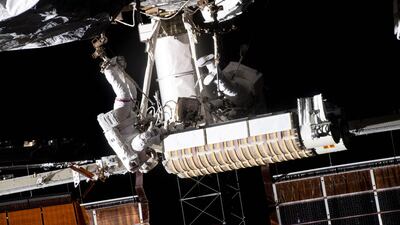
French astronaut Thomas Pesquet, left, of the European Space Agency is attached to a foot restraint while installing new solar panels on the International Space Station, with US astronaut Shane Kimbrough. AFP -

The astronauts installed the panels in a six-hour spacewalk on Sunday, 20 June. AP Photo -
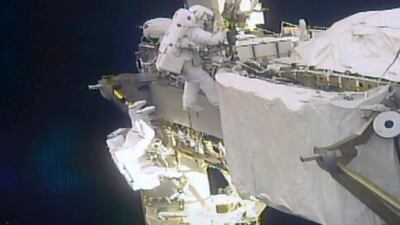
The pair attached, positioned and deployed six new-generation panels, known as Roll-Out Solar Array, or iROSA. AP Photo -
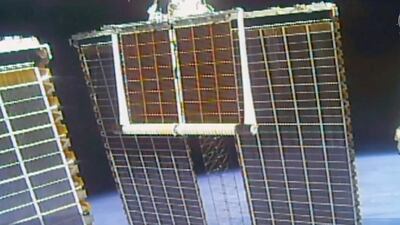
Once installed, the panels unrolled over a 10-minute period. Watching them unfurl, Thomas Pesquet described the process as 'beautiful'. AP Photo -
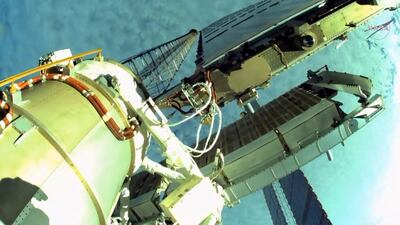
A sideview of the newly installed solar panels seen from US astronaut Shane Kimbrough's helmet camera. Five more rollout panels have still to be installed. AFP -
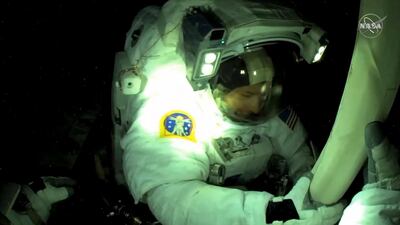
US astronaut Shane Kimbrough seen from ESA astronaut Thomas Pesquet's helmet camera, fixing bolts on the new solar panels. AFP -
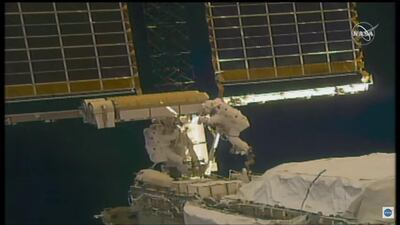
A view of Shane Kimbrough, left, and Thomas Pesquet, at work shows the scale of the iROSA solar panels. AFP -

Thomas Pesquet uses a space drill while installing the new solar panels. Parts of the ageing International Space Station date from 1998, and the panels with boost energy supplies. AFP -
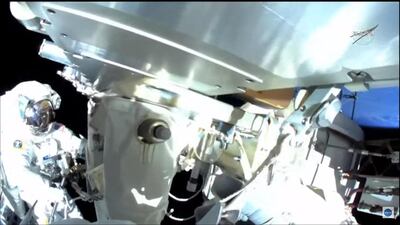
Shane Kimbrough seen from Thomas Pesquet's helmet camera during unfolding and alignment of the solar panel. The 19-metre panels should have a 15-year lifespan. AFP -
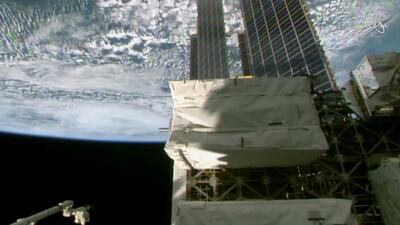
The Earth provides a dramatic backdrop to the newly installed solar panels on the International Space Station. AFP