
The G7 countries signalled on Friday that they would lead the world through the Covid-19 pandemic by providing an extra $4 billion and millions of vaccines to developing countries.
After a two-hour virtual meeting hosted by British Prime Minister Boris Johnson, the world leaders also set out plans for the reversal of global biodiversity loss, as a landmark policy for the Cop26 climate change conference later this year.
In addition, they backed Japan’s hopes to hold the Olympic Games this year, delayed from 2020, “as a symbol for global unity” in conquering Covid-19.
In a joint statement the G7 said it was “resolved to work together to beat Covid-19”.
The leaders vowed to use increased international co-operation to make 2021 “a turning point for multilateralism” and to shape a recovery that promoted “the health and prosperity of our people and planet”.
-
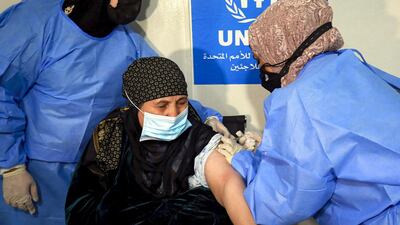
A Syrian refugee receives a Covid-19 vaccine at a medical centre in the Zaatari refugee camp in Jordan in February. AFP -
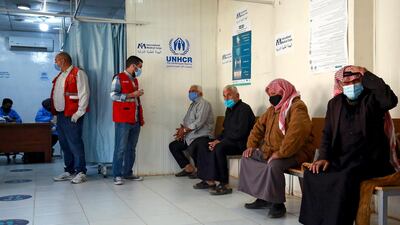
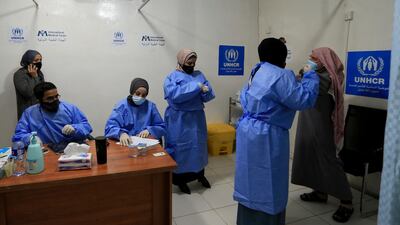
Syrian refugees wait to receive their vaccine at Zaatari. AFP -
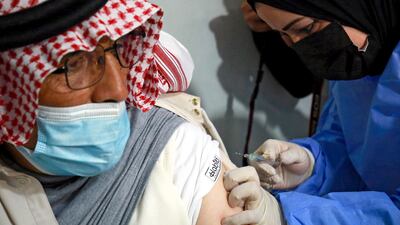
The UK is leading calls for a vaccination ceasefire to allow Covid-19 vaccines to reach people living in conflict zones. AFP -
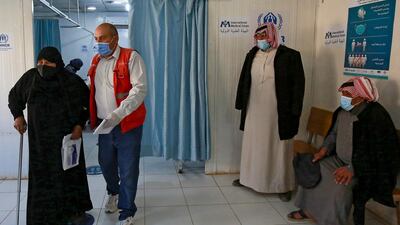
About $2.4bn has been raised for the UN-backed Covax campaign to help developing countries that are unable to afford their own vaccine stockpiles. AFP -
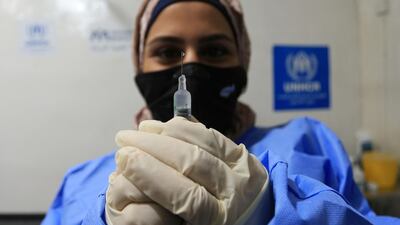
A medical worker prepares the coronavirus vaccine made by Sinopharm to administer to Syrian refugees in Jordan. AP Photo -
Britain's Foreign Secretary Dominic Raab highlighted the 160 million people who could miss out on Covid-19 vaccination because of conflict in their countries. AP Photo -
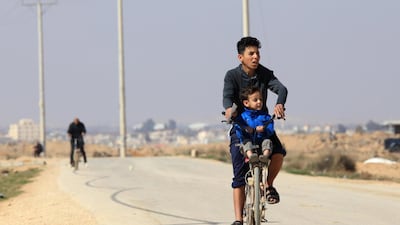
Syrian refugees ride their bicycles in the Zaatari camp, where a Covid-19 vaccination programme has begun. EPA -

'Global vaccination coverage is essential to beating coronavirus,' UK Foreign Secretary Dominic Raab said. EPA


With US President Joe Biden taking America back into the World Health Organisation, from which his predecessor Donald Trump withdrew, there is now greater urgency to get the vaccine distributed around the world to beat the virus mutations.
The G7 leaders promised to accelerate global vaccine development and work with industry to increase manufacturing capacity.
The world leaders also promised to increase contributions to the Covax vaccine distribution programme – a global initiative to supply vaccines to low-income countries – by $4bn to $7.5bn.
They also invited the G20 countries and international financial institutions to donate more money “to increase developing countries’ access to WHO-approved vaccines”.
“Covid-19 shows that the world needs stronger defences against future risks to global health security,” said the G7 – France, Germany, Italy, Japan, Canada, Britain and the US.
The statement disclosed that more than $6 trillion has been pumped into the seven economies since the pandemic began and now the mission was to help other countries recover, including African nations.
“Recovery from Covid-19 must build back better for all.”
In a bold position on the environment, the leaders promised to “put our global ambitions on climate change and the reversal of biodiversity loss at the centre of our plans” at the November Cop26 summit in Glasgow, Scotland.
They plan to deliver a “green transformation” and to cut carbon emissions “on a path to net zero no later than 2050”.
“We are committed to levelling up our economies so that no geographic region or person, irrespective of gender or ethnicity, is left behind,” the G7 said.

The group called for a fairer “rules-based multilateral trading system” that delivered balanced growth with a reformed World Trade Organisation at its centre.
They also want a solution to international taxation by mid-2021 within the framework of intergovernmental economic group the Organisation for Economic Co-operation and Development.
The leaders agreed to “concrete action” on the global priorities at the G7 Summit due to be held in Cornwall, in south-west England, in June.

