
Worn down by conflict, poverty and the pandemic, many Libyans are observing Eid Al Adha in a mood of gloom this year.
On the eve of the Muslim festival, the usually bustling annual sheep market on the outskirts of the capital Tripoli was largely deserted, lambs bleating in their wire-mesh pens with few customers in sight.
A handful of potential buyers eyed the sacrificial animals, their makeshift enclosures partially shaded against the blazing summer sun, in the suburb of Tajoura.
Breeder Suleiman Ertel got up long before dawn to bring his livestock from his hometown of Zliten, about 140 kilometres away, to the biggest animal market in western Libya.
The festival honours the prophet Abraham's willingness to sacrifice his son as an act of obedience to God, who then intervened and provided a sacrificial lamb instead.
The faithful commemorate this by ritually sacrificing an animal – a sheep, goat, cow or even a camel – and dividing it into three parts; for the poor, for relatives and for the home.
"Usually, in the days before the festival, people rush to buy their sheep," said Mr Ertel said, his eyes scanning the dusty three-square-kilometre expanse of the market.
But this year high livestock prices, a pandemic-driven fear of crowded markets, a financial crisis and heightened insecurity in Libya itself have all kept customers away.
For livestock farmers like him, Mr Ertel said, "everything is more expensive. Fodder has doubled in price, but also transport costs between towns, because of insecurity on some routes".
"It's discouraging," he said.
_______________
Eid Al Adha around the world
-
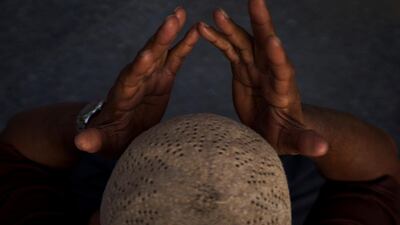
A man offers Eid Al Adha prayers at the Thai Islamic Centre in Bangkok, Thailand. Reuters -
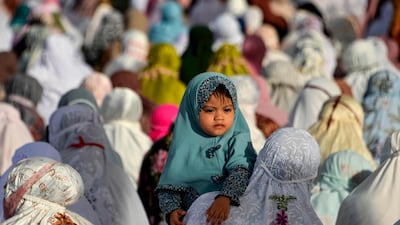
A child looks as Indonesians Muslims attend an Eid Al Adha prayer at the Baiturrahman grand mosque in Banda Aceh. AFP -
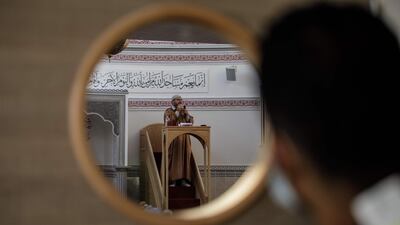
TOPSHOT - A cleric leads a prayer to celebrate Eid al-Adha at Maryam Mosque in the city of Caen northwestern France on July 31, 2020. Eid Al-Adha is celebrated each year by Muslims sacrificing various animals according to religious traditions, including cows, camels, goats and sheep. The festival marks the end of the Hajj pilgrimage to Mecca and commemorates Prophet Abraham's readiness to sacrifice his son to show obedience to God. Mosques started to reopen as France eases lockdown measures after the spreading of the COVID-19 (novel coronavirus) while respecting barrier gestures. / AFP / Sameer Al-DOUMY -

Bosnian Muslims wearing face masks take part in the Eid Al-Adha prayer outside of Gazi-Husref Bey's mosque, in Sarajevo, on July 31, 2020 as a large number of believers remained on the outer perimeter of the mosque, due to limited numbers of attendants. Eid al-Adha, the Festival of Sacrifice, is celebrated throughout the Muslim world as a commemoration of Abraham's willingness to sacrifice his son for God, and cows, camels, goats and sheep are traditionally slaughtered on the holiest day. / AFP / ELVIS BARUKCIC -
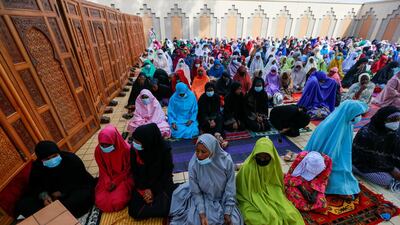
Nigerian Muslims are seen during Eid al-Adha prayers at the National Mosque, during the outbreak of the coronavirus disease (COVID-19) in Abuja, Nigeria July 31, 2020. REUTERS/Afolabi Sotunde -

Muslim men take part in Eid Al-Adha prayer in a mosque in the village of Dinos near capital Podgorica on July 31, 2020. Eid al-Adha, the Festival of Sacrifice, is celebrated throughout the Muslim world as a commemoration of Abraham's willingness to sacrifice his son for God, and cows, camels, goats and sheep are traditionally slaughtered on the holiest day. / AFP / Savo PRELEVIC -
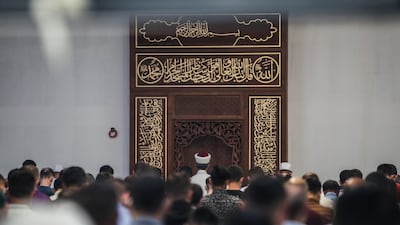
epa08576317 Muslims wearing face mask gather and pray in a Turkish mosque to pray and mark the Muslim religious holiday of Eid aL-Adha, at the northern suburbs of Paris, France , 31 July 2020. Eid al-Adha is the holiest of the two Muslims holidays celebrated each year, it marks the yearly Muslim pilgrimage (Hajj) to visit Mecca, the holiest place in Islam. Muslims slaughter a sacrificial animal and split the meat into three parts, one for the family, one for friends and relatives, and one for the poor and needy. EPA/Mohammed Badra -
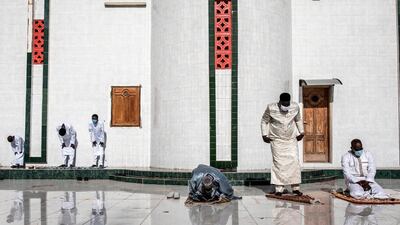
Muslim worshippers perform their prayer at the Mosque of Divinity in Dakar on July 31, 2020 ahead of prayers for the Muslim Eid al-Adha (Festival of Sacrifice), known as Tabaski in Western Africa. / AFP / JOHN WESSELS -
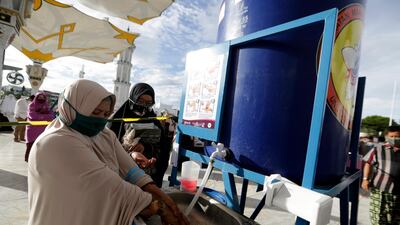
Muslim devotees wash their hand before attending Eid Al Adha prayers at Baiturrahman Grand Mosque, Banda Aceh, Indonesia. EPA -
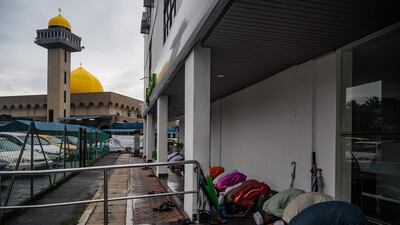
Muslims offer prayers outside a mosque in Kuala Lumpur, Malaysia. AFP -
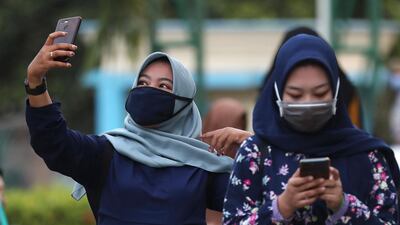
A Muslim woman takes a selfie after Eid Al Adha prayers at a mosque in Jakarta, Indonesia. AP Photo -
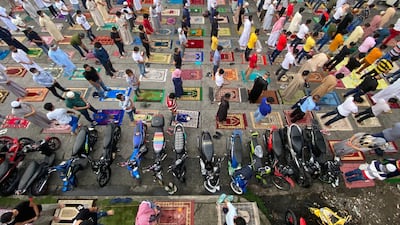
Muslim devotees pray outside a mosque in Taguig city, south of Manila, Philippines. EPA -
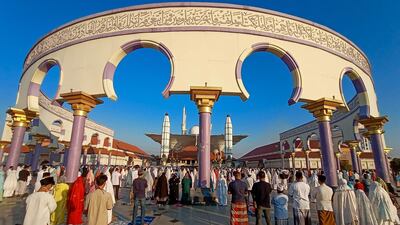
Indonesian families perform Eid Al Adha prayers with social distancing in Semarang, Central Java. AFP -
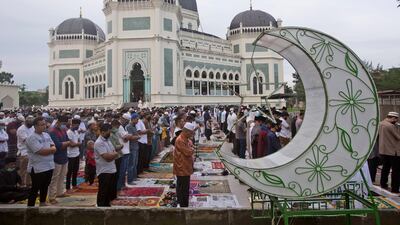
Muslims take part in Eid Al Adha prayers at Al Mashun Grand Mosque in Medan, North Sumatra, Indonesia. AP Photo -
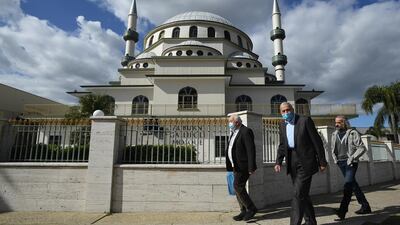
Members of the Muslim community leave after Eid Al Adha prayers at the Auburn Gallipoli Mosque in Sydney, Australia. EPA -
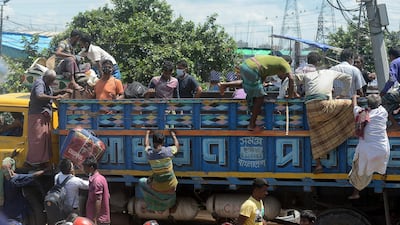
People get on a truck as they travel back to their homes on the eve of the Muslim festival of Eid al-Adha or the festival of sacrifice, in Dhaka on July 31, 2020. Eid al-Adha, feast of the sacrifice, marks the end of the Hajj pilgrimage to Mecca and commemorates Prophet Abraham's readiness to sacrifice his son to show obedience to Allah. / AFP / Munir Uz zaman / Munir Uz zaman -

A Palestinian lights fireworks to celebrate Eid Al Adha in Khan Younis town, southern Gaza Strip. EPA


_______________
Libya has endured almost a decade of violent chaos since the 2011 Nato-backed uprising that toppled and killed veteran dictator Muammar Qaddafi.
Tripoli, seat of the UN-recognised Government of National Accord (GNA), was besieged until several months ago by forces loyal to rival administration based in the east, and the battlefront has since moved to central Libya.
The war, involving foreign mercenary forces, fighter jets and drones provided by multiple outside actors, has taken a heavy human toll but also battered the oil-dependent economy.
The war-weary country is also plagued by water shortages and power blackouts that hobble air-conditioners and also make it impossible to store meat in freezers.
The deplorable situation is compounded by the Covid-19 crisis, which has depressed global oil prices. The virus has flared again in Libya despite curfews, the closure of schools and mosques, and a travel ban.
In recent weeks, new infections have surged above 100 a day for the first time since the virus was detected in the North African country in late March.
There have been 3,017 confirmed cases and 67 deaths in Libya from the respiratory disease, deemed by many as underestimates in a divided country with a shattered public health system.
At Tajoura's market, Ahmed Al Fallah was on the third day of his search for a sheep he could afford, in a desperate bid to try to maintain the crucial religious and family tradition.
"I ask about prices without being able to buy anything," he told AFP, keeping an eye on one of his three sons posing for a photo next to a sheep.
"I don't have enough money. I think I'm going to have to borrow some."
An average-sized sheep costs 1,200 to 1,400 Libyan dinars (Dh5,245-Dh6,120) – too much for many Libyans who, even if they have the means, cannot withdraw enough cash from their bank accounts.
"Most banks have capped withdrawals at 1,000 dinars in the days leading up to the festival," said Mohamad Kecher, another frustrated customer at the market.
"So we hesitate," he said. "Should we spend it all on the sacrificial sheep or keep the money for the family's expenses for a month?"

