
Despite what its title suggests, Vincent van Gogh’s The Siesta is rife with movement. The hay field ripples with shimmering shades of gold, and the clothes of the snoozing farmers rustle with the breeze.
The Siesta is Van Gogh’s interpretation of an 1866 canvas by Jean-Francois Millet. However, where Millet’s version is honed with realist sensibilities, Van Gogh’s takes on the peaceful scene with feverish intensity. The work was painted between 1889 and 1890, during the time Van Gogh was interned at an asylum in the French commune of Saint-Remy-de-Provence.
It is a potent example of the alchemy that preoccupied the post-impressionist painters – to take a scene and transmute it with an almost mystical flair through unconventional techniques and colour choices.
-

Running until February 9, Post-Impressionism: Beyond Appearances brings together a collection of masterpieces that offers a sharp insight into one of history's most affecting artistic eras. All photos: Chris Whiteoak / The National -
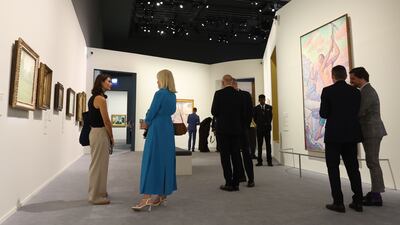
The exhibition was developed in partnership with Musee d’Orsay and France Museums -

Vincent van Gogh's The Siesta is one of three paintings by the Dutch master on display -

Van Gogh painted The Siesta between December 1889 and January 1890. Chris Whiteoak / The National -

Towards the end of the exhibition, two works by the French-Egyptian artist Georges Hanna Sabbagh are displayed -
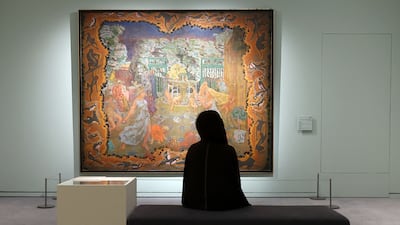
Pierre Bonnard's Pleasure, painted in 1906 -
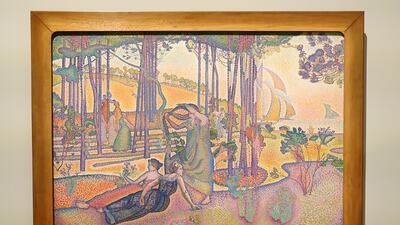
Henri-Edmond Cross's The Evening Air, painted between 1893-1894 -
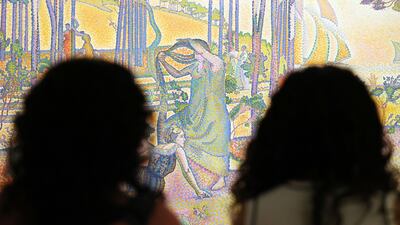
Cross applied a technique called divisionism for The Evening Air, painting small rectangles that come together as the viewer steps back -
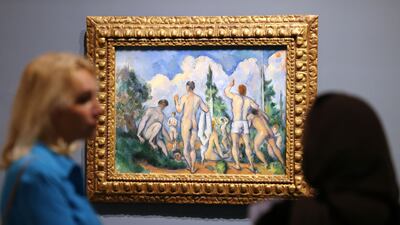
Paul Cezanne's Bathers, painted between 1898–1905 -
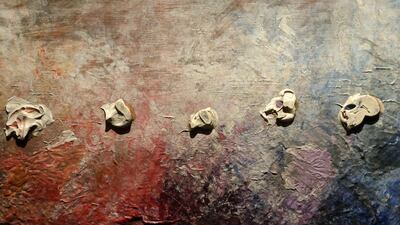
Georges Seurat's palette is displayed alongside others by Vincent van Gogh, Paul Cezanne, and Georges Seurat -

An interactive table lets visitors discover more about the history of the post-impressionists


The Siesta is one of three works by Van Gogh to be featured in a new exhibition at Louvre Abu Dhabi.
Running until February 9, Post-Impressionism: Beyond Appearances brings together a collection of masterpieces that offers a sharp insight into one of history's most affecting artistic eras. It also shows how the legacy of the post-impressionists was not limited to Europe and even touched on the Middle East.
The exhibition, developed in partnership with Musee d’Orsay and France Museums, is put together by Jean-Remi Touzet, curator of paintings at Musee d’Orsay, and Jerome Farigoule, chief curator at Louvre Abu Dhabi.
Post-Impressionism: Beyond Appearances comes exactly two years after Impressionism: Pathways to Modernity. The 2022 exhibition at Louvre Abu Dhabi showed how a group of painters that included Claude Monet, Alfred Sisley and Pierre-Auguste Renoir ventured out of the studio to paint outdoors. In the process, they challenged the artistic norms of the time and the conventions of the rigid 19th-century Paris Salon, which was the official exhibitor of the storied Academie des Beaux-Arts and the then-gatekeeper of the art world.

The post-impressionists were just as revolutionary. They were not so much a movement as a network of artists with similar interests and principles, whose careers often converged with camaraderie as well as drama.
A foundational figure of the post-impressionists was Georges Seurat. The painter was one of the first to want to venture beyond the tenets of impressionism. For one thing, he opted to not mix his colours on his palette, but rather divide them on the canvas and let the eye blend them instead.
This pointillist technique is seen in Seurat’s Port-en-Bassein, Outer Harbour, High Tide. The 1888 painting shows a seascape off the Normandy village after which it is named. From afar, the vibrant view is seen with a grainy texture, perhaps evoking the sensation of a light mist during the day. Approach the canvas and the colours separate with molecular grace, and you begin seeing varying shades of brown, red, blue and green. Even the frame itself is painted a deep navy blue and with dots of pink, red and ochre. The frame seems to be an important part of the work – presenting the scene with the dramatic flair of a theatre curtain.

Port-en-Bassein was produced just two years after the 1886 exhibition at Rue Laffitte which marked the end of impressionism and the beginning of a new movement.
“The impressionists were divided by then,” Touzet says. "Some of them wanted to go in the official salon, like Monet, he wanted to get more recognition. Whereas others, like Edgar Degas, wanted to remain independent.”
The post-impressionists took their cue from the latter, cherishing their independence and taking it as an opportunity to experiment and push the envelope that the impressionists had put down. Not that the salon would have accepted them anyway.
“A lot of them were self taught,” Touzet says. “In 1884, the impressionist groups created a new salon called the exhibition of independence. It was a free jury, so everyone could exhibit their work. There were a lot of artists, and not all so good. But the Salon des Independants was very important for all the avant garde and Vincent van Gogh, Paul Gauguin and other artists exhibited here.”

The post-impressionists often tried to find new avenues to present their works, such as cafes, further seeking to break the conventions of the art world of the time. The exhibition takes a cue from this decentralised spirit in its scenography. There are sections dedicated to Van Gogh, Gaugin, Henri de Toulouse-Lautrec and Paul Cezanne, among others.
However, visitors can navigate these spaces in several ways as the galleries branch out from a central rotunda. Go left, and you'll be in the section dedicated to Cezanne, with a series of works that include Mont Sainte-Victoire, a painting dedicated to the mountain that was a lifelong inspiration to the artist.
Ahead is Van Gogh’s wing, where you’ll find his fabled Bedroom in Arles, with mystifying and alluring furniture depictions that break from realistic angles of perception. Toulouse-Lautrec’s section features the motley cabaret and theatre performers the artist was famous for depicting. In the section dedicated to Gaugin, you'll find his famous Arearea, a case study of the artist's penchant for mixing cultural motifs that were foreign to him.
This free mobility between the sections is a somewhat novel structure for an exhibition at Louvre Abu Dhabi. Moving away from a linear approach serves the exhibition well, particularly as it helps visitors understand the points of connection between the artists and how they influenced one another, to truly see them as "a constellation" more than a movement, says Aisha Al Ahmadi, curatorial assistant at Louvre Abu Dhabi.
“This exhibition is the first of its kind in the region, but abroad, there have been multiple post-impressionist exhibitions,” Al Ahmadi says. “We wanted a fresh way to present the content. You have freedom to move in and out of the sections.”
The central rotunda also features an interactive console that delves into the histories of each of the post-impressionist artists. Their palettes are also displayed, meaning visitors are just a pane away from the wooden slabs that these masters used to paint.

“The mediation table is content heavy,” Al Ahmadi says. “It allows you to read a little bit about the different sections and then decide where you want to go next. We're focusing on different styles and different artists who were working at the same time period, but not necessarily a part of the same movement. They didn't consider themselves a movement. They were sending real letters to each other. They were exhibiting sometimes together. They were giving each other guidance. They were friends turned enemies. There was a lot of drama and mystery around the group.”
Towards the end of the exhibition, two works by the French-Egyptian artist Georges Hanna Sabbagh are displayed. The two paintings were created in 1920 and 1921 and feature the artist and his family, albeit depicted in a manner that draws from post-impressionist styles. It isn’t surprising, given Sabbagh studied with figures from the post-impressionist group Les Nabis, including Paul Serusier and Felix Vallotton.
“These are some of the later paintings that we have in the exhibition,” Al Ahmadi says. “We wanted to essentially talk about the true influence of post Impressionism, and do something that the Louvre Abu Dhabi always tries to do, which is to broaden the art history canon.”

