
Five years ago, the Port of Beirut blast tore through the Lebanese capital, destroying lives, livelihoods and homes. Fatalities, injuries and trauma aside, the tragedy also played out through the crumbling remains of about 650 heritage and culturally significant buildings, as the explosion’s shockwave ripped through the city’s historic districts.
Now a national day of mourning, August 4 has looked different each year since the catastrophe, as people slowly try to piece their lives back together. Directly after the blast, the world came together to help rebuild, including a host of heritage NGOs that took on the monumental task of restoring and safeguarding the stunning Ottoman and French Mandate buildings.
However, the once-strong restoration efforts – funded by private donations and a few international NGOs and other institutions – have stalled in recent years. Funding has dried up and new catastrophes occupy people’s minds. After almost two years of watching a horrifying genocide in Gaza, and Lebanon’s own suffering under Israeli bombardment in late 2024, this year’s port blast anniversary feels different.
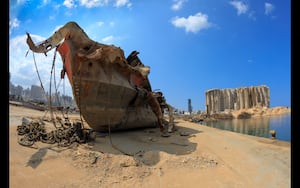
The victim’s families still strive for justice, but the recent war’s destruction is a more pressing concern for the rest of the populace. According to NGO Beirut Heritage Initiative (BHI), which formed in the wake of the blast, about 60 per cent of the damaged heritage buildings were restored through non-profit efforts, but the remaining 40 per cent sit in limbo with the work halted.
“After the blast, there was great mobilisation from NGOs and individuals to restore the heritage and even the contemporary buildings that were destroyed,” BHI member Yasmine Dagher tells The National. “The reconstruction efforts lasted for about two and a half years. Starting February 2022, with the war in Ukraine, funding started to decline.
“In October 2023, with the war in Gaza, a lot of funding went there for humanitarian efforts, so now heritage is not a priority any more,” she adds. “Of the 40 per cent remaining unrestored, approximately 15 per cent were inhabited prior to the blast, but are now so damaged that they need a huge budget to restore them.”

One such building that still resembles a dilapidated, blown-out shell is an Ottoman site in upper Gemmayzeh – once a stone-clad two-storey with beautiful archways – that completely collapsed. The location swept headlines when a Chilean rescue team detected possible signs of life under the rubble a month after the explosion, as the country held its breath for a potential survivor. Ultimately, none was found, and the destroyed building sits as an eerie reminder of those 72 hours, unlikely to be rebuilt any time soon.
Some people chose to restore their homes and businesses privately after funds dwindled, doing repair work over the years or restoring a floor or two to use but leaving the rest for another day. Larger projects including some churches and Sursock Palace have been hosting fundraising events or renting out the gardens as a wedding venue to pay for restoration. Other owners are not interested in restoring due to the costs, and prefer to demolish the remains to start anew.

“Of the unrestored buildings, 25 per cent were uninhabited prior to the blast, which is a big number, and already about a third of those buildings have been destroyed since,” Dagher says. “In September 2020, the Directorate General of Antiquities passed Law 194, which obliged owners to not destroy or sell their heritage buildings, and this law was active for a period of two years.
“After 2022, a lot of destruction permits were given. About 10 buildings were partially or fully destroyed in Gemmayzeh and Mar Mikhael,” she adds. “A lot of buildings in Zokak el Blat, Bachoura and Achrafieh are also being destroyed, but they are not in the spotlight simply because they’re not in the zone that was affected the most.”
Dagher says one of most positive outcomes has been the encouragement of thinking outside the box.

By partnering with institutions such as the British Council, she has managed to run on-site training sessions for foreign student restorers and craftspeople, giving them a chance to learn firsthand whilst restoring damaged structures.
Another post-blast NGO, Together Li Beirut, says that funding is only half the battle. Inefficient legal protection for heritage buildings and a lack of government strategy on restoration makes it difficult to move forward when small NGOs are unable to pick up the slack.
“We haven't had any clear national strategy on this and, given the challenges of the government and incapacity to pull efforts and funds, the restoration has been a difficult process,” Together Li Beirut's programme coordinator Soha Karam says. “It is important to protect these buildings from demolition by any real estate development, but it's equally important to rehabilitate them so they have a social and economic impact.

“We can’t just restore buildings and leave them without purpose. Heritage is a long-term thing and should be preserved for generations to come,” she adds. “Strategically, we need to think of how we give them another life, for them to be economically sustainable; for it to make sense to restore them.”
Despite the cultural significance of Lebanon’s architecture, the only law that protects heritage structures is from 1933, officially classifying only those sites built before the 1700s as “heritage”. While some additions to the protected lists were made – such as religious sites and a few grand mansions – the language and criteria on anything built post the 18th century is vague.
This situation leaves many of Beirut’s stunning Ottoman, French Mandate and Modernist architecture at the mercy of legal loopholes. Even as volunteer organisations work to restore blast-damaged properties, like many things in Lebanon, as new crises take over, older ones are left forgotten.

