The International Monetary Fund has raised its global economic growth forecast for this year on milder-than-expected tariff increases and private sector resilience to tariff pressures.
With fragilities and risks abounding, the weaker US dollar has both amplified the tariff shock and supported global trade, the Washington-based multilateral lender said in its latest World Economic Outlook report on Tuesday.
The fund said it expects global output to grow by 3.2 per cent in 2025 – up from its July forecast of 3 per cent – and 3.1 per cent in 2026, unchanged from its previous estimate.
Global headline inflation is forecast to dip to 4.2 per cent this year and 3.7 per cent in 2026, almost unchanged since the previous forecast.
The IMF increased its forecast for economic growth the in the US, the world's biggest economy, while it kept growth projections for China unchanged.
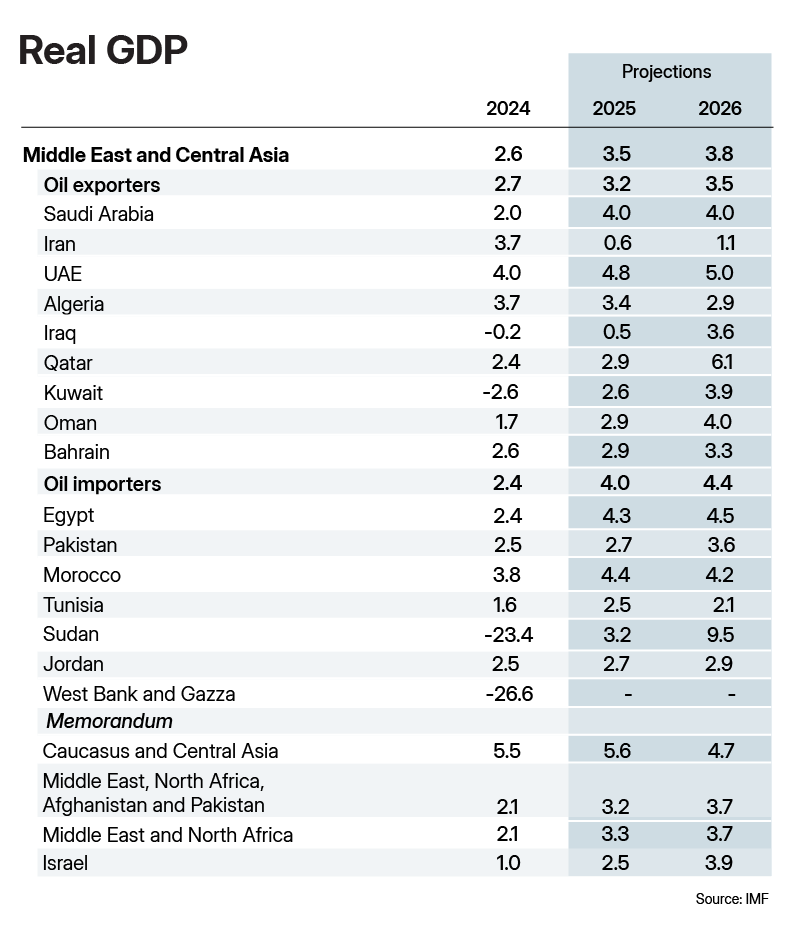
Economic forecasts for the Middle East were revised slightly higher, driven by growth in Saudi Arabia, the region's biggest economy.
'Steady but fragile'
Although the global economy has remained steady so far in the face of Trump administration's push to levy tariffs on its trading partners, a new degree of uncertainty now prevails in trade patterns.
“The global outlook as we see it is steady but fragile,” IMF chief economist Pierre-Olivier Gourinchas told reporters.
The latest report is the second straight upgrade in which the fund has raised its forecast for the global economy after President Donald Trump's tariff announcement in April.
The global outlook as we see it is steady but fragile
Pierre-Olivier Gourinchas,
IMF chief economist
Still, should the forecasts hold up, it would mark a decline from last year's annual growth rate of 3.3 per cent and remain below the pre-pandemic average of 3.7 per cent.
“Bottom line: not as bad as we feared, but worse than we anticipated a year ago, and worse than we need,” Mr Gourinchas said.
Minor upgrade for US
The IMF said it projects the US economy to grow at a 2.0 per cent rate in 2025 and 2.1 per cent in 2026. The upwards revision reflects lower tariff rates, a fiscal boost from the passage of the One Big Beautiful Bill Act, and easing of financial conditions, although the fund said it still represents a significant slowdown from 2024.
The US economy has so far remained resilient to tariff-driven higher prices that are expected to filter through the economy, posting GDP growth of 3.8 per cent in the second quarter following an import-driven contraction in the first quarter.
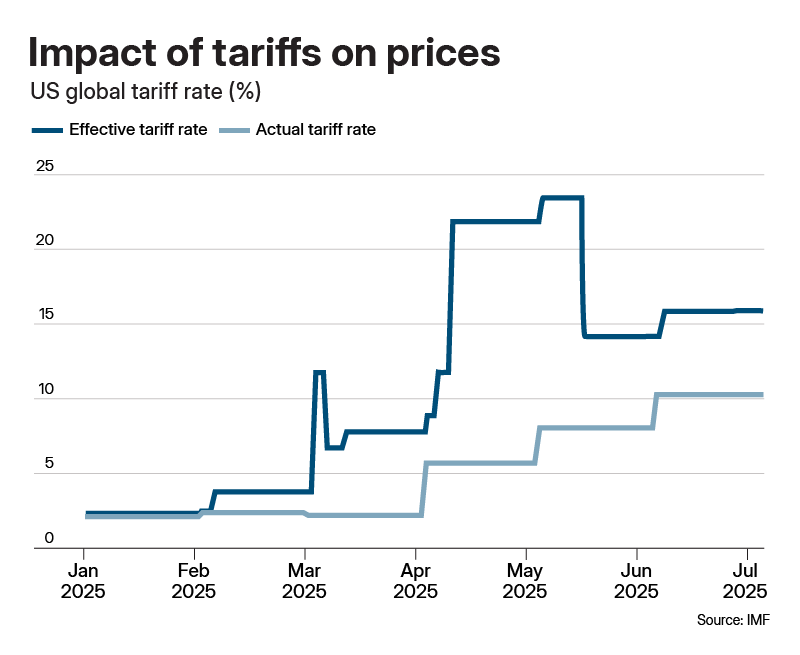
The IMF anticipates inflation to pick up in the US in the second half this year as higher prices are passed on to consumers.
Saudi Arabia drives Mena outlook
The fund slightly raised its forecast for the Middle East and North Africa, which is projected to grow 3.3 per cent rate in 2025 and 3.7 per cent in 2026, up 0.1 and 0.3 percentage points from July estimates, respectively.
The revision was driven by growth in Saudi Arabia, the Arab world's largest economy, which is forecast to grow at a 4 per cent pace this year and next, up 0.4 and 0.1 percentage points, respectively, because of Opec+'s unwinding of voluntary oil production cuts.
The regional forecast is also expected to benefit from stronger-than-expected first-half economic performance in Egypt, the most populous Arab nation.
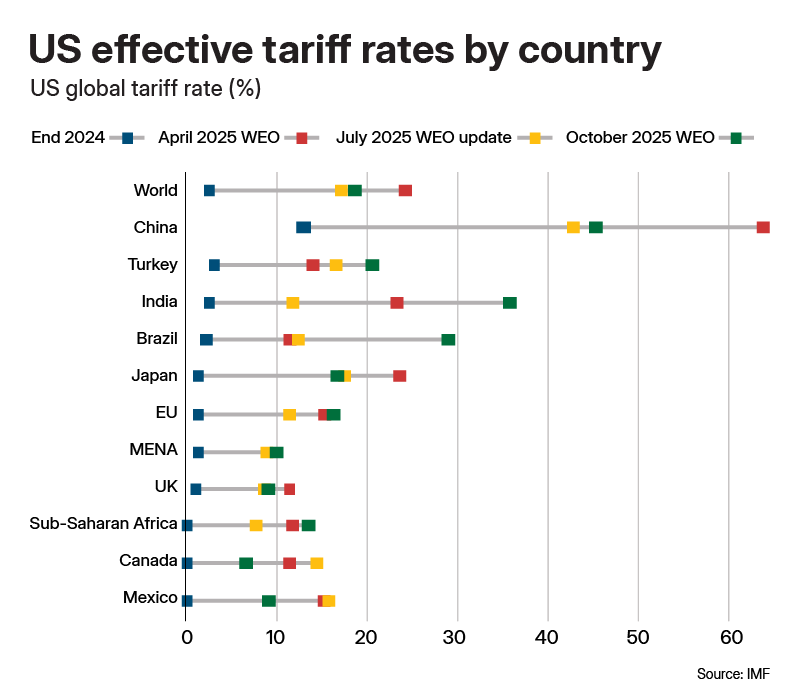
Despite the Middle East's limited exposure to new US tariffs, the IMF's growth projections are cumulatively 0.8 percentage points lower this year and the next due to the indirect effects of weaker world demand on commodity prices, it said.
The UAE economy is expected to grow by 4.8 per cent in 2025 and 5 per cent in 2026, unchanged from the projects during the fund's mission to the Emirates earlier this month.
The fund will release its full outlook for the Middle East next week in Dubai.
Euro area and India
The surge of investment in artificial intelligence, fiscal policy in the euro area and China have also helped support the global economy this year despite shifting trade patterns and economic headwinds.
India, where a 50 per cent tariff rate imposed by the US came into effect in August, is expected to record growth of 6.6 per cent this year due to a strong first quarter, offsetting the tariffs' impact.
Growth in the euro area is estimated at 1.2 per cent in 2025 and 1.1 per cent in 2026, a decrease from the fund's 2024 forecast, due to higher tariffs and elevated uncertainty only marginally offset by strong private consumption in Germany and robust economic performance in Ireland.
The UK, the second-largest economy in Europe, is expected to grow by 1.3 per cent each in 2025 and 2026.
Tariff uncertainty
Despite the revised outlook, Mr Gourinchas said it would be “premature” to assume there have not been any effects from the tariff shock.
“There is trade policy uncertainty that remains. The deals are not all sealed. There could still be tensions,” Mr Gourinchas said.
This week's meetings began under fresh trade threats between the US and China. Beijing last week announced new export restrictions on critical minerals, prompting a furious Mr Trump to announce a new 100 per cent tariff on China. US markets rebounded on Monday after a sell-off no Friday after Mr Trump softened his rhetoric over the weekend.
The developments added another wrinkle to negotiations between the US and China, which had previously agreed to lower their high tariff rates set on each other earlier this year. Mr Trump also cast doubt over whether he would meet Chinese President Xi Jinping this month.
"The most recent announcements last week make us realise that trade uncertainty is still with us," Mr Gourinchas said.
And while the US has announced trade deals with the UK, Japan, the EU and others, Mr Trump has yet to close deals with Canada and Mexico – the two largest US trade partners.
AI warning
The IMF on Tuesday also delivered a warning on artificial intelligence, whose promised productivity gains have pushed US markets to record-highs this year.
US private investment grew to $109.1 billion in 2024, according to data from Stanford University. And AI start-ups in the first half of this year raised $104.3 billion in the US, almost matching the total investment for 2024, PitchBook data showed.
The fund noted risks to the AI boom, arguing that there could be a market correction if AI hype is not justified, and that the investment surge could add to price pressures in the US.
“If the AI investment boom is not all hype … some of this will translate in productivity gains that would be good for the global economy,” Mr Gourinchas said.
Should trade tensions be resolved and AI hype does pan out, global output could increase by up to 1 percentage point, he added.
Central bank independence
The fund also made a call for the protection of central bank independence, as Mr Trump continues to seek greater control over the Federal Reserve.
While not naming the Fed in its report, the fund said protecting central bank independence is critical for economic stability, warning that losing such credibility could lead to higher interest rates and tighter monetary policy.
Mr Trump has made consistent efforts this year to reshape the Fed to his liking that includes a legal battle over his attempt to oust a sitting Federal Reserve governor.
The US President has repeatedly pressured the Fed to dramatically lower rates this year to help service the nation's debt – a concept known as fiscal dominance. The Fed has so far defied those calls.
“Seeking to influence the central bank to keep policy rates low or tolerating surprise inflation may appear to ease the near-term fiscal arithmetic, but it is eventually self-defeating,” the fund said.

The specs: 2018 Nissan 370Z Nismo
Price, base / as tested: Dh182,178
Engine: 3.7-litre V6
Power: 350hp @ 7,400rpm
Torque: 374Nm @ 5,200rpm
Transmission: Seven-speed automatic
Fuel consumption, combined: 10.5L / 100km
Bugatti Chiron Super Sport - the specs:
Engine: 8.0-litre quad-turbo W16
Transmission: 7-speed DSG auto
Power: 1,600hp
Torque: 1,600Nm
0-100kph in 2.4seconds
0-200kph in 5.8 seconds
0-300kph in 12.1 seconds
Top speed: 440kph
Price: Dh13,200,000
Bugatti Chiron Pur Sport - the specs:
Engine: 8.0-litre quad-turbo W16
Transmission: 7-speed DSG auto
Power: 1,500hp
Torque: 1,600Nm
0-100kph in 2.3 seconds
0-200kph in 5.5 seconds
0-300kph in 11.8 seconds
Top speed: 350kph
Price: Dh13,600,000
Why it pays to compare
A comparison of sending Dh20,000 from the UAE using two different routes at the same time - the first direct from a UAE bank to a bank in Germany, and the second from the same UAE bank via an online platform to Germany - found key differences in cost and speed. The transfers were both initiated on January 30.
Route 1: bank transfer
The UAE bank charged Dh152.25 for the Dh20,000 transfer. On top of that, their exchange rate margin added a difference of around Dh415, compared with the mid-market rate.
Total cost: Dh567.25 - around 2.9 per cent of the total amount
Total received: €4,670.30
Route 2: online platform
The UAE bank’s charge for sending Dh20,000 to a UK dirham-denominated account was Dh2.10. The exchange rate margin cost was Dh60, plus a Dh12 fee.
Total cost: Dh74.10, around 0.4 per cent of the transaction
Total received: €4,756
The UAE bank transfer was far quicker – around two to three working days, while the online platform took around four to five days, but was considerably cheaper. In the online platform transfer, the funds were also exposed to currency risk during the period it took for them to arrive.
Tips to keep your car cool
- Place a sun reflector in your windshield when not driving
- Park in shaded or covered areas
- Add tint to windows
- Wrap your car to change the exterior colour
- Pick light interiors - choose colours such as beige and cream for seats and dashboard furniture
- Avoid leather interiors as these absorb more heat
Results
Stage 7:
1. Caleb Ewan (AUS) Lotto Soudal - 3:18:29
2. Sam Bennett (IRL) Deceuninck-QuickStep - same time
3. Phil Bauhaus (GER) Bahrain Victorious
4. Michael Morkov (DEN) Deceuninck-QuickStep
5. Cees Bol (NED) Team DSM
General Classification:
1. Tadej Pogacar (SLO) UAE Team Emirates - 24:00:28
2. Adam Yates (GBR) Ineos Grenadiers - 0:00:35
3. Joao Almeida (POR) Deceuninck-QuickStep - 0:01:02
4. Chris Harper (AUS) Jumbo-Visma - 0:01:42
5. Neilson Powless (USA) EF Education-Nippo - 0:01:45
UNpaid bills:
Countries with largest unpaid bill for UN budget in 2019
USA – $1.055 billion
Brazil – $143 million
Argentina – $52 million
Mexico – $36 million
Iran – $27 million
Israel – $18 million
Venezuela – $17 million
Korea – $10 million
Countries with largest unpaid bill for UN peacekeeping operations in 2019
USA – $2.38 billion
Brazil – $287 million
Spain – $110 million
France – $103 million
Ukraine – $100 million
The Gentlemen
Director: Guy Ritchie
Stars: Colin Farrell, Hugh Grant
Three out of five stars
Tax authority targets shisha levy evasion
The Federal Tax Authority will track shisha imports with electronic markers to protect customers and ensure levies have been paid.
Khalid Ali Al Bustani, director of the tax authority, on Sunday said the move is to "prevent tax evasion and support the authority’s tax collection efforts".
The scheme’s first phase, which came into effect on 1st January, 2019, covers all types of imported and domestically produced and distributed cigarettes. As of May 1, importing any type of cigarettes without the digital marks will be prohibited.
He said the latest phase will see imported and locally produced shisha tobacco tracked by the final quarter of this year.
"The FTA also maintains ongoing communication with concerned companies, to help them adapt their systems to meet our requirements and coordinate between all parties involved," he said.
As with cigarettes, shisha was hit with a 100 per cent tax in October 2017, though manufacturers and cafes absorbed some of the costs to prevent prices doubling.
yallacompare profile
Date of launch: 2014
Founder: Jon Richards, founder and chief executive; Samer Chebab, co-founder and chief operating officer, and Jonathan Rawlings, co-founder and chief financial officer
Based: Media City, Dubai
Sector: Financial services
Size: 120 employees
Investors: 2014: $500,000 in a seed round led by Mulverhill Associates; 2015: $3m in Series A funding led by STC Ventures (managed by Iris Capital), Wamda and Dubai Silicon Oasis Authority; 2019: $8m in Series B funding with the same investors as Series A along with Precinct Partners, Saned and Argo Ventures (the VC arm of multinational insurer Argo Group)
Mohammed bin Zayed Majlis
What vitamins do we know are beneficial for living in the UAE
Vitamin D: Highly relevant in the UAE due to limited sun exposure; supports bone health, immunity and mood.
Vitamin B12: Important for nerve health and energy production, especially for vegetarians, vegans and individuals with absorption issues.
Iron: Useful only when deficiency or anaemia is confirmed; helps reduce fatigue and support immunity.
Omega-3 (EPA/DHA): Supports heart health and reduces inflammation, especially for those who consume little fish.
SPECS
%3Cp%3E%3Cstrong%3EEngine%3A%3C%2Fstrong%3E%201.5-litre%204-cylinder%3Cbr%3E%3Cstrong%3EPower%3A%3C%2Fstrong%3E%20101hp%3Cbr%3E%3Cstrong%3ETorque%3A%3C%2Fstrong%3E%20135Nm%3Cbr%3E%3Cstrong%3ETransmission%3C%2Fstrong%3E%3A%20Six-speed%20auto%3Cbr%3E%3Cstrong%3EPrice%3A%3C%2Fstrong%3E%20From%20Dh79%2C900%3Cbr%3E%3Cstrong%3EOn%20sale%3A%3C%2Fstrong%3E%20Now%3C%2Fp%3E%0A
Email sent to Uber team from chief executive Dara Khosrowshahi
From: Dara
To: Team@
Date: March 25, 2019 at 11:45pm PT
Subj: Accelerating in the Middle East
Five years ago, Uber launched in the Middle East. It was the start of an incredible journey, with millions of riders and drivers finding new ways to move and work in a dynamic region that’s become so important to Uber. Now Pakistan is one of our fastest-growing markets in the world, women are driving with Uber across Saudi Arabia, and we chose Cairo to launch our first Uber Bus product late last year.
Today we are taking the next step in this journey—well, it’s more like a leap, and a big one: in a few minutes, we’ll announce that we’ve agreed to acquire Careem. Importantly, we intend to operate Careem independently, under the leadership of co-founder and current CEO Mudassir Sheikha. I’ve gotten to know both co-founders, Mudassir and Magnus Olsson, and what they have built is truly extraordinary. They are first-class entrepreneurs who share our platform vision and, like us, have launched a wide range of products—from digital payments to food delivery—to serve consumers.
I expect many of you will ask how we arrived at this structure, meaning allowing Careem to maintain an independent brand and operate separately. After careful consideration, we decided that this framework has the advantage of letting us build new products and try new ideas across not one, but two, strong brands, with strong operators within each. Over time, by integrating parts of our networks, we can operate more efficiently, achieve even lower wait times, expand new products like high-capacity vehicles and payments, and quicken the already remarkable pace of innovation in the region.
This acquisition is subject to regulatory approval in various countries, which we don’t expect before Q1 2020. Until then, nothing changes. And since both companies will continue to largely operate separately after the acquisition, very little will change in either teams’ day-to-day operations post-close. Today’s news is a testament to the incredible business our team has worked so hard to build.
It’s a great day for the Middle East, for the region’s thriving tech sector, for Careem, and for Uber.
Uber on,
Dara
Mercer, the investment consulting arm of US services company Marsh & McLennan, expects its wealth division to at least double its assets under management (AUM) in the Middle East as wealth in the region continues to grow despite economic headwinds, a company official said.
Mercer Wealth, which globally has $160 billion in AUM, plans to boost its AUM in the region to $2-$3bn in the next 2-3 years from the present $1bn, said Yasir AbuShaban, a Dubai-based principal with Mercer Wealth.
“Within the next two to three years, we are looking at reaching $2 to $3 billion as a conservative estimate and we do see an opportunity to do so,” said Mr AbuShaban.
Mercer does not directly make investments, but allocates clients’ money they have discretion to, to professional asset managers. They also provide advice to clients.
“We have buying power. We can negotiate on their (client’s) behalf with asset managers to provide them lower fees than they otherwise would have to get on their own,” he added.
Mercer Wealth’s clients include sovereign wealth funds, family offices, and insurance companies among others.
From its office in Dubai, Mercer also looks after Africa, India and Turkey, where they also see opportunity for growth.
Wealth creation in Middle East and Africa (MEA) grew 8.5 per cent to $8.1 trillion last year from $7.5tn in 2015, higher than last year’s global average of 6 per cent and the second-highest growth in a region after Asia-Pacific which grew 9.9 per cent, according to consultancy Boston Consulting Group (BCG). In the region, where wealth grew just 1.9 per cent in 2015 compared with 2014, a pickup in oil prices has helped in wealth generation.
BCG is forecasting MEA wealth will rise to $12tn by 2021, growing at an annual average of 8 per cent.
Drivers of wealth generation in the region will be split evenly between new wealth creation and growth of performance of existing assets, according to BCG.
Another general trend in the region is clients’ looking for a comprehensive approach to investing, according to Mr AbuShaban.
“Institutional investors or some of the families are seeing a slowdown in the available capital they have to invest and in that sense they are looking at optimizing the way they manage their portfolios and making sure they are not investing haphazardly and different parts of their investment are working together,” said Mr AbuShaban.
Some clients also have a higher appetite for risk, given the low interest-rate environment that does not provide enough yield for some institutional investors. These clients are keen to invest in illiquid assets, such as private equity and infrastructure.
“What we have seen is a desire for higher returns in what has been a low-return environment specifically in various fixed income or bonds,” he said.
“In this environment, we have seen a de facto increase in the risk that clients are taking in things like illiquid investments, private equity investments, infrastructure and private debt, those kind of investments were higher illiquidity results in incrementally higher returns.”
The Abu Dhabi Investment Authority, one of the largest sovereign wealth funds, said in its 2016 report that has gradually increased its exposure in direct private equity and private credit transactions, mainly in Asian markets and especially in China and India. The authority’s private equity department focused on structured equities owing to “their defensive characteristics.”
Global state-owned investor ranking by size
|
1.
|
United States
|
|
2.
|
China
|
|
3.
|
UAE
|
|
4.
|
Japan
|
|
5
|
Norway
|
|
6.
|
Canada
|
|
7.
|
Singapore
|
|
8.
|
Australia
|
|
9.
|
Saudi Arabia
|
|
10.
|
South Korea
|
Islamophobia definition
A widely accepted definition was made by the All Party Parliamentary Group on British Muslims in 2019: “Islamophobia is rooted in racism and is a type of racism that targets expressions of Muslimness or perceived Muslimness.” It further defines it as “inciting hatred or violence against Muslims”.
Mohammed bin Zayed Majlis
MATCH INFO
Hoffenheim v Liverpool
Uefa Champions League play-off, first leg
Location: Rhein-Neckar-Arena, Sinsheim
Kick-off: Tuesday, 10.45pm (UAE)