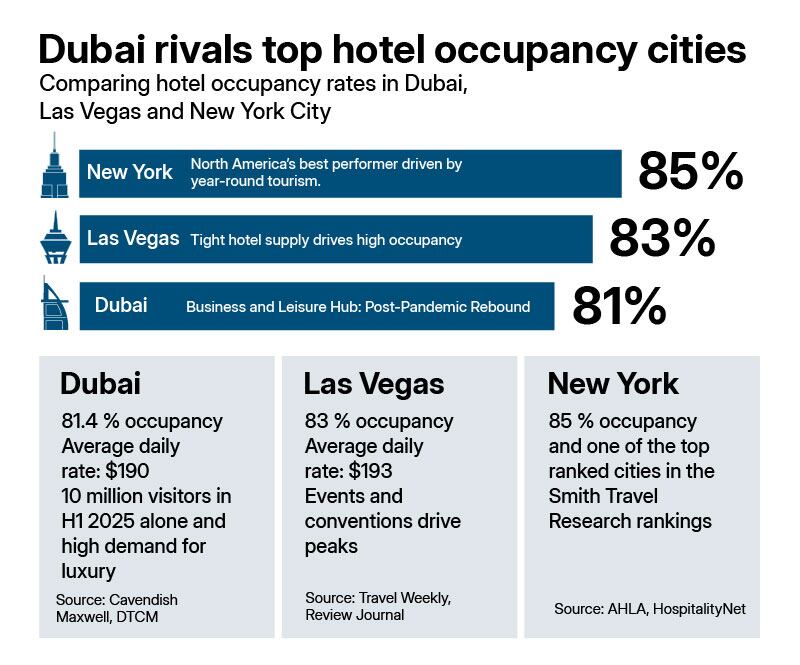
Dubai's push to attract more tourists, businesses and ultra-wealthy people is set to fill up its hotels to above 80 per cent this year, new research shows.
The emirate's hotels are projected to record an 81 per cent increase in occupancy rates this year, up 4.6 per cent on 2024, according to data provided to The National by STR, a CoStar group company specialising in hospitality and commercial real estate data research. The average daily room rate at Dubai hotels is projected to rise 6.5 per cent to Dh730 ($198.8), STR data shows.
“The UAE is the best-managed country on the planet from a tourism point of view. There's a drive to make this a successful city in terms of leisure travel, business events and medical tourism,” Philip Wooller, STR's regional director for the Middle East and Africa, said in an interview.
“There's huge interest from successful entrepreneurs in moving to the UAE and … there's a migration of the wealthy because this is a business-friendly country,” he added, pointing to the influx of millionaires from the UK as an example.
The emirate is doubling down on hosting large-scale global events such as Adipec, Idex, Gitex and the upcoming Dubai Airshow in November.
Capitalising on its pleasant winter weather, it has also curated a busy calendar of entertainment events including music concerts and art shows, and identified culinary concepts to replicate in its hotels to attract international tourists to stay in the city rather than just transit through its airport. Dubai's tourism chief Issam Kazim has highlighted the strategy of positioning Dubai as a leisure destination that aims to attract repeat visitors.
Dubai hosted 12.54 million international overnight visitors in the first eight months of 2025 − up 5 per cent year on year, according to the Department of Economy & Tourism. Around 21 per cent are from Western Europe, 15 per cent from South Asia, 14 per cent from the CIS and Eastern Europe and 11 per cent from the Mena region. The rest are from the Americas, Africa and Australasia.
During the January to August period, the emirate recorded 29.03 million occupied room nights at the city’s hotels, up 4 per cent year on year, with an occupancy rate of 78.5 per cent, a two per cent rise year on year. The average daily rate for the hotel rooms rose 4 per cent to Dh526, while revenue per available room increased 8 per cent to Dh413 on an annual basis.
Dubai Airport, the world's busiest hub by international passenger traffic, expects to handle 95.3 million travellers this year and to cross the 100 million mark within 18 months, it said in October.
A maturing market?
A panel of UAE hoteliers said the Dubai market continues to grow and has not yet reached its saturation point amid the surge in inbound tourists, they told the Future Hospitality Summit (FHS) in Dubai on Tuesday.
IHG Hotels and Resorts' regional boss said he has not seen any “shortfall” in demand compared to the existing supply of hotel rooms.
“Q4 is really amazing in terms of demand, so is Q1 next year, there's a ripple effect of continuation of demand for the region for tourism which is incredible,” Haitham Mattar, IHG's managing director in the Middle East, Africa and South-West Asia told the event.
“There's not really a point of saturation that we've seen in Dubai,” he said when asked how long growth can continue before it becomes a mature market.
Philip Barnes, chief executive of the Abu Dhabi hotel operator Rotana, said he has “tremendous confidence” in the UAE market, while there are other countries in the region that will “blossom” in the next decade as travellers seek new destinations and experiences.
“This region as a whole has a tremendous amount to offer, as indeed does Africa, which is very much on my radar screen,” he said.
The region's hospitality sector is a “buoyant” market and “the next decade is for the Middle East to lose”, Mr Mattar said, noting that India is showing amazing, phenomenal potential”, while Africa “has so much to offer”.
In terms of supply, there are 141,000 rooms in the pipeline (in terms of planning, final planning and under construction) in the Middle East as of October 2025, according to STR.
Saudi Arabia is leading the new pipeline in the GCC with a 59 per cent increase in supply, followed by the UAE with a 10.8 per cent increase in the number of hotel rooms, STR data showed.
Abu Dhabi market growth
Meanwhile, the UAE capital's hotels are also forecast to record high occupancy levels of 80.8 per cent this year, compared to 78.9 per cent in 2024, according to STR data. Abu Dhabi hotels' average daily room rate is projected to reach Dh697 in 2025, jumping 13.7 per cent last year.
This is largely driven by hosting major sporting events such as Formula One, music concerts such as Coldplay and major business events such as Idex, said Sarah Duignan, director of client relationships at STR, during a presentation at FHS on Tuesday.
Among all the F1 markets in the GCC, Abu Dhabi leads the way for the highest hotel average daily room rate of nearly $700 in 2024, STR data shows. That compares with $400 in Bahrain, nearly $200 in Doha and nearly $500 in Jeddah during the three-day F1 race period last year.
Meanwhile, the Coldplay concert in Abu Dhabi this year drove average daily hotel room rates in the capital city to just shy of Dh1,000, Ms Duignan said.
“The competition is definitely heating up between Dubai and Abu Dhabi,” she said, pointing to a Dh30 difference in average daily room rates between the two emirates in the year to date through to September. This compares with a price difference of Dh331 in 2015 and Dh119, indicating that the gap in pricing is closing.
“This does not mean that Dubai is declining in average rate. Quite the opposite. It just means that Abu Dhabi is catching up,” she said.
Abu Dhabi GP schedule
Friday: First practice - 1pm; Second practice - 5pm
Saturday: Final practice - 2pm; Qualifying - 5pm
Sunday: Etihad Airways Abu Dhabi Grand Prix (55 laps) - 5.10pm
Key changes
Commission caps
For life insurance products with a savings component, Peter Hodgins of Clyde & Co said different caps apply to the saving and protection elements:
• For the saving component, a cap of 4.5 per cent of the annualised premium per year (which may not exceed 90 per cent of the annualised premium over the policy term).
• On the protection component, there is a cap of 10 per cent of the annualised premium per year (which may not exceed 160 per cent of the annualised premium over the policy term).
• Indemnity commission, the amount of commission that can be advanced to a product salesperson, can be 50 per cent of the annualised premium for the first year or 50 per cent of the total commissions on the policy calculated.
• The remaining commission after deduction of the indemnity commission is paid equally over the premium payment term.
• For pure protection products, which only offer a life insurance component, the maximum commission will be 10 per cent of the annualised premium multiplied by the length of the policy in years.
Disclosure
Customers must now be provided with a full illustration of the product they are buying to ensure they understand the potential returns on savings products as well as the effects of any charges. There is also a “free-look” period of 30 days, where insurers must provide a full refund if the buyer wishes to cancel the policy.
“The illustration should provide for at least two scenarios to illustrate the performance of the product,” said Mr Hodgins. “All illustrations are required to be signed by the customer.”
Another illustration must outline surrender charges to ensure they understand the costs of exiting a fixed-term product early.
Illustrations must also be kept updatedand insurers must provide information on the top five investment funds available annually, including at least five years' performance data.
“This may be segregated based on the risk appetite of the customer (in which case, the top five funds for each segment must be provided),” said Mr Hodgins.
Product providers must also disclose the ratio of protection benefit to savings benefits. If a protection benefit ratio is less than 10 per cent "the product must carry a warning stating that it has limited or no protection benefit" Mr Hodgins added.
Best Academy: Ajax and Benfica
Best Agent: Jorge Mendes
Best Club : Liverpool
Best Coach: Jurgen Klopp (Liverpool)
Best Goalkeeper: Alisson Becker
Best Men’s Player: Cristiano Ronaldo
Best Partnership of the Year Award by SportBusiness: Manchester City and SAP
Best Referee: Stephanie Frappart
Best Revelation Player: Joao Felix (Atletico Madrid and Portugal)
Best Sporting Director: Andrea Berta (Atletico Madrid)
Best Women's Player: Lucy Bronze
Best Young Arab Player: Achraf Hakimi
Kooora – Best Arab Club: Al Hilal (Saudi Arabia)
Kooora – Best Arab Player: Abderrazak Hamdallah (Al-Nassr FC, Saudi Arabia)
Player Career Award: Miralem Pjanic and Ryan Giggs
Uefa Nations League: How it works
The Uefa Nations League, introduced last year, has reached its final stage, to be played over five days in northern Portugal. The format of its closing tournament is compact, spread over two semi-finals, with the first, Portugal versus Switzerland in Porto on Wednesday evening, and the second, England against the Netherlands, in Guimaraes, on Thursday.
The winners of each semi will then meet at Porto’s Dragao stadium on Sunday, with the losing semi-finalists contesting a third-place play-off in Guimaraes earlier that day.
Qualifying for the final stage was via League A of the inaugural Nations League, in which the top 12 European countries according to Uefa's co-efficient seeding system were divided into four groups, the teams playing each other twice between September and November. Portugal, who finished above Italy and Poland, successfully bid to host the finals.
THE%20JERSEYS
%3Cp%3E%3Cstrong%3ERed%20Jersey%3C%2Fstrong%3E%0D%3Cbr%3EGeneral%20Classification%2C%20sponsored%20by%20Fatima%20bint%20Mubarak%20Ladies%20Academy%3A%20Worn%20daily%2C%20starting%20from%20Stage%202%2C%20by%20the%20leader%20of%20the%20General%20Classification.%0D%3Cbr%3E%3Cstrong%3EGreen%20Jersey%3C%2Fstrong%3E%0D%3Cbr%3EPoints%20Classification%2C%20sponsored%20by%20Bike%20Abu%20Dhabi%3A%20Worn%20daily%2C%20starting%20from%20Stage%202%2C%20by%20the%20fastest%20sprinter.%0D%3Cbr%3E%3Cstrong%3EWhite%20Jersey%3C%2Fstrong%3E%0D%3Cbr%3EYoung%20Rider%20Classification%2C%20sponsored%20by%20Abu%20Dhabi%20360%3A%20Worn%20daily%2C%20starting%20from%20Stage%202%2C%20by%20the%20best%20young%20rider%20(U25).%0D%3Cbr%3E%3Cstrong%3EBlack%20Jersey%3C%2Fstrong%3E%0D%3Cbr%3EIntermediate%20Sprint%20Classification%2C%20sponsored%20by%20Experience%20Abu%20Dhabi%3A%20Worn%20daily%2C%20starting%20from%20Stage%202%2C%20by%20the%20rider%20who%20has%20gained%20most%20Intermediate%20sprint%20points.%3C%2Fp%3E%0A
Plan to boost public schools
A major shake-up of government-run schools was rolled out across the country in 2017. Known as the Emirati School Model, it placed more emphasis on maths and science while also adding practical skills to the curriculum.
It was accompanied by the promise of a Dh5 billion investment, over six years, to pay for state-of-the-art infrastructure improvements.
Aspects of the school model will be extended to international private schools, the education minister has previously suggested.
Recent developments have also included the introduction of moral education - which public and private schools both must teach - along with reform of the exams system and tougher teacher licensing requirements.
Specs – Taycan 4S
Engine: Electric
Transmission: 2-speed auto
Power: 571bhp
Torque: 650Nm
Price: Dh431,800
Specs – Panamera
Engine: 3-litre V6 with 100kW electric motor
Transmission: 2-speed auto
Power: 455bhp
Torque: 700Nm
Price: from Dh431,800