Earth’s climate is changing. This is a foregone conclusion, laid out earlier this year in a report by the Intergovernmental Panel on Climate Change that outlined how it is “unequivocal that human influence has warmed the atmosphere, oceans and land”.
Already each year, 150,000 people die as a result of climate change effects, according to estimates by the World Health Organisation.
Adaptations are now needed in order to survive. Futurist Parag Khanna outlines how to adapt in his new book, Move: The Forces Uprooting Us.
Khanna argues that humans have a knack for moving – and this can be our superpower in the uncertain decades to come.
“We’re really incredibly good at mass migration, which is a funny thing that people often forget,” he told The National. “That’s how America became America. It’s how South America became South America. It’s literally mass migrations. We’re terrible at ecological conservation. We’re terrible at maintaining military stability.”
Khanna points to two factors pushing humans to get moving: changing demographics and uninhabitable land.
-
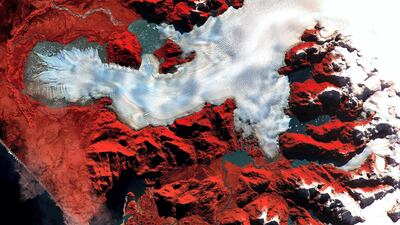
An image captured by Nasa's Terra satellite on May 2, 2000, shows the North Patagonia Ice Sheet in Chile. A single large glacier covered with crevasses is visible, while a semi-circular terminal moraine indicates that the glacier was once more extensive. Nasa -

A firefighter drags a hose closer to battle a grass fire in Knightsen, California. -
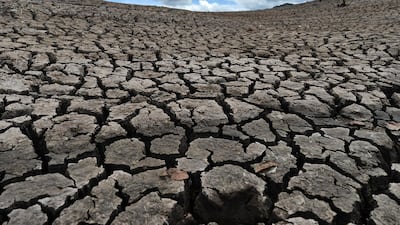
La Concepcion reservoir, which supplies 30 per cent of the Honduran capital of Tegucigalpa, during a severe drought caused by climate change. AFP -
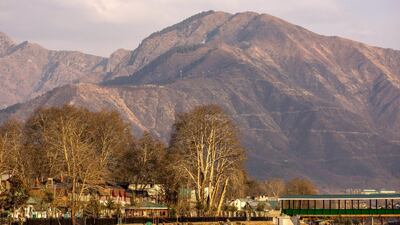
A view of mountains that used to be covered by snow, during a warm winter day in Srinagar, the summer capital of Indian-administered Kashmir. Getty -
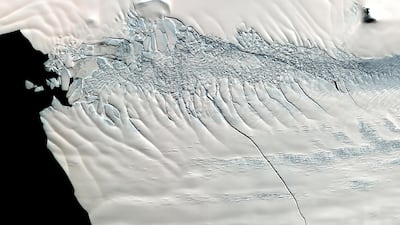
An image captured from Nasa's Terra spacecraft shows a vast crack across the Pine Island Glacier, a major ice stream that drains the West Antarctic Ice Sheet. Eventually, the crack will extend all the way across the glacier. -
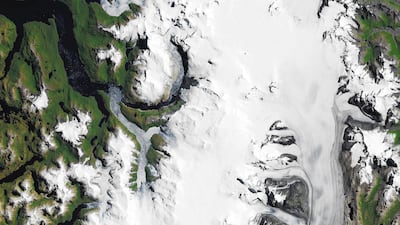
In this Landsat 8 image, glacial retreat is revealed in the rugged wilderness region of Patagonia, site of the largest contiguous areas of ice cover outside Antarctica. USGS -
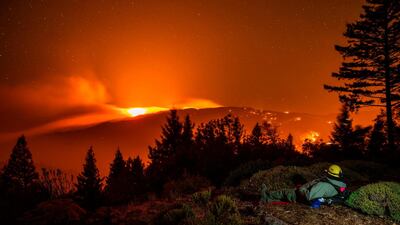
Destructive fires have raged in California and strong winds could spark new blazes. AFP -
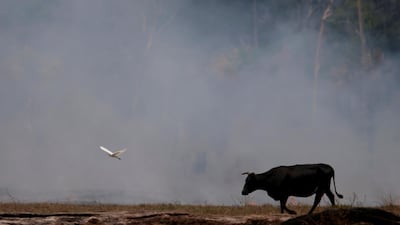
A bird flies next to an ox walking on a smouldering field after a fire burnt a tract of the Amazon rainforest as it was cleared by farmers in Brazil. Reuters -
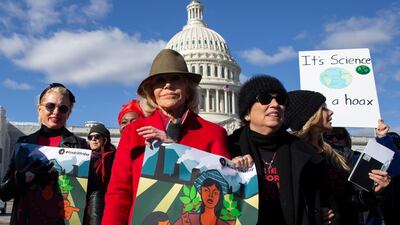
US actress Jane Fonda, centre, participates in a climate change protest before being arrested by US Capitol Police in Washington. EPA -
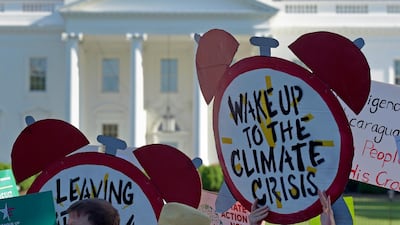
Protesters gather outside the White House in Washington to protest against Donald Trump's decision to withdraw the US from the Paris climate change accord. AP


He agrees with research from the University of Washington and a separate study from the UN that the world’s population will peak this century and then begin to decline. There is some disagreement over the exact timing and count, but “peak humanity” has major implications for our future.
“From that point forward, survival becomes a distribution game,” Mr Khanna writes. “How will we choose to organise ourselves across the planet’s 150 million-square kilometres of territory?”
As Earth makes its push towards nine, 10 or 11 billion humans before dropping off, there will be a further run on resources – food, water, energy – that will threaten the stability of our environment. As consumption grows, worldwide waste volumes will continue unabated, increasing another 75 per cent until the middle of the century, according to Swiss bank Julius Baer.
“This is clearly something which would put an increasing burden on the environment, but also on society,” Carsten Menke, its head of next-generation research, told The National.
In the face of population peak and runaway consumption, Khanna proposes Civilisation 3.0.
Civilisation 1.0 was “nomadic and agricultural”, when the global human population was relatively small and localised and the environment “dictated where we would live”. The 2.0 version came with industrialisation, when people flocked to ever-growing urban centres, became sedentary and over time developed a globalised supply chain that exploits nature for profit.
“The negative feedback loop between man and nature is killing us both,” according to Khanna, and this means we have to again adapt.
Civilisation 3.0 will need to be mobile and sustainable. Khanna suggests that we will move inland towards greater elevation and to the cooler northern reaches of the planet. “More people will be nomadic; settlements may be temporary. We will disperse, but we will remain connected,” he writes.
Signs of this change are already here. Amid growing labour shortages across North America, Europe and northern Asia, which are set to grow more acute amid an ageing population, Khanna suggests “opening the taps” of immigration.
Canada is already allowing in as many as 500,000 people a year. Khanna says this is helping Canada diversify its economy into emerging growth sectors and replenish a stalling population – a critical piece to maintaining a social safety net as people age.
“And there isn’t a big political backlash against it,” he said. While Canada is not a representative example, Khanna says xenophobic populism will become an increasingly difficult option amid the demographic shift and climate change.
“It’s perfectly plausible for a country like Hungary or Italy to say we don’t want more migrants. But that country can also commit suicide, and that country is not a role model,” he said. “I think that we’re already at the point where countries are waking up and saying, wait a minute, what the hell are we doing warding off young people? We’re desperate for young people.”
-
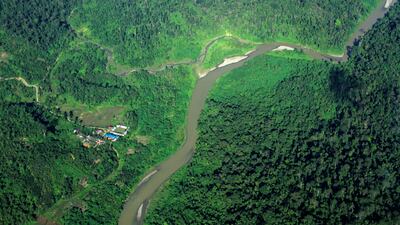
Leuser Mountain National Park in Aceh, Indonesia, is listed as a Unesco World Heritage Site. Anadolu Agency/Getty Images -

The Rio Platano biosphere reserve in La Mosquitia, Honduras, where the government has begun to evict people deforesting land declared a World Heritage by Unesco in 1980. AFP -

A couple has their photo taken close to the edge of the Grand Canyon in the southern US. AFP -
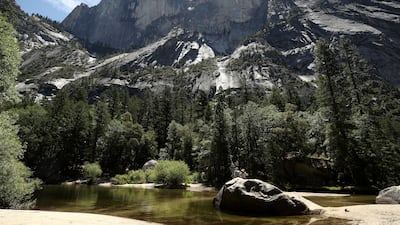
Visitors enjoy Mirror Lake in Yosemite National Park, California. Getty Images via AFP -
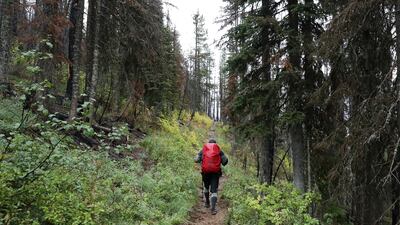
US park rangers hike in Glacier National Park, Montana. Getty Images via AFP -
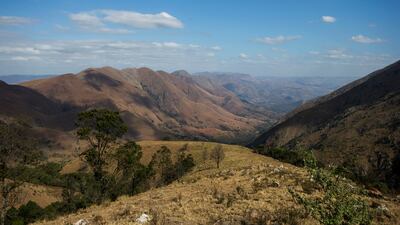
The Barberton Makhonjwa Mountains were recently named a Unesco World Heritage Site. AFP -
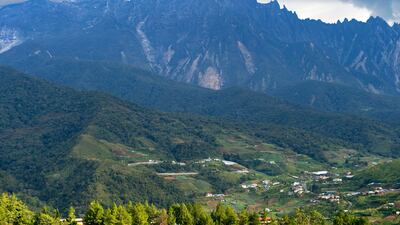
Mount Kinabalu in Malaysia, the highest mountain on the island of Borneo, is located in Kinabalu National Park, a Unesco World Nature Heritage Site. Education Images/Universal Images Group via Getty Images -
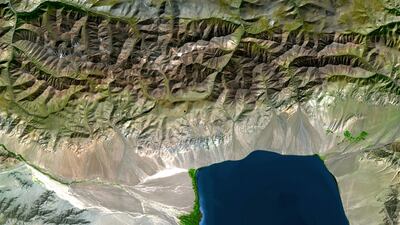
The Uvs Nuur Basin in Mongolia and Russia is the northernmost of the enclosed basins of Central Asia. Universal History Archive/Universal Images Group via Getty Images -
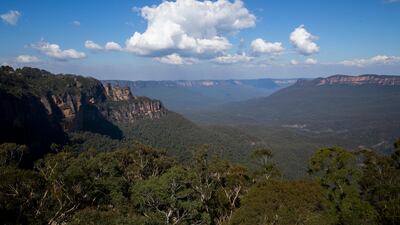
The Three Sisters, an unusual rock formation, in the Jamison Valley, Australia. Corbis via Getty Images -

Freshwater lake in Morne Trois Pitons National Park, Dominica. Reuters


Survival and, beyond that, even economic prosperity, will depend on humanity’s ability to embrace movement across borders.
As parts of Asia become uninhabitable owing to rising temperatures, Khanna estimates tens of millions more Asians will be forced to relocate permanently across Eurasia to find work. He also predicts a large number of south Asians and Chinese will head north towards southern Russia and Kazakhstan, “regions abundant in fertile land and almost wholly lacking in people”.
He also predicts some countries won’t make it, either due to “ecological decay, unstable politics, free-falling economies and brain drain”.
Even vacated states, Khanna writes, can be useful.
“Wherever their populations go, Central and West African countries have rich deposits of cobalt, iron ore and bauxite that will be mined until there is nothing left, while sub-Saharan African countries such as Namibia, South Africa and Angola hold significant reserves of diamonds, gold, uranium, zinc and other minerals. Bolivia and Afghanistan have giant pits of lithium essential for batteries.
“The six million people of Turkmenistan ... may have to migrate into western Kazakhstan or southern Russia, even as their gas reserves and solar power are harnessed for regional markets. There are other roles that vacated states will play in the global division of labour: as dumps for briny refuse from desalination plants and waste from nuclear reactors.”
A massive resettlement of planet Earth means a new understanding – or even new definitions – for borders and sovereignty. Khanna wonders if we might have designated lands best suited for agriculture, forestry, marine life or habitation.
“In this spirit, countries could lease critical habitats to international co-operatives for their sustainable cultivation. When spaces are so important that no one country should control them exclusively, we can design mechanisms that balance sustainability with fair access.”
This is a solution-oriented approach to something governments have been talking about for at least three decades.
Khanna writes that previous civilisations failed because they did not adapt “to the complexity they themselves created”. The mission, then, today is to cut down on the complexity of the globalised world and focus on self-sufficient localised hubs.
“A world of more compact, even mobile communes could be less risky than one where huge populations are concentrated in coastal megacities vulnerable to sea-level rise and disease,” he writes.
Ignoring these complexities and maintaining the status quo is a risk, one that puts millions of lives in danger.
In 1992, most countries joined an international treaty – the UN Framework Convention on Climate Change – to start the work of combatting global warming and to support one another as rising temperatures wrought consequences. But the movement of people as a result of a warming climate has not been addressed, even at the Cop26 meeting currently under way in Glasgow.
“The countries of the world will agree on how to colonise the Moon before they will agree that there will be free movement of people on Earth,” Khanna said. “We will literally never, ever, ever, ever have a global migration accord. That’s a shame. But it’s a fact.”