Over recent years, it has become apparent that democratic governance as we know it is failing around the globe.
Amid a global pandemic, a worsening climate crisis, a war on the doorstep of the G7 and rampant inflation, world leaders are struggling to keep a handle on today’s challenges.
To progress, existing governance systems need a complete overhaul to usher in a new, equitable and decentralised future.
When it comes to global democracy, the writing has been on the wall for some time.
Today, half of the democratic governments around the globe are in decline, the International Institute for Democracy and Electoral Assistance has said.
In its 2022 report, the institute said democratic progress has stalled across countries in its global index in the past five years, with a rise in authoritarian regimes, restrictions on the freedom of expression and growing distrust in election results.
More and more countries have recently experienced highly divided elections, including Brazil, France, Italy, the UK and the US.
For example, the UK went through no less than three prime ministers in 2022, while populism has been on the rise globally in recent years.
In short, it’s clear people are desperate for a change to the legacy system, which has always allowed power to remain concentrated in the hands of the few, to the detriment of the many.
DAO to the rescue
With old models of governance failing, it is perhaps time for a change and, once again, blockchain technology poses a solution with the decentralised autonomous organisation, or DAO.
A DAO has no central leadership and is governed from the bottom up by a community, with its rules recorded on the blockchain in a transparent and immutable manner.
Unlike legacy governance systems, the DAO allows an entire group to make important decisions in full consensus.
DAOs form the foundation of the entire decentralised finance (DeFi) ecosystem.
Through their innovative governance models, DAOs incentivise members to vote on specific issues, offering them rewards in the form of tokens or a proportion of a protocol’s revenue.
Built using open-source code, DAOs are completely transparent and eliminate the risk of rigging, bribery or fraud.
Though DAOS (and DeFi as a whole) only account for a fraction of the global financial ecosystem, they are growing and evolving rapidly.
Today, there are 2,368 DAOs in existence, with more than $100 million in assets and total DAO treasury assets of $25.6 billion.
Their growth has accelerated over the past month, as total treasury assets jumped 79 per cent between March and April, according to data analytics site Deep DAO.
A natural evolution
The DAO model is the obvious evolution of the archaic and outdated shareholder and dividend policies that form the backbone of the business world today.
Far from promoting fairness and equality, today’s models prioritise the interests of shareholders over those of their employees, customers and the wider community.
This results in decisions that seek to boost short-term profits and reinforce existing power structures and wealth inequality, to the detriment of the people and the planet.
Meanwhile, many government bodies today are a drain on public resources amid rampant bureaucracy, inefficiencies and time wasting.
In many developed nations, including the US, the number of government institutions has expanded significantly over the past few decades, yet they contribute little to the world at large.
We could be making much better use of finite financial and natural resources by replacing 60 per cent of all incompetent middle management employees — in the public and private sectors — with smart contracts.
Those policies that are still relevant for the modern world can then be transferred on to the blockchain and managed by code in a transparent and efficient manner.
Unlike government elections, which have suffered from declining turnout for decades, DAO models ensure each participant is involved in decision-making and that their opinion will truly contribute to the future of the organisation.
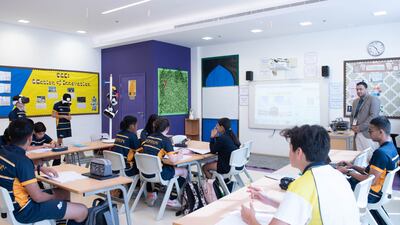
UAE schools start teaching pupils about blockchain technology — in pictures
In this system, each participant’s vote will carry an equal weight, regardless of their social or economic standing.
It’s clearer than ever that the DAO model is the future of governance.
It may take us years to change, but eventually the BlackRocks of this world will be replaced by MoonRock, and Uniswap will become the new Nasdaq.
With all of the innumerable benefits on offer, greater and greater decentralisation is inevitable.
Stefan Rust is chief executive of independent inflation data aggregator Truflation and former chief executive of bitcoin.com
More from Neighbourhood Watch:
Mercer, the investment consulting arm of US services company Marsh & McLennan, expects its wealth division to at least double its assets under management (AUM) in the Middle East as wealth in the region continues to grow despite economic headwinds, a company official said.
Mercer Wealth, which globally has $160 billion in AUM, plans to boost its AUM in the region to $2-$3bn in the next 2-3 years from the present $1bn, said Yasir AbuShaban, a Dubai-based principal with Mercer Wealth.
“Within the next two to three years, we are looking at reaching $2 to $3 billion as a conservative estimate and we do see an opportunity to do so,” said Mr AbuShaban.
Mercer does not directly make investments, but allocates clients’ money they have discretion to, to professional asset managers. They also provide advice to clients.
“We have buying power. We can negotiate on their (client’s) behalf with asset managers to provide them lower fees than they otherwise would have to get on their own,” he added.
Mercer Wealth’s clients include sovereign wealth funds, family offices, and insurance companies among others.
From its office in Dubai, Mercer also looks after Africa, India and Turkey, where they also see opportunity for growth.
Wealth creation in Middle East and Africa (MEA) grew 8.5 per cent to $8.1 trillion last year from $7.5tn in 2015, higher than last year’s global average of 6 per cent and the second-highest growth in a region after Asia-Pacific which grew 9.9 per cent, according to consultancy Boston Consulting Group (BCG). In the region, where wealth grew just 1.9 per cent in 2015 compared with 2014, a pickup in oil prices has helped in wealth generation.
BCG is forecasting MEA wealth will rise to $12tn by 2021, growing at an annual average of 8 per cent.
Drivers of wealth generation in the region will be split evenly between new wealth creation and growth of performance of existing assets, according to BCG.
Another general trend in the region is clients’ looking for a comprehensive approach to investing, according to Mr AbuShaban.
“Institutional investors or some of the families are seeing a slowdown in the available capital they have to invest and in that sense they are looking at optimizing the way they manage their portfolios and making sure they are not investing haphazardly and different parts of their investment are working together,” said Mr AbuShaban.
Some clients also have a higher appetite for risk, given the low interest-rate environment that does not provide enough yield for some institutional investors. These clients are keen to invest in illiquid assets, such as private equity and infrastructure.
“What we have seen is a desire for higher returns in what has been a low-return environment specifically in various fixed income or bonds,” he said.
“In this environment, we have seen a de facto increase in the risk that clients are taking in things like illiquid investments, private equity investments, infrastructure and private debt, those kind of investments were higher illiquidity results in incrementally higher returns.”
The Abu Dhabi Investment Authority, one of the largest sovereign wealth funds, said in its 2016 report that has gradually increased its exposure in direct private equity and private credit transactions, mainly in Asian markets and especially in China and India. The authority’s private equity department focused on structured equities owing to “their defensive characteristics.”
Match info
Newcastle United 1
Joselu (11')
Tottenham Hotspur 2
Vertonghen (8'), Alli (18')
Ten tax points to be aware of in 2026
1. Domestic VAT refund amendments: request your refund within five years
If a business does not apply for the refund on time, they lose their credit.
2. E-invoicing in the UAE
Businesses should continue preparing for the implementation of e-invoicing in the UAE, with 2026 a preparation and transition period ahead of phased mandatory adoption.
3. More tax audits
Tax authorities are increasingly using data already available across multiple filings to identify audit risks.
4. More beneficial VAT and excise tax penalty regime
Tax disputes are expected to become more frequent and more structured, with clearer administrative objection and appeal processes. The UAE has adopted a new penalty regime for VAT and excise disputes, which now mirrors the penalty regime for corporate tax.
5. Greater emphasis on statutory audit
There is a greater need for the accuracy of financial statements. The International Financial Reporting Standards standards need to be strictly adhered to and, as a result, the quality of the audits will need to increase.
6. Further transfer pricing enforcement
Transfer pricing enforcement, which refers to the practice of establishing prices for internal transactions between related entities, is expected to broaden in scope. The UAE will shortly open the possibility to negotiate advance pricing agreements, or essentially rulings for transfer pricing purposes.
7. Limited time periods for audits
Recent amendments also introduce a default five-year limitation period for tax audits and assessments, subject to specific statutory exceptions. While the standard audit and assessment period is five years, this may be extended to up to 15 years in cases involving fraud or tax evasion.
8. Pillar 2 implementation
Many multinational groups will begin to feel the practical effect of the Domestic Minimum Top-Up Tax (DMTT), the UAE's implementation of the OECD’s global minimum tax under Pillar 2. While the rules apply for financial years starting on or after January 1, 2025, it is 2026 that marks the transition to an operational phase.
9. Reduced compliance obligations for imported goods and services
Businesses that apply the reverse-charge mechanism for VAT purposes in the UAE may benefit from reduced compliance obligations.
10. Substance and CbC reporting focus
Tax authorities are expected to continue strengthening the enforcement of economic substance and Country-by-Country (CbC) reporting frameworks. In the UAE, these regimes are increasingly being used as risk-assessment tools, providing tax authorities with a comprehensive view of multinational groups’ global footprints and enabling them to assess whether profits are aligned with real economic activity.
Contributed by Thomas Vanhee and Hend Rashwan, Aurifer
The specs
Engine: 1.5-litre 4-cyl turbo
Power: 194hp at 5,600rpm
Torque: 275Nm from 2,000-4,000rpm
Transmission: 6-speed auto
Price: from Dh155,000
On sale: now
The specs
Engine: 2x201bhp AC Permanent-magnetic electric
Transmission: n/a
Power: 402bhp
Torque: 659Nm
Price estimate: Dh200,000
On sale: Q3 2022