

Children in vulnerable nations bearing the brunt of the climate change crisis issued an impassioned plea at a Cop29 youth summit on Monday for global action to safeguard future generations. Young activists taking part in the Unicef Children and Youth Press Conference – being held during the talks in Baku – told of the stark consequences of extreme weather in communities around the world as they endure severe droughts, polluted rivers and limited access to clean drinking water.
Their united call for support was made as Unicef – the UN agency responsible for humanitarian aid and development for children – outlined the need to ensure critical services can withstand environmental threats. "Children need to be included in the solutions, and global leaders need to make health care, education, water and sanitation – systems that children rely on – more resilient to the impacts of climate change," said Unicef executive director, Catherine Russell. "Now is the time to act.”
Unicef is calling on nations submitting climate action plans, also known as Nationally Determined Contributions, to ensure children are at the heart of their plans. The agency said less than half of the current national plans are child or youth-sensitive, and only 3 per cent were developed through participatory processes involving children.
'Our future at stake'

"You made a promise to protect our future – I stand here as a child asking you to keep that promise", said Georgina, 10, from Tanzania, the youngest participant in the youth conference. Unicef asked for only the first names of the child speakers to be used.
"Climate change is making us sick in the rural areas where there is no clean water, children must drink from unsafe sources. Boys and girls from the village walk up to 6km searching for water" she said.
"Sometimes they search the water source only to find it completely dry because there has been no rain, so they must search for another source, walking even further. By the time they return home, they are exhausted, dehydrated and too tired to study." Georgina is not alone: roughly one billion children – nearly half of the world's 2.2 billion children – live in countries classified as being at "extremely high risk" from climate hazards.
Rasul, 16, from Azerbaijan, told delegates that young people must be involved in this decision-making process. "For the people who live near the Caspian Sea in Baku, the weather is becoming more extreme and harder to predict," he said. "Winters and summers are getting longer, and it makes it difficult for me and my friends to enjoy simple activities such as cycling, walking or even playing."

Catarina, a 17-year-old surfer from Brazil, the host of next year's Cop climate summit, has called for a dedicated climate conference for children to address their needs and concerns. "When I look at my city and my rivers, and they are polluted, and if I go surf, when my government opens and throws sewage on the river, it goes to the ocean. I can't surf. I can't practice my spot, because I'm going to get sick."
"Children have things to say, and children know how to say it. We need the space. We need a Cop for children." Catarina told the conference.
Climate threat for families
Beyond health care and education, SOS Children's Villages, a non-profit developmental organisation, told The National that climate change is having an impact on a fundamental pillar of a child's upbringing: their family environment. An analysis published by the group on the loss of parental care found that climate change can increase poverty due to loss of livelihoods, which in turn can result in child labour, becoming street-connected, early or forced marriage and vulnerability to trafficking and exploitation.
"It's the loss of their livelihoods. It is their loss of food security. It's the loss of the families being able to take care of their children, and also, then, of course, the need to migrate, to leave their homes, to leave their current traditional ways of being." Angela Rosales, chief executive of SOS Children's Villages International said. "Many traditional communities are suffering from climate crisis. And then many children are unnecessarily losing parental care or family care."
Cop29 - in pictures
-

Participants at the Cop29 venue in Baku, Azerbaijan. Reuters -
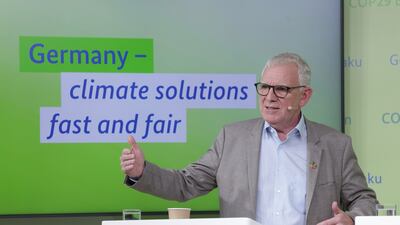
Jochen Flasbarth, State Secretary in the German Ministry for Economic Co-operation and Development, speaks in the Germany pavilion. Getty Images -
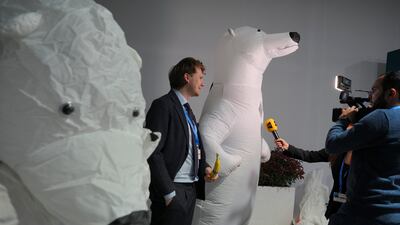
Nuclear power activists demonstrate. AP -
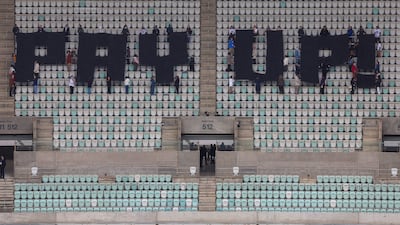
Activists hold a protest calling on developed nations to provide financing. Reuters -
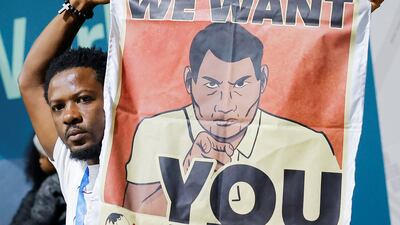
An activist holds up a sign. Reuters -
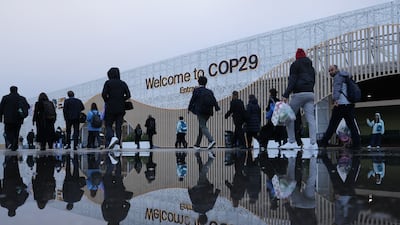
Conference participants arrive on day four. Getty Images -
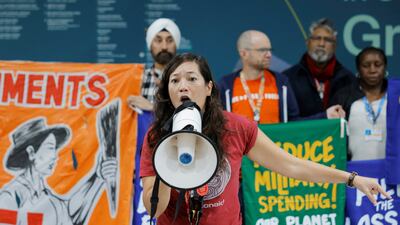
Another protest. Reuters -
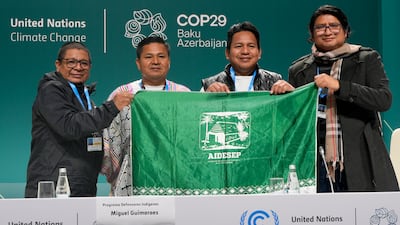
From left, Jorge Perez, Rolando Escobar, Miguel Vasquez and Esteban Cama at a session on Indigenous communities in the Peruvian Amazon. AP -
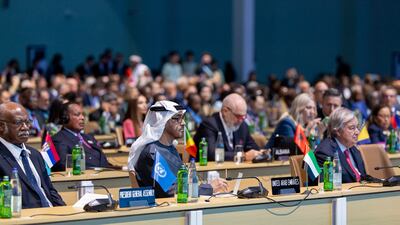
President Sheikh Mohamed attends the World Leaders Climate Action Summit at Cop29, in Azerbaijan's capital Baku. UAE Presidential Court -
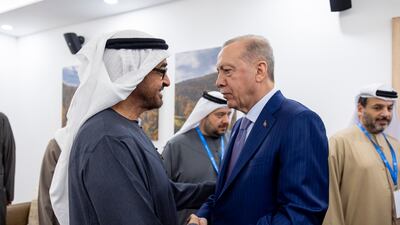
Sheikh Mohamed greets Recep Tayyip Erdogan, President of Turkey. WAM -
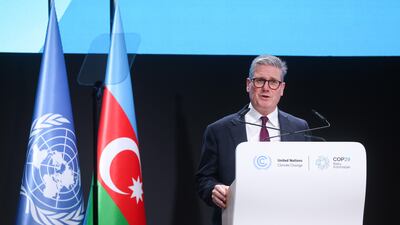
British Prime Minister Keir Starmer at Cop29. Bloomberg -

Ding Xuexiang, China's first Vice Premier, at Cop29. Bloomberg -
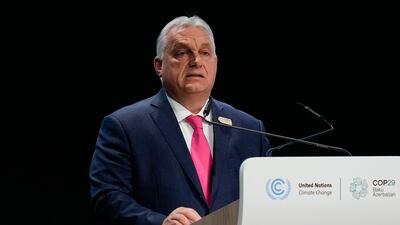
Hungary's Prime Minister Viktor Orban at a plenary session at Cop29. AP -
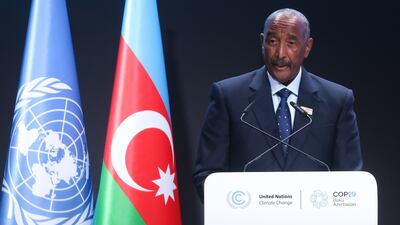
Sudan's military leader Abdel Fattah Al Burhan, at Cop29. Bloomberg -
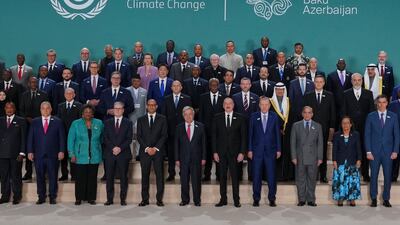
World leaders pose for a group photo at the Cop29 United Nations Climate Change Conference, in Baku, Azerbaijan. AP -
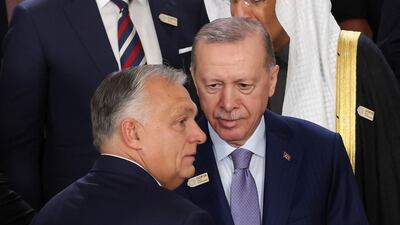
Hungarian Prime Minister Viktor Orban, left, stands next to Turkish President Recep Tayyip Erdogan. Reuters -
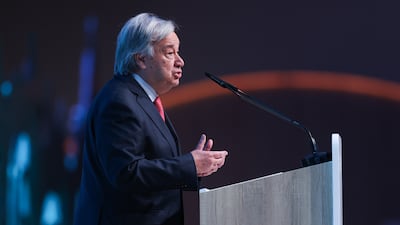
Antonio Guterres, UN secretary-general, addresses Cop29. Bloomberg -
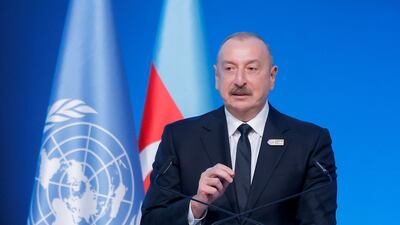
Azerbaijan's President Ilham Aliyev speaks during the Cop29 opening ceremony. Reuters -
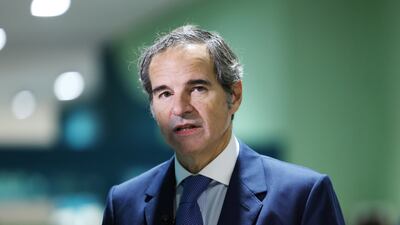
Rafael Grossi, director general of International Atomic Energy Agency (IAEA), at Cop29. Bloomberg -

Activists demonstrate for climate justice and a ceasefire in the Israel-Hamas war in Gaza, on day one of Cop29. AP -
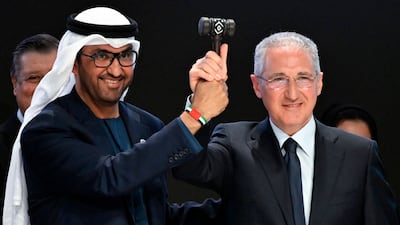
Cop28 President Dr Sultan Al Jaber and Cop29 President Mukhtar Babayev at the official handover. AFP -
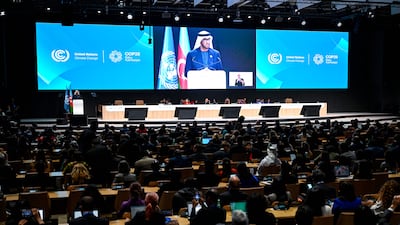
Dr Al Jaber, Minister of Industry and Advanced Technology, delivers a speech during the opening of Cop29 in Baku. AFP -
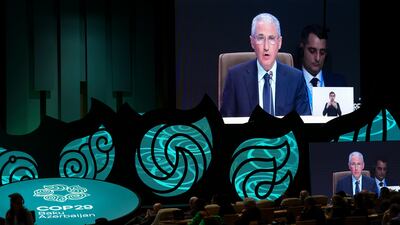
Mr Babayev speaks during the opening plenary session. AP -
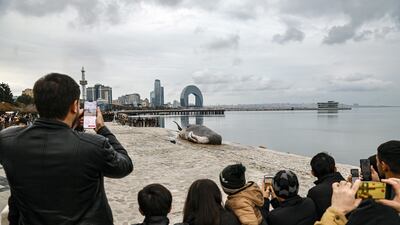
An installation depicting a beached whale by the Belgian art collective Captain Boomer on an embankment in Baku. EPA -

The Turkey Solidarity Centre pavilion. Bloomberg -
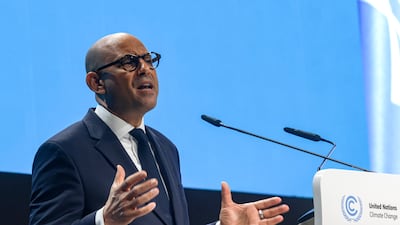
Simon Stiell, executive secretary of the UN Framework Convention on Climate Change, speaks during the opening ceremony. EPA -
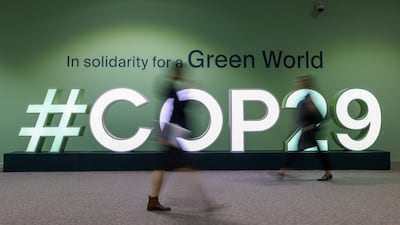
People begin arriving for the start of Cop29 in Baku. Bloomberg -
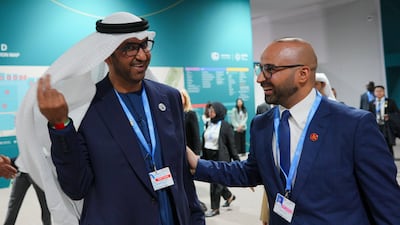
Dr Al Jaber at Cop29 with Moroccan climate researcher Cherif El Khalil. AP -
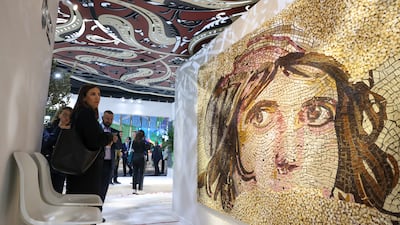
A mosaic adorns a wall at the Cop29 venue, Baku Stadium, in the capital of Azerbaijan. Bloomberg -

A woman tries out a VR headset at the tourism booth as the Cop29 UN climate summit gets under way in Baku, Azerbaijan. AP



