

African countries at Cop27 have called on developed nations to stop talking and start acting on promises of financial support to help them tackle the fallout from climate change.
The continent, which is home to about 18 per cent of the world’s population, contributes only 4 per cent of global emissions — and yet it is Africa that is at risk of bearing the brunt of the effects of climate change.
-
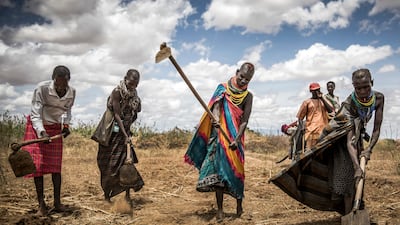
Members of the Turkana community plough a dry field as they prepare to grow sorghum near Lodwar, Kenya, in 2019. Save the Children says that 3.5 million people in Kenya are short of food this year. All photos: AFP -
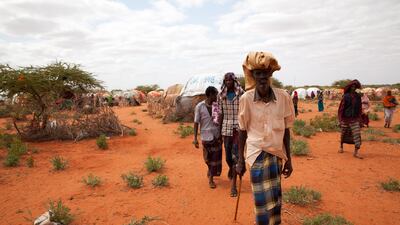
People displaced by Ethiopia's drought walk at a camp for displaced people in Werder. The Somali people of Ethiopia's sout-heast have a name for the drought that has killed livestock, dried up wells and forced hundreds of thousands into camps: sima, which means "equalised". It's an appropriate name, they say, because this drought has left no person untouched, spared no corner of their arid region. And it has forced 7.8 million people across Ethiopia to rely on emergency food handouts to stay alive. -
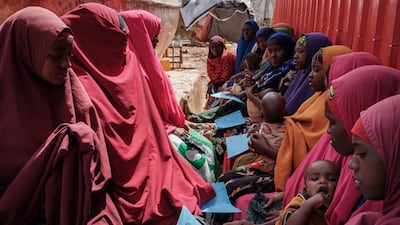
Mothers wait for food relief and health services at Tawkal 2 Dinsoor camp for internally displaced people in Baidoa, Somalia, in February. Insufficient rainfall since late 2020 has come as a fatal blow to populations already suffering from a locust invasion between 2019 and 2021, and the Covid-19 pandemic. -
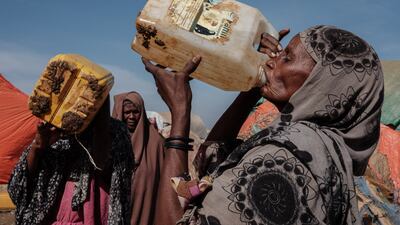
Hawa Mohamed Isack, 60, drinks water at Muuri, one of the 500 camps for internally displaced people, in Baidoa. For several weeks, humanitarian organisations have multiplied alerts on the situation in the Horn of Africa, which raises fears of a tragedy similar to that of 2011, the last famine that killed 260,000 people in Somalia. -
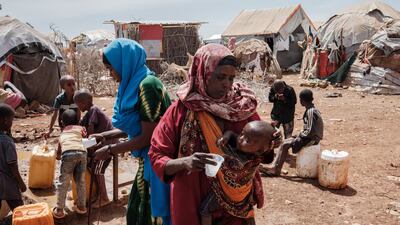
Bulley Hassanow Alliyow,30, gives water to her child at Tawkal 2 Dinsoor camp for internally displaced people in Baidoa. -
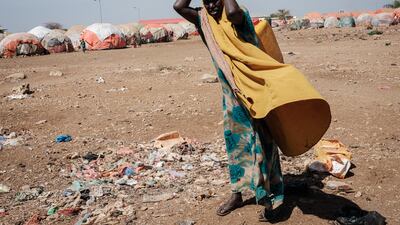
Desperate, hungry and thirsty, more and more people are flocking to Baidoa from rural areas of southern Somalia. -
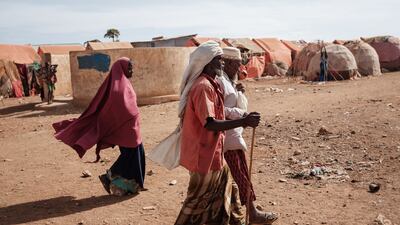
Somalia is one of the countries hardest hit by the drought that is engulfing the Horn of Africa. -
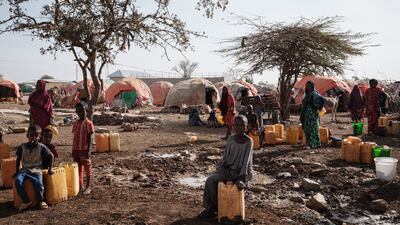
People wait for water with containers at a camp, in Baidoa. -

A field worked by Othman Cheikh Idriss, 60, a Sudanese farmer, in the capital Khartoum's district of Jureif Gharb. -

An aerial veiw of the town of Baidoa, Somalia.


The UN’s climate summit is being referred to as the “African Cop” and these countries are making their voice heard early in the two-week summit.
“We need support — financial support,” Sierra Leone’s Minister of Environment and Climate Change Foday Jaward told The National on Tuesday. “We need money to mitigate all these effects.”
Extreme weather
Sierra Leone has been hit hard by extreme weather events that the UN has attributed to climate change.
Increasing global temperatures, extreme heat, heavy rainy seasons and rising sea levels are imperilling food security, causing drought and threatening to overwhelm low-lying islands that are home to generations of fishermen.
“A lot of wealthier nations are responsible for climate issues affecting us,” said Mr Jaward. “In 2017, we had mudslides that killed thousands, with billions of dollars lost mainly because of climate issues.”
Sierra Leone's Minister of Environment
Lee White, Minister of Forests, Oceans, Environment and Climate Change in the West African state of Gabon, said millions of Africans will die for every 0.5°C rise in global temperatures.
“We are on 1.2°C,” he said. “If we go to 2.8°C, do the maths.
“The developed nations are not reducing their emissions quick enough. And no, they are not producing the financing they committed to.
“We don’t see it on the ground. Where is it? It is not hitting the ground in the Congo Basin.”
Loss and damage controversy
A particularly contentious issue at Cop27 is “loss and damage” funding that would lead to wealthier nations paying financial aid to countries hit by climate change-fuelled catastrophes.
Countries agreed to add it to the agenda for the first time on Sunday but only after lengthy and tortuous negotiations. While several European countries said they would contribute to such a fund, many richer countries such as the US have resisted it.
“We got a very timid decision on loss and damage,” said Mr White, regarding the decision to put it on the agenda. “The door is ajar but not open. It was a weak decision … a half victory.”
He said there was already “a bit of fighting” at the summit as to what extent countries would actually talk about loss and damage, but he added that the issue could define the event.
“How loss and damage gets treated here is probably going to be one of the defining questions of this Egypt Cop.”
The issue will be in the spotlight particularly on Wednesday as it is “finance day”, one of several thematic days at the event.
Scores of events across the sprawling convention centre in Sharm El Sheikh are dedicated to funding, but African ministers say the time for discussion has now passed.
“We have been talking too much and for too long,” said Mr Jaward. “It took years for loss and damage to be included on the agenda. We have flooding [and] droughts. But is it going to be implemented? Let’s wait and see.”
Zimbabwe's President Emmerson Mnangagwa also said those that were chiefly responsible for the climate crisis needed to hear the message from Africa.
“Those mostly responsible … must listen and prioritise climate finance to help prevent disasters and climate victims recover,” he said.
“Commitments we have made and continue to make can only make a difference when we act on them.”
Ghanaian President Nana Akufo Addo said Africa could be key to the decarbonisation of the world — if it were to receive assistance.
“No one wins if Africa loses,” he said.
Cop27 continues at Sharm El Sheikh until November 18.

