From left to right, Nischala Doddamani, Elvina Edison, Trisha Banerjee, Gayathri Vinod and Unnimaya Muraledharan, from Gems Our Own English School – Dubai, have created a slow-release fertiliser. Photo: Gems Our Own English School
From left to right, Nischala Doddamani, Elvina Edison, Trisha Banerjee, Gayathri Vinod and Unnimaya Muraledharan, from Gems Our Own English School – Dubai, have created a slow-release fertiliser. Phot

UAE pupils and teacher among finalists in global climate change competition


Anam Rizvi
  • English
  • Arabic

A team of enterprising Dubai school pupils on a mission to boost air quality and an Abu Dhabi teacher delivering a crucial climate message to learners have won global recognition for their eco efforts.

The five pupils from Gems Our Own English High School – Dubai are among the five finalists of the Burjeel Holdings-Oxford Saïd Climate Change Challenge, which attracted entries from 43 countries.

Unnimaya Muraledharan, in 12th Grade, and Trisha Banerjee, Elvina Edison, Nischala Doddamani and Gayathri Vinod, all Grade 11 pupils, have created a natural fertiliser, Biogrow, that uses carbon dioxide and ammonia reducing the amount of carbon dioxide and ammonia in the air.

Frithi Francis, director of innovation, IT and sustainability at Cambridge High School – Abu Dhabi, also secured her place as a finalist in the teacher category of the competition, after ensuring the environment was a key topic of discussion in classrooms.

The UAE representatives have been invited to present their green solutions to judges in Abu Dhabi on December 1, with the winners being declared at a ceremony at Cop28 at Expo City Dubai the following day.

The winning pupils will get the opportunity to study a specially curated climate change course at the University of Oxford in 2024.

Making a difference

Elvina spoke of the need to combat rising pollution, highlighting the challenges faced in her homeland of India.

“We are from India and because of rising air pollution, there are some kids who could not attend school and had online learning. Also, one in eight households experience food insecurity, that’s what inspired us to get involved.

“We created a fertiliser that reduces carbon from the atmosphere, especially from places where factories give out a lot of carbon dioxide.

“This fertiliser has a slow-release technology, and we're capturing carbon from the atmosphere. I don't think another product like this exists.”

Gayathri said their idea, Biogrow, required a large amount of capital investment as well as government support to actually come to life.

“But it is a product that has a lot of long-term benefits, and we cannot put a price tag on our future.

“We need a lot of resources to bring it to life. But once it's created, the benefits will be huge and it can impact every corner of the world.”

The pupils were excited to have their chance to present their plan on the Cop 28 stage next week.

“It's definitely a new experience. I think for all of us it's the first time we will experience such a big event,” said Unnimaya.

“We are thinking of the fact that our idea actually went to the finals at such a big event.

“We are really happy and we're very excited and looking forward to December 1.”

Fellow pupil Trisha said she was excited to meet the judges and interact with like-minded people who were passionate about climate action.

The team will be competing against pupils from Poland, India, Syria, USA, South Korea and Indonesia.

Prof Soumitra Dutta, dean of Said Business School at the University of Oxford, hailed the enthusiasm of young people around the world to help protect the planet.

“The diverse range of applications from more than 40 countries, including entries from refugee camps, highlights the intense interest among school students and educators in tackling climate change,” he said.

“It also reaffirms the competition’s role as a catalyst for driving innovative solutions and giving young people agency in tackling the greatest challenge of our age.”

Learning valuable lessons

Frithi Francis, right, director of innovation, IT and sustainability at Cambridge High School – Abu Dhabi, with pupils. Photo: Cambridge High School

Ms Francis is in line for the international accolade after helping to teach the next generation about the need to go green.

The school adopted a cross-curriculum approach to educating pupils on climate action with elements of climate change being taught through different subjects such as history, geography, science.

Ms Francis created opportunities for pupils to head out in the real world and get experience at hospitals.

She will compete against other finalists from Canada, UK, Lebanon and India. The winning teacher will be able to attend a course at the University of Oxford in 2024.

“I have been an educator for more than 23 years. Integrating climate change into the curriculum was a challenge for me initially,” said Ms Francis.

“The main reason why we integrated it is to help our students develop a deeper understanding about climate change.

“Cambridge High School Abu Dhabi staff have integrated climate literacy into the curriculum and have become climate change educators.

“There are real world scenarios where we give students to chances to do a research project. We give our pupils internship opportunities. For example, our pupils, we have been giving them internship opportunities with Burjeel Hospital.”

Countdown to Cop28 – in pictures

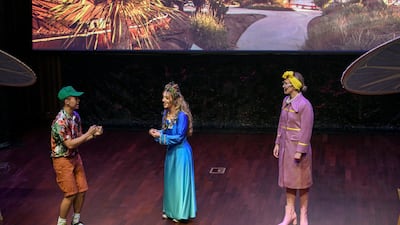
  • A rehearsal of 'Alya in Terraland,' a musical on climate change that will be open to all visitors of the Cop28 green zone at Expo City Dubai. The performance urges the audience to leave a positive impact on the environment. All photos: Khushnum Bhandari / The National
    A rehearsal of 'Alya in Terraland,' a musical on climate change that will be open to all visitors of the Cop28 green zone at Expo City Dubai. The performance urges the audience to leave a positive impact on the environment. All photos: Khushnum Bhandari / The National
  • Hend Al Mheiri, director of special projects at Expo City Dubai, Marjan Faraidooni, chief of education and culture, Nadia Verjee, executive director of Expo Dubai Group, Matt Brown, chief of sustainability at Expo City Dubai, and Yousuf Caires, executive director of the Expo Live Innovation Programme announce Expo City Dubai's public programming for Cop28.
    Hend Al Mheiri, director of special projects at Expo City Dubai, Marjan Faraidooni, chief of education and culture, Nadia Verjee, executive director of Expo Dubai Group, Matt Brown, chief of sustainability at Expo City Dubai, and Yousuf Caires, executive director of the Expo Live Innovation Programme announce Expo City Dubai's public programming for Cop28.
  • Hend Al Mheiri, director of special projects Expo City Dubai, said hosting Cop28 shows the UAE's commitment to working towards environmental sustainability and helping to address the global challenges of climate change.
    Hend Al Mheiri, director of special projects Expo City Dubai, said hosting Cop28 shows the UAE's commitment to working towards environmental sustainability and helping to address the global challenges of climate change.
  • A rehearsal at the Terra Pavilion, of the musical Alya in Terraland, at Expo City.
    A rehearsal at the Terra Pavilion, of the musical Alya in Terraland, at Expo City.
  • Cast members during the rehearsal of Alya in Terraland.
    Cast members during the rehearsal of Alya in Terraland.
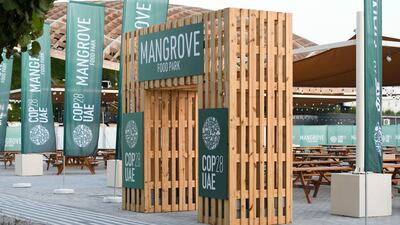
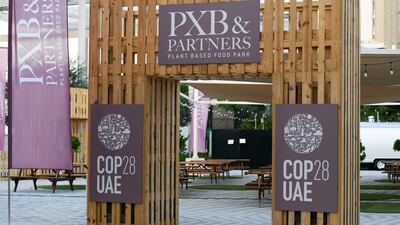
  • Reused material from palm trees has been used in Cop28 signs across Expo City Dubai.
    Reused material from palm trees has been used in Cop28 signs across Expo City Dubai.
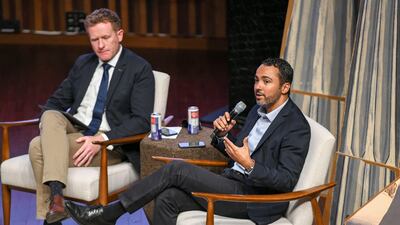
  • Matt Brown, sustainability chief, Expo City Dubai (left) and Yousuf Caires, executive director, Expo Live Innovation Programme, share details of an organic farm and workshops on climate action open to all in the Cop28 green zone.
    Matt Brown, sustainability chief, Expo City Dubai (left) and Yousuf Caires, executive director, Expo Live Innovation Programme, share details of an organic farm and workshops on climate action open to all in the Cop28 green zone.
  • Ms Faraidooni says youth engagement is a key component of Cop28.
    Ms Faraidooni says youth engagement is a key component of Cop28.
  • A 45-minute musical Alya in Terraland aims to inspire people to participate in climate discussions.
    A 45-minute musical Alya in Terraland aims to inspire people to participate in climate discussions.
  • Sustainable material has been used in the Cop28 signs across Expo City Dubai.
    Sustainable material has been used in the Cop28 signs across Expo City Dubai.
UAE currency: the story behind the money in your pockets
Inside%20Out%202
%3Cp%3E%3Cstrong%3EDirector%3A%C2%A0%3C%2Fstrong%3EKelsey%20Mann%3C%2Fp%3E%0A%3Cp%3E%3Cstrong%3EStarring%3A%3C%2Fstrong%3E%C2%A0Amy%20Poehler%2C%20Maya%20Hawke%2C%20Ayo%20Edebiri%3C%2Fp%3E%0A%3Cp%3E%3Cstrong%3ERating%3A%20%3C%2Fstrong%3E4.5%2F5%3C%2Fp%3E%0A

Mercer, the investment consulting arm of US services company Marsh & McLennan, expects its wealth division to at least double its assets under management (AUM) in the Middle East as wealth in the region continues to grow despite economic headwinds, a company official said.

Mercer Wealth, which globally has $160 billion in AUM, plans to boost its AUM in the region to $2-$3bn in the next 2-3 years from the present $1bn, said Yasir AbuShaban, a Dubai-based principal with Mercer Wealth.

Within the next two to three years, we are looking at reaching $2 to $3 billion as a conservative estimate and we do see an opportunity to do so,” said Mr AbuShaban.

Mercer does not directly make investments, but allocates clients’ money they have discretion to, to professional asset managers. They also provide advice to clients.

“We have buying power. We can negotiate on their (client’s) behalf with asset managers to provide them lower fees than they otherwise would have to get on their own,” he added.

Mercer Wealth’s clients include sovereign wealth funds, family offices, and insurance companies among others.

From its office in Dubai, Mercer also looks after Africa, India and Turkey, where they also see opportunity for growth.

Wealth creation in Middle East and Africa (MEA) grew 8.5 per cent to $8.1 trillion last year from $7.5tn in 2015, higher than last year’s global average of 6 per cent and the second-highest growth in a region after Asia-Pacific which grew 9.9 per cent, according to consultancy Boston Consulting Group (BCG). In the region, where wealth grew just 1.9 per cent in 2015 compared with 2014, a pickup in oil prices has helped in wealth generation.

BCG is forecasting MEA wealth will rise to $12tn by 2021, growing at an annual average of 8 per cent.

Drivers of wealth generation in the region will be split evenly between new wealth creation and growth of performance of existing assets, according to BCG.

Another general trend in the region is clients’ looking for a comprehensive approach to investing, according to Mr AbuShaban.

“Institutional investors or some of the families are seeing a slowdown in the available capital they have to invest and in that sense they are looking at optimizing the way they manage their portfolios and making sure they are not investing haphazardly and different parts of their investment are working together,” said Mr AbuShaban.

Some clients also have a higher appetite for risk, given the low interest-rate environment that does not provide enough yield for some institutional investors. These clients are keen to invest in illiquid assets, such as private equity and infrastructure.

“What we have seen is a desire for higher returns in what has been a low-return environment specifically in various fixed income or bonds,” he said.

“In this environment, we have seen a de facto increase in the risk that clients are taking in things like illiquid investments, private equity investments, infrastructure and private debt, those kind of investments were higher illiquidity results in incrementally higher returns.”

The Abu Dhabi Investment Authority, one of the largest sovereign wealth funds, said in its 2016 report that has gradually increased its exposure in direct private equity and private credit transactions, mainly in Asian markets and especially in China and India. The authority’s private equity department focused on structured equities owing to “their defensive characteristics.”

Updated: November 27, 2023, 5:48 AM