The UAE will impose a nationwide ban on single-use plastic from next year, the government has said.
From January 1, 2024, plastic bags of any material or composition will be prohibited.
From January 1, 2026, it will be prohibited to import plastic cutlery, drinks cups, styrofoam and boxes.
The ban will include everything from “food packaging, plastic bottles, cotton sticks, crackers bags and cigarette butts … wet wipes, balloons and balloon sticks” that contain plastic.
The move will protect the environment and be of benefit to consumers, state news agency Wam said.
The government said authorities, retailers, suppliers and consumers should prepare with “suitable, sustainable and multi-use alternatives in all shopping stores, retail stores and sales outlets on a permanent basis”, the agency reported.
The federal ruling goes further than new rules last summer in Dubai, which imposed a nominal 25 fils charge on plastic bags, and in Abu Dhabi, which banned most plastic bags.
In Abu Dhabi, the June 1 ban has already led to 87 million fewer single-use plastic bags being used, a cut of about 90 per cent. Sharjah had already planned a ban on bags from January 1, 2024.
The ruling contains exceptions that include plastic bags made from recycled materials. It also includes plastics required in goods that are exported abroad.
Plastic bags are one of the most problematic kinds of waste, polluting streets and waterways and harming birds and marine life. It takes decades to degrade and microscopic particles have been found inside the bodies of fish, birds and other animals.
Last year, as the plastic charge was rolled out, Dubai officals said nine in 10 turtles and five in ten camels found dead had plastic in their stomachs.
The UAE, which will host the United Nations climate summit Cop28 in November, aims to achieve carbon neutrality by 2050.
Best long-life alternatives: in pictures
-

Cotton reusable mesh bags can be used for fruit and vegetables. Getty Images -
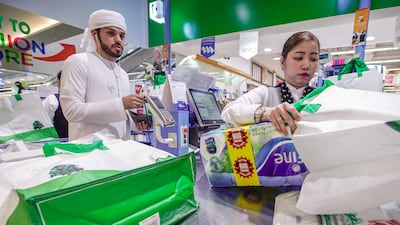
Reuseable plastic bags on sale at Lulu Hypermarket are thicker and more durable than single-use ones. Victor Besa / The National -
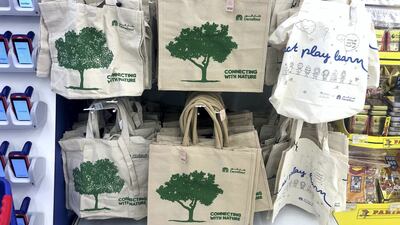
Reusable canvas and jute bags on display at Carrefour in Mall of the Emirates. Jute bags are one of the most durable options and are also naturally biodegradable. Canvas tote bags may not be as environmentally friendly because they require more resources to produce and distribute but can be used many times. Chris Whiteoak / The National -
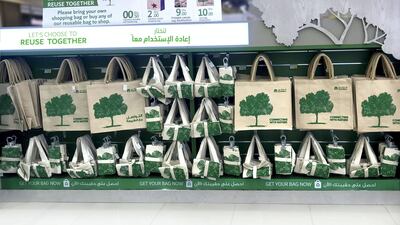
Carrefour is encouraging customers to bring their own recyclable bags by providing dedicated checkout counters and bonus Share points as incentives. Photo: Majid Al Futtaim -

Jute bags are both durable and biodegradable. Pawan Singh / The National -

A customer using a trolley bag at Spinneys supermarket in Dubai Marina. Trolley bags are perfect for those walking home from the supermarket. Pawan Singh / The National
Brave CF 27 fight card
Welterweight:
Abdoul Abdouraguimov (champion, FRA) v Jarrah Al Selawe (JOR)
Lightweight:
Anas Siraj Mounir (TUN) v Alex Martinez (CAN)
Welterweight:
Mzwandile Hlongwa (RSA) v Khamzat Chimaev (SWE)
Middleweight:
Tarek Suleiman (SYR) v Rustam Chsiev (RUS)
Mohammad Fakhreddine (LEB) v Christofer Silva (BRA)
Super lightweight:
Alex Nacfur (BRA) v Dwight Brooks (USA)
Bantamweight:
Jalal Al Daaja (JOR) v Tariq Ismail (CAN)
Chris Corton (PHI) v Zia Mashwani (PAK)
Featherweight:
Sulaiman (KUW) v Abdullatip (RUS)
Super lightweight:
Flavio Serafin (BRA) v Mohammad Al Katib (JOR)
Our legal columnist
Name: Yousef Al Bahar
Advocate at Al Bahar & Associate Advocates and Legal Consultants, established in 1994
Education: Mr Al Bahar was born in 1979 and graduated in 2008 from the Judicial Institute. He took after his father, who was one of the first Emirati lawyers
Directed: Smeep Kang
Produced: Soham Rockstar Entertainment; SKE Production
Cast: Rishi Kapoor, Jimmy Sheirgill, Sunny Singh, Omkar Kapoor, Rajesh Sharma
Rating: Two out of five stars
RESULTS
West Asia Premiership
Dubai Hurricanes 58-10 Dubai Knights Eagles
Dubai Tigers 5-39 Bahrain
Jebel Ali Dragons 16-56 Abu Dhabi Harlequins
MATCH INFO
Syria v Australia
2018 World Cup qualifying: Asia fourth round play-off first leg
Venue: Hang Jebat Stadium, Malayisa
Kick-off: Thursday, 4.30pm (UAE)
Watch: beIN Sports HD
* Second leg in Australia on October 10
The National's picks
4.35pm: Tilal Al Khalediah
5.10pm: Continous
5.45pm: Raging Torrent
6.20pm: West Acre
7pm: Flood Zone
7.40pm: Straight No Chaser
8.15pm: Romantic Warrior
8.50pm: Calandogan
9.30pm: Forever Young
More from Neighbourhood Watch:
Our family matters legal consultant
Name: Hassan Mohsen Elhais
Position: legal consultant with Al Rowaad Advocates and Legal Consultants.
Origin
Dan Brown
Doubleday
The Facility’s Versatility
Between the start of the 2020 IPL on September 20, and the end of the Pakistan Super League this coming Thursday, the Zayed Cricket Stadium has had an unprecedented amount of traffic.
Never before has a ground in this country – or perhaps anywhere in the world – had such a volume of major-match cricket.
And yet scoring has remained high, and Abu Dhabi has seen some classic encounters in every format of the game.
October 18, IPL, Kolkata Knight Riders tied with Sunrisers Hyderabad
The two playoff-chasing sides put on 163 apiece, before Kolkata went on to win the Super Over
January 8, ODI, UAE beat Ireland by six wickets
A century by CP Rizwan underpinned one of UAE’s greatest ever wins, as they chased 270 to win with an over to spare
February 6, T10, Northern Warriors beat Delhi Bulls by eight wickets
The final of the T10 was chiefly memorable for a ferocious over of fast bowling from Fidel Edwards to Nicholas Pooran
March 14, Test, Afghanistan beat Zimbabwe by six wickets
Eleven wickets for Rashid Khan, 1,305 runs scored in five days, and a last session finish
June 17, PSL, Islamabad United beat Peshawar Zalmi by 15 runs
Usman Khawaja scored a hundred as Islamabad posted the highest score ever by a Pakistan team in T20 cricket
Who has lived at The Bishops Avenue?
- George Sainsbury of the supermarket dynasty, sugar magnate William Park Lyle and actress Dame Gracie Fields were residents in the 1930s when the street was only known as ‘Millionaires’ Row’.
- Then came the international super rich, including the last king of Greece, Constantine II, the Sultan of Brunei and Indian steel magnate Lakshmi Mittal who was at one point ranked the third richest person in the world.
- Turkish tycoon Halis Torprak sold his mansion for £50m in 2008 after spending just two days there. The House of Saud sold 10 properties on the road in 2013 for almost £80m.
- Other residents have included Iraqi businessman Nemir Kirdar, singer Ariana Grande, holiday camp impresario Sir Billy Butlin, businessman Asil Nadir, Paul McCartney’s former wife Heather Mills.
Hunting park to luxury living
- Land was originally the Bishop of London's hunting park, hence the name
- The road was laid out in the mid 19th Century, meandering through woodland and farmland
- Its earliest houses at the turn of the 20th Century were substantial detached properties with extensive grounds
Five expert hiking tips
- Always check the weather forecast before setting off
- Make sure you have plenty of water
- Set off early to avoid sudden weather changes in the afternoon
- Wear appropriate clothing and footwear
- Take your litter home with you
Our legal columnist
Name: Yousef Al Bahar
Advocate at Al Bahar & Associate Advocates and Legal Consultants, established in 1994
Education: Mr Al Bahar was born in 1979 and graduated in 2008 from the Judicial Institute. He took after his father, who was one of the first Emirati lawyers
Mercer, the investment consulting arm of US services company Marsh & McLennan, expects its wealth division to at least double its assets under management (AUM) in the Middle East as wealth in the region continues to grow despite economic headwinds, a company official said.
Mercer Wealth, which globally has $160 billion in AUM, plans to boost its AUM in the region to $2-$3bn in the next 2-3 years from the present $1bn, said Yasir AbuShaban, a Dubai-based principal with Mercer Wealth.
“Within the next two to three years, we are looking at reaching $2 to $3 billion as a conservative estimate and we do see an opportunity to do so,” said Mr AbuShaban.
Mercer does not directly make investments, but allocates clients’ money they have discretion to, to professional asset managers. They also provide advice to clients.
“We have buying power. We can negotiate on their (client’s) behalf with asset managers to provide them lower fees than they otherwise would have to get on their own,” he added.
Mercer Wealth’s clients include sovereign wealth funds, family offices, and insurance companies among others.
From its office in Dubai, Mercer also looks after Africa, India and Turkey, where they also see opportunity for growth.
Wealth creation in Middle East and Africa (MEA) grew 8.5 per cent to $8.1 trillion last year from $7.5tn in 2015, higher than last year’s global average of 6 per cent and the second-highest growth in a region after Asia-Pacific which grew 9.9 per cent, according to consultancy Boston Consulting Group (BCG). In the region, where wealth grew just 1.9 per cent in 2015 compared with 2014, a pickup in oil prices has helped in wealth generation.
BCG is forecasting MEA wealth will rise to $12tn by 2021, growing at an annual average of 8 per cent.
Drivers of wealth generation in the region will be split evenly between new wealth creation and growth of performance of existing assets, according to BCG.
Another general trend in the region is clients’ looking for a comprehensive approach to investing, according to Mr AbuShaban.
“Institutional investors or some of the families are seeing a slowdown in the available capital they have to invest and in that sense they are looking at optimizing the way they manage their portfolios and making sure they are not investing haphazardly and different parts of their investment are working together,” said Mr AbuShaban.
Some clients also have a higher appetite for risk, given the low interest-rate environment that does not provide enough yield for some institutional investors. These clients are keen to invest in illiquid assets, such as private equity and infrastructure.
“What we have seen is a desire for higher returns in what has been a low-return environment specifically in various fixed income or bonds,” he said.
“In this environment, we have seen a de facto increase in the risk that clients are taking in things like illiquid investments, private equity investments, infrastructure and private debt, those kind of investments were higher illiquidity results in incrementally higher returns.”
The Abu Dhabi Investment Authority, one of the largest sovereign wealth funds, said in its 2016 report that has gradually increased its exposure in direct private equity and private credit transactions, mainly in Asian markets and especially in China and India. The authority’s private equity department focused on structured equities owing to “their defensive characteristics.”
'Midnights'
'Falling%20for%20Christmas'
Monday's results
- UAE beat Bahrain by 51 runs
- Qatar beat Maldives by 44 runs
- Saudi Arabia beat Kuwait by seven wickets
Tomorrow 2021
The national orchestra
MATCH SCHEDULE
Uefa Champions League semi-final, first leg
Tuesday, April 24 (10.45pm)
Liverpool v Roma
Wednesday, April 25
Bayern Munich v Real Madrid (10.45pm)
Europa League semi-final, first leg
Thursday, April 26
Arsenal v Atletico Madrid (11.05pm)
Marseille v Salzburg (11.05pm)
The%20Roundup
Why does a queen bee feast only on royal jelly?
Some facts about bees:
The queen bee eats only royal jelly, an extraordinary food created by worker bees so she lives much longer
The life cycle of a worker bee is from 40-60 days
A queen bee lives for 3-5 years
This allows her to lay millions of eggs and allows the continuity of the bee colony
About 20,000 honey bees and one queen populate each hive
Honey is packed with vital vitamins, minerals, enzymes, water and anti-oxidants.
Apart from honey, five other products are royal jelly, the special food bees feed their queen
Pollen is their protein source, a super food that is nutritious, rich in amino acids
Beewax is used to construct the combs. Due to its anti-fungal, anti-bacterial elements, it is used in skin treatments
Propolis, a resin-like material produced by bees is used to make hives. It has natural antibiotic qualities so works to sterilize hive, protects from disease, keeps their home free from germs. Also used to treat sores, infection, warts
Bee venom is used by bees to protect themselves. Has anti-inflammatory properties, sometimes used to relieve conditions such as rheumatoid arthritis, nerve and muscle pain
Honey, royal jelly, pollen have health enhancing qualities
The other three products are used for therapeutic purposes
Is beekeeping dangerous?
As long as you deal with bees gently, you will be safe, says Mohammed Al Najeh, who has worked with bees since he was a boy.
“The biggest mistake people make is they panic when they see a bee. They are small but smart creatures. If you move your hand quickly to hit the bees, this is an aggressive action and bees will defend themselves. They can sense the adrenalin in our body. But if we are calm, they are move away.”
More from Neighbourhood Watch:
Hili 2: Unesco World Heritage site
The site is part of the Hili archaeological park in Al Ain. Excavations there have proved the existence of the earliest known agricultural communities in modern-day UAE. Some date to the Bronze Age but Hili 2 is an Iron Age site. The Iron Age witnessed the development of the falaj, a network of channels that funnelled water from natural springs in the area. Wells allowed settlements to be established, but falaj meant they could grow and thrive. Unesco, the UN's cultural body, awarded Al Ain's sites - including Hili 2 - world heritage status in 2011. Now the most recent dig at the site has revealed even more about the skilled people that lived and worked there.

