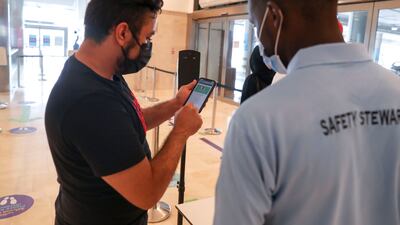
The new Al Hosn green pass rules have come into effect in Abu Dhabi.
The status of people who are fully vaccinated against Covid-19 will remain green as long as they have a PCR test once every 30 days.
People who received a second dose of the Sinopharm vaccine more than six months ago must take a booster shot to maintain their green status.
Authorities made the announcement last month and gave a 30-day grace period for people to receive the booster dose by September 20 to prevent their status from turning grey. That deadline expired on Monday.
The green status is required to enter many public places but those with grey status will be excluded.
Security staff at public buildings, shopping centres and restaurants will check that visitors have a green pass.
Unvaccinated people who have not received an official exemption, those who have not had a booster or failed to take a PCR test in the past 30 days will have grey status on the Al Hosn app.
The immunised-only list is made up of all shops, restaurants, cafes, gyms, recreational and sports centres and health clubs.
Resorts, museums, cultural centres and theme parks, plus universities, institutes, public and private schools and children’s nurseries, also appear on the list.
However, the green pass is no longer needed to enter Abu Dhabi from other emirates.
Drivers used to stop at the Ghantoot border to present proof of their virus-free status on Al Hosn, but recent announcements mean commuters can now plot a smooth course for Abu Dhabi without planning PCR tests in advance.
The border between Abu Dhabi and Dubai was closed on June 2, 2020. When it reopened, drivers were allowed to travel freely but were asked to show proof of a recent PCR test to cross into the emirate.
Officials announced on Saturday that the screening protocol would be removed after a welcome fall in infection rates in the capital.
An intensive testing programme and a rapid vaccination drive – allied to the public’s support of existing safety measures, such as the wearing of masks – has buoyed confidence in national efforts to overcome the virus.
More than 19.4 million doses of Covid-19 vaccine have been administered to the public, with more than 81 per cent of the population fully vaccinated.
The UAE has carried out about 80.7 million PCR tests, with daily testing rates regularly exceeding 300,000.
Abu Dhabi removes PCR test rules for entry from other emirates
The specs: 2018 Nissan 370Z Nismo
The specs: 2018 Nissan 370Z Nismo
Price, base / as tested: Dh182,178
Engine: 3.7-litre V6
Power: 350hp @ 7,400rpm
Torque: 374Nm @ 5,200rpm
Transmission: Seven-speed automatic
Fuel consumption, combined: 10.5L / 100km
Tips to keep your car cool
- Place a sun reflector in your windshield when not driving
- Park in shaded or covered areas
- Add tint to windows
- Wrap your car to change the exterior colour
- Pick light interiors - choose colours such as beige and cream for seats and dashboard furniture
- Avoid leather interiors as these absorb more heat
Benefits of first-time home buyers' scheme
- Priority access to new homes from participating developers
- Discounts on sales price of off-plan units
- Flexible payment plans from developers
- Mortgages with better interest rates, faster approval times and reduced fees
- DLD registration fee can be paid through banks or credit cards at zero interest rates
THE BIO
Favourite author - Paulo Coelho
Favourite holiday destination - Cuba
New York Times or Jordan Times? NYT is a school and JT was my practice field
Role model - My Grandfather
Dream interviewee - Che Guevara
How to get there
Emirates (www.emirates.com) flies directly to Hanoi, Vietnam, with fares starting from around Dh2,725 return, while Etihad (www.etihad.com) fares cost about Dh2,213 return with a stop. Chuong is 25 kilometres south of Hanoi.
UJDA CHAMAN
Produced: Panorama Studios International
Directed: Abhishek Pathak
Cast: Sunny Singh, Maanvi Gagroo, Grusha Kapoor, Saurabh Shukla
Rating: 3.5 /5 stars
The biog
Favourite colour: Brown
Favourite Movie: Resident Evil
Hobbies: Painting, Cooking, Imitating Voices
Favourite food: Pizza
Trivia: Was the voice of three characters in the Emirati animation, Shaabiyat Al Cartoon
Ten tax points to be aware of in 2026
1. Domestic VAT refund amendments: request your refund within five years
If a business does not apply for the refund on time, they lose their credit.
2. E-invoicing in the UAE
Businesses should continue preparing for the implementation of e-invoicing in the UAE, with 2026 a preparation and transition period ahead of phased mandatory adoption.
3. More tax audits
Tax authorities are increasingly using data already available across multiple filings to identify audit risks.
4. More beneficial VAT and excise tax penalty regime
Tax disputes are expected to become more frequent and more structured, with clearer administrative objection and appeal processes. The UAE has adopted a new penalty regime for VAT and excise disputes, which now mirrors the penalty regime for corporate tax.
5. Greater emphasis on statutory audit
There is a greater need for the accuracy of financial statements. The International Financial Reporting Standards standards need to be strictly adhered to and, as a result, the quality of the audits will need to increase.
6. Further transfer pricing enforcement
Transfer pricing enforcement, which refers to the practice of establishing prices for internal transactions between related entities, is expected to broaden in scope. The UAE will shortly open the possibility to negotiate advance pricing agreements, or essentially rulings for transfer pricing purposes.
7. Limited time periods for audits
Recent amendments also introduce a default five-year limitation period for tax audits and assessments, subject to specific statutory exceptions. While the standard audit and assessment period is five years, this may be extended to up to 15 years in cases involving fraud or tax evasion.
8. Pillar 2 implementation
Many multinational groups will begin to feel the practical effect of the Domestic Minimum Top-Up Tax (DMTT), the UAE's implementation of the OECD’s global minimum tax under Pillar 2. While the rules apply for financial years starting on or after January 1, 2025, it is 2026 that marks the transition to an operational phase.
9. Reduced compliance obligations for imported goods and services
Businesses that apply the reverse-charge mechanism for VAT purposes in the UAE may benefit from reduced compliance obligations.
10. Substance and CbC reporting focus
Tax authorities are expected to continue strengthening the enforcement of economic substance and Country-by-Country (CbC) reporting frameworks. In the UAE, these regimes are increasingly being used as risk-assessment tools, providing tax authorities with a comprehensive view of multinational groups’ global footprints and enabling them to assess whether profits are aligned with real economic activity.
Contributed by Thomas Vanhee and Hend Rashwan, Aurifer