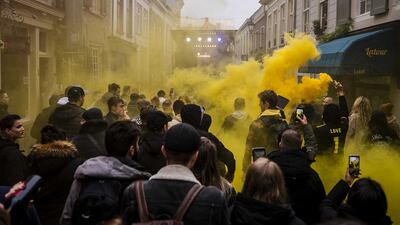
Austria entered a national lockdown on Monday to contain a rapidly spreading coronavirus outbreak, becoming the first country in Western Europe to re-impose blanket restrictions since vaccines became widely available.
The country’s nine million people, including the fully vaccinated, will be banned from leaving their homes for 20 days except for essential purposes.
It is the strictest measure taken so far to stem a rising tide of Covid-19 infections across Europe, which German Health Minister Jens Spahn said on Monday would leave almost everyone in the country "vaccinated, cured or dead" by the end of winter.
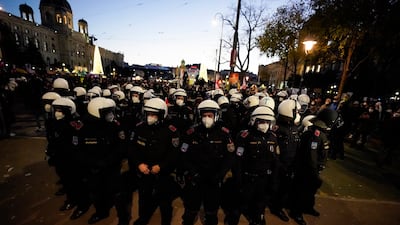
Austria's measures led to weekend protests that the government said were infiltrated by neo-Nazis and other extremists.
Some protesters wore a yellow star reading “not vaccinated” in a provocative echo of the Star of David which Jews were forced to wear by the Nazis.
Interior Minister Karl Nehammer said that although many protesters were peaceful, the mood among unvaccinated people and opponents of restrictions was becoming more radicalised.
“There are worried citizens who want to express their discontent. But there is also a group who tries to hijack these demonstrations and use it for their own purposes, and that is the extreme right,” he said.
“There were well-known neo-Nazis from days gone by, as well as representatives of the new extreme-right scene.”
Mr Nehammer said hooligans had clashed with police, and revealed that death threats had been made against Austria’s chancellor and health minister because of the restrictions.
About 66 per cent of Austria’s population is fully vaccinated, one of the lower rates in Western Europe. Compulsory shots will take effect from February.
David Nabarro, a special envoy for the World Health Organisation, said the UN agency was worried by polarised views on the virus.
“There’s only one way to deal with this, and that’s partnerships between governments and people,” he told BBC Radio 4’s Today programme.
“Of course, if that’s going to be turned into polarisation, that gets to be extremely challenging.”
Asked about compulsory vaccinations, he said he wished they were not necessary but could become so if health systems came under strain.
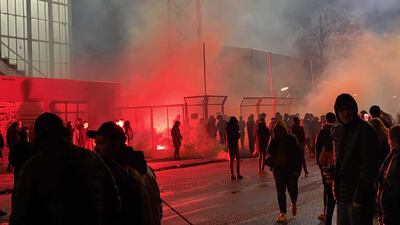
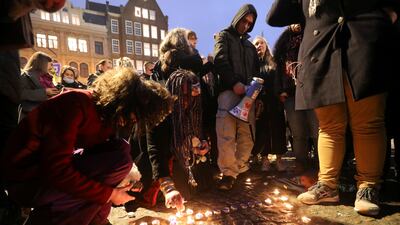
The Austrian protests came amid sometimes violent rallies across Europe as the restrictions gradually lifted over the past year start to come back into play.
About 35,000 protested in Brussels on Sunday, with Belgian police firing tear gas and water cannon at demonstrators.
The rally descended into violence after many of the protesters had left, with some of the stragglers smashing cars and setting bins on fire.
Although Belgium has stopped short of locking down like Austria, it has ordered people to work from home where possible and extended mask requirements across the country.
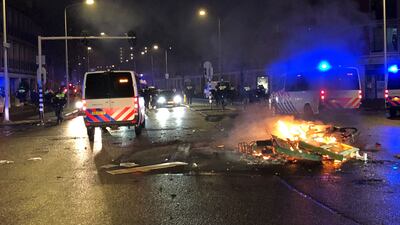
In the Netherlands, where the government has ordered businesses to close early and limited social visits, more than 130 people were arrested during three nights of unrest.
Dutch Prime Minister Mark Rutte on Monday described the riots as "pure violence under the guise of protest".
"I will never accept that idiots use pure violence," he told Dutch media.
In Leeuwarden, police vans were pelted with rocks on Sunday and black-clad groups chanted and set off flares. Police used batons to disperse a crowd in Enschede.
In Denmark, about 1,000 people expressed their anger at the return of vaccine certificates for civil servants. There was further public anger in Zagreb, the capital of Croatia.
Meanwhile, France sent dozens of elite forces to its Caribbean island territory of Guadeloupe after arson and looting erupted despite an overnight curfew.
The WHO said last week that Europe was the only region in which Covid-19 deaths were rising. The autumn surge of infections is overwhelming hospitals in many Central and Eastern European nations.
In Germany, where infection levels are at a record high, state leaders agreed new rules in which tougher measures will be triggered if the pressure on hospitals becomes too severe.
After Mr Spahn's stark comments, Chancellor Angela Merkel told party colleagues that the situation was "highly dramatic" and that current measures were not enough, party sources told AFP.
In the UK, which lifted nearly all restrictions in July, ministers have resisted calls to switch to a Plan B in which masks and vaccine checks could become compulsory.
Ten tax points to be aware of in 2026
1. Domestic VAT refund amendments: request your refund within five years
If a business does not apply for the refund on time, they lose their credit.
2. E-invoicing in the UAE
Businesses should continue preparing for the implementation of e-invoicing in the UAE, with 2026 a preparation and transition period ahead of phased mandatory adoption.
3. More tax audits
Tax authorities are increasingly using data already available across multiple filings to identify audit risks.
4. More beneficial VAT and excise tax penalty regime
Tax disputes are expected to become more frequent and more structured, with clearer administrative objection and appeal processes. The UAE has adopted a new penalty regime for VAT and excise disputes, which now mirrors the penalty regime for corporate tax.
5. Greater emphasis on statutory audit
There is a greater need for the accuracy of financial statements. The International Financial Reporting Standards standards need to be strictly adhered to and, as a result, the quality of the audits will need to increase.
6. Further transfer pricing enforcement
Transfer pricing enforcement, which refers to the practice of establishing prices for internal transactions between related entities, is expected to broaden in scope. The UAE will shortly open the possibility to negotiate advance pricing agreements, or essentially rulings for transfer pricing purposes.
7. Limited time periods for audits
Recent amendments also introduce a default five-year limitation period for tax audits and assessments, subject to specific statutory exceptions. While the standard audit and assessment period is five years, this may be extended to up to 15 years in cases involving fraud or tax evasion.
8. Pillar 2 implementation
Many multinational groups will begin to feel the practical effect of the Domestic Minimum Top-Up Tax (DMTT), the UAE's implementation of the OECD’s global minimum tax under Pillar 2. While the rules apply for financial years starting on or after January 1, 2025, it is 2026 that marks the transition to an operational phase.
9. Reduced compliance obligations for imported goods and services
Businesses that apply the reverse-charge mechanism for VAT purposes in the UAE may benefit from reduced compliance obligations.
10. Substance and CbC reporting focus
Tax authorities are expected to continue strengthening the enforcement of economic substance and Country-by-Country (CbC) reporting frameworks. In the UAE, these regimes are increasingly being used as risk-assessment tools, providing tax authorities with a comprehensive view of multinational groups’ global footprints and enabling them to assess whether profits are aligned with real economic activity.
Contributed by Thomas Vanhee and Hend Rashwan, Aurifer
EPL's youngest
- Ethan Nwaneri (Arsenal)
15 years, 181 days old
- Max Dowman (Arsenal)
15 years, 235 days old
- Jeremy Monga (Leicester)
15 years, 271 days old
- Harvey Elliott (Fulham)
16 years, 30 days old
- Matthew Briggs (Fulham)
16 years, 68 days old
Prop idols
Girls full-contact rugby may be in its infancy in the Middle East, but there are already a number of role models for players to look up to.
Sophie Shams (Dubai Exiles mini, England sevens international)
An Emirati student who is blazing a trail in rugby. She first learnt the game at Dubai Exiles and captained her JESS Primary school team. After going to study geophysics at university in the UK, she scored a sensational try in a cup final at Twickenham. She has played for England sevens, and is now contracted to top Premiership club Saracens.
----
Seren Gough-Walters (Sharjah Wanderers mini, Wales rugby league international)
Few players anywhere will have taken a more circuitous route to playing rugby on Sky Sports. Gough-Walters was born in Al Wasl Hospital in Dubai, raised in Sharjah, did not take up rugby seriously till she was 15, has a master’s in global governance and ethics, and once worked as an immigration officer at the British Embassy in Abu Dhabi. In the summer of 2021 she played for Wales against England in rugby league, in a match that was broadcast live on TV.
----
Erin King (Dubai Hurricanes mini, Ireland sevens international)
Aged five, Australia-born King went to Dubai Hurricanes training at The Sevens with her brothers. She immediately struck up a deep affection for rugby. She returned to the city at the end of last year to play at the Dubai Rugby Sevens in the colours of Ireland in the Women’s World Series tournament on Pitch 1.
The alternatives
• Founded in 2014, Telr is a payment aggregator and gateway with an office in Silicon Oasis. It’s e-commerce entry plan costs Dh349 monthly (plus VAT). QR codes direct customers to an online payment page and merchants can generate payments through messaging apps.
• Business Bay’s Pallapay claims 40,000-plus active merchants who can invoice customers and receive payment by card. Fees range from 1.99 per cent plus Dh1 per transaction depending on payment method and location, such as online or via UAE mobile.
• Tap started in May 2013 in Kuwait, allowing Middle East businesses to bill, accept, receive and make payments online “easier, faster and smoother” via goSell and goCollect. It supports more than 10,000 merchants. Monthly fees range from US$65-100, plus card charges of 2.75-3.75 per cent and Dh1.2 per sale.
• 2checkout’s “all-in-one payment gateway and merchant account” accepts payments in 200-plus markets for 2.4-3.9 per cent, plus a Dh1.2-Dh1.8 currency conversion charge. The US provider processes online shop and mobile transactions and has 17,000-plus active digital commerce users.
• PayPal is probably the best-known online goods payment method - usually used for eBay purchases - but can be used to receive funds, providing everyone’s signed up. Costs from 2.9 per cent plus Dh1.2 per transaction.
Day 3, Dubai Test: At a glance
Moment of the day Lahiru Gamage, the Sri Lanka pace bowler, has had to play a lot of cricket to earn a shot at the top level. The 29-year-old debutant first played a first-class game 11 years ago. His first Test wicket was one to savour, bowling Pakistan opener Shan Masood through the gate. It set the rot in motion for Pakistan’s batting.
Stat of the day – 73 Haris Sohail took 73 balls to hit a boundary. Which is a peculiar quirk, given the aggressive intent he showed from the off. Pakistan’s batsmen were implored to attack Rangana Herath after their implosion against his left-arm spin in Abu Dhabi. Haris did his best to oblige, smacking the second ball he faced for a huge straight six.
The verdict One year ago, when Pakistan played their first day-night Test at this ground, they held a 222-run lead over West Indies on first innings. The away side still pushed their hosts relatively close on the final night. With the opposite almost exactly the case this time around, Pakistan still have to hope they can salvage a win from somewhere.
The%20specs%3A%202024%20Mercedes%20E200
%3Cp%3E%3Cstrong%3EEngine%3A%20%3C%2Fstrong%3E2.0-litre%20four-cyl%20turbo%20%2B%20mild%20hybrid%0D%3Cbr%3E%3Cstrong%3EPower%3A%20%3C%2Fstrong%3E204hp%20at%205%2C800rpm%20%2B23hp%20hybrid%20boost%0D%3Cbr%3E%3Cstrong%3ETorque%3A%20%3C%2Fstrong%3E320Nm%20at%201%2C800rpm%20%2B205Nm%20hybrid%20boost%0D%3Cbr%3E%3Cstrong%3ETransmission%3A%20%3C%2Fstrong%3E9-speed%20auto%0D%3Cbr%3E%3Cstrong%3EFuel%20consumption%3A%20%3C%2Fstrong%3E7.3L%2F100km%0D%3Cbr%3E%3Cstrong%3EOn%20sale%3A%20%3C%2Fstrong%3ENovember%2FDecember%0D%3Cbr%3E%3Cstrong%3EPrice%3A%20%3C%2Fstrong%3EFrom%20Dh205%2C000%20(estimate)%3C%2Fp%3E%0A
COMPANY%20PROFILE
%3Cp%3E%3Cstrong%3ECompany%20name%3A%3C%2Fstrong%3E%20Klipit%3C%2Fp%3E%0A%3Cp%3E%3Cstrong%3EStarted%3A%3C%2Fstrong%3E%202022%3C%2Fp%3E%0A%3Cp%3E%3Cstrong%3EFounders%3A%3C%2Fstrong%3E%20Venkat%20Reddy%2C%20Mohammed%20Al%20Bulooki%2C%20Bilal%20Merchant%2C%20Asif%20Ahmed%2C%20Ovais%20Merchant%3C%2Fp%3E%0A%3Cp%3E%3Cstrong%3EBased%3A%3C%2Fstrong%3E%20Dubai%2C%20UAE%3C%2Fp%3E%0A%3Cp%3E%3Cstrong%3EIndustry%3A%3C%2Fstrong%3E%20Digital%20receipts%2C%20finance%2C%20blockchain%3C%2Fp%3E%0A%3Cp%3E%3Cstrong%3EFunding%3A%3C%2Fstrong%3E%20%244%20million%3C%2Fp%3E%0A%3Cp%3E%3Cstrong%3EInvestors%3A%3C%2Fstrong%3E%20Privately%2Fself-funded%3C%2Fp%3E%0A
Kill%20
%3Cp%3E%3Cstrong%3EDirector%3A%3C%2Fstrong%3E%20Nikhil%20Nagesh%20Bhat%3C%2Fp%3E%0A%3Cp%3E%3Cstrong%3EStarring%3C%2Fstrong%3E%3A%20Lakshya%2C%20Tanya%20Maniktala%2C%20Ashish%20Vidyarthi%2C%20Harsh%20Chhaya%2C%20Raghav%20Juyal%3C%2Fp%3E%0A%3Cp%3E%3Cstrong%3ERating%3A%3C%2Fstrong%3E%204.5%2F5%3Cbr%3E%3C%2Fp%3E%0A
The specs
Engine: 3.8-litre V6
Power: 295hp at 6,000rpm
Torque: 355Nm at 5,200rpm
Transmission: 8-speed auto
Fuel consumption: 10.7L/100km
Price: Dh179,999-plus
On sale: now
More from Neighbourhood Watch:
Mercer, the investment consulting arm of US services company Marsh & McLennan, expects its wealth division to at least double its assets under management (AUM) in the Middle East as wealth in the region continues to grow despite economic headwinds, a company official said.
Mercer Wealth, which globally has $160 billion in AUM, plans to boost its AUM in the region to $2-$3bn in the next 2-3 years from the present $1bn, said Yasir AbuShaban, a Dubai-based principal with Mercer Wealth.
“Within the next two to three years, we are looking at reaching $2 to $3 billion as a conservative estimate and we do see an opportunity to do so,” said Mr AbuShaban.
Mercer does not directly make investments, but allocates clients’ money they have discretion to, to professional asset managers. They also provide advice to clients.
“We have buying power. We can negotiate on their (client’s) behalf with asset managers to provide them lower fees than they otherwise would have to get on their own,” he added.
Mercer Wealth’s clients include sovereign wealth funds, family offices, and insurance companies among others.
From its office in Dubai, Mercer also looks after Africa, India and Turkey, where they also see opportunity for growth.
Wealth creation in Middle East and Africa (MEA) grew 8.5 per cent to $8.1 trillion last year from $7.5tn in 2015, higher than last year’s global average of 6 per cent and the second-highest growth in a region after Asia-Pacific which grew 9.9 per cent, according to consultancy Boston Consulting Group (BCG). In the region, where wealth grew just 1.9 per cent in 2015 compared with 2014, a pickup in oil prices has helped in wealth generation.
BCG is forecasting MEA wealth will rise to $12tn by 2021, growing at an annual average of 8 per cent.
Drivers of wealth generation in the region will be split evenly between new wealth creation and growth of performance of existing assets, according to BCG.
Another general trend in the region is clients’ looking for a comprehensive approach to investing, according to Mr AbuShaban.
“Institutional investors or some of the families are seeing a slowdown in the available capital they have to invest and in that sense they are looking at optimizing the way they manage their portfolios and making sure they are not investing haphazardly and different parts of their investment are working together,” said Mr AbuShaban.
Some clients also have a higher appetite for risk, given the low interest-rate environment that does not provide enough yield for some institutional investors. These clients are keen to invest in illiquid assets, such as private equity and infrastructure.
“What we have seen is a desire for higher returns in what has been a low-return environment specifically in various fixed income or bonds,” he said.
“In this environment, we have seen a de facto increase in the risk that clients are taking in things like illiquid investments, private equity investments, infrastructure and private debt, those kind of investments were higher illiquidity results in incrementally higher returns.”
The Abu Dhabi Investment Authority, one of the largest sovereign wealth funds, said in its 2016 report that has gradually increased its exposure in direct private equity and private credit transactions, mainly in Asian markets and especially in China and India. The authority’s private equity department focused on structured equities owing to “their defensive characteristics.”
Roger Federer's 2018 record
Australian Open Champion
Rotterdam Champion
Indian Wells Runner-up
Miami Second round
Stuttgart Champion
Halle Runner-up
Wimbledon Quarter-finals
Cincinnati Runner-up
US Open Fourth round
Shanghai Semi-finals
Basel Champion
Paris Masters Semi-finals
The specs
Engine: 3.5-litre twin-turbo V6
Power: 380hp at 5,800rpm
Torque: 530Nm at 1,300-4,500rpm
Transmission: Eight-speed auto
Price: From Dh299,000 ($81,415)
On sale: Now
COMPANY%20PROFILE
%3Cp%3E%3Cstrong%3ECompany%20name%3A%3C%2Fstrong%3E%20Alaan%3Cbr%3E%3Cstrong%3EStarted%3A%3C%2Fstrong%3E%202021%3Cbr%3E%3Cstrong%3EBased%3A%3C%2Fstrong%3E%20Dubai%3Cbr%3E%3Cstrong%3EFounders%3A%3C%2Fstrong%3E%20Parthi%20Duraisamy%20and%20Karun%20Kurien%3Cbr%3E%3Cstrong%3ESector%3A%3C%2Fstrong%3E%20FinTech%3Cbr%3E%3Cstrong%3EInvestment%20stage%3A%3C%2Fstrong%3E%20%247%20million%20raised%20in%20total%20%E2%80%94%20%242.5%20million%20in%20a%20seed%20round%20and%20%244.5%20million%20in%20a%20pre-series%20A%20round%3Cbr%3E%3Cbr%3E%3C%2Fp%3E%0A
Living in...
This article is part of a guide on where to live in the UAE. Our reporters will profile some of the country’s most desirable districts, provide an estimate of rental prices and introduce you to some of the residents who call each area home.
KEY%20DATES%20IN%20AMAZON'S%20HISTORY
%3Cp%3E%3Cstrong%3EJuly%205%2C%201994%3A%3C%2Fstrong%3E%20Jeff%20Bezos%20founds%20Cadabra%20Inc%2C%20which%20would%20later%20be%20renamed%20to%20Amazon.com%2C%20because%20his%20lawyer%20misheard%20the%20name%20as%20'cadaver'.%20In%20its%20earliest%20days%2C%20the%20bookstore%20operated%20out%20of%20a%20rented%20garage%20in%20Bellevue%2C%20Washington%3C%2Fp%3E%0A%3Cp%3E%3Cstrong%3EJuly%2016%2C%201995%3A%3C%2Fstrong%3E%20Amazon%20formally%20opens%20as%20an%20online%20bookseller.%20%3Cem%3EFluid%20Concepts%20and%20Creative%20Analogies%3A%20Computer%20Models%20of%20the%20Fundamental%20Mechanisms%20of%20Thought%3C%2Fem%3E%20becomes%20the%20first%20item%20sold%20on%20Amazon%3C%2Fp%3E%0A%3Cp%3E%3Cstrong%3E1997%3A%3C%2Fstrong%3E%20Amazon%20goes%20public%20at%20%2418%20a%20share%2C%20which%20has%20grown%20about%201%2C000%20per%20cent%20at%20present.%20Its%20highest%20closing%20price%20was%20%24197.85%20on%20June%2027%2C%202024%3C%2Fp%3E%0A%3Cp%3E%3Cstrong%3E1998%3A%3C%2Fstrong%3E%20Amazon%20acquires%20IMDb%2C%20its%20first%20major%20acquisition.%20It%20also%20starts%20selling%20CDs%20and%20DVDs%3C%2Fp%3E%0A%3Cp%3E%3Cstrong%3E2000%3A%3C%2Fstrong%3E%20Amazon%20Marketplace%20opens%2C%20allowing%20people%20to%20sell%20items%20on%20the%20website%3C%2Fp%3E%0A%3Cp%3E%3Cstrong%3E2002%3A%3C%2Fstrong%3E%20Amazon%20forms%20what%20would%20become%20Amazon%20Web%20Services%2C%20opening%20the%20Amazon.com%20platform%20to%20all%20developers.%20The%20cloud%20unit%20would%20follow%20in%202006%3C%2Fp%3E%0A%3Cp%3E%3Cstrong%3E2003%3A%3C%2Fstrong%3E%20Amazon%20turns%20in%20an%20annual%20profit%20of%20%2475%20million%2C%20the%20first%20time%20it%20ended%20a%20year%20in%20the%20black%3C%2Fp%3E%0A%3Cp%3E%3Cstrong%3E2005%3A%3C%2Fstrong%3E%20Amazon%20Prime%20is%20introduced%2C%20its%20first-ever%20subscription%20service%20that%20offered%20US%20customers%20free%20two-day%20shipping%20for%20%2479%20a%20year%3C%2Fp%3E%0A%3Cp%3E%3Cstrong%3E2006%3A%3C%2Fstrong%3E%20Amazon%20Unbox%20is%20unveiled%2C%20the%20company's%20video%20service%20that%20would%20later%20morph%20into%20Amazon%20Instant%20Video%20and%2C%20ultimately%2C%20Amazon%20Video%3C%2Fp%3E%0A%3Cp%3E%3Cstrong%3E2007%3A%3C%2Fstrong%3E%20Amazon's%20first%20hardware%20product%2C%20the%20Kindle%20e-reader%2C%20is%20introduced%3B%20the%20Fire%20TV%20and%20Fire%20Phone%20would%20come%20in%202014.%20Grocery%20service%20Amazon%20Fresh%20is%20also%20started%3C%2Fp%3E%0A%3Cp%3E%3Cstrong%3E2009%3A%3C%2Fstrong%3E%20Amazon%20introduces%20Amazon%20Basics%2C%20its%20in-house%20label%20for%20a%20variety%20of%20products%3C%2Fp%3E%0A%3Cp%3E%3Cstrong%3E2010%3A%3C%2Fstrong%3E%20The%20foundations%20for%20Amazon%20Studios%20were%20laid.%20Its%20first%20original%20streaming%20content%20debuted%20in%202013%3C%2Fp%3E%0A%3Cp%3E%3Cstrong%3E2011%3A%3C%2Fstrong%3E%20The%20Amazon%20Appstore%20for%20Google's%20Android%20is%20launched.%20It%20is%20still%20unavailable%20on%20Apple's%20iOS%3C%2Fp%3E%0A%3Cp%3E%3Cstrong%3E2014%3A%3C%2Fstrong%3E%20The%20Amazon%20Echo%20is%20launched%2C%20a%20speaker%20that%20acts%20as%20a%20personal%20digital%20assistant%20powered%20by%20Alexa%3C%2Fp%3E%0A%3Cp%3E%3Cstrong%3E2017%3A%3C%2Fstrong%3E%20Amazon%20acquires%20Whole%20Foods%20for%20%2413.7%20billion%2C%20its%20biggest%20acquisition%3C%2Fp%3E%0A%3Cp%3E%3Cstrong%3E2018%3A%3C%2Fstrong%3E%20Amazon's%20market%20cap%20briefly%20crosses%20the%20%241%20trillion%20mark%2C%20making%20it%2C%20at%20the%20time%2C%20only%20the%20third%20company%20to%20achieve%20that%20milestone%3C%2Fp%3E%0A