Hunting for Omicron inside America's largest Covid testing lab


Willy Lowry
  • English
  • Arabic

Live updates: follow the latest news on Covid-19 variant Omicron

Inside a sprawling facility in Henderson, North Carolina, dozens of scientists in full medical scrubs sort through positive Covid-19 tests from across the country, searching for the B1.1.529 variant, better known as Omicron.

The cavernous 930-square-metre lab is the biggest single-site testing facility in the US and the frontline of America’s fight against Covid-19, which has killed about 800,000 Americans so far.

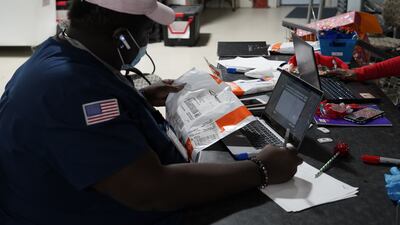
Located in a rural area of the state, Mako receives thousands of FedEx packages filled with PCR Covid-19 tests per day. The packages are catalogued and each individual test is registered. From there, the samples are put into batches and processed.

“It’s been pretty hectic,” said Matthew Tugwell, director of genomic Sequencing at Mako Medical Laboratories.

The lab is constantly buzzing with activity with up to 50 people on site at any one time, extracting samples and running tests against the continual hum of machines. Scientists and technicians work in three eight-hour shifts, 24 hours a day.

Before the pandemic the team was just a handful of scientists and now they number 150 strong.

Currently, the lab processes about 30,000 tests daily but has the capacity to do up to 150,000 per day.

The North Carolina site is one of more than 60 national reference laboratories in the US that work with the Centres for Disease Control (CDC) in Atlanta to search for new variants of coronavirus.

Each confirmed Omicron case they find is shipped to Atlanta, for further study and for testing the efficacy against various vaccines.

So far, the Mako scientists have found four individual cases of Omicron from the US states of Colorado, Georgia, Pennsylvania and Maryland, not nearly enough to fully understand the variant.

With only a few samples to study, the CDC must largely rely on the work of other countries to learn about the variant, making each sample they receive crucial as lives depend on them.

“There’s not that many samples currently,” Mr Tugwell told The National. “So, we're able to contribute to that effort by providing the samples.”

The variant, first detected in South Africa, has spread rapidly around the globe. Fifty-seven countries have confirmed cases of Omicron and it has been found in 19 US states.

As scientists around the world scramble to learn more about the variant and its potential dangers, countries are once again doubling down on certain Covid-19 restrictions, with many banning flights from southern Africa and enacting stricter testing requirements.

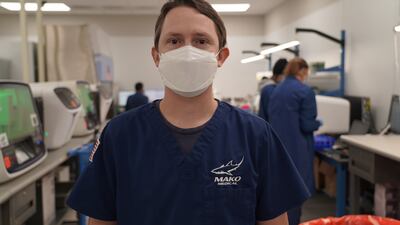
  • Matthew Tugwell is director of genomics at Mako Medical Laboratories. Willy Lowry / The National
    Matthew Tugwell is director of genomics at Mako Medical Laboratories. Willy Lowry / The National
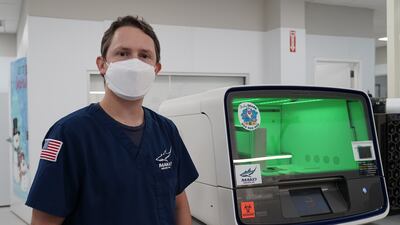
  • Matthew Tugwell poses next to a machine that extracts mRNA. Willy Lowry / The National
    Matthew Tugwell poses next to a machine that extracts mRNA. Willy Lowry / The National
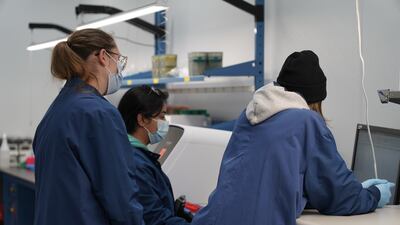
  • Scientists at Mako Medical Laboratories work to better understand coronavirus. Willy Lowry / The National
    Scientists at Mako Medical Laboratories work to better understand coronavirus. Willy Lowry / The National
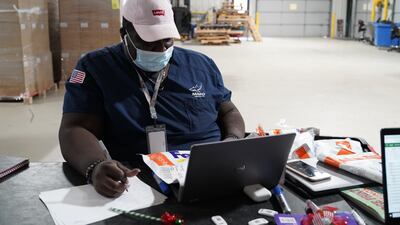
  • A worker at Mako Medical Laboratories registers a FedEx package full of PCR tests. Willy Lowry / The National
    A worker at Mako Medical Laboratories registers a FedEx package full of PCR tests. Willy Lowry / The National
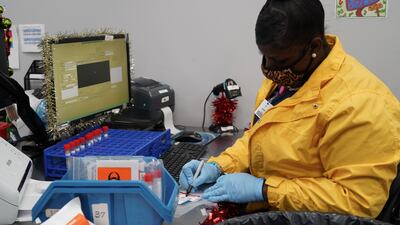
  • A worker at Mako Medical Laboratories registers a PCR test. Willy Lowry / The National
    A worker at Mako Medical Laboratories registers a PCR test. Willy Lowry / The National
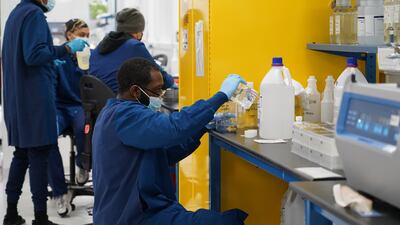
  • A scientist pours a solution into a beaker at Mako Medical Laboratories. Willy Lowry / The National
    A scientist pours a solution into a beaker at Mako Medical Laboratories. Willy Lowry / The National
  • A worker at Mako Medical Laboratories registers a FedEx package full of PCR tests. Willy Lowry / The National
    A worker at Mako Medical Laboratories registers a FedEx package full of PCR tests. Willy Lowry / The National
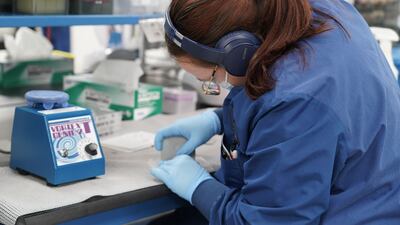
  • A scientist at Mako Medical Laboratories prepares to use a gene mixer. Willy Lowry / The National
    A scientist at Mako Medical Laboratories prepares to use a gene mixer. Willy Lowry / The National
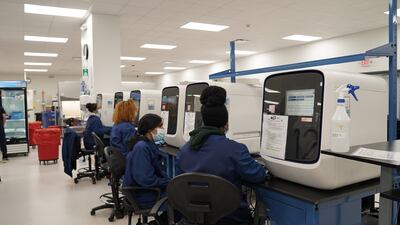
  • A row of scientists study QPCR machines at Mako Medical Laboratories. Willy Lowry / The National.
    A row of scientists study QPCR machines at Mako Medical Laboratories. Willy Lowry / The National.
  • Scientists study the genomics sequencing of a Covid-19 test sample. Willy Lowry / The National
    Scientists study the genomics sequencing of a Covid-19 test sample. Willy Lowry / The National
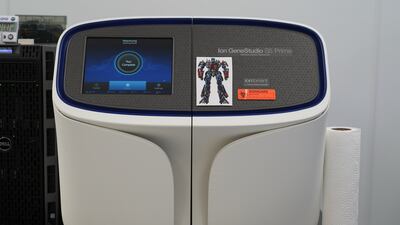
  • One of several cDNA sequencing machines at Mako Medical Laboratories in Henderson, North Carolina, which allow scientists to scrutinize positive Covid-19 tests for Omicron and other variants. Willy Lowry / The National
    One of several cDNA sequencing machines at Mako Medical Laboratories in Henderson, North Carolina, which allow scientists to scrutinize positive Covid-19 tests for Omicron and other variants. Willy Lowry / The National
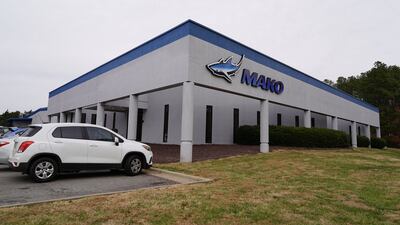
  • Mako Medical Laboratories is the largest single-site Covid-19 testing facility in the US. Willy Lowry / The National
    Mako Medical Laboratories is the largest single-site Covid-19 testing facility in the US. Willy Lowry / The National

How genomic sequencing works

Scientists extract the RNA from positive samples that are then converted into into another type of DNA, known as cDNA, which is run through a series of high-powered machines that prepare the cDNA libraries and format them in a way that allows them to be sequenced.

The cDNA material is loaded on to small, plastic chips filled with millions of tiny wells that store the material, which is then put through a sequencing machine. The results are then analysed by a team of scientists.

The results show the genetic makeup of the virus and allow scientists to examine how and if it has changed over time. In the case of Omicron, scientists are looking for a specific marker known as an “S-gene drop out".

The CDC is relying on labs to be the tip of its spear in virus detection, keeping a close watch on which variant is behind the most cases in the US at any given time.

At Mako, the whole process from start to finish takes between two to three days, a time-consuming and costly process.

For Mr Tugwell, the long hours and hard work are all worth it, as he knows he is at the vanguard of America’s efforts to fight the virus.

“Having that direct positive impact on people's lives is very motivating,” he said.

Mercer, the investment consulting arm of US services company Marsh & McLennan, expects its wealth division to at least double its assets under management (AUM) in the Middle East as wealth in the region continues to grow despite economic headwinds, a company official said.

Mercer Wealth, which globally has $160 billion in AUM, plans to boost its AUM in the region to $2-$3bn in the next 2-3 years from the present $1bn, said Yasir AbuShaban, a Dubai-based principal with Mercer Wealth.

Within the next two to three years, we are looking at reaching $2 to $3 billion as a conservative estimate and we do see an opportunity to do so,” said Mr AbuShaban.

Mercer does not directly make investments, but allocates clients’ money they have discretion to, to professional asset managers. They also provide advice to clients.

“We have buying power. We can negotiate on their (client’s) behalf with asset managers to provide them lower fees than they otherwise would have to get on their own,” he added.

Mercer Wealth’s clients include sovereign wealth funds, family offices, and insurance companies among others.

From its office in Dubai, Mercer also looks after Africa, India and Turkey, where they also see opportunity for growth.

Wealth creation in Middle East and Africa (MEA) grew 8.5 per cent to $8.1 trillion last year from $7.5tn in 2015, higher than last year’s global average of 6 per cent and the second-highest growth in a region after Asia-Pacific which grew 9.9 per cent, according to consultancy Boston Consulting Group (BCG). In the region, where wealth grew just 1.9 per cent in 2015 compared with 2014, a pickup in oil prices has helped in wealth generation.

BCG is forecasting MEA wealth will rise to $12tn by 2021, growing at an annual average of 8 per cent.

Drivers of wealth generation in the region will be split evenly between new wealth creation and growth of performance of existing assets, according to BCG.

Another general trend in the region is clients’ looking for a comprehensive approach to investing, according to Mr AbuShaban.

“Institutional investors or some of the families are seeing a slowdown in the available capital they have to invest and in that sense they are looking at optimizing the way they manage their portfolios and making sure they are not investing haphazardly and different parts of their investment are working together,” said Mr AbuShaban.

Some clients also have a higher appetite for risk, given the low interest-rate environment that does not provide enough yield for some institutional investors. These clients are keen to invest in illiquid assets, such as private equity and infrastructure.

“What we have seen is a desire for higher returns in what has been a low-return environment specifically in various fixed income or bonds,” he said.

“In this environment, we have seen a de facto increase in the risk that clients are taking in things like illiquid investments, private equity investments, infrastructure and private debt, those kind of investments were higher illiquidity results in incrementally higher returns.”

The Abu Dhabi Investment Authority, one of the largest sovereign wealth funds, said in its 2016 report that has gradually increased its exposure in direct private equity and private credit transactions, mainly in Asian markets and especially in China and India. The authority’s private equity department focused on structured equities owing to “their defensive characteristics.”

Diriyah%20project%20at%20a%20glance
%3Cp%3E-%20Diriyah%E2%80%99s%201.9km%20King%20Salman%20Boulevard%2C%20a%20Parisian%20Champs-Elysees-inspired%20avenue%2C%20is%20scheduled%20for%20completion%20in%202028%3Cbr%3E-%20The%20Royal%20Diriyah%20Opera%20House%20is%20expected%20to%20be%20completed%20in%20four%20years%3Cbr%3E-%20Diriyah%E2%80%99s%20first%20of%2042%20hotels%2C%20the%20Bab%20Samhan%20hotel%2C%20will%20open%20in%20the%20first%20quarter%20of%202024%3Cbr%3E-%20On%20completion%20in%202030%2C%20the%20Diriyah%20project%20is%20forecast%20to%20accommodate%20more%20than%20100%2C000%20people%3Cbr%3E-%20The%20%2463.2%20billion%20Diriyah%20project%20will%20contribute%20%247.2%20billion%20to%20the%20kingdom%E2%80%99s%20GDP%3Cbr%3E-%20It%20will%20create%20more%20than%20178%2C000%20jobs%20and%20aims%20to%20attract%20more%20than%2050%20million%20visits%20a%20year%3Cbr%3E-%20About%202%2C000%20people%20work%20for%20the%20Diriyah%20Company%2C%20with%20more%20than%2086%20per%20cent%20being%20Saudi%20citizens%3Cbr%3E%3C%2Fp%3E%0A
Updated: December 13, 2021, 1:13 PM