
With more than 36 million people in the UK now fully vaccinated and boosted, and England's remaining coronavirus rules now lifted, the British government is moving away from treating the disease as separate from the broader spectrum of respiratory illnesses circulating the population.
Confirming this shift, and to the horror of the World Health Organisation, UK Health Secretary Sajid Javid has suggested the virus should now be treated like the flu. The WHO called this position premature and believes coronavirus should continue to be seen as a separate entity.
So who's right: the UK government or the WHO? Or, given the many thousands of respiratory-illness deaths in the UK each year, is the more pertinent question should flu be treated more like Covid-19?
To answer, it is first worth addressing the elephant in the room: the concept of “flu” is highly subjective — and now political.
“I think people use the term depending on whether they want to call [Covid-19] mild or severe, we don't have any real benchmarks because there can be very severe forms and mild forms,” Prof Tim Spector of King's College London told The National.
The acclaimed genetic epidemiologist and founder of the Covid-19 symptom-tracking ZOE app called for a revision in how flu is defined to ward against its politicisation.
Its latest data set shows that for the first time in the UK since the pandemic struck, the incidence of Covid-19 with respiratory symptoms has converged with the incidence of cold and flu-like respiratory symptoms not related to Covid-19.
In simple terms, in the UK if you feel like you have a respiratory illness, it is just as likely to be Covid-19 as one of the many other respiratory illnesses currently circulating.
Unlike the UK government, Prof Spector does not see this convergence as the green light to return to our behaviours before the pandemic, but instead as an opportunity to reset our entire approach to public health.
“I think we have got to realise this pandemic is just going to be one of many that are inevitable due to the population size and our interactions with animals — and seeing how [Covid-19] has now gone into many animals, it's likely to come back at us in different forms”, he said.
This politicisation has been on clear display during the pandemic, with “it's no worse than flu” the mantra of many a Covid-19 sceptic since early 2020.

In this context, flu is used as a proxy for mild illness, certainly not a virus which warrants the imposition of public health measures and the limitation of personal freedoms.
Yet UK Office for National Statistics mortality data between 2013 and 2015 show that flu and its attendant complications, namely pneumonia, are far from benign.
During the time period monitored, on average more than 26,625 people a year died from influenza or pneumonia — a figure dwarfed by the 73,512 people who died from Covid-19 in 2020, according to Public Health England data, but hardly statistically insignificant.
Another complicating factor has been the conflation of seasonal flu and flu pandemics.
Francois Balloux, professor of computational biology at University College London, told The National it was somewhat ironic that Covid-19's comparison with flu had become a trope of those seeking to play down its severity.
“The most dramatic pandemics, with the exception of HIV, were influenza pandemics,” he said. “1957 and 68 were not particularly mild, and 1918 the same!”
To illustrate his point, the latter, also known as the Spanish Flu, is estimated to have killed between 17 and 50 million people globally. Quite a broad estimate, admittedly, but even if the lowest parameter is taken as accurate, that is still over three times the number killed by Covid-19 globally to date.
Perhaps the only thing that is clear about flu, then, is that no one is very clear about it at all, even scientists who struggle to harvest accurate data. Prof Balloux said the Centre for Disease Control in the US has produced “the best estimates”, but that even these are “pretty rough".
The flu paradox
That flu does mean different things to different people raises one rather alarming question. How can the UK government base its future Covid-19 mitigation strategy on a non-existent strategy for an indefinable and interpretative virus which was already killing many thousands a year?
The lack of logic concerns Prof Balloux.
“We have such bad numbers and people underestimated the burden of the flu before, including academics. They saw it as something trivial, which it isn't.”
Treating Covid-19 with similar triviality would be a risk for any government, even in a largely vaccinated population like the UK's.
Deaths as a percentage of overall cases have fallen dramatically by dint of the vaccine and the relative mildness of the dominant Omicron variant.
Yet even an infinitesimal percentage of a hefty number is hard to ignore.
The latest seven-day Covid-19 daily case-rate average in the UK stands at more than 92,000.
This equates to an average seven-day Covid-19 death toll of 261.
This is not to say the data support Covid-19 in highly vaccinated and previously exposed populations continuing to be delineated from other respiratory illnesses.
“I think we have to realise that things have changed and [Covid-19] is acting more similarly to most respiratory viruses in the current environment of previous exposure and vaccinations,” said Prof Tim Spector.
“So calling it a cold or flu-like illness, or cold or flu-like virus, is probably becoming more appropriate now than it was. You can't separate them symptomatically in vaccinated populations.”
This assertion is corroborated by data mined from Prof Spector's ZOE Covid-19 symptom tracker, which throughout the pandemic has invited downloaders to log their daily symptoms, whether they have a Covid-19 infection or not. Through this mechanism, the researchers at ZOE have been able to glean early insights on the changing nature of the virus and how it manifests symptomatically.
Its success in doing so is clear. In the incipient stages of the pandemic, the app was instrumental in alerting policymakers to the emergence of loss of smell and taste as indications of an infection.
“I do think we need a more global monitoring not only of the genetics … but also like the ZOE app of symptoms, so people can see when something funny is happening and investigate,” said Prof Spector.
“I think we just haven't devoted really any money to this kind of stuff in the past.”
The global data black hole
Prof Spector is bemused that other countries have not set up something similar to the ZOE app and called the data it has extracted showing the convergence of Covid-19 and non-Covid-19 respiratory symptoms “unique".
The importance of producing better data more quickly is central to Prof Spector's thinking in the fight against future pandemics, although he acknowledged the concomitant ethical challenges.
“An early warning system I think is needed by every country that can afford it,” he said.
“And I think the other thing we missed out on is realising that most of these waves have started in kids, which we cottoned on to rather late, even in our [ZOE] data. Because of the complicated ethical ways of getting at kids, we had to get to them from their parents and get them to do these tests.
Go with the lateral flow
Prof Spector does see cause for hope: “I think there are some good things that come out of it. We have incredibly compliant populations who are doing lateral flow tests and reporting their symptoms. And we've managed all this without any real government support or publicity.
“So if any government wants to get behind a national programme that gets populations to test for viruses once a week and log their symptoms, and particularly get kids in schools involved, it would be pretty easy.”
King's College London
These tests must be the quick lateral flow tests, according to Prof Spector, who suggested a lateral flow test which tested for a combination of Covid-19 and other circulating respiratory illnesses would be a useful tool for the next couple of years “until Covid fades into the distance".
“Lateral flow is definitely the way to go; PCR is too expensive and too slow,” he said.
“Naturally these viruses get quicker so everything's got to be done faster. And generally done at home, at the airport, at the office, to get a real result immediately, not waiting 72 hours. That's nonsense.”
Getting public buy-in through relatively non-divisive measures such as lateral flow testing has to be prioritised, Prof Spector believes.
He thinks measures like the wearing of masks — state funded and high grade — and societal restrictions can be leveraged in future, but they can't be taken for granted.
Prof Balloux is doubtful that they should be used at all.
“I think we cannot just stay in a pandemic mood for ever,” he said.
“I'm really in favour of people feeling free and encouraged to do anything they're happy to do.
“And on the mask debate, I think we've got that very wrong because now I think it's clear to everyone that it's only high-grade masks that really have an effect.”
Tackling poor health
Instead of a focus on masks and societal restrictions, which he described as “mission creep”, Prof Balloux would like to see a more holistic approach to health.
“While producing better ventilated buildings and controlling transmission in hospitals can help, we have to face it that the main problem is the poor health of populations,” he said.
He believes a focus should be placed on education and young people, and exhorted the need for better school meals and more exercise, things he believes require “less political will” — although the child poverty campaigner and Manchester United footballer, Marcus Rashford, may well disagree.
The nub of Prof Balloux's thinking is that it is not feasible or reasonable in the long term to ask people continuously to think what they can to do protect others. He wants the approach to shift to how individuals can better protect themselves.
With the UK public facing a cost of living crisis, the greatest squeeze on real-time wages since the Napoleonic wars and rising inequality, some may question placing the emphasis on the individual to improve their own health.
And some would argue it is debatable that people cannot be asked to think about others in the long term, especially if doing so comes at very little personal cost and only offers personal gain.
Cultural change required
Prof Spector would like to see the adoption of an attitude to health which is far more societally and communally minded.
“We need to learn from the Japanese who for the last 10 years have been wearing masks every winter, and travelling to work in them even if they don't have a cold.
“They realise it's a sign of respect and, and they wouldn't sneeze on people. So I think we need to change our cultural habits.”
Although Prof Spector and Prof Balloux diverge in their public-health visions and their prescriptions for how to contend with Covid-19 in the future, they agree that it is now reasonable in fully vaccinated populations for Covid-19 to be given broad equivalence with other respiratory illnesses.
Does this mean treat it like flu, or even flu like Covid-19? No. It means as a matter of exigency global society must look again at its approach to public health management and its preparedness for future pandemics.
UK Covid latest — in pictures
-
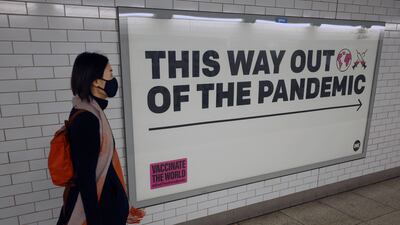
A sign pointing the way out of the pandemic on the London Underground. Reuters -
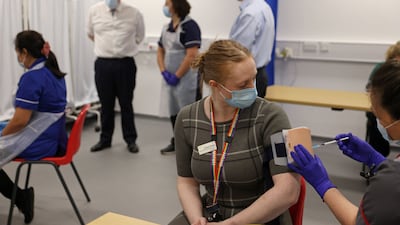
UK Prime Minister Boris Johnson visits a coronavirus vaccination training session during a visit to Milton Keynes University Hospital. AFP -
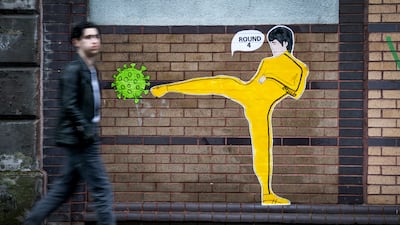
A picture by street artist 'Palley' in Glasgow's East End shows Bruce Lee kicking a coronavirus molecule. PA -
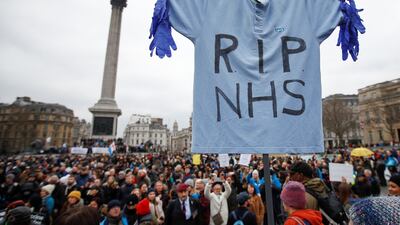
National Health Service workers carry an NHS polo shirt with a slogan written across it during a protest against vaccine rules in Trafalgar Square, central London. Reuters -
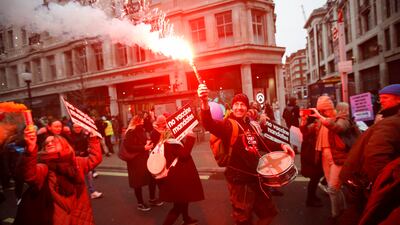
A marcher burns a flare during the NHS staff protest in London. Reuters -
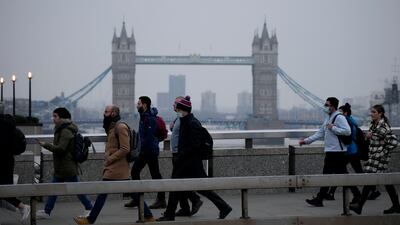
Commuters walk over London Bridge during the morning rush hour. The British government has asked people to return to working in offices as coronavirus restrictions are eased. AP -
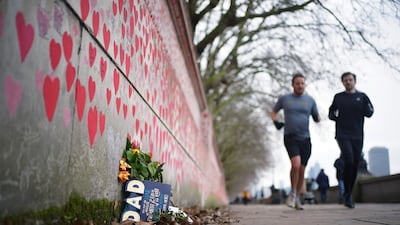
The National Covid Memorial Wall outside St Thomas' Hospital in London. PA -

Trainee nurse Chloe Slevin, with her painting 'Corona Lisa'. The interpretation of Leonardo da Vinci's masterpiece in PPE clothing will be auctioned for charity. PA



