US National Security Adviser Mike Waltz. AFP

US National Security Adviser Mike Waltz's technology woes put him in the hot seat


Cody Combs
  • English
  • Arabic

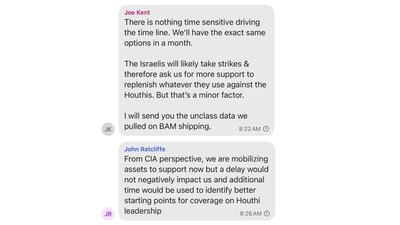
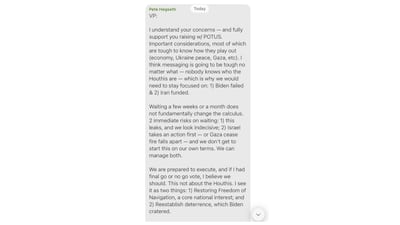
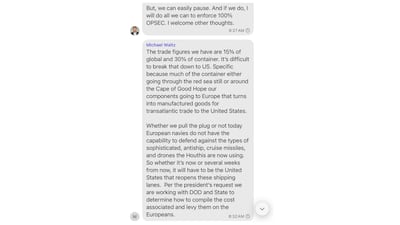
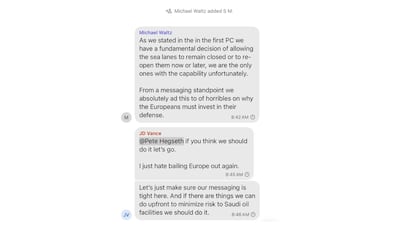
Amid the friction caused by US officials using Signal to plan military strikes in Yemen, National Security Adviser Mike Waltz's use of technology has come under the microscope following reports he has also used Gmail to discuss government business.

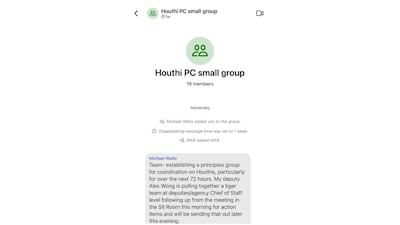
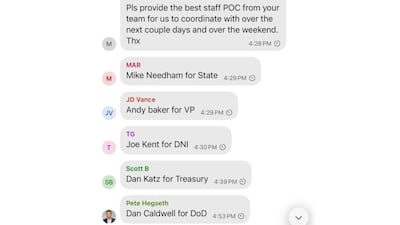
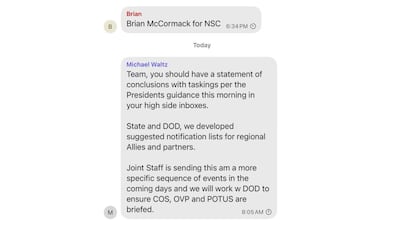
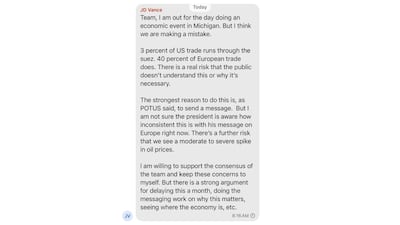
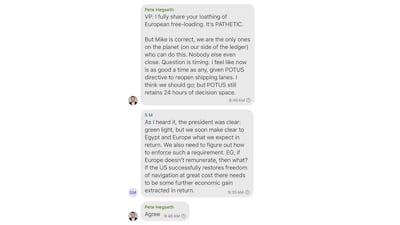
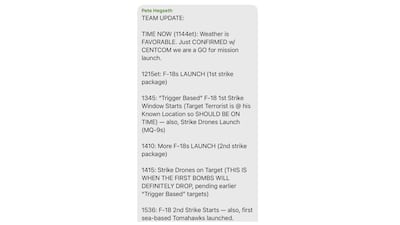
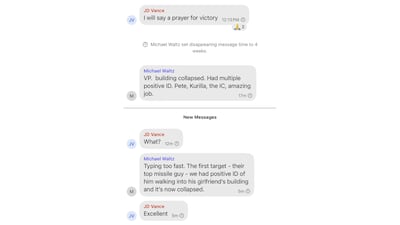
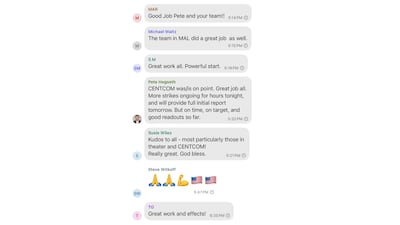
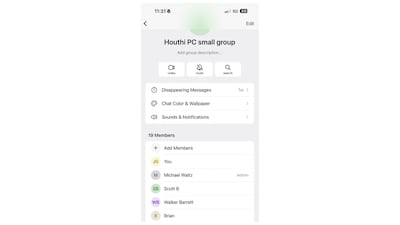
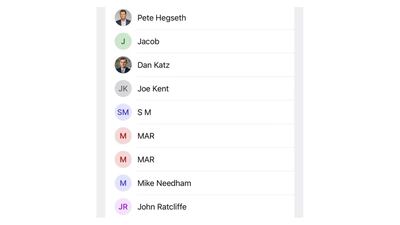
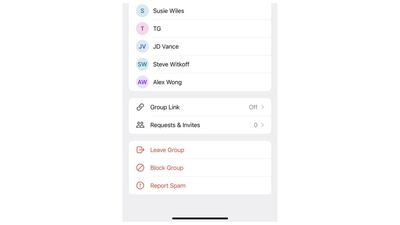
In what has become known as “Signalgate”, Jeffrey Goldberg, the editor-in-chief of The Atlantic magazine, reported late last month that he had inadvertently learnt details of US plans for attacks on Houthi rebels in Yemen after he was added to a group chat on the popular messaging app Signal. Mr Waltz was involved in that chat and was reportedly the one who added Goldberg.

The controversy was further stoked by a story published last week in The Washington Post, which claimed that Mr Waltz had also used Gmail for government communications.

Much like the fallout from the Signal revelations, security experts expressed shock that someone in such a prominent US government role would use conventional email to communicate about policy decisions.

“The big problem is that Gmail is not end-to-end encrypted,” Robert Graham, chief executive of Atlanta-based cyber security company Errata Security, told The National.

He said that “essentially, Google reads all the emails”, referring to default settings that allow the company to target advertising to users of Gmail.

The platform does offer an encryption setting, but it only works if other users have that particular setting activated as well, creating a security loophole.

Mr Graham has also been critical of US officials using Signal to discuss military operations, despite the app's encryption features.

“Often the defence department will urge against using these apps for secure communication because humans will be humans and they can't be trusted to use it correctly,” he said. “That was verified by this whole story – a journalist was accidentally added to the group.”

Military analysts, former defence officials and technology experts have expressed concern and confusion over Signal being used in the sharing of sensitive military information.

Peter Yacobucci, a political science and constitutional law professor at Buffalo State University, told The National that President Donald Trump and his advisers are continuing a trend from his first term in office in breaking with precedent on information related to national security.

“The Waltz story is more of the same,” he said. “It also suggests that they see state secrets and classified information not as something that needs to be guarded but as private commodities to be utilised for private capital gain.

“I have always thought Trump and his team would sell the nuclear codes at the drop of a hat if they got a price they like.”

Timothy Kneeland, a history and political science professor at Nazareth College in upstate New York, echoed those sentiments, adding the Trump administration's claims that the information in the Signal chats was not technically classified pushed credulity.

“Even if there was no classified information available, sometimes the most routine information can be useful,” he said, referring to the potential for the Houthis to intercept the Signal chat information.

“For example, the schedule could be used by an intelligence agency outside the United States to determine who the secretary was meeting with and draw conclusions about future actions of the US government.”

US National Security Adviser Mike Waltz with Defence Secretary Pete Hegseth. AFP

In addition to Mr Waltz, pressure has been high on Defence Secretary Pete Hegseth. “The purpose of this memorandum is to notify you that we are initiating the subject evaluation,” read a letter sent last Thursday from the acting US Inspector General to Mr Hegseth.

Although Democrats in Congress have pushed for Mr Hegseth to resign, he does not seem to be bowing to that pressure, insisting he did nothing wrong.

He also has the backing of Mr Trump, who has called the criticism “a witch hunt”.

As for Mr Waltz, several days after the Signal messages were made public, he went on Fox News and took “full responsibility” for the incident, but said he had no idea how the journalist was added to the Signal group chat.

As of April 7, the Gmail revelations are limited to Mr Waltz.

Meanwhile, Signal Messenger is also trying to clear up what it describes as misinformation about the platform that is the focus of so much discussion.

“Right now, there are a lot of new eyes on Signal, and not all of them are familiar with secure messaging and its nuances,” Signal posted to X, referring to a government memo which referred to “vulnerabilities” related to phishing attempts in Signal.

“Phishing isn’t new, and it’s not a flaw in our encryption or any of Signal’s underlying technology … Signal remains the gold standard for private, secure communications.”

As the fallout continues and scrutiny increases for the Trump administration's use of Signal to discuss military plans, the popular messaging app is looking to address what it describes as misinformation. Photo: Signal

Yet as the situation involving the Trump administration shows, all the security technology in the world would not have helped when a journalist was accidentally added to a Signal group chat.

For ultimate security, Mr Graham points out that sensitive compartmented information facilities, SCIFs, should always be used.

“You have to get into the habit of 'We need to have a conversation, let's go to a SCIF'. There's a high principle here in that the area is secure and you don't need to worry about journalists because the endpoints are secure.”


What is dialysis?

Dialysis is a way of cleaning your blood when your kidneys fail and can no longer do the job.

It gets rid of your body's wastes, extra salt and water, and helps to control your blood pressure. The main cause of kidney failure is diabetes and hypertension.

There are two kinds of dialysis — haemodialysis and peritoneal.

In haemodialysis, blood is pumped out of your body to an artificial kidney machine that filter your blood and returns it to your body by tubes.

In peritoneal dialysis, the inside lining of your own belly acts as a natural filter. Wastes are taken out by means of a cleansing fluid which is washed in and out of your belly in cycles.

It isn’t an option for everyone but if eligible, can be done at home by the patient or caregiver. This, as opposed to home haemodialysis, is covered by insurance in the UAE.

INFO
ICC T20 Rankings

1. India - 270 ranking points


2. England - 265 points


3. Pakistan - 261 points


4. South Africa - 253 points


5. Australia - 251 points 


6. New Zealand - 250 points


7. West Indies - 240 points


8. Bangladesh - 233 points


9. Sri Lanka - 230 points


10. Afghanistan - 226 points


Student Of The Year 2

Director: Punit Malhotra

Stars: Tiger Shroff, Tara Sutaria, Ananya Pandey, Aditya Seal 

1.5 stars

In numbers: China in Dubai

The number of Chinese people living in Dubai: An estimated 200,000

Number of Chinese people in International City: Almost 50,000

Daily visitors to Dragon Mart in 2018/19: 120,000

Daily visitors to Dragon Mart in 2010: 20,000

Percentage increase in visitors in eight years: 500 per cent

Our Time Has Come
Alyssa Ayres, Oxford University Press

LIVERPOOL SQUAD

Alisson Becker, Virgil van Dijk, Georginio Wijnaldum, James Milner, Naby Keita, Roberto Firmino, Sadio Mane, Mohamed Salah, Joe Gomez, Adrian, Jordan Henderson, Alex Oxlade-Chamberlain, Adam Lallana, Andy Lonergan, Xherdan Shaqiri, Andy Robertson, Divock Origi, Curtis Jones, Trent Alexander-Arnold, Neco Williams

The National's picks

4.35pm: Tilal Al Khalediah
5.10pm: Continous
5.45pm: Raging Torrent
6.20pm: West Acre
7pm: Flood Zone
7.40pm: Straight No Chaser
8.15pm: Romantic Warrior
8.50pm: Calandogan
9.30pm: Forever Young

Mercer, the investment consulting arm of US services company Marsh & McLennan, expects its wealth division to at least double its assets under management (AUM) in the Middle East as wealth in the region continues to grow despite economic headwinds, a company official said.

Mercer Wealth, which globally has $160 billion in AUM, plans to boost its AUM in the region to $2-$3bn in the next 2-3 years from the present $1bn, said Yasir AbuShaban, a Dubai-based principal with Mercer Wealth.

Within the next two to three years, we are looking at reaching $2 to $3 billion as a conservative estimate and we do see an opportunity to do so,” said Mr AbuShaban.

Mercer does not directly make investments, but allocates clients’ money they have discretion to, to professional asset managers. They also provide advice to clients.

“We have buying power. We can negotiate on their (client’s) behalf with asset managers to provide them lower fees than they otherwise would have to get on their own,” he added.

Mercer Wealth’s clients include sovereign wealth funds, family offices, and insurance companies among others.

From its office in Dubai, Mercer also looks after Africa, India and Turkey, where they also see opportunity for growth.

Wealth creation in Middle East and Africa (MEA) grew 8.5 per cent to $8.1 trillion last year from $7.5tn in 2015, higher than last year’s global average of 6 per cent and the second-highest growth in a region after Asia-Pacific which grew 9.9 per cent, according to consultancy Boston Consulting Group (BCG). In the region, where wealth grew just 1.9 per cent in 2015 compared with 2014, a pickup in oil prices has helped in wealth generation.

BCG is forecasting MEA wealth will rise to $12tn by 2021, growing at an annual average of 8 per cent.

Drivers of wealth generation in the region will be split evenly between new wealth creation and growth of performance of existing assets, according to BCG.

Another general trend in the region is clients’ looking for a comprehensive approach to investing, according to Mr AbuShaban.

“Institutional investors or some of the families are seeing a slowdown in the available capital they have to invest and in that sense they are looking at optimizing the way they manage their portfolios and making sure they are not investing haphazardly and different parts of their investment are working together,” said Mr AbuShaban.

Some clients also have a higher appetite for risk, given the low interest-rate environment that does not provide enough yield for some institutional investors. These clients are keen to invest in illiquid assets, such as private equity and infrastructure.

“What we have seen is a desire for higher returns in what has been a low-return environment specifically in various fixed income or bonds,” he said.

“In this environment, we have seen a de facto increase in the risk that clients are taking in things like illiquid investments, private equity investments, infrastructure and private debt, those kind of investments were higher illiquidity results in incrementally higher returns.”

The Abu Dhabi Investment Authority, one of the largest sovereign wealth funds, said in its 2016 report that has gradually increased its exposure in direct private equity and private credit transactions, mainly in Asian markets and especially in China and India. The authority’s private equity department focused on structured equities owing to “their defensive characteristics.”

Red flags
  • Promises of high, fixed or 'guaranteed' returns.
  • Unregulated structured products or complex investments often used to bypass traditional safeguards.
  • Lack of clear information, vague language, no access to audited financials.
  • Overseas companies targeting investors in other jurisdictions - this can make legal recovery difficult.
  • Hard-selling tactics - creating urgency, offering 'exclusive' deals.

Courtesy: Carol Glynn, founder of Conscious Finance Coaching

Jetour T1 specs

Engine: 2-litre turbocharged

Power: 254hp

Torque: 390Nm

Price: From Dh126,000

Available: Now

GAC GS8 Specs

Engine: 2.0-litre 4cyl turbo

Power: 248hp at 5,200rpm

Torque: 400Nm at 1,750-4,000rpm

Transmission: 8-speed auto

Fuel consumption: 9.1L/100km

On sale: Now

Price: From Dh149,900

Updated: April 07, 2025, 2:36 PM