An increasing number of UAE residents are turning to hotels for long-term stays.
Aside from perks such as room service and regular housekeeping, long-term hotel stays can be more convenient for some as they are flexible compared to signing a year-long rental contract. For others, it's a more economical option, given rising rents and all the other fees that come with such leases, including paying brokerage and utility bills.
In the UAE, there are plenty of long-term stay options on offer, many located conveniently near major business districts or, if you're in Dubai, close to a metro station.
Here, The National rounds up some of the best deals across the UAE.
Jumeira Rotana
Located in Bur Dubai, the hotel is a 10-minute drive from Downtown Dubai, making it a good choice for those who also want quick access to the heritage areas of Dubai, such as the famous Al Fahidi neighbourhood.
Long-term stays at this property include weekly housekeeping and access to a self-service laundry area. Guests also get several discounts – 30 per cent on on-demand laundry services, 50 per cent on room service and 15 per cent at the hotel restaurant.
Monthly cost: Prices differ based on the room, but start from Dh3,999 in a classic king suite; rotana.com
Rove Hotels
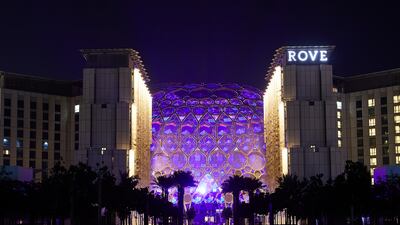
Rove Hotels has nine properties across Dubai, most of which are located in prime areas, such as Marina, Downtown and City Walk.
A long-term stay here includes 50 per cent off on self-service laundromat and on-demand laundry service, 30 per cent off on food and drinks at The Daily restaurant and a 20 per cent membership discount on co-working application Letswork.
Monthly cost: Prices differ based on the property. The cheapest is Rove At The Park, where prices start at Dh2,999; rovehotels.com
Edge Creekside Hotel
The four-star property near old Dubai offers its guests – short and long-term – an outdoor pool and a 24-hour gym, as well as select rooms with creek views.
The deal includes twice-weekly housekeeping, 25 per cent off on laundry services, as well as a 20 per cent discount on food and drinks.
Monthly cost: A deluxe room with city views costs Dh6,000, while a two-bedroom suite with creek views costs Dh13,000; edgehotels.com
Premier Inn
The budget hotel, which has properties in Dubai and Abu Dhabi, is offering long-term stays with daily free breakfast. The brand is popular with long-term guests – about 240,000 tenants stay across its hotels in the UAE and Qatar every year.
Aside from the daily breakfast, there are also up to 30 per cent discounts on other food and drink purchases, as well as laundry services.
Monthly cost: Prices start at Dh2,640; mena.premierinn.com
Studio One Hotel
The funky property is popular with on-the-go executives looking for long-term hotel stays.
Three rooms are available for this offer, which also includes 20 per cent discount on food and drinks, swimming pool and gym access, as well as two tokens for self-service laundry per week. Guests can also get special rates for the hotel's meeting spaces and private cinema.
Monthly cost: Prices start at Dh5,500; studioonehotel.com
Ibis Al Barsha
The budget hotel in Al Barsha near Mall of the Emirates recently underwent renovation. The lobby doubles as a co-working space, as well as a lounge area with foosball and pool tables.
The long-term stay comes with free parking for one car and twice-weekly housekeeping by arrangement.
Monthly cost: Prices differ based on the room, starting at Dh3,999 for a standard king room; all.accor.com
Media One Hotel
The four-star property in Dubai Media City is conveniently close to a lot of office buildings in the area. Dubai Marina is also a quick drive from the hotel.
A 30-day stay gives guests twice-weekly housekeeping services with daily rubbish collection, an indoor parking space, dining discounts at the hotel restaurants and access to a guest pantry.
Monthly cost: Prices start at Dh9,870; mediaonehotel.com
Hyde Hotel
Guests can book a room at the Business Bay hotel for six months for a special price. The deal comes with daily housekeeping, parking, as well as gym and swimming pool access. There's also a 25 per cent discount on all food and drinks at the property. Guests can pay more to add breakfast.
Monthly cost: Prices start at Dh8,500 with minimum six-month stay, inclusive of taxes. Breakfast can be added for Dh1,500; ennismore.com
Jumeirah Living Marina Gate
The Jumeirah Hotel property in Dubai Marina offers perks for those booking 30 nights or more.
Guests can choose between studios, one-bedroom and two-bedroom suites, all equipped with open-plan kitchens. Housekeeping can be arranged thrice weekly and guests can negotiate a flexible payment plan.
There are special rates to access Wild Wadi Waterpark, and guests booking a one or two-bedroom suite get complimentary private beach access.
Monthly cost: Rates depend on the unit. Studio stays start at Dh13,470; jumeirah.com
Dusit Thani Abu Dhabi
The hotel offers studios and one-bedroom apartments to its long-term guests. Both rooms are furnished and include a fully fitted kitchenette.
Guests can avail themselves of special discounts at the hotel's food and drinks outlets, as well as the spa. The deal also comes with weekly housekeeping, access to the swimming pool and gym, plus an individual washing machine.
Monthly cost: A studio costs Dh9,500; dusit.com
Anantara Eastern Mangroves Abu Dhabi
Guests looking for a five-star experience can check out this property with its view of Abu Dhabi's unique mangrove expanse and proximity to the Eastern Mangroves promenade, which is home to a bustling food and beverage scene.
The hotel offers long-term residents 30 per cent off on laundry services, 20 per cent off on food and drinks, and 20 per cent off at the spa.
Monthly cost: Prices start at Dh8,499; anantara.com
Jannah Hotels
The four-star hotel has five locations across Dubai, Abu Dhabi and Ras Al Khaimah.
Long-term guests get twice-weekly housekeeping service, underground parking and complimentary use of recreational facilities within the hotels. There is also a 20 per cent discount on food and drinks.
Monthly cost: Prices depend on the unit. A suite with a sea view at Jannah Burj Al Sarab in Abu Dhabi costs Dh7,500; jannah-hotels.com
UAE Rugby finals day
Games being played at The Sevens, Dubai
2pm, UAE Conference final
Dubai Tigers v Al Ain Amblers
4pm, UAE Premiership final
Abu Dhabi Harlequins v Jebel Ali Dragons
What is Diwali?
The Hindu festival is at once a celebration of the autumn harvest and the triumph of good over evil, as outlined in the Ramayana.
According to the Sanskrit epic, penned by the sage Valmiki, Diwali marks the time that the exiled king Rama – a mortal with superhuman powers – returned home to the city of Ayodhya with his wife Sita and brother Lakshman, after vanquishing the 10-headed demon Ravana and conquering his kingdom of Lanka. The people of Ayodhya are believed to have lit thousands of earthen lamps to illuminate the city and to guide the royal family home.
In its current iteration, Diwali is celebrated with a puja to welcome the goodness of prosperity Lakshmi (an incarnation of Sita) into the home, which is decorated with diyas (oil lamps) or fairy lights and rangoli designs with coloured powder. Fireworks light up the sky in some parts of the word, and sweetmeats are made (or bought) by most households. It is customary to get new clothes stitched, and visit friends and family to exchange gifts and greetings.
Mercer, the investment consulting arm of US services company Marsh & McLennan, expects its wealth division to at least double its assets under management (AUM) in the Middle East as wealth in the region continues to grow despite economic headwinds, a company official said.
Mercer Wealth, which globally has $160 billion in AUM, plans to boost its AUM in the region to $2-$3bn in the next 2-3 years from the present $1bn, said Yasir AbuShaban, a Dubai-based principal with Mercer Wealth.
“Within the next two to three years, we are looking at reaching $2 to $3 billion as a conservative estimate and we do see an opportunity to do so,” said Mr AbuShaban.
Mercer does not directly make investments, but allocates clients’ money they have discretion to, to professional asset managers. They also provide advice to clients.
“We have buying power. We can negotiate on their (client’s) behalf with asset managers to provide them lower fees than they otherwise would have to get on their own,” he added.
Mercer Wealth’s clients include sovereign wealth funds, family offices, and insurance companies among others.
From its office in Dubai, Mercer also looks after Africa, India and Turkey, where they also see opportunity for growth.
Wealth creation in Middle East and Africa (MEA) grew 8.5 per cent to $8.1 trillion last year from $7.5tn in 2015, higher than last year’s global average of 6 per cent and the second-highest growth in a region after Asia-Pacific which grew 9.9 per cent, according to consultancy Boston Consulting Group (BCG). In the region, where wealth grew just 1.9 per cent in 2015 compared with 2014, a pickup in oil prices has helped in wealth generation.
BCG is forecasting MEA wealth will rise to $12tn by 2021, growing at an annual average of 8 per cent.
Drivers of wealth generation in the region will be split evenly between new wealth creation and growth of performance of existing assets, according to BCG.
Another general trend in the region is clients’ looking for a comprehensive approach to investing, according to Mr AbuShaban.
“Institutional investors or some of the families are seeing a slowdown in the available capital they have to invest and in that sense they are looking at optimizing the way they manage their portfolios and making sure they are not investing haphazardly and different parts of their investment are working together,” said Mr AbuShaban.
Some clients also have a higher appetite for risk, given the low interest-rate environment that does not provide enough yield for some institutional investors. These clients are keen to invest in illiquid assets, such as private equity and infrastructure.
“What we have seen is a desire for higher returns in what has been a low-return environment specifically in various fixed income or bonds,” he said.
“In this environment, we have seen a de facto increase in the risk that clients are taking in things like illiquid investments, private equity investments, infrastructure and private debt, those kind of investments were higher illiquidity results in incrementally higher returns.”
The Abu Dhabi Investment Authority, one of the largest sovereign wealth funds, said in its 2016 report that has gradually increased its exposure in direct private equity and private credit transactions, mainly in Asian markets and especially in China and India. The authority’s private equity department focused on structured equities owing to “their defensive characteristics.”
BMW M5 specs
Engine: 4.4-litre twin-turbo V-8 petrol enging with additional electric motor
Power: 727hp
Torque: 1,000Nm
Transmission: 8-speed auto
Fuel consumption: 10.6L/100km
On sale: Now
Price: From Dh650,000
Scoreline:
Everton 4
Richarlison 13'), Sigurdsson 28', Digne 56', Walcott 64'
Manchester United 0
Man of the match: Gylfi Sigurdsson (Everton)
UAE currency: the story behind the money in your pockets
In numbers
1,000 tonnes of waste collected daily:
- 800 tonnes converted into alternative fuel
- 150 tonnes to landfill
- 50 tonnes sold as scrap metal
800 tonnes of RDF replaces 500 tonnes of coal
Two conveyor lines treat more than 350,000 tonnes of waste per year
25 staff on site
Tu%20Jhoothi%20Main%20Makkaar%20
%3Cp%3E%3Cstrong%3EDirector%3A%20%3C%2Fstrong%3ELuv%20Ranjan%26nbsp%3B%3C%2Fp%3E%0A%3Cp%3E%3Cstrong%3EStars%3A%20%3C%2Fstrong%3ERanbir%20Kapoor%2C%20Shraddha%20Kapoor%2C%20Anubhav%20Singh%20Bassi%20and%20Dimple%20Kapadia%3C%2Fp%3E%0A%3Cp%3E%3Cstrong%3ERating%3A%3C%2Fstrong%3E%203%2F5%3C%2Fp%3E%0A
Ten tax points to be aware of in 2026
1. Domestic VAT refund amendments: request your refund within five years
If a business does not apply for the refund on time, they lose their credit.
2. E-invoicing in the UAE
Businesses should continue preparing for the implementation of e-invoicing in the UAE, with 2026 a preparation and transition period ahead of phased mandatory adoption.
3. More tax audits
Tax authorities are increasingly using data already available across multiple filings to identify audit risks.
4. More beneficial VAT and excise tax penalty regime
Tax disputes are expected to become more frequent and more structured, with clearer administrative objection and appeal processes. The UAE has adopted a new penalty regime for VAT and excise disputes, which now mirrors the penalty regime for corporate tax.
5. Greater emphasis on statutory audit
There is a greater need for the accuracy of financial statements. The International Financial Reporting Standards standards need to be strictly adhered to and, as a result, the quality of the audits will need to increase.
6. Further transfer pricing enforcement
Transfer pricing enforcement, which refers to the practice of establishing prices for internal transactions between related entities, is expected to broaden in scope. The UAE will shortly open the possibility to negotiate advance pricing agreements, or essentially rulings for transfer pricing purposes.
7. Limited time periods for audits
Recent amendments also introduce a default five-year limitation period for tax audits and assessments, subject to specific statutory exceptions. While the standard audit and assessment period is five years, this may be extended to up to 15 years in cases involving fraud or tax evasion.
8. Pillar 2 implementation
Many multinational groups will begin to feel the practical effect of the Domestic Minimum Top-Up Tax (DMTT), the UAE's implementation of the OECD’s global minimum tax under Pillar 2. While the rules apply for financial years starting on or after January 1, 2025, it is 2026 that marks the transition to an operational phase.
9. Reduced compliance obligations for imported goods and services
Businesses that apply the reverse-charge mechanism for VAT purposes in the UAE may benefit from reduced compliance obligations.
10. Substance and CbC reporting focus
Tax authorities are expected to continue strengthening the enforcement of economic substance and Country-by-Country (CbC) reporting frameworks. In the UAE, these regimes are increasingly being used as risk-assessment tools, providing tax authorities with a comprehensive view of multinational groups’ global footprints and enabling them to assess whether profits are aligned with real economic activity.
Contributed by Thomas Vanhee and Hend Rashwan, Aurifer
Ain Dubai in numbers
126: The length in metres of the legs supporting the structure
1 football pitch: The length of each permanent spoke is longer than a professional soccer pitch
16 A380 Airbuses: The equivalent weight of the wheel rim.
9,000 tonnes: The amount of steel used to construct the project.
5 tonnes: The weight of each permanent spoke that is holding the wheel rim in place
192: The amount of cable wires used to create the wheel. They measure a distance of 2,4000km in total, the equivalent of the distance between Dubai and Cairo.
UAE currency: the story behind the money in your pockets