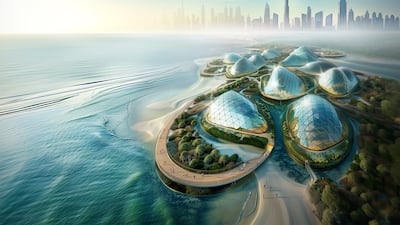
Plans for what would be the world’s largest coastal regeneration project have been revealed in Dubai.
If it eventually goes ahead and is completed, Dubai Mangroves would become a 72km stretch of regenerated coastline and home to 100 million planted mangrove trees, developer URB has announced.
The project, currently in the design and research stage, aims to enhance Dubai’s marine biodiversity, transform the appearance of its coastline and create 10,000 eco-tourism jobs. The developer said the project would also boost Dubai’s seagrass beds and coral reefs.
Research is currently continuing across six pilot zones in Dubai. These are Jebel Ali Beach, Dubai Marina Beach, Jumeirah Public Beach, Umm Suqeim Beach and Dubai Islands Beach. Each location has been selected “based on their unique challenges, potential for community benefits, and suitability for urban integration”, a representative for URB told The National. “Each site offers distinct conditions that are essential for testing different innovative coastal regeneration methods and ensuring the project adapts to varying local needs.”
If the project is approved and realised, Dubai Mangroves would also consist of pocket beach parks and social spaces where people would be able to enjoy the natural scenery. Cycling paths, running tracks and beach sports facilities are also part of the plan.
The plan includes green coastal zones, where guided nature walks would be on offer. A Mangrove Visitor Hub is planned as a place where the local community would be able to engage in environmental issues. The Hub and a Nature Reserve Conservation Centre, meanwhile, would be places where visitors could learn more about mangrove trees and environmental stewardship.
At the heart of the project is a Botanical Museum. It would guide visitors through interactive exhibits that narrate the story of plant evolution and adaptation, with exhibits on coastal protection, climate change and biodiversity. The glass-domed museum would also be a place for community engagement, with workshops, events and seminars aimed at inspiring a generation of environmental stewards.
Known for their ability to sequester carbon dioxide, the mangroves would be able to remove 1.23 million tonnes of CO2 a year, according to the developer. That is the equivalent of taking more than 260,000 petrol-powered cars off the road.
URB – the same developer behind The Loop, a climate-controlled, sustainable 93km cycling and wellness motorway planned for Dubai – is masterminding the project and says it could be ready by 2040.
Technology is a key part of the Dubai Mangroves project, with drones being utilised for reforestation and satellite imagery. URB said artificial intelligence would be used to monitor the mangrove forests and guide conservation efforts.
Dubai Mangroves was initially a part of Dubai Reefs, which was announced by URB last year. The project has now evolved into its own initiative. “Although separate, both initiatives complement each other and share connected objectives”, confirmed a URB representative.
Essentials
The flights
Etihad and Emirates fly direct from the UAE to Delhi from about Dh950 return including taxes.
The hotels
Double rooms at Tijara Fort-Palace cost from 6,670 rupees (Dh377), including breakfast.
Doubles at Fort Bishangarh cost from 29,030 rupees (Dh1,641), including breakfast. Doubles at Narendra Bhawan cost from 15,360 rupees (Dh869). Doubles at Chanoud Garh cost from 19,840 rupees (Dh1,122), full board. Doubles at Fort Begu cost from 10,000 rupees (Dh565), including breakfast.
The tours
Amar Grover travelled with Wild Frontiers. A tailor-made, nine-day itinerary via New Delhi, with one night in Tijara and two nights in each of the remaining properties, including car/driver, costs from £1,445 (Dh6,968) per person.
Fight card
Preliminaries:
Nouredine Samir (UAE) v Sheroz Kholmirzav (UZB); Lucas Porst (SWE) v Ellis Barboza (GBR); Mouhmad Amine Alharar (MAR) v Mohammed Mardi (UAE); Ibrahim Bilal (UAE) v Spyro Besiri (GRE); Aslamjan Ortikov (UZB) v Joshua Ridgwell (GBR)
Main card:
Carlos Prates (BRA) v Dmitry Valent (BLR); Bobirjon Tagiev (UZB) v Valentin Thibaut (FRA); Arthur Meyer (FRA) v Hicham Moujtahid (BEL); Ines Es Salehy (BEL) v Myriame Djedidi (FRA); Craig Coakley (IRE) v Deniz Demirkapu (TUR); Artem Avanesov (ARM) v Badreddine Attif (MAR); Abdulvosid Buranov (RUS) v Akram Hamidi (FRA)
Title card:
Intercontinental Lightweight: Ilyass Habibali (UAE) v Angel Marquez (ESP)
Intercontinental Middleweight: Amine El Moatassime (UAE) v Francesco Iadanza (ITA)
Asian Featherweight: Zakaria El Jamari (UAE) v Phillip Delarmino (PHI)
ICC Women's T20 World Cup Asia Qualifier 2025, Thailand
UAE fixtures
May 9, v Malaysia
May 10, v Qatar
May 13, v Malaysia
May 15, v Qatar
May 18 and 19, semi-finals
May 20, final
ENGLAND SQUAD
For first two Test in India Joe Root (captain), Jofra Archer, Moeen Ali, James Anderson , Dom Bess, Stuart Broad , Rory Burns, Jos Buttler, Zak Crawley, Ben Foakes, Dan Lawrence, Jack Leach, Dom Sibley, Ben Stokes, Olly Stone, Chris Woakes. Reserves James Bracey, Mason Crane, Saqib Mahmood, Matthew Parkinson, Ollie Robinson, Amar Virdi.
Timeline
2012-2015
The company offers payments/bribes to win key contracts in the Middle East
May 2017
The UK SFO officially opens investigation into Petrofac’s use of agents, corruption, and potential bribery to secure contracts
September 2021
Petrofac pleads guilty to seven counts of failing to prevent bribery under the UK Bribery Act
October 2021
Court fines Petrofac £77 million for bribery. Former executive receives a two-year suspended sentence
December 2024
Petrofac enters into comprehensive restructuring to strengthen the financial position of the group
May 2025
The High Court of England and Wales approves the company’s restructuring plan
July 2025
The Court of Appeal issues a judgment challenging parts of the restructuring plan
August 2025
Petrofac issues a business update to execute the restructuring and confirms it will appeal the Court of Appeal decision
October 2025
Petrofac loses a major TenneT offshore wind contract worth €13 billion. Holding company files for administration in the UK. Petrofac delisted from the London Stock Exchange
November 2025
180 Petrofac employees laid off in the UAE
Killing of Qassem Suleimani
Mercer, the investment consulting arm of US services company Marsh & McLennan, expects its wealth division to at least double its assets under management (AUM) in the Middle East as wealth in the region continues to grow despite economic headwinds, a company official said.
Mercer Wealth, which globally has $160 billion in AUM, plans to boost its AUM in the region to $2-$3bn in the next 2-3 years from the present $1bn, said Yasir AbuShaban, a Dubai-based principal with Mercer Wealth.
“Within the next two to three years, we are looking at reaching $2 to $3 billion as a conservative estimate and we do see an opportunity to do so,” said Mr AbuShaban.
Mercer does not directly make investments, but allocates clients’ money they have discretion to, to professional asset managers. They also provide advice to clients.
“We have buying power. We can negotiate on their (client’s) behalf with asset managers to provide them lower fees than they otherwise would have to get on their own,” he added.
Mercer Wealth’s clients include sovereign wealth funds, family offices, and insurance companies among others.
From its office in Dubai, Mercer also looks after Africa, India and Turkey, where they also see opportunity for growth.
Wealth creation in Middle East and Africa (MEA) grew 8.5 per cent to $8.1 trillion last year from $7.5tn in 2015, higher than last year’s global average of 6 per cent and the second-highest growth in a region after Asia-Pacific which grew 9.9 per cent, according to consultancy Boston Consulting Group (BCG). In the region, where wealth grew just 1.9 per cent in 2015 compared with 2014, a pickup in oil prices has helped in wealth generation.
BCG is forecasting MEA wealth will rise to $12tn by 2021, growing at an annual average of 8 per cent.
Drivers of wealth generation in the region will be split evenly between new wealth creation and growth of performance of existing assets, according to BCG.
Another general trend in the region is clients’ looking for a comprehensive approach to investing, according to Mr AbuShaban.
“Institutional investors or some of the families are seeing a slowdown in the available capital they have to invest and in that sense they are looking at optimizing the way they manage their portfolios and making sure they are not investing haphazardly and different parts of their investment are working together,” said Mr AbuShaban.
Some clients also have a higher appetite for risk, given the low interest-rate environment that does not provide enough yield for some institutional investors. These clients are keen to invest in illiquid assets, such as private equity and infrastructure.
“What we have seen is a desire for higher returns in what has been a low-return environment specifically in various fixed income or bonds,” he said.
“In this environment, we have seen a de facto increase in the risk that clients are taking in things like illiquid investments, private equity investments, infrastructure and private debt, those kind of investments were higher illiquidity results in incrementally higher returns.”
The Abu Dhabi Investment Authority, one of the largest sovereign wealth funds, said in its 2016 report that has gradually increased its exposure in direct private equity and private credit transactions, mainly in Asian markets and especially in China and India. The authority’s private equity department focused on structured equities owing to “their defensive characteristics.”
Shubh Mangal Saavdhan
Directed by: RS Prasanna
Starring: Ayushmann Khurrana, Bhumi Pednekar
Keep it fun and engaging
Stuart Ritchie, director of wealth advice at AES International, says children cannot learn something overnight, so it helps to have a fun routine that keeps them engaged and interested.
“I explain to my daughter that the money I draw from an ATM or the money on my bank card doesn’t just magically appear – it’s money I have earned from my job. I show her how this works by giving her little chores around the house so she can earn pocket money,” says Mr Ritchie.
His daughter is allowed to spend half of her pocket money, while the other half goes into a bank account. When this money hits a certain milestone, Mr Ritchie rewards his daughter with a small lump sum.
He also recommends books that teach the importance of money management for children, such as The Squirrel Manifesto by Ric Edelman and Jean Edelman.
Nepotism is the name of the game
Salman Khan’s father, Salim Khan, is one of Bollywood’s most legendary screenwriters. Through his partnership with co-writer Javed Akhtar, Salim is credited with having paved the path for the Indian film industry’s blockbuster format in the 1970s. Something his son now rules the roost of. More importantly, the Salim-Javed duo also created the persona of the “angry young man” for Bollywood megastar Amitabh Bachchan in the 1970s, reflecting the angst of the average Indian. In choosing to be the ordinary man’s “hero” as opposed to a thespian in new Bollywood, Salman Khan remains tightly linked to his father’s oeuvre. Thanks dad.
Company%20profile
%3Cp%3E%3Cstrong%3EName%3A%3C%2Fstrong%3E%20Yabi%20by%20Souqalmal%C2%A0%3C%2Fp%3E%0A%3Cp%3E%3Cstrong%3EStarted%3A%20%3C%2Fstrong%3EMay%202022%2C%20launched%20June%202023%3C%2Fp%3E%0A%3Cp%3E%3Cstrong%3EFounder%3A%20%3C%2Fstrong%3EAmbareen%20Musa%3C%2Fp%3E%0A%3Cp%3E%3Cstrong%3EBased%3A%20%3C%2Fstrong%3EDubai%C2%A0%3C%2Fp%3E%0A%3Cp%3E%3Cstrong%3ESector%3A%20%3C%2Fstrong%3EFinTech%C2%A0%3C%2Fp%3E%0A%3Cp%3E%3Cstrong%3EInitial%20investment%3A%20u%3C%2Fstrong%3Endisclosed%20but%20soon%20to%20be%20announced%C2%A0%3C%2Fp%3E%0A%3Cp%3E%3Cstrong%3ENumber%20of%20staff%3A%20%3C%2Fstrong%3E12%C2%A0%3C%2Fp%3E%0A%3Cp%3E%3Cstrong%3EInvestment%20stage%3A%20%3C%2Fstrong%3Eseed%C2%A0%C2%A0%3C%2Fp%3E%0A%3Cp%3E%3Cstrong%3EInvestors%3A%20%3C%2Fstrong%3EShuaa%20Capital%3C%2Fp%3E%0A
Seven tips from Emirates NBD
1. Never respond to e-mails, calls or messages asking for account, card or internet banking details
2. Never store a card PIN (personal identification number) in your mobile or in your wallet
3. Ensure online shopping websites are secure and verified before providing card details
4. Change passwords periodically as a precautionary measure
5. Never share authentication data such as passwords, card PINs and OTPs (one-time passwords) with third parties
6. Track bank notifications regarding transaction discrepancies
7. Report lost or stolen debit and credit cards immediately
MATCH INFO
Rajasthan Royals 158-8 (20 ovs)
Kings XI Punjab 143/7 (20 ovs)
Rajasthan Royals won by 15 runs
CHATGPT%20ENTERPRISE%20FEATURES
%3Cp%3E%E2%80%A2%20Enterprise-grade%20security%20and%20privacy%3C%2Fp%3E%0A%3Cp%3E%E2%80%A2%20Unlimited%20higher-speed%20GPT-4%20access%20with%20no%20caps%3C%2Fp%3E%0A%3Cp%3E%E2%80%A2%20Longer%20context%20windows%20for%20processing%20longer%20inputs%3C%2Fp%3E%0A%3Cp%3E%E2%80%A2%20Advanced%20data%20analysis%20capabilities%3C%2Fp%3E%0A%3Cp%3E%E2%80%A2%20Customisation%20options%3C%2Fp%3E%0A%3Cp%3E%E2%80%A2%20Shareable%20chat%20templates%20that%20companies%20can%20use%20to%20collaborate%20and%20build%20common%20workflows%3C%2Fp%3E%0A%3Cp%3E%E2%80%A2%20Analytics%20dashboard%20for%20usage%20insights%3C%2Fp%3E%0A%3Cp%3E%E2%80%A2%20Free%20credits%20to%20use%20OpenAI%20APIs%20to%20extend%20OpenAI%20into%20a%20fully-custom%20solution%20for%20enterprises%3C%2Fp%3E%0A
COMPANY%20PROFILE%20
%3Cp%3E%3Cstrong%3EName%3A%3C%2Fstrong%3E%20Haltia.ai%0D%3Cbr%3E%3Cstrong%3EStarted%3A%3C%2Fstrong%3E%202023%0D%3Cbr%3E%3Cstrong%3ECo-founders%3A%3C%2Fstrong%3E%20Arto%20Bendiken%20and%20Talal%20Thabet%0D%3Cbr%3E%3Cstrong%3EBased%3A%3C%2Fstrong%3E%20Dubai%2C%20UAE%0D%3Cbr%3E%3Cstrong%3EIndustry%3A%3C%2Fstrong%3E%20AI%0D%3Cbr%3E%3Cstrong%3ENumber%20of%20employees%3A%3C%2Fstrong%3E%2041%0D%3Cbr%3E%3Cstrong%3EFunding%3A%3C%2Fstrong%3E%20About%20%241.7%20million%0D%3Cbr%3E%3Cstrong%3EInvestors%3A%3C%2Fstrong%3E%20Self%2C%20family%20and%20friends%26nbsp%3B%3C%2Fp%3E%0A
What is the definition of an SME?
SMEs in the UAE are defined by the number of employees, annual turnover and sector. For example, a “small company” in the services industry has six to 50 employees with a turnover of more than Dh2 million up to Dh20m, while in the manufacturing industry the requirements are 10 to 100 employees with a turnover of more than Dh3m up to Dh50m, according to Dubai SME, an agency of the Department of Economic Development.
A “medium-sized company” can either have staff of 51 to 200 employees or 101 to 250 employees, and a turnover less than or equal to Dh200m or Dh250m, again depending on whether the business is in the trading, manufacturing or services sectors.