


More than half of young Arabs — 56 per cent — are concerned about climate change, a survey shows.
The same number said they would boycott a brand if it was operating in a way that damaged the environment.
The findings are the latest results of the Arab Youth Survey 2021, based on face-to-face interviews with 3,400 people aged 18-24 and released to coincide with the Cop26 in Glasgow.
Authors said the region’s young people are now taking a more critical look at look at whether governments and businesses act responsibly. Nearly two thirds — 63 per cent — of young people in the Gulf said they are willing to boycott a brand that does not respect the environment. The figure was 56 per cent in North Africa and 51 per cent in the Levant.
Climate campaigners have named and shamed some of the worst environmental polluters. The fashion industry alone accounts for about 10 per cent of global carbon emissions, with a fast fashion culture leading to high waste and increased factory output.
And each year, climate campaigners rank and name the worst multinationals for plastic waste, with companies such as Coca-Cola, Pepsi and Nestle most commonly in the crosshairs.
The Arab Youth Survey's author, Dubai-based communications agency Asda’a BCW, said attitudes have shifted significantly in the past 13 years.
“In 2008, during the inaugural Arab Youth Survey, just 11 per cent of youths surveyed felt climate change and the environment were the biggest challenges facing the world”, said Sunil John, founder of Asda'a BCW.
“Fast forward 13 years, and climate change dominates the youth agenda, with 56 per cent saying they are concerned by the issues. This is an eye-opener for governments and private enterprises in the region on the urgent need to embrace positive climate action.”
What will halt climate change - technology or human behaviour?
Polling found there was a significant divide between whether people thought most climate problems could be solved by technology, or whether their lives would have to change to cut emissions.
In Kuwait and the UAE, 75 per cent and 71 per cent of people respectively felt climate change would be "mainly addressed" by technology.
In contrast, just 31 and 38 per cent in Algeria and Morocco believed technology would be the main driver.
Climate change experts warn both will be necessary to avoid unsustainable temperature rises. Under present targets, the world will warm by 2.7C by 2100, which the UN says would result in "climate catastrophe".
For example, meat accounts for nearly 60 per cent of all greenhouse gases from food production. The UK Climate Change Committee, which advises the government, recommended that people should consume 20 per cent less meat and dairy by 2030, and 35 per cent less by 2050.
Arab governments pressed to do more
Furthermore, 43 per cent of respondents felt Arab governments should be doing more than other countries to address climate change, and therefore take a leading position on the world stage to address the important issues.
Thirty-seven per cent think their government has the same responsibility as others globally, and only 20 per cent said their government should be doing less than others.
“The message is clear, Arab youth expect their governments to take a lead in addressing climate change and global warming, and 50 per cent believe their governments can address this challenge,” the survey's authors said.
An overwhelming majority of 79 per cent of young people in the GCC strongly feel their government is capable of driving effective climate change mitigation measures, while in North Africa, 43 per cent feel their governments will be capable of dealing with climate change issues. However, only 26 per cent of those surveyed in the Levant region believe their government is up to the task of dealing with climate change, showing wide disparities in the region.
In the GCC, 44 per cent of respondents said Arab nations should be doing more than other nations. In North Africa, 39 per cent expect strong leadership action, compared with 45 per cent in the Levant.
Arab Youth Survey 2021 — in pictures
-
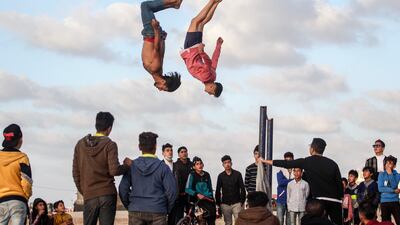
Palestinian youths practise parkour skills on Gaza Beach during sunset, on February 12. Those aged 18 to 24 in Gaza and the West Bank were polled for the 2021 Arab Youth Survey. Photo: Sameh Rahmi / NurPhoto -
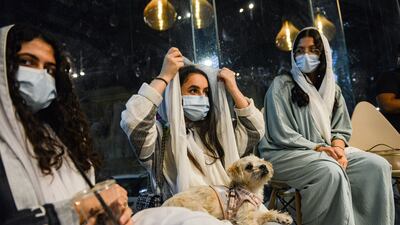
A woman adjusts her headscarf as she sits with her dog at a cafe in Saudi Arabia's eastern city of Khobar. About 82 per cent of young Saudi Arabian citizens are optimistic about their future. Photo: Fayez Nureldine / AFP -

Emiratis gather around an open fire at the Liwa desert. The UAE was named the most desirable country to live in for the 10th consecutive year by young Arabs polled for the 2021 Arab Youth Survey. Photo: Karim Sahib / AFP -
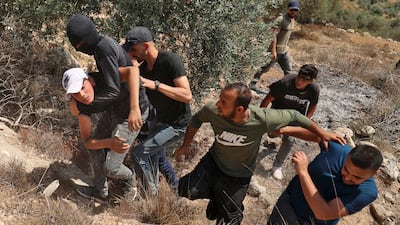
Palestinian protesters carry an injured youth amid clashes with Israeli security forces in the village of Beita, south of Nablus, in the occupied West Bank, on May 28. Despite this, 41 per cent of young Palestinians polled in the Arab Youth Survey were optimistic about their future. Photo: Jaafar Ashtiyeh / AFP -

Young Moroccans in the capital Rabat. About 70 per cent of those questioned said Covid-19 harmed their education, the survey said. Photo: Fadel Senna / AFP -
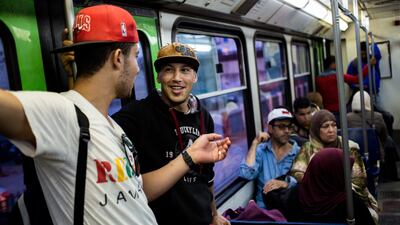
Two young rappers in the Tunis metro. More than three quarters of young Tunisians surveyed said they were confident that their voice mattered to their country's leadership. The survey was conducted in July. Photo: Emeric Fohlen / NurPhoto -

Young Iraqis chat as they gather to perform stunts on motorbikes and scooters in the Jadriya district of Baghdad. About 42 per cent of young Iraqis say religion is central to their identity. Photo: Ahmad Al Rubaye / AFP -
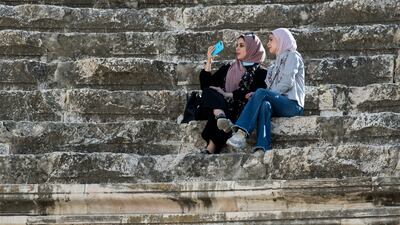
Young women enjoy fresh air and sun near the Amman citadel and Roman amphitheatre In Amman, Jordan. About 71 per cent of young Jordanians said they believed their voice mattered to their country's leadership. Photo: Hristo Vladev / NurPhoto -

Egyptian fans gather at a sports cafe to watch a football match. Egypt is regarded as the region's strongest ally by young Arabs. Photo: Ibrahim Ezzat / AFP -
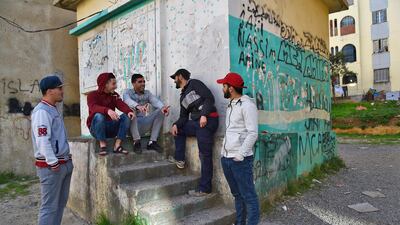
A group of young Algerians in a popular neighbourhood of the capital Algiers. The influence of the US is felt by 61 per cent of young Arabs polled in the 2021 survey. Photo: Ryad Kramdi / AFP -
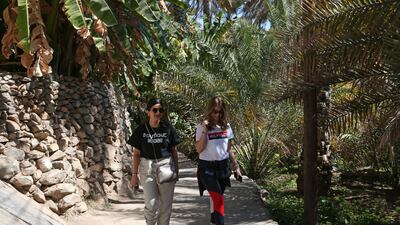
Young Omani women walk on a hiking trail in the village of Misfat Al Abriyeen. Only 13 per cent of young Omanis say they would consider emigrating. Photo: Mohammed Mahjoub / AFP -

Students line up to receive their certificates during the Visual Graduation Ceremony 2021 of Bahrain Bayan School in Sakhir. About half of young Bahrainis said they felt the pandemic affected their educational. Photo: Hamad I Mohammed / Reuters -
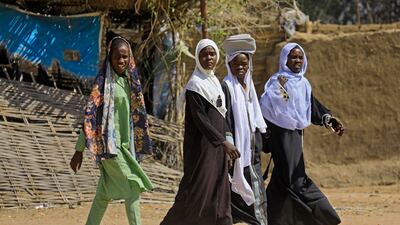
Young Sudanese women walk in the Otash camp for internally displaced people near Nyala town, the capital of South Darfur. Two thirds of young Sudanese people said they want to live in the UAE. Photo: Ashraf Shazly / AFP -
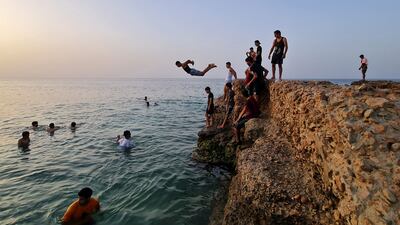
Libyan youths gather at a cliff by the Mediterranean Sea in the capital Tripoli. Young Libyans were polled in Tripoli, Misrata and Benghazi for the 2021 Arab Youth Survey. Photo: Mahmud Turkia / AFP -

Ghenwa, 20, a trainee flight attendant, Souna, 25, a business manager, Karam, 23, a DJ, and Ali, 24, an IT student, go bowling in Damascus, Syria. More than two thirds of young Syrians believe their best days are ahead of them, up from 12 per cent in 2020. Photo: Yamam Al Shaar / Reuters -

Iraqi graduates sit in a tent as they protest against a lack of jobs in Baghdad. About one third of young Iraqis say they have considered emigrating. Photo: Teba Sadiq / Reuters -
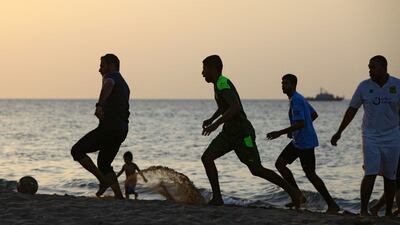
Omani youths play football on the beach at sunset in the capital Muscat. More than 90 per cent of young Omanis believe their voice matters to their country's leadership. Photo: Mohammed Mahjoub / AFP -
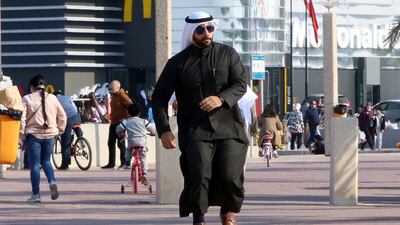
A Kuwaiti rides a skateboard, on a warm day near the beachfront, in the capital Kuwait City. More than 80 per cent of young Kuwaitis believe Covid-19 has affected their education. Photo: Yasser Al Zayyat / AFP -

About 97 per cent of young Syrians believe the Covid-19 pandemic affected their educational experience, according to the 2021 Arab Youth Survey. Photo: Alamy -
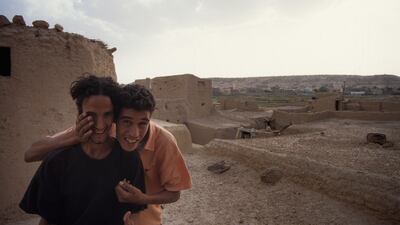
Two young men on the terrace of a kasbah in Morocco. Almost 80 per cent of young Moroccans said they believed their best days were ahead. Photo: Alamy -

About 71 per cent of young Tunisians said their institutions needed reform, according to the 2021 Arab Youth Survey. Photo: Alamy -
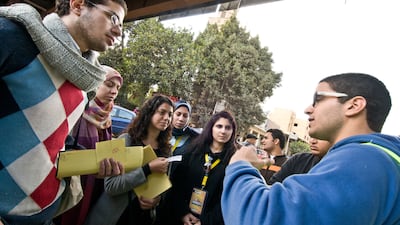
Volunteers of the anti-sexual harassment organisation, Harassmap, during a street awareness campaign in Cairo. About 65 per cent of young Egyptians said they would want to live in the UAE. Photo: Alamy



