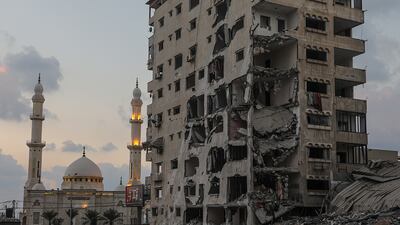
Six months after an 11-day conflict ravaged Gaza, Palestinian children remain burdened by trauma while their parents struggle to gain access to urgently needed care.
Sitting beside her father, eight-year-old Suzy Ishkontana wears a T-shirt with the slogan: “Girls are always strong."
She talks in a whisper about life at school, where she likes to play on the swings and has a handful of friends.
“One is called Salma, one is called Nour, one is in the 10th grade,” she said, perched on a brown sofa in her grandmother’s apartment.
During the violence in Gaza, Suzy spent hours trapped under the rubble of her home. Her brother died beside her.
Israeli air strikes on the centre of Gaza city killed her mother and four siblings. Her father, Riad Ishkontana, survived.
“They would get up at six in the morning and play as a group,” he said, remembering his children. “They loved each other and would even share a packet of crisps among themselves.”
Mr Ishkontana has videos on his phone of his children dancing, while portraits printed since they died rest against a wall.
A few metres from the apartment block is a vast empty space. Piles of concrete and rebar from destroyed homes once lay there, but the debris has since been cleared.
Mr Ishkontana said he and his neighbours are scarred by the air strikes, which killed more than 40 people in one night.
“The grief remains, the place is gloomy because, regardless of the days passing, people remember,” he said.
“Because the people who died and were martyred, they’re the people of the neighbourhood.”
My daughter stopped laughing and stopped being happy.
Riad Ishkontana,
Palestinian father
Across Gaza, 67 children were among 261 Palestinians killed during the conflict. Two children and 11 adults were killed in Israel, UN figures show.
While Suzy has been able to return to the classroom, her father said she was suffering from the loss and trauma.
“She stopped laughing and stopped being happy. She wants little kids in the house because she used to be with her younger siblings," he said.
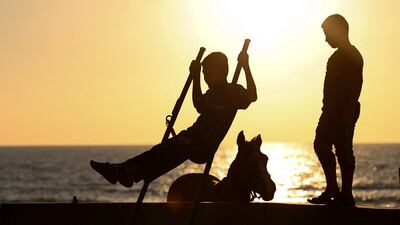
He said she once joined a children’s trip to the seaside, which was aimed at improving her mental health.
But the family does not know exactly how to help her.
“Sometimes I sit and cry about Suzy’s condition, but I don’t let her see me,” said her grandmother, Samira Al Dora.
Gazans reported incessant bombing throughout the conflict, during which the Israeli military said it struck more than 1,000 targets.
At least 4,000 rockets were fired by Hamas, the group that controls Gaza, the Israeli military said in May.
A fragile ceasefire has been pockmarked by outbreaks of violence, such as the numerous Israeli air strikes on Gaza in recent months.
The Israeli military said the strikes were a response to Palestinians flying incendiary balloons into Israeli territory, while rockets have been fired from Gaza on five occasions.
Such incidents increase fears of another conflict, hampering residents’ chances of recovering from the trauma they experienced in May.
“In the border areas it could be like a flashback to the same event every day, hearing the sound of [Israeli] drones and seeing the flare of bombs,” said Rania El Soussi, a psychologist at the Gaza Community Mental Health Programme (GCMHP).
“All this recalls the painful situation of living through the war, or the 2014 war, or before it, if they were older."
Gazan teenagers have experienced four wars fought with Israel since 2008.
In recent months, psychologists have reported an increase in symptoms related to post-traumatic stress disorder.
Children have suffered from symptoms such as wetting themselves, having nightmares and becoming aggressive or anxious.
Nour Abdel Wahed, a psychologist with the GCMHP, treats families who called its helpline or were referred by other organisations.
“I’m seeing a child who has post-traumatic stress disorder, then discover that his mother and father also have it,” she said.
“A lot of our cases were exposed to instances of direct bombardment … the whole family saw people killed and wounded."
The programme has 200 families on its waiting list. Staff have already treated hundreds more people this year than in 2020, when they dealt with 3,200 cases.
While many Gazan families are seeking to overcome their trauma six months on, some are still dealing with the physical effects of the conflict.
About 685 children were wounded in the war, along with more than 1,500 adults, UN records show.
One of the most seriously injured was four-year-old Sara Al Metrabei, whose spine was impaled with shrapnel in an Israeli air strike on her home.
Her father, Zaher Al Metrabei, recalled his daughter’s confusion in hospital as she asked: “Why did they burn my back, daddy? Why did they burn me?”
He broke down in tears as he showed photos of Sara’s wounds taken in May.
Days after the ceasefire, she became one of the few Gazan children to be granted permission to leave the Palestinian enclave for treatment in Jordan.
She screamed as she was lifted on to a trolley bed and wheeled out of hospital, her head resting on a pink pillow.
Mr Al Metrabei has not seen his daughter since, because he has been unable to obtain the necessary paperwork to travel with his son to be at her bedside.
Sara’s mother, Lina, is heavily pregnant and has been with her daughter throughout the treatment. Sara has undergone about 10 operations so far and remains unable to walk.
The uncertainty about whether her condition will improve, coupled with the family separation, has taken its toll on her father.
“I’m not able to do anything, neither taking any decisions or work in my life, because things for me are at a standstill,” he said.
War compounds tough conditions in Gaza
Charles Nelson, a professor of pediatrics and neuroscience at Harvard Medical School, said parents and relatives were vital to helping children recover mentally from trauma.
“Do they have adults that are looking out for them, adults that are supportive and sensitive to their needs? For those that do, they will likely do much better than those who don't," he said.
But despite their best intentions, some Gazans will struggle to provide support to their relatives because they are traumatised themselves.
“This fundamentally shapes what kind of parents they are. Those kids are at much higher risk of long-term challenges,” said Prof Nelson, who has extensively researched the effects of early adversity on brain development.
The conflict compounded the pressure on families in Gaza, which has been under an Israeli-led blockade since 2007.
There was the sound of thunder, my sisters thought it was bombing.
Mayssa Rabi Al Tanani,
counsellor
Few of Gaza’s nearly two million residents are able to leave the territory, while the arrival and departure of goods is also strictly limited.
“The alarming unemployment rate in Gaza is roughly 50 per cent and more than half of its population lives in poverty,” the World Bank said in July.
There are some community centres in the Palestinian territory where children and parents can receive private or group counselling.
At one centre in Gaza city, run by the Palestinian NGO Ma’an, children jump around and giggle while they play a game. A colourful picture on the wall shows different emotions, with tears rolling down one face.
“We teach the children a bit about things and behaviours, how to be able to deal with situations they face, how they can make friends, how they can overcome fear,” said counsellor Mayssa Rabi Al Tanani.
About two months ago, she noticed some of the children were showing symptoms of PTSD. They were suffering from nightmares and had become fearful, but avoided talking about the conflict.
“Yesterday when it rained a lot and there was the sound of thunder, my sisters thought it was bombing and were really scared,” she said.
A fear of loud noises has been widely observed in people by mental health experts and families in the months since the conflict.
Many of those at the Ma’an centre, which is funded by the UN children’s agency, had already sought support before the war.
Tamam Al Akawi has been caring for her 14-year-old son, who has a heart condition. Although he was able to travel for treatment in Nablus in the occupied West Bank, Ms Al Akawi said they were struggling to afford the medical costs in Gaza.
“Our situation is really, really bad,” she said.
“I’m appealing for anyone to help us with my son’s treatment and to help me with my children’s mental state.”
While counsellors have helped, Ms Al Akawi said her six children were deeply affected by air strikes on their home district and footage of attacks.
“The children were always sitting in front of the TV and saw bombs coming down on the towers,” she said.
The Israeli military destroyed four high-rise buildings during the conflict in strikes that Human Rights Watch said could amount to war crimes. Israel refutes the allegations.
Severe shortages affect trauma treatment
While some children have started to recover from the war, the acute lack of resources puts the mental health of many at risk. Dr Yasser Abu Jamei, director of the GCMHP, estimates that there are 3,500 unemployed psychology graduates in Gaza.
“We need resources in order to train them. They need equipped places, they need salaries … and this is not available,” he said.
He said bringing in more psychologists from abroad was unlikely to help unless they were fluent Arabic speakers and stayed for more than a few months.
Administering treatment is also particularly complex in Gaza, because patients’ symptoms are often related to numerous traumatic events over the years.
“We were not fine before May, and we are not fine today,” Dr Abu Jamei said.
He pointed out of his office window at the various parts of the district that were bombed.
Mr Al Metrabei said his daughter's mental health had improved slightly in Jordan.
“She has started to talk, started talking to people,” he said.
Opening his phone to show a video of Sara eating a pomegranate in her hospital bed, Mr Al Metrabei said he was in contact with his daughter every day.
In Gaza, he feels abandoned by those unaffected by the war.
“After a week, they were living their lives normally,” he said. “I’m not living, I’m just damaged.”
Mr Ishkontana has also expressed a need for more support.
The recovery of traumatised children will not only hinge on their long-term access to care, but also the treatment of their parents.
“Unless the dad gets access to resources that will help him, it is going to be hard for him to be a good dad,” Prof Nelson said.
“And worse yet, the one thing he’ll suffer from is guilt. He’ll think he’s not being a good dad.”
Mr Ishkontana said his daughter was not receiving one-on-one mental health treatment and remained isolated from her peers.
“Suzy wants to live like any child in the world and see her psychological state improve,” he said.
As she grows up, there is a risk she will develop survivor’s guilt or become overwhelmed by grief.
“There are few things that are worse than what she experienced," Prof Nelson said.
“Her experience won’t go away. The only thing we can hope for is that she gets the kind of counselling or psychological care that will be maintained."
She sits quietly beside her father as he talks about her future. Mr Ishkontana said he wished for a foreign government to grant his daughter a new nationality so she can flee Gaza.
He fears he will be unable to protect his only surviving child if violence flares again.
“Because if she’s not wounded in the next war, the sound of the war will kill her," he said.
COMPANY PROFILE
Founders: Alhaan Ahmed, Alyina Ahmed and Maximo Tettamanzi
Total funding: Self funded
MATCH INFO
Euro 2020 qualifier
Fixture: Liechtenstein v Italy, Tuesday, 10.45pm (UAE)
TV: Match is shown on BeIN Sports
Other must-tries
Tomato and walnut salad
A lesson in simple, seasonal eating. Wedges of tomato, chunks of cucumber, thinly sliced red onion, coriander or parsley leaves, and perhaps some fresh dill are drizzled with a crushed walnut and garlic dressing. Do consider yourself warned: if you eat this salad in Georgia during the summer months, the tomatoes will be so ripe and flavourful that every tomato you eat from that day forth will taste lacklustre in comparison.
Badrijani nigvzit
A delicious vegetarian snack or starter. It consists of thinly sliced, fried then cooled aubergine smothered with a thick and creamy walnut sauce and folded or rolled. Take note, even though it seems like you should be able to pick these morsels up with your hands, they’re not as durable as they look. A knife and fork is the way to go.
Pkhali
This healthy little dish (a nice antidote to the khachapuri) is usually made with steamed then chopped cabbage, spinach, beetroot or green beans, combined with walnuts, garlic and herbs to make a vegetable pâté or paste. The mix is then often formed into rounds, chilled in the fridge and topped with pomegranate seeds before being served.
Ten tax points to be aware of in 2026
1. Domestic VAT refund amendments: request your refund within five years
If a business does not apply for the refund on time, they lose their credit.
2. E-invoicing in the UAE
Businesses should continue preparing for the implementation of e-invoicing in the UAE, with 2026 a preparation and transition period ahead of phased mandatory adoption.
3. More tax audits
Tax authorities are increasingly using data already available across multiple filings to identify audit risks.
4. More beneficial VAT and excise tax penalty regime
Tax disputes are expected to become more frequent and more structured, with clearer administrative objection and appeal processes. The UAE has adopted a new penalty regime for VAT and excise disputes, which now mirrors the penalty regime for corporate tax.
5. Greater emphasis on statutory audit
There is a greater need for the accuracy of financial statements. The International Financial Reporting Standards standards need to be strictly adhered to and, as a result, the quality of the audits will need to increase.
6. Further transfer pricing enforcement
Transfer pricing enforcement, which refers to the practice of establishing prices for internal transactions between related entities, is expected to broaden in scope. The UAE will shortly open the possibility to negotiate advance pricing agreements, or essentially rulings for transfer pricing purposes.
7. Limited time periods for audits
Recent amendments also introduce a default five-year limitation period for tax audits and assessments, subject to specific statutory exceptions. While the standard audit and assessment period is five years, this may be extended to up to 15 years in cases involving fraud or tax evasion.
8. Pillar 2 implementation
Many multinational groups will begin to feel the practical effect of the Domestic Minimum Top-Up Tax (DMTT), the UAE's implementation of the OECD’s global minimum tax under Pillar 2. While the rules apply for financial years starting on or after January 1, 2025, it is 2026 that marks the transition to an operational phase.
9. Reduced compliance obligations for imported goods and services
Businesses that apply the reverse-charge mechanism for VAT purposes in the UAE may benefit from reduced compliance obligations.
10. Substance and CbC reporting focus
Tax authorities are expected to continue strengthening the enforcement of economic substance and Country-by-Country (CbC) reporting frameworks. In the UAE, these regimes are increasingly being used as risk-assessment tools, providing tax authorities with a comprehensive view of multinational groups’ global footprints and enabling them to assess whether profits are aligned with real economic activity.
Contributed by Thomas Vanhee and Hend Rashwan, Aurifer
The UAE squad for the Asian Indoor and Martial Arts Games
The jiu-jitsu men’s team: Faisal Al Ketbi, Zayed Al Kaabi, Yahia Al Hammadi, Taleb Al Kirbi, Obaid Al Nuaimi, Omar Al Fadhli, Zayed Al Mansoori, Saeed Al Mazroui, Ibrahim Al Hosani, Mohammed Al Qubaisi, Salem Al Suwaidi, Khalfan Belhol, Saood Al Hammadi.
Women’s team: Mouza Al Shamsi, Wadeema Al Yafei, Reem Al Hashmi, Mahra Al Hanaei, Bashayer Al Matrooshi, Hessa Thani, Salwa Al Ali.
UAE v Gibraltar
What: International friendly
When: 7pm kick off
Where: Rugby Park, Dubai Sports City
Admission: Free
Online: The match will be broadcast live on Dubai Exiles’ Facebook page
UAE squad: Lucas Waddington (Dubai Exiles), Gio Fourie (Exiles), Craig Nutt (Abu Dhabi Harlequins), Phil Brady (Harlequins), Daniel Perry (Dubai Hurricanes), Esekaia Dranibota (Harlequins), Matt Mills (Exiles), Jaen Botes (Exiles), Kristian Stinson (Exiles), Murray Reason (Abu Dhabi Saracens), Dave Knight (Hurricanes), Ross Samson (Jebel Ali Dragons), DuRandt Gerber (Exiles), Saki Naisau (Dragons), Andrew Powell (Hurricanes), Emosi Vacanau (Harlequins), Niko Volavola (Dragons), Matt Richards (Dragons), Luke Stevenson (Harlequins), Josh Ives (Dubai Sports City Eagles), Sean Stevens (Saracens), Thinus Steyn (Exiles)
Mercer, the investment consulting arm of US services company Marsh & McLennan, expects its wealth division to at least double its assets under management (AUM) in the Middle East as wealth in the region continues to grow despite economic headwinds, a company official said.
Mercer Wealth, which globally has $160 billion in AUM, plans to boost its AUM in the region to $2-$3bn in the next 2-3 years from the present $1bn, said Yasir AbuShaban, a Dubai-based principal with Mercer Wealth.
“Within the next two to three years, we are looking at reaching $2 to $3 billion as a conservative estimate and we do see an opportunity to do so,” said Mr AbuShaban.
Mercer does not directly make investments, but allocates clients’ money they have discretion to, to professional asset managers. They also provide advice to clients.
“We have buying power. We can negotiate on their (client’s) behalf with asset managers to provide them lower fees than they otherwise would have to get on their own,” he added.
Mercer Wealth’s clients include sovereign wealth funds, family offices, and insurance companies among others.
From its office in Dubai, Mercer also looks after Africa, India and Turkey, where they also see opportunity for growth.
Wealth creation in Middle East and Africa (MEA) grew 8.5 per cent to $8.1 trillion last year from $7.5tn in 2015, higher than last year’s global average of 6 per cent and the second-highest growth in a region after Asia-Pacific which grew 9.9 per cent, according to consultancy Boston Consulting Group (BCG). In the region, where wealth grew just 1.9 per cent in 2015 compared with 2014, a pickup in oil prices has helped in wealth generation.
BCG is forecasting MEA wealth will rise to $12tn by 2021, growing at an annual average of 8 per cent.
Drivers of wealth generation in the region will be split evenly between new wealth creation and growth of performance of existing assets, according to BCG.
Another general trend in the region is clients’ looking for a comprehensive approach to investing, according to Mr AbuShaban.
“Institutional investors or some of the families are seeing a slowdown in the available capital they have to invest and in that sense they are looking at optimizing the way they manage their portfolios and making sure they are not investing haphazardly and different parts of their investment are working together,” said Mr AbuShaban.
Some clients also have a higher appetite for risk, given the low interest-rate environment that does not provide enough yield for some institutional investors. These clients are keen to invest in illiquid assets, such as private equity and infrastructure.
“What we have seen is a desire for higher returns in what has been a low-return environment specifically in various fixed income or bonds,” he said.
“In this environment, we have seen a de facto increase in the risk that clients are taking in things like illiquid investments, private equity investments, infrastructure and private debt, those kind of investments were higher illiquidity results in incrementally higher returns.”
The Abu Dhabi Investment Authority, one of the largest sovereign wealth funds, said in its 2016 report that has gradually increased its exposure in direct private equity and private credit transactions, mainly in Asian markets and especially in China and India. The authority’s private equity department focused on structured equities owing to “their defensive characteristics.”
Scores in brief:
Boost Defenders 205-5 in 20 overs
(Colin Ingram 84 not out, Cameron Delport 36, William Somerville 2-28)
bt Auckland Aces 170 for 5 in 20 overs
(Rob O’Donnell 67 not out, Kyle Abbott 3-21).
UAE Premiership
Results
Dubai Exiles 24-28 Jebel Ali Dragons
Abu Dhabi Harlequins 43-27 Dubai Hurricanes
Final
Abu Dhabi Harlequins v Jebel Ali Dragons, Friday, March 29, 5pm at The Sevens, Dubai
Result
6.30pm: Al Maktoum Challenge Round-3 – Group 1 (PA) $65,000 (Dirt) 2,000m; Winner: Brraq, Ryan Curatolo (jockey), Jean-Claude Pecout (trainer)
7.05pm: Handicap (TB) $65,000 (Turf) 1,800m; Winner: Bright Melody, James Doyle, Charlie Appleby
7.40pm: Meydan Classic – Listed (TB) $88,000 (T) 1,600m; Winner: Naval Crown, Mickael Barzalona, Charlie Appleby
8.15pm: Nad Al Sheba Trophy – Group 3 (TB) $195,000 (T) 2,810m; Winner: Volcanic Sky, Frankie Dettori, Saeed bin Suroor
8.50pm: Dubai Millennium Stakes – Group 3 (TB) $130,000 (T) 2,000m; Winner: Star Safari, William Buick, Charlie Appleby
9.25pm: Meydan Challenge – Listed Handicap (TB) $88,000 (T) 1,400m; Winner: Zainhom, Dane O’Neill, Musabah Al Muhairi
AGL AWARDS
Golden Ball - best Emirati player: Khalfan Mubarak (Al Jazira)
Golden Ball - best foreign player: Igor Coronado (Sharjah)
Golden Glove - best goalkeeper: Adel Al Hosani (Sharjah)
Best Coach - the leader: Abdulaziz Al Anbari (Sharjah)
Fans' Player of the Year: Driss Fetouhi (Dibba)
Golden Boy - best young player: Ali Saleh (Al Wasl)
Best Fans of the Year: Sharjah
Goal of the Year: Michael Ortega (Baniyas)
WOMAN AND CHILD
Director: Saeed Roustaee
Starring: Parinaz Izadyar, Payman Maadi
Rating: 4/5
Why your domicile status is important
Your UK residence status is assessed using the statutory residence test. While your residence status – ie where you live - is assessed every year, your domicile status is assessed over your lifetime.
Your domicile of origin generally comes from your parents and if your parents were not married, then it is decided by your father. Your domicile is generally the country your father considered his permanent home when you were born.
UK residents who have their permanent home ("domicile") outside the UK may not have to pay UK tax on foreign income. For example, they do not pay tax on foreign income or gains if they are less than £2,000 in the tax year and do not transfer that gain to a UK bank account.
A UK-domiciled person, however, is liable for UK tax on their worldwide income and gains when they are resident in the UK.
Read more about the coronavirus
The specs
Price, base / as tested Dh1,100,000 (est)
Engine 5.2-litre V10
Gearbox seven-speed dual clutch
Power 630bhp @ 8,000rpm
Torque 600Nm @ 6,500rpm
Fuel economy, combined 15.7L / 100km (est)
Who is Mohammed Al Halbousi?
The new speaker of Iraq’s parliament Mohammed Al Halbousi is the youngest person ever to serve in the role.
The 37-year-old was born in Al Garmah in Anbar and studied civil engineering in Baghdad before going into business. His development company Al Hadeed undertook reconstruction contracts rebuilding parts of Fallujah’s infrastructure.
He entered parliament in 2014 and served as a member of the human rights and finance committees until 2017. In August last year he was appointed governor of Anbar, a role in which he has struggled to secure funding to provide services in the war-damaged province and to secure the withdrawal of Shia militias. He relinquished the post when he was sworn in as a member of parliament on September 3.
He is a member of the Al Hal Sunni-based political party and the Sunni-led Coalition of Iraqi Forces, which is Iraq’s largest Sunni alliance with 37 seats from the May 12 election.
He maintains good relations with former Prime Minister Nouri Al Maliki’s State of Law Coaliton, Hadi Al Amiri’s Badr Organisation and Iranian officials.
Who has been sanctioned?
Daniella Weiss and Nachala
Described as 'the grandmother of the settler movement', she has encouraged the expansion of settlements for decades. The 79 year old leads radical settler movement Nachala, whose aim is for Israel to annex Gaza and the occupied West Bank, where it helps settlers built outposts.
Harel Libi & Libi Construction and Infrastructure
Libi has been involved in threatening and perpetuating acts of aggression and violence against Palestinians. His firm has provided logistical and financial support for the establishment of illegal outposts.
Zohar Sabah
Runs a settler outpost named Zohar’s Farm and has previously faced charges of violence against Palestinians. He was indicted by Israel’s State Attorney’s Office in September for allegedly participating in a violent attack against Palestinians and activists in the West Bank village of Muarrajat.
Coco’s Farm and Neria’s Farm
These are illegal outposts in the West Bank, which are at the vanguard of the settler movement. According to the UK, they are associated with people who have been involved in enabling, inciting, promoting or providing support for activities that amount to “serious abuse”.
More from Rashmee Roshan Lall
Founders: Abdulmajeed Alsukhan, Turki Bin Zarah and Abdulmohsen Albabtain.
Based: Riyadh
Offices: UAE, Vietnam and Germany
Founded: September, 2020
Number of employees: 70
Sector: FinTech, online payment solutions
Funding to date: $116m in two funding rounds
Investors: Checkout.com, Impact46, Vision Ventures, Wealth Well, Seedra, Khwarizmi, Hala Ventures, Nama Ventures and family offices
Biggest%20applause
%3Cp%3EAsked%20to%20rate%20Boris%20Johnson's%20leadership%20out%20of%2010%2C%20Mr%20Sunak%20awarded%20a%20full%2010%20for%20delivering%20Brexit%20%E2%80%94%20remarks%20that%20earned%20him%20his%20biggest%20round%20of%20applause%20of%20the%20night.%20%22My%20views%20are%20clear%2C%20when%20he%20was%20great%20he%20was%20great%20and%20it%20got%20to%20a%20point%20where%20we%20need%20to%20move%20forward.%20In%20delivering%20a%20solution%20to%20Brexit%20and%20winning%20an%20election%20that's%20a%2010%2F10%20-%20you've%20got%20to%20give%20the%20guy%20credit%20for%20that%2C%20no-one%20else%20could%20probably%20have%20done%20that.%22%3C%2Fp%3E%0A
Dust and sand storms compared
Sand storm
- Particle size: Larger, heavier sand grains
- Visibility: Often dramatic with thick "walls" of sand
- Duration: Short-lived, typically localised
- Travel distance: Limited
- Source: Open desert areas with strong winds
Dust storm
- Particle size: Much finer, lightweight particles
- Visibility: Hazy skies but less intense
- Duration: Can linger for days
- Travel distance: Long-range, up to thousands of kilometres
- Source: Can be carried from distant regions
The%20specs%20
%3Cp%3E%3Cstrong%3EEngine%3A%20%3C%2Fstrong%3E2.0-litre%204cyl%20turbo%0D%3Cbr%3E%3Cstrong%3EPower%3A%20%3C%2Fstrong%3E261hp%20at%205%2C500rpm%0D%3Cbr%3E%3Cstrong%3ETorque%3A%20%3C%2Fstrong%3E400Nm%20at%201%2C750-4%2C000rpm%0D%3Cbr%3E%3Cstrong%3ETransmission%3A%20%3C%2Fstrong%3E7-speed%20dual-clutch%20auto%0D%3Cbr%3E%3Cstrong%3EFuel%20consumption%3A%20%3C%2Fstrong%3E10.5L%2F100km%0D%3Cbr%3E%3Cstrong%3EOn%20sale%3A%20%3C%2Fstrong%3ENow%0D%3Cbr%3E%3Cstrong%3EPrice%3A%20%3C%2Fstrong%3EFrom%20Dh129%2C999%20(VX%20Luxury)%3B%20from%20Dh149%2C999%20(VX%20Black%20Gold)%3C%2Fp%3E%0A
A list of the animal rescue organisations in the UAE
Milestones on the road to union
1970
October 26: Bahrain withdraws from a proposal to create a federation of nine with the seven Trucial States and Qatar.
December: Ahmed Al Suwaidi visits New York to discuss potential UN membership.
1971
March 1: Alex Douglas Hume, Conservative foreign secretary confirms that Britain will leave the Gulf and “strongly supports” the creation of a Union of Arab Emirates.
July 12: Historic meeting at which Sheikh Zayed and Sheikh Rashid make a binding agreement to create what will become the UAE.
July 18: It is announced that the UAE will be formed from six emirates, with a proposed constitution signed. RAK is not yet part of the agreement.
August 6: The fifth anniversary of Sheikh Zayed becoming Ruler of Abu Dhabi, with official celebrations deferred until later in the year.
August 15: Bahrain becomes independent.
September 3: Qatar becomes independent.
November 23-25: Meeting with Sheikh Zayed and Sheikh Rashid and senior British officials to fix December 2 as date of creation of the UAE.
November 29: At 5.30pm Iranian forces seize the Greater and Lesser Tunbs by force.
November 30: Despite a power sharing agreement, Tehran takes full control of Abu Musa.
November 31: UK officials visit all six participating Emirates to formally end the Trucial States treaties
December 2: 11am, Dubai. New Supreme Council formally elects Sheikh Zayed as President. Treaty of Friendship signed with the UK. 11.30am. Flag raising ceremony at Union House and Al Manhal Palace in Abu Dhabi witnessed by Sheikh Khalifa, then Crown Prince of Abu Dhabi.
December 6: Arab League formally admits the UAE. The first British Ambassador presents his credentials to Sheikh Zayed.
December 9: UAE joins the United Nations.
Law%2041.9.4%20of%20men%E2%80%99s%20T20I%20playing%20conditions
%3Cp%3EThe%20fielding%20side%20shall%20be%20ready%20to%20start%20each%20over%20within%2060%20seconds%20of%20the%20previous%20over%20being%20completed.%0D%3Cbr%3EAn%20electronic%20clock%20will%20be%20displayed%20at%20the%20ground%20that%20counts%20down%20seconds%20from%2060%20to%20zero.%0D%3Cbr%3EThe%20clock%20is%20not%20required%20or%2C%20if%20already%20started%2C%20can%20be%20cancelled%20if%3A%0D%3Cbr%3E%E2%80%A2%09A%20new%20batter%20comes%20to%20the%20wicket%20between%20overs.%0D%3Cbr%3E%E2%80%A2%09An%20official%20drinks%20interval%20has%20been%20called.%0D%3Cbr%3E%E2%80%A2%09The%20umpires%20have%20approved%20the%20on%20field%20treatment%20of%20an%20injury%20to%20a%20batter%20or%20fielder.%0D%3Cbr%3E%E2%80%A2%09The%20time%20lost%20is%20for%20any%20circumstances%20beyond%20the%20control%20of%20the%20fielding%20side.%0D%3Cbr%3E%E2%80%A2%09The%20third%20umpire%20starts%20the%20clock%20either%20when%20the%20ball%20has%20become%20dead%20at%20the%20end%20of%20the%20previous%20over%2C%20or%20a%20review%20has%20been%20completed.%0D%3Cbr%3E%E2%80%A2%09The%20team%20gets%20two%20warnings%20if%20they%20are%20not%20ready%20to%20start%20overs%20after%20the%20clock%20reaches%20zero.%0D%3Cbr%3E%E2%80%A2%09On%20the%20third%20and%20any%20subsequent%20occasion%20in%20an%20innings%2C%20the%20bowler%E2%80%99s%20end%20umpire%20awards%20five%20runs.%0D%3Cbr%3E%3C%2Fp%3E%0A
Profile of MoneyFellows
Founder: Ahmed Wadi
Launched: 2016
Employees: 76
Financing stage: Series A ($4 million)
Investors: Partech, Sawari Ventures, 500 Startups, Dubai Angel Investors, Phoenician Fund
New UK refugee system
- A new “core protection” for refugees moving from permanent to a more basic, temporary protection
- Shortened leave to remain - refugees will receive 30 months instead of five years
- A longer path to settlement with no indefinite settled status until a refugee has spent 20 years in Britain
- To encourage refugees to integrate the government will encourage them to out of the core protection route wherever possible.
- Under core protection there will be no automatic right to family reunion
- Refugees will have a reduced right to public funds
Gulf Under 19s final
Dubai College A 50-12 Dubai College B
MOUNTAINHEAD REVIEW
Starring: Ramy Youssef, Steve Carell, Jason Schwartzman
Director: Jesse Armstrong
Rating: 3.5/5