

Iraq is calling for regional co-operation to ease tensions, and the country is central to solving challenges facing the Middle East, Foreign Minister Fuad Hussein told The National.
Baghdad hosted a conference in August where officials from the UAE, Saudi Arabia, Egypt, France, Jordan, Kuwait and Qatar, as well as officials from Iran, Turkey and the EU, participated in talks on economic, political and security co-operation.
“We are mediating, trying to bring together countries that have tensions, and we did, not only with the Saudis and Iranians, but we brought many other states in the region together,” Mr Hussein told The National.
A glimmer of optimism about the prospect of a thaw in relations between Tehran and Riyadh was seen earlier this year, as the two decided to hold talks in the Iraqi capital.
Representatives from Riyadh and Tehran had just concluded their fourth round of discussions, said Mr Hussein, and the summit supported the constructive path of positive dialogue and negotiations.
“Baghdad from outside has been seen as a country of challenges but states have also started to see that it is part of the solution,” he said on the sidelines of the annual Manama Dialogue in Bahrain.
Iraq is the only country in the region that has “friendship with all neighbouring and regional states,” he said.

Diplomatic efforts led by Baghdad have resulted in “stability in the region, rejecting violence, resolving differences and adopting dialogue as a way of co-operation and integration”, he said.
The US is set to withdraw its combat troops from Iraq by the end of this year but will continue to train and advise the Iraqi military. There are currently 2,500 US troops in Iraq helping local forces counter what remains of ISIS, with the vast majority of US forces tied up in training Iraqi forces.
Since 2014, the US has led an international coalition in Iraq to fight ISIS.
"The American presence in Iraq is very small, in fact the existence of American combat forces will not affect the whole security situation," he said.
"This means that the fight against ISIS can be done also by Iraqi forces themselves," said the Iraqi minister.
However, Mr Hussein said that Baghdad will still need some support.
The issue of foreign forces stationed in Iraq has presented a number of political challenges to the government, raising the ire of Iran-backed militias within an official government organisation, the Popular Mobilisation Forces, who have attacked US and coalition troops.
Tensions heightened in the region after the US killing of top Iranian general Qassem Soleimani and the leader of an Iran-backed militia Abu Mahdi Al Muhandis in January 2020, in Baghdad.
In recent months officials in Baghdad have pushed to “bring states together but also in trying to control their tensions," Mr Hussein said.
“Iraq will not spare any effort to achieve good relationships and partnerships with its neighbouring countries,” he said.
The turning point for taking on this new role, Mr Hussein said, was when Iraqis transformed their vision from “being victims to seeing themselves as leaders”.
“We need co-operation in the region, we need to agree on collective security, it’s not easy to have this policy but we can agree on how to deal with it,” the Iraqi minister said.
“We need each other to solve the problem or even to manage it,” he said, citing successful cooperation between the international community in countering the Covid-19 pandemic.
-
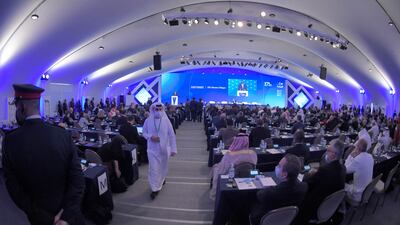
People attend a speech by US Secretary of Defence Lloyd Austin during the 17th IISS Manama Dialogue in the Bahraini capital. All photos: AFP -

Ayman Safadi, Jordan's Deputy Prime Minister and Minister of Foreign Affairs and Expatriates, delivers a speech at the dialogue. -
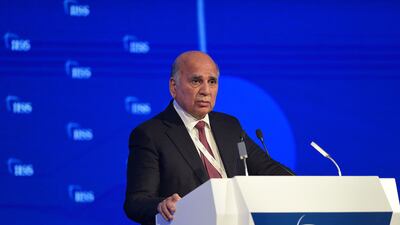
Iraq's Deputy Prime Minister and Foreign Minister Fuad Hussein speaks during the event. -
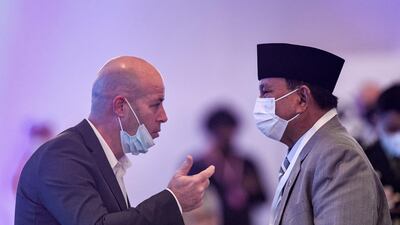
Itay Tagner, Israel's charge d'affaires to Bahrain, speaks to Indonesia's Defence Minister Prabowo Subianto. -
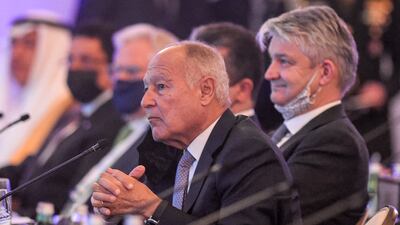
Arab League Secretary General Ahmed Aboul Gheit was among the officials in Manama. -
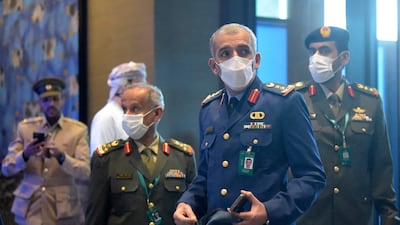
Emirati military officers attend the event in the Bahraini capital. -

Bahraini female security officers at the dialogue. -
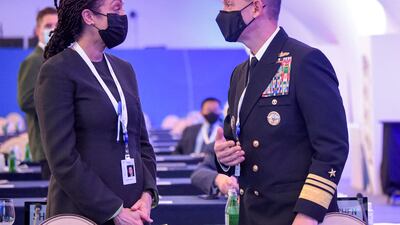
Stacey Dixon, US principal deputy director for National Intelligence, speaks to a US Navy officer. -

Lloyd Austin, US Secretary of Defence, and John Chipman, director general and chief executive of the International Institute for Strategic Studies, which organised the dialogue. -
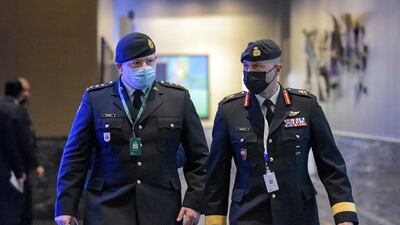
A Royal Marines lieutenant general and captain arrive at the event. -
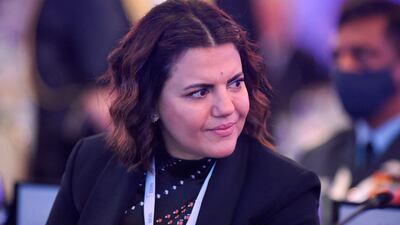
Najla Mangoush, Libya's Minister of Foreign Affairs, attends the conference in Manama. -
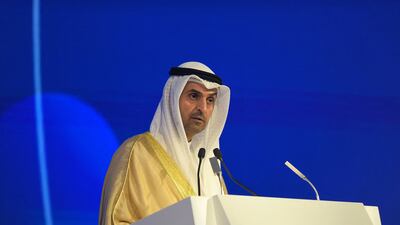
Nayef Al Hajraf, Secretary General of the GCC, gives a speech at the event. -
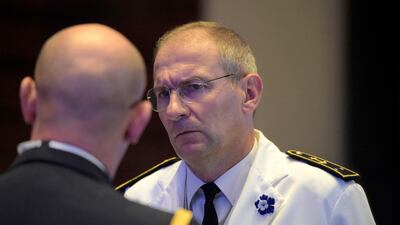
A French naval officer attends the Manama dialogue. -
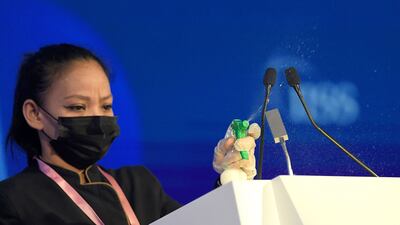
An employee at the event cleans the podium between speeches. -
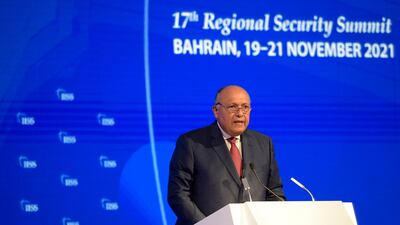
Egypt's Foreign Minister Sameh Shoukry addresses the conference. -

Peter Maurer, president of the International Committee of the Red Cross, speaks at the event in Manama.


Iraq's history of crises
Iraq was isolated from the region for more than a decade after the 1990 invasion of Kuwait by former dictator Saddam Hussein, as countries severed ties with his regime and imposed sanctions.
Following the ousting of the Hussein regime in 2003, through a US-led invasion, many regional countries were hesitant to restore ties due to the takeover by a Shiite-led government, which many consider to have close relations with Iran.
"For a while there were some misunderstandings between Iraq and Gulf countries about the changes happening in Baghdad, the future, their intentions, but gradually they approached each other and now we've reached a different state," he said.
Iraq is now enjoying strong ties with Gulf states, he said.
"We started to increase ties in common security, trade, electricity, co-operating on oil policy, we started to widen these ties between Baghdad and the Gulf countries," he said.
Mr Hussein said he "pushed for a balanced relationship" between Baghdad and the region which in turn helped Iraq.

