Prime Minister Naftali Bennett said Israel intends to double the amount of settlers living in the Golan Heights. AP

Israel approves plan to double settler population in the Golan Heights


  • English
  • Arabic

Israel’s government has approved a $317 million plan to double the Jewish settler population in the Golan Heights.

Forty years since Israel annexed the territory, the Cabinet voted to build 7,300 homes at Mevo Hama over five years.

“Our goal today is to double the population of the Golan Heights,” Prime Minister Naftali Bennett said before the meeting on Sunday.

The plan calls for one billion shekels to be spent on housing, infrastructure and other projects to attract 23,000 settlers to the area.

Mr Bennett left the meeting early when told his 14-year-old daughter had tested positive for the coronavirus, sending him into quarantine. But the vote went ahead later.

Israel captured two-thirds of the Golan Heights from Syria in the 1967 Middle East War. On December 14, 1981, it applied Israeli law to the region, a move not recognised by most of the international community.

About 25,000 Israeli settlers live in there, as do about 23,000 members of the Druze sect who remained on the land after it was seized.

An aerial view of Katsrin city, an Israeli settlement in the Golan Heights. AFP

Former US president Donald Trump granted US recognition of Israeli sovereignty over the Golan in 2019.

Syria condemned the move as a “flagrant violation”.

“The Golan Heights are Israeli. This is self-evident,” Mr Bennett said.

“The fact that the Trump administration recognised this, and the fact that the Biden administration has made it clear that there has been no change in this policy, are also important.”

Soon after US President Biden took office in January, his secretary of state, Antony Blinken, suggested there were legal questions surrounding Mr Trump’s move.

But Mr Blinken indicated there was no thought of reversing course, especially with the Syrian civil war continuing.

  • Druze supporters of Syrian President Bashar Al Assad hold a rally at Majdal Shams in the occupied Golan Heights, in February 2021. Former Syrian MP Midhat Saleh, a native of Majdal Shams, was assassinated – allegedly by an Israeli sniper – on the Syrian side of the border on Saturday, October 16. AP Photo
    Druze supporters of Syrian President Bashar Al Assad hold a rally at Majdal Shams in the occupied Golan Heights, in February 2021. Former Syrian MP Midhat Saleh, a native of Majdal Shams, was assassinated – allegedly by an Israeli sniper – on the Syrian side of the border on Saturday, October 16. AP Photo
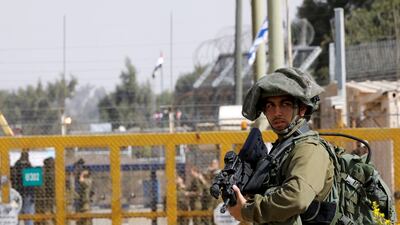
  • An Israeli soldier at the Quneitra crossing in the Golan Heights on the border between Israel and Syria. Israel captured the Golan Heights from Syria in the 1967 Arab-Israeli War and later annexed the strategic territory. Reuters
    An Israeli soldier at the Quneitra crossing in the Golan Heights on the border between Israel and Syria. Israel captured the Golan Heights from Syria in the 1967 Arab-Israeli War and later annexed the strategic territory. Reuters
  • Israeli Prime Minister Naftali Bennett speaks at a conference on economics and regional development in the occupied Golan Heights, on October 11. AFP
    Israeli Prime Minister Naftali Bennett speaks at a conference on economics and regional development in the occupied Golan Heights, on October 11. AFP
  • Naftali Bennett in discussion at the conference. AFP
    Naftali Bennett in discussion at the conference. AFP
  • An Israeli soldier stands on a Merkava tank in the Golan Heights, overlooking the Syrian village of Breqa.
    An Israeli soldier stands on a Merkava tank in the Golan Heights, overlooking the Syrian village of Breqa.
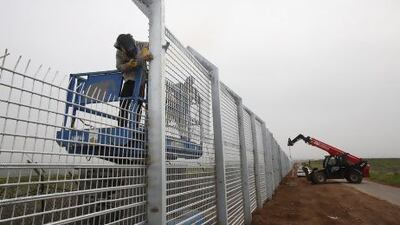
  • Workers reinforce the fence near Israel's border with Syria in the Golan Heights.
    Workers reinforce the fence near Israel's border with Syria in the Golan Heights.
  • Israeli troops patrol the Golan Heights.
    Israeli troops patrol the Golan Heights.
  • Israeli tanks are arrayed near the border with Syria in the Golan Heights. Reuters
    Israeli tanks are arrayed near the border with Syria in the Golan Heights. Reuters

Mr Bennett said that after a decade of conflict in Syria, international calls to return control of the Golan Heights to Damascus were muted.

“Every knowledgeable person in the world understands that it is preferable to have Israeli heights that are quiet, flourishing and green as opposed to the alternative,” he said.

Mr Bennett leads an ideologically disparate eight-party coalition that counts on support from left-wingers.

Some in his Cabinet, notably from the Meretz party, have vocally opposed plans to expand settlements in the West Bank, Palestinian territory also occupied by Israel since 1967.

About 475,000 settlers now live in the West Bank, in communities widely regarded as illegal under international law.

Mr Bennett opposes Palestinian statehood and is a former head of a settler lobbying council.

But he said unity on the Golan plan showed that Israeli control of the area was a matter of “national consensus”.

“The Golan Heights, the need to strengthen, cultivate and live in it, is certainly a principle that unites everyone here,” he said.

Israel and Syria, which are still technically at war, are separated by a de facto border at the Golan Heights.

Andor
%3Cp%3E%3Cstrong%3ECreator%3A%3C%2Fstrong%3E%20Tony%20Gilroy%3Cbr%3E%3Cstrong%3EStars%3A%20%3C%2Fstrong%3EDiego%20Luna%2C%20Genevieve%20O'Reilly%2C%20Alex%20Ferns%3Cbr%3E%3Cstrong%3ERating%3A%205%3C%2Fstrong%3E%2F5%3C%2Fp%3E%0A

Mercer, the investment consulting arm of US services company Marsh & McLennan, expects its wealth division to at least double its assets under management (AUM) in the Middle East as wealth in the region continues to grow despite economic headwinds, a company official said.

Mercer Wealth, which globally has $160 billion in AUM, plans to boost its AUM in the region to $2-$3bn in the next 2-3 years from the present $1bn, said Yasir AbuShaban, a Dubai-based principal with Mercer Wealth.

Within the next two to three years, we are looking at reaching $2 to $3 billion as a conservative estimate and we do see an opportunity to do so,” said Mr AbuShaban.

Mercer does not directly make investments, but allocates clients’ money they have discretion to, to professional asset managers. They also provide advice to clients.

“We have buying power. We can negotiate on their (client’s) behalf with asset managers to provide them lower fees than they otherwise would have to get on their own,” he added.

Mercer Wealth’s clients include sovereign wealth funds, family offices, and insurance companies among others.

From its office in Dubai, Mercer also looks after Africa, India and Turkey, where they also see opportunity for growth.

Wealth creation in Middle East and Africa (MEA) grew 8.5 per cent to $8.1 trillion last year from $7.5tn in 2015, higher than last year’s global average of 6 per cent and the second-highest growth in a region after Asia-Pacific which grew 9.9 per cent, according to consultancy Boston Consulting Group (BCG). In the region, where wealth grew just 1.9 per cent in 2015 compared with 2014, a pickup in oil prices has helped in wealth generation.

BCG is forecasting MEA wealth will rise to $12tn by 2021, growing at an annual average of 8 per cent.

Drivers of wealth generation in the region will be split evenly between new wealth creation and growth of performance of existing assets, according to BCG.

Another general trend in the region is clients’ looking for a comprehensive approach to investing, according to Mr AbuShaban.

“Institutional investors or some of the families are seeing a slowdown in the available capital they have to invest and in that sense they are looking at optimizing the way they manage their portfolios and making sure they are not investing haphazardly and different parts of their investment are working together,” said Mr AbuShaban.

Some clients also have a higher appetite for risk, given the low interest-rate environment that does not provide enough yield for some institutional investors. These clients are keen to invest in illiquid assets, such as private equity and infrastructure.

“What we have seen is a desire for higher returns in what has been a low-return environment specifically in various fixed income or bonds,” he said.

“In this environment, we have seen a de facto increase in the risk that clients are taking in things like illiquid investments, private equity investments, infrastructure and private debt, those kind of investments were higher illiquidity results in incrementally higher returns.”

The Abu Dhabi Investment Authority, one of the largest sovereign wealth funds, said in its 2016 report that has gradually increased its exposure in direct private equity and private credit transactions, mainly in Asian markets and especially in China and India. The authority’s private equity department focused on structured equities owing to “their defensive characteristics.”

Updated: December 26, 2021, 5:03 PM