

Libya was the most popular departure point for illegal crossings into southern Europe last year, the European Border and Guard Agency said.
One-third of about 200,000 people who were stopped last year by coastal and border guards in European countries had arrived by crossing the Central Mediterranean.
The route runs from North Africa, primarily from Libya, to Italy.
Frontex, as the agency is called, said in its latest survey illegal immigration is up 83 per cent, year-on-year.
The UN’s refugee agency said the popularity of the route was unlikely to drop, owing to Libya’s proximity to Europe and that political instability in the country prevented an effective border force operation from being mounted.
Most of those using the route rely on unstable vessels and rickety boats to cross dangerous waters. They are often subject to exploitation by human traffickers.
The total number registered by Frontex in 2021 is the highest since 2017.
People migrating illegally or seeking refuge have seized on the relaxing of Covid-19 restrictions in many countries.

Up to 65,000 people have tried to reach Europe from Libya or Tunisia.
They were followed by nearly 60,000 from the Balkans, the report said.
The border authorities returned more than 18,000 citizens of non-EU states to 102 destination countries last year.
About one in 10 of all detected irregular crossings last year occurred on the Eastern Mediterranean route, from about 20,000 people. The Eastern Mediterranean route refers to arrivals from Turkey, Greece, Cyprus and Bulgaria.
Syrians remained the most frequently reported nationality of the people detected when crossing the border without permission, followed by Tunisians, Moroccans, Algerians and Afghans.
As in 2020, women continued to make up fewer than one in 10 arrivals in 2021, a significant drop in their share compared with that in 2019.
-
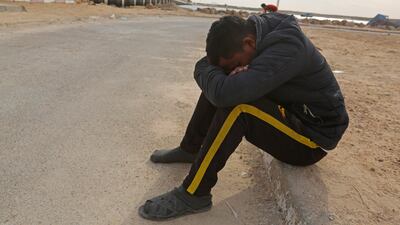
A migrant rescued by Tunisia's national guard during an attempt to enter Europe by crossing the Mediterranean by boat at the port of El Ketef, near the border with Libya. All photos: AFP -
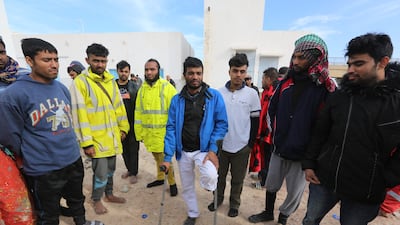
Rescued migrants rest at El Ketef after an aborted crossing of the Mediterranean. -
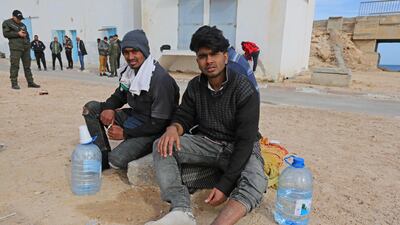
Migrants arrive in Tunisia and Libya from many parts of Africa, the Middle East and Asia to attempt the crossing. -
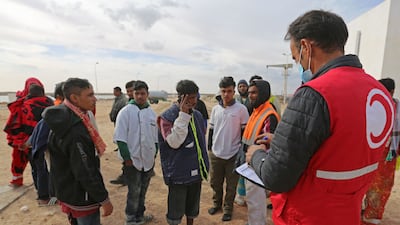
Thousands pay traffickers to help them on the last leg of their journey, often in vessels that are not seaworthy. These migrants are resting at El Ketef after being rescued by Tunisia's national guard. -
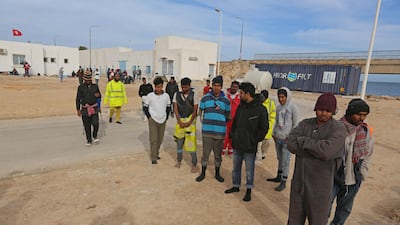
Huge numbers are still attempting the crossing despite cold winter weather and rough seas. -
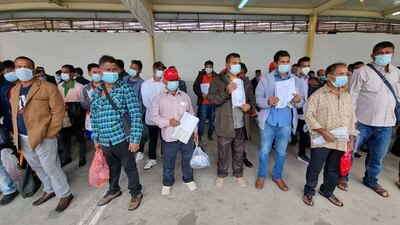
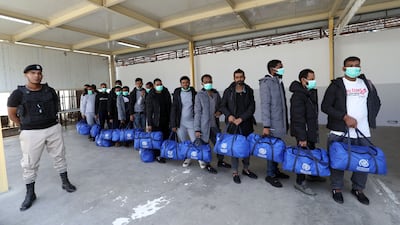
Bangladeshi migrants who were rescued as they attempted to cross the Mediterranean Sea by boat wait to board a bus as they are deported from Libya in Tripoli. Tunisia and Libya are key departure points for migrants attempting the dangerous crossing from the North African coast to Europe, particularly Italy. -
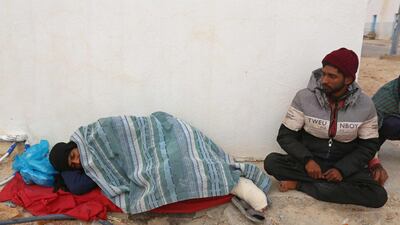
Last year, a record 35,000 migrants reached the Italian island of Lampedusa, which lies about 333 kilometres off the coast of Tunisia. -
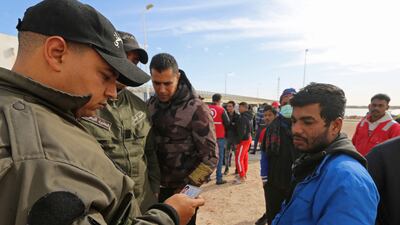
Other migrants become stranded in North Africa because they cannot afford to pay traffickers for the boat journey to Europe. -
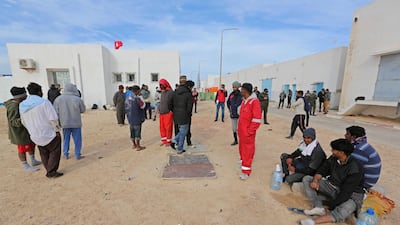
The UN says some migrants are joining forces to buy their own boats to attempt the crossing. -
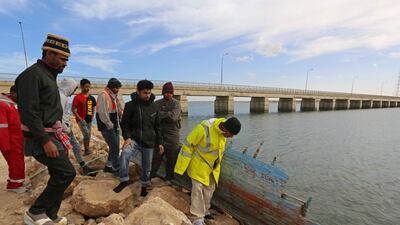
Migrants rescued by Tunisia's national guard during an attempted crossing of the Mediterranean by boat, rest on the beach at the port of el-Ketef in Ben Guerdane in southern Tunisia near the border with Libya. -
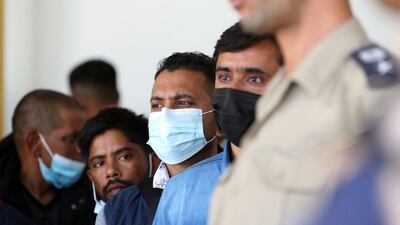
Bangladeshi migrants wait to board a bus as they are deported from Libya. -
The Libyan Coast Guard rescued more than 30,000 as they attempted the crossing last year, more than three times as many as in the previous year. -
More than 1,300 people died trying to make the journey. -
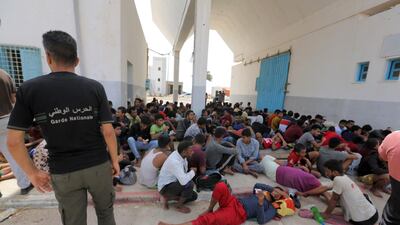
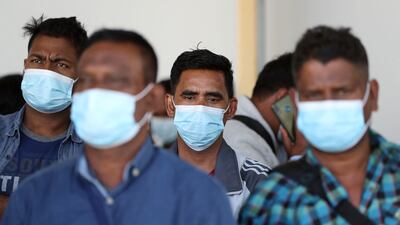
Migrants from South Asia in Tunisia after being rescued in the Mediterranean.


The Frontex data cover only people who tried to enter the EU illegally and were caught. There is no accurate information on the number of people who infiltrated the bloc.
But the International Organisation for Migration estimates that about 610,000 migrants, comprising more than 44 nationalities, are in Libya.
Many of them have escaped war and poverty elsewhere in Africa and hope to reach Europe by crossing the Mediterranean.
The UN has condemned the Libyan authorities for subjecting tens of thousands of migrants to appalling treatment including enslavement, torture and rape.
On Monday, UN Secretary General Antonio Guterres said more than 12,000 people were known to be held in 27 prisons and detention centres in Libya and that thousands more were being detained illegally.
To curb migration through the Mediterranean, EU countries, chiefly Italy, have signed agreements with Libyan officials to train and equip local coastguards.
-

Migrants aboard a rubber boat end up in the water before being rescued by 'Sea Watch-3' crew members, approximately 35 miles from Libya. All photos: AP -
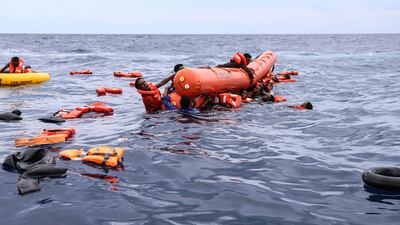
Migrants hold on to the rubber vessel and wait to be rescued. -
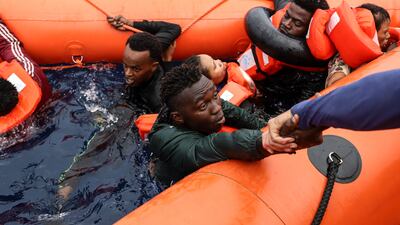
'Sea-Watch 3' is used for rescue operations in the Mediterranean. -
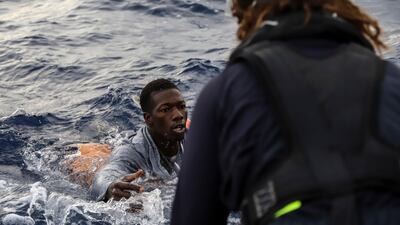
A migrant is rescued from the water. -
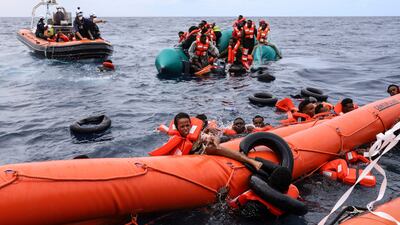
Migrants hold onto a centifloat. -

Migrants wait to board the rescue boat. -

Help is on the way: the migrants spot the 'Sea Watch-3' rescue boat. -

Migrants scramble to get to safety. -
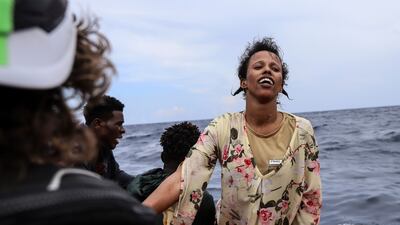
A woman smiles with relief as she sees the rescue team approaching. -
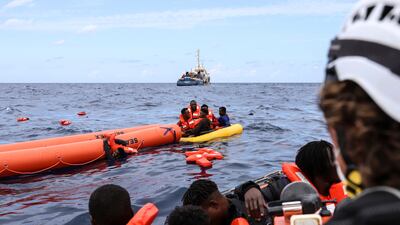
The 'Sea Watch-3' approaches the migrants. -
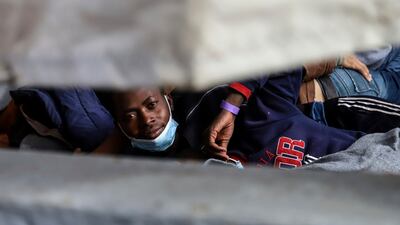
A migrant rests with others on the deck of the 'Sea Watch-3'. -
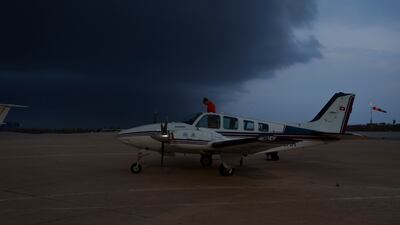
Eike Bretschneider disembarks the 'Seabird' after flying over the Mediterranean Sea, north of Libya. The aircraft documents any breach of human rights against migrants at sea and relays distress cases to nearby ships and authorities. -
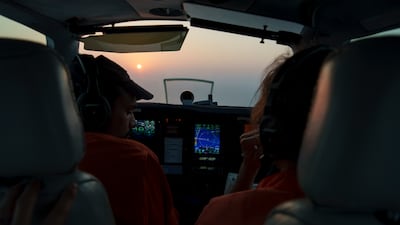
French volunteer pilot Augustin Clot, left, and tactical co-ordinator Jakob Fruehmann of Austria sit in the cockpit of 'Seabird', owned and operated by the German NGO Sea-Watch. -

Migrants who were intercepted crossing the Mediterranean by boat line up behind a fence in Lampedusa, Italy, as they wait to board a ferry to Sicily. -
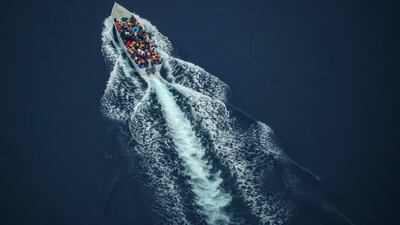
Migrants are crammed in an overcrowded wooden boat, as seen from ‘Seabird’. Despite the risks, many migrants say they would rather die trying to reach Europe than return to Libya. -
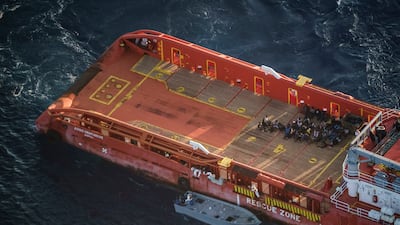
Migrants sit on the deck of the Italian supply vessel ‘Asso Ventinove’ after they were rescued from an unseaworthy boat drifting in the Mediterranean near the Bouri oilfields, north of Libya. -

German volunteers Leona Blankenstein, left, and David Lohmueller aboard 'Seabird', looking for migrant boats in distress. -
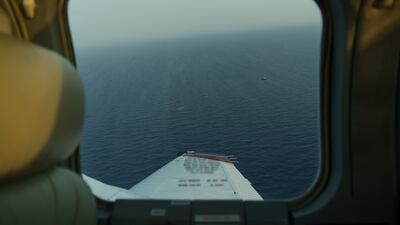
A small migrant boat and a Libyan merchant vessel are visible through the window of the humanitarian aircraft, above the Mediterranean Sea between Libya and Italy.


Last year was one of the deadliest for illegal migration to Europe by sea or land, with at least 4,400 deaths, the IOM said.
The figure could be far higher because unseaworthy boats often sink without a trace.
A group of international human rights organisations, including Amnesty International and Human Rights Watch, said in a joint statement last year that the Central Mediterranean route is one of the most dangerous migration routes in the world.
“Many lives could be saved if EU member states ensured and enabled robust search and rescue operations in the Central Mediterranean. There’s no evidence that SAR operations encourage people to embark,” the statement said.
The first presidential election was due to take place in Libya on December 24, followed by legislative polls, but the UN-sponsored electoral process was postponed owing to political tension.

