Gen Abdel Fattah Al Burhan, Sudan's military leader, offers concessions to pro-democracy groups opposing the takeover he led in October 2021. Reuters

Sudan’s Al Burhan promises measures to ease back into democratic transition


Hamza Hendawi
  • English
  • Arabic

Sudan’s military leader has promised measures to ease the country’s political crisis and create a climate for restoring the democratic transition he stopped when he seized power last October.

In an address to guests at a banquet on Friday night, Gen Abdel Fattah Al Burhan said that he and leaders of the judiciary were looking into the release “within two or three days” of activists and protesters arrested over the past five months.

Gen Al Burhan said their release would “prepare the climate for dialogue and allow the detainees to contribute with others to reaching a [political] consensus”.

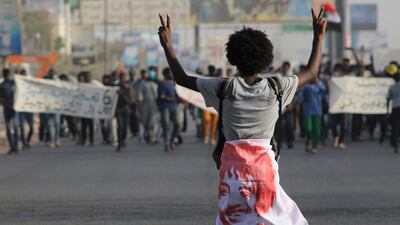
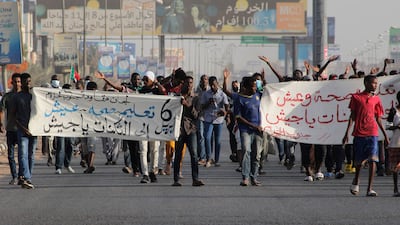
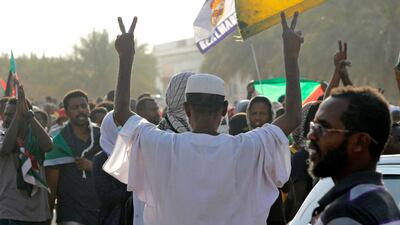
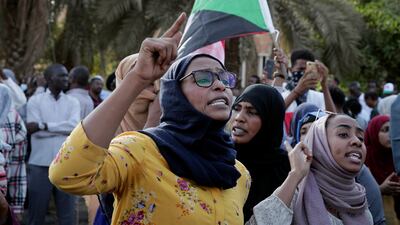
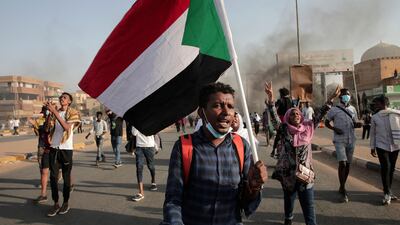
  • Sudanese protesters rally in Kartoum against military rule on the anniversary of previous popular uprisings. AFP
    Sudanese protesters rally in Kartoum against military rule on the anniversary of previous popular uprisings. AFP
  • Pro-democracy activists have warned of a people power 'earthquake of April 6' - a momentous day in Sudan's history that was key in bringing down earlier strongmen. AFP
    Pro-democracy activists have warned of a people power 'earthquake of April 6' - a momentous day in Sudan's history that was key in bringing down earlier strongmen. AFP
  • In 1985, the day saw the removal of former president Jaafar Nimeiri following a popular uprising. AFP
    In 1985, the day saw the removal of former president Jaafar Nimeiri following a popular uprising. AFP
  • In 2019 it marked the start of a mass sit-in outside army headquarters, after months of protests against Omar Al Bashir's three decades in power. AFP
    In 2019 it marked the start of a mass sit-in outside army headquarters, after months of protests against Omar Al Bashir's three decades in power. AFP
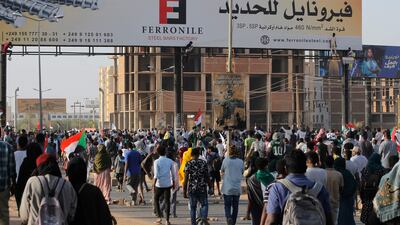
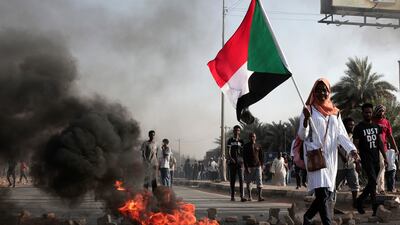
  • The rallies have been met with the deployment of thousands of police across the Sudanese capital. AFP
    The rallies have been met with the deployment of thousands of police across the Sudanese capital. AFP
  • Wednesday's protesters braved unforgiving heat and, for many, also the hunger and thirst of the dawn-to-dusk fast Muslims observe during the holy month of Ramadan. AP Photo
    Wednesday's protesters braved unforgiving heat and, for many, also the hunger and thirst of the dawn-to-dusk fast Muslims observe during the holy month of Ramadan. AP Photo
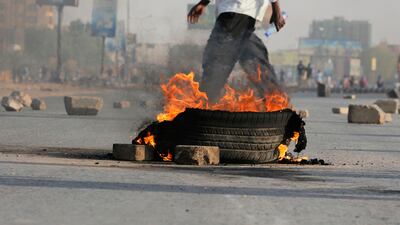
  • At least 92 protesters have been killed and about 3,000 injured since a crackdown against opposition. AP Photo
    At least 92 protesters have been killed and about 3,000 injured since a crackdown against opposition. AP Photo
  • US State Department spokesman Ned Price called on Sudan's military rulers on Tuesday to allow peaceful protests 'to continue without fear of violence'. AP Photo
    US State Department spokesman Ned Price called on Sudan's military rulers on Tuesday to allow peaceful protests 'to continue without fear of violence'. AP Photo
  • Most Sudanese are unable to make ends meet in the face of rising prices of essential food items and fuel. AP Photo
    Most Sudanese are unable to make ends meet in the face of rising prices of essential food items and fuel. AP Photo

He said he also instructed authorities to review the nationwide state of emergency he declared when he seized power on October 25.

Measures that safeguard national security and the economy would remain in effect.

Gen Al Burhan also promised a review of recent court rulings that reinstated scores of loyalists of Omar Al Bashir to government jobs they lost after the dictator was toppled.

We are embarking on a difficult period and we must all present concessions for the sake of our country
Gen Abdel Fattah Al Burhan

Besides derailing the democratic transition launched after the military’s removal of Al Bashir in 2019, the October coup resulted in near daily street protests against military rule in which millions have participated.

Security forces dealt violently with the rallies, killing at least 94 protesters and injuring about 3,000.

The violence against the protesters drew strong condemnation from western powers and cast doubts on Gen Al Burhan’s declared intention to work towards the restoration of the democratic transition.

Scores of people, including leading pro-democracy campaigners, have been detained.

The pro-democracy groups behind the protests have refused to hold talks with the military and are demanding that it quit politics altogether and be held accountable in court for overthrowing a legitimate government and killing protesters.

The coup has also wiped out the small economic gains made under the civilian-led government it removed, and prompted Sudan’s western backers, led by the US, EU and World Bank, to suspend billions of dollars’ worth of aid and debt forgiveness.

“We are embarking on a difficult period and we must all present concessions for the sake of our country,” Gen Al Burhan said on Friday.

“We are prepared to put forward what we can to create the atmosphere for a dialogue that leads to solutions.”

He has repeatedly said that the military is prepared to step aside and hand over power to an elected government. However, leaders of pro-democracy groups suspect the general has political ambitions of his own and that he and his associates were promoting political groups that would be beholden to them.

He has promised elections for next year.

Company%20profile
%3Cp%3E%3Cstrong%3EName%3A%3C%2Fstrong%3E%20Homie%20Portal%20LLC%3C%2Fp%3E%0A%3Cp%3E%3Cstrong%3EStarted%3A%3C%2Fstrong%3E%20End%20of%202021%C2%A0%3C%2Fp%3E%0A%3Cp%3E%3Cstrong%3EFounder%3A%20%3C%2Fstrong%3EAbdulla%20Al%20Kamda%C2%A0%3C%2Fp%3E%0A%3Cp%3E%3Cstrong%3EBased%3A%3C%2Fstrong%3E%20Dubai%3C%2Fp%3E%0A%3Cp%3E%3Cstrong%3ESector%3A%3C%2Fstrong%3E%20FinTech%C2%A0%3C%2Fp%3E%0A%3Cp%3E%3Cstrong%3EInitial%20investment%3A%3C%2Fstrong%3E%20Undisclosed%C2%A0%3C%2Fp%3E%0A%3Cp%3E%3Cstrong%3ECurrent%20number%20of%20staff%3A%3C%2Fstrong%3E%2014%C2%A0%3C%2Fp%3E%0A%3Cp%3E%3Cstrong%3EInvestment%20stage%3A%20%3C%2Fstrong%3ELaunch%C2%A0%3C%2Fp%3E%0A%3Cp%3E%3Cstrong%3EInvestors%3A%3C%2Fstrong%3E%20Self-funded%3C%2Fp%3E%0A
SERIE A FIXTURES

Friday Sassuolo v Torino (Kick-off 10.45pm UAE)

Saturday Atalanta v Sampdoria (5pm),

Genoa v Inter Milan (8pm),

Lazio v Bologna (10.45pm)

Sunday Cagliari v Crotone (3.30pm) 

Benevento v Napoli (6pm) 

Parma v Spezia (6pm)

 Fiorentina v Udinese (9pm)

Juventus v Hellas Verona (11.45pm)

Monday AC Milan v AS Roma (11.45pm)

Tamkeen's offering
  • Option 1: 70% in year 1, 50% in year 2, 30% in year 3
  • Option 2: 50% across three years
  • Option 3: 30% across five years 
RESULTS

Men – semi-finals

57kg – Tak Chuen Suen (MAC) beat Phuong Xuan Nguyen (VIE) 29-28; Almaz Sarsembekov (KAZ) beat Zakaria Eljamari (UAE) by points 30-27.

67kg – Mohammed Mardi (UAE) beat Huong The Nguyen (VIE) by points 30-27; Narin Wonglakhon (THA) v Mojtaba Taravati Aram (IRI) by points 29-28.

60kg – Yerkanat Ospan (KAZ) beat Amir Hosein Kaviani (IRI) 30-27; Long Doan Nguyen (VIE) beat Ibrahim Bilal (UAE) 29-28

63.5kg – Abil Galiyev (KAZ) beat Truong Cao Phat (VIE) 30-27; Nouredine Samir (UAE) beat Norapat Khundam (THA) RSC round 3.

71kg​​​​​​​ – Shaker Al Tekreeti (IRQ) beat Fawzi Baltagi (LBN) 30-27; Amine El Moatassime (UAE) beat Man Kongsib (THA) 29-28

81kg – Ilyass Hbibali (UAE) beat Alexandr Tsarikov (KAZ) 29-28; Khaled Tarraf (LBN) beat Mustafa Al Tekreeti (IRQ) 30-27

86kg​​​​​​​ – Ali Takaloo (IRI) beat Mohammed Al Qahtani (KSA) RSC round 1; Emil Umayev (KAZ) beat Ahmad Bahman (UAE) TKO round

Mercer, the investment consulting arm of US services company Marsh & McLennan, expects its wealth division to at least double its assets under management (AUM) in the Middle East as wealth in the region continues to grow despite economic headwinds, a company official said.

Mercer Wealth, which globally has $160 billion in AUM, plans to boost its AUM in the region to $2-$3bn in the next 2-3 years from the present $1bn, said Yasir AbuShaban, a Dubai-based principal with Mercer Wealth.

Within the next two to three years, we are looking at reaching $2 to $3 billion as a conservative estimate and we do see an opportunity to do so,” said Mr AbuShaban.

Mercer does not directly make investments, but allocates clients’ money they have discretion to, to professional asset managers. They also provide advice to clients.

“We have buying power. We can negotiate on their (client’s) behalf with asset managers to provide them lower fees than they otherwise would have to get on their own,” he added.

Mercer Wealth’s clients include sovereign wealth funds, family offices, and insurance companies among others.

From its office in Dubai, Mercer also looks after Africa, India and Turkey, where they also see opportunity for growth.

Wealth creation in Middle East and Africa (MEA) grew 8.5 per cent to $8.1 trillion last year from $7.5tn in 2015, higher than last year’s global average of 6 per cent and the second-highest growth in a region after Asia-Pacific which grew 9.9 per cent, according to consultancy Boston Consulting Group (BCG). In the region, where wealth grew just 1.9 per cent in 2015 compared with 2014, a pickup in oil prices has helped in wealth generation.

BCG is forecasting MEA wealth will rise to $12tn by 2021, growing at an annual average of 8 per cent.

Drivers of wealth generation in the region will be split evenly between new wealth creation and growth of performance of existing assets, according to BCG.

Another general trend in the region is clients’ looking for a comprehensive approach to investing, according to Mr AbuShaban.

“Institutional investors or some of the families are seeing a slowdown in the available capital they have to invest and in that sense they are looking at optimizing the way they manage their portfolios and making sure they are not investing haphazardly and different parts of their investment are working together,” said Mr AbuShaban.

Some clients also have a higher appetite for risk, given the low interest-rate environment that does not provide enough yield for some institutional investors. These clients are keen to invest in illiquid assets, such as private equity and infrastructure.

“What we have seen is a desire for higher returns in what has been a low-return environment specifically in various fixed income or bonds,” he said.

“In this environment, we have seen a de facto increase in the risk that clients are taking in things like illiquid investments, private equity investments, infrastructure and private debt, those kind of investments were higher illiquidity results in incrementally higher returns.”

The Abu Dhabi Investment Authority, one of the largest sovereign wealth funds, said in its 2016 report that has gradually increased its exposure in direct private equity and private credit transactions, mainly in Asian markets and especially in China and India. The authority’s private equity department focused on structured equities owing to “their defensive characteristics.”

THE BIO: Martin Van Almsick

Hometown: Cologne, Germany

Family: Wife Hanan Ahmed and their three children, Marrah (23), Tibijan (19), Amon (13)

Favourite dessert: Umm Ali with dark camel milk chocolate flakes

Favourite hobby: Football

Breakfast routine: a tall glass of camel milk

The chef's advice

Troy Payne, head chef at Abu Dhabi’s newest healthy eatery Sanderson’s in Al Seef Resort & Spa, says singles need to change their mindset about how they approach the supermarket.

“They feel like they can’t buy one cucumber,” he says. “But I can walk into a shop – I feed two people at home – and I’ll walk into a shop and I buy one cucumber, I’ll buy one onion.”

Mr Payne asks for the sticker to be placed directly on each item, rather than face the temptation of filling one of the two-kilogram capacity plastic bags on offer.

The chef also advises singletons not get too hung up on “organic”, particularly high-priced varieties that have been flown in from far-flung locales. Local produce is often grown sustainably, and far cheaper, he says.

Know before you go
  • Jebel Akhdar is a two-hour drive from Muscat airport or a six-hour drive from Dubai. It’s impossible to visit by car unless you have a 4x4. Phone ahead to the hotel to arrange a transfer.
  • If you’re driving, make sure your insurance covers Oman.
  • By air: Budget airlines Air Arabia, Flydubai and SalamAir offer direct routes to Muscat from the UAE.
  • Tourists from the Emirates (UAE nationals not included) must apply for an Omani visa online before arrival at evisa.rop.gov.om. The process typically takes several days.
  • Flash floods are probable due to the terrain and a lack of drainage. Always check the weather before venturing into any canyons or other remote areas and identify a plan of escape that includes high ground, shelter and parking where your car won’t be overtaken by sudden downpours.


Updated: April 16, 2022, 5:24 PM