

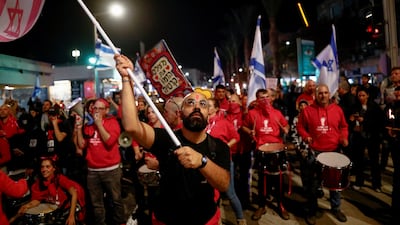
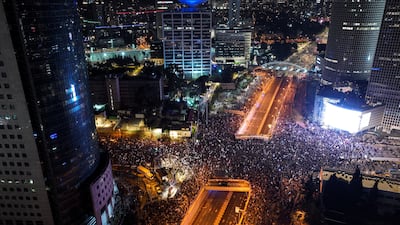
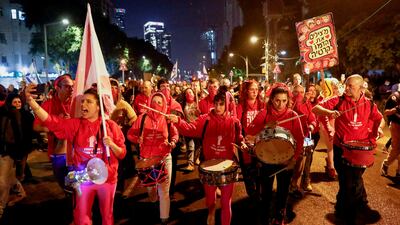
Tens of thousands of Israelis turned out for a fifth weekend of demonstrations against the government's plans to reform the Supreme Court, which they see as an unacceptable attack on a key democratic institution.
According to Israeli newspaper Haaretz, about 60,000 people joined protests across the country on Saturday despite bad weather to voice anger at Justice Minister Yariv Lavin’s proposal to allow parliament to override the court's rulings by simple majority.
The court has stood at the centre of Israel’s democracy since the country was founded in 1948. As the highest court in the land, it hears petitions against public bodies and authorities.
People of all ages joined the protests.
Ellen, a pensioner who chartered a bus to bring protesters to Jerusalem, called on President Isaac Herzog to intervene. “I’m a little old lady, but I wish the president would get off his little chair and do something,” she told The National.
-

A protest against the new government in Tel Aviv, Israel on January 21. EPA -

Protests come over a government plan to weaken the power of the Israeli Supreme Court. Getty -

Prime Minister Benjamin Netanyahu is also yet to follow a Supreme Court ruling to sack Interior Minister Aryeh Deri. Getty -

Mr Deri was previously convicted of tax fraud. Reuters -

Police said 100,000 turned out for the protest. Reuters -
Mr Deri is also Mr Netanyahu's Health Minister. Reuters -

Justice Minister Yariv Levin announced the move to weaken the Supreme Court. EPA -

Mr Deri is the leader of the Ultra-Orthodox Shas party, a key ally in Mr Netanyahu's right-wing coalition. Reuters -
He was forced to resign from the Knesset last year after receiving a suspended sentence. Reuters -
Parliament had to pass special legislation in December for Mr Deri to become a minister. Reuters -
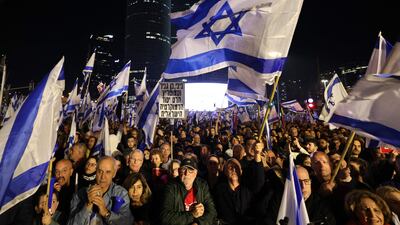
The new government has prompted division and outrage in Israel. AFP


On Sunday, Mr Herzog issued a plea to the government for dialogue.
“Stop the whole process for a moment, take a deep breath, allow dialogue to take place, because there is a huge majority of the nation that wants dialogue,” he said.
Prime Minister Benjamin Netanyahu, whose government is barely five weeks old, is facing mounting opposition from world leaders, industrialists and financiers over the judicial reforms.
The reforms, which involve giving politicians more power to appoint judges, removing ministerial obligations to respect the opinions of legal advisers and ending the top court's powers to block government decisions it considers unreasonable, might “have an impact on investment flows” into Israel, according to a recent JP Morgan report.
During a visit to Israel last week, Secretary of State Antony Blinken hinted at US anxiety over the planned changes, while French President Emmanuel Macron raised the issue when he hosted Mr Netanyahu in Paris at the weekend.
Domestic opposition to the reforms is reflected in opinion polls. A survey released on Sunday by the Israel Democracy Institute found that just 31 per cent of Israelis believe the judicial overhaul is “good”. Forty-three per cent said they think it is “bad” while 64 per cent of those surveyed were in favour of “dialogue to reach a compromise”.
Moshe Levy, a protester in Jerusalem, told The National: “I don’t think the government cares about us Israelis, but the world cares and can see us. And the government definitely cares what the world thinks. This is democracy being eradicated in live action.”
James Inverne, a resident of the central Israeli city of Modi'in, said the issue was stirring patriotic feelings in defence of a key pillar of the constitution: “When I see religious, secular and right-wing Jews, and not only Jews, it makes me feel even more proud of being Israeli. This is the true Israel right here.”
“I’ve always had a rule that I would never criticise any Israeli government to a non-Jew. But now I can’t stay silent any more. This is the gravest threat to Israeli democracy we’ve ever seen.”
His son, Doron Inverne, 17, highlighted the crucial role of young people, a demographic that was key to the rise of the far-right in November’s elections.
“Most of us aren’t in favour of the reforms. We need to turn up to fight the impression that no one cares,” he said.

