Follow the latest Sudan updates here
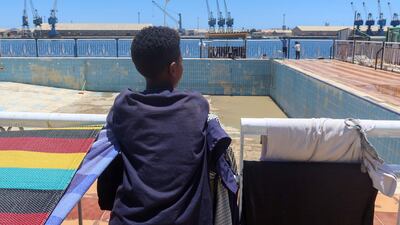
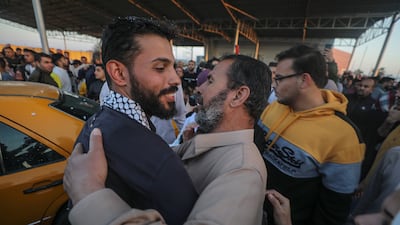
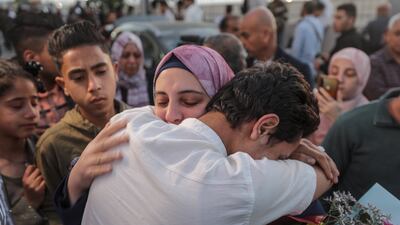
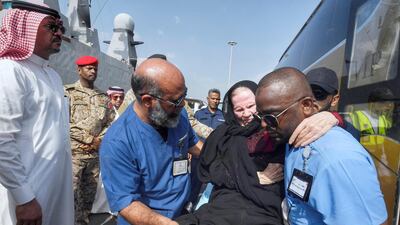
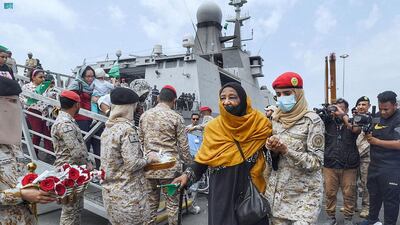
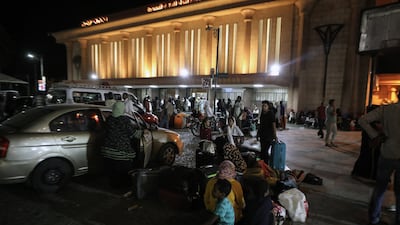
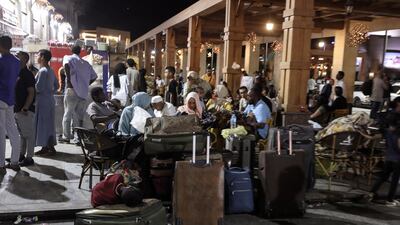
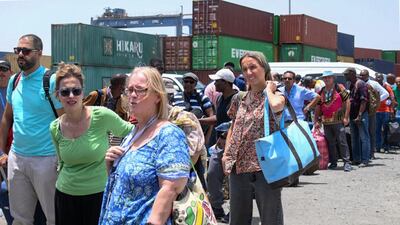
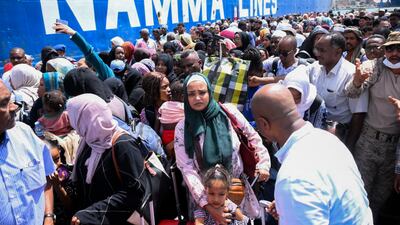
More than 800,000 people could flee Sudan as a result of the clashes there between rival military factions, the UN refugee agency said on Monday.
“In consultation with all concerned governments and partners we've arrived at a planning figure of 815,000 people that may flee into the seven neighbouring countries,” Raouf Mazou, Assistant High Commissioner for Refugees, said at a UN member state briefing in Geneva.
The estimate includes about 580,000 Sudanese, while the others are existing refugees living temporarily in the country, he said
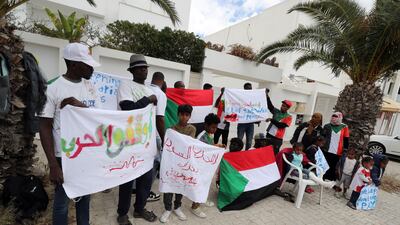
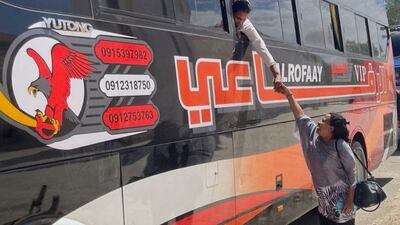
Mr Mazou said about 73,000 people had already fled to Sudan's seven neighbours — South Sudan, Chad, Egypt, Eritrea, Ethiopia, Central African Republic and Libya — since fighting between the Sudanese army and the paramilitary Rapid Support Forces began on April 15
The UN humanitarian co-ordinator in Sudan warned that the humanitarian crisis was turning into a “full blown catastrophe” and that the risk of spillover into neighbouring countries was worrying.
“It has been more than two weeks of devastating fighting in Sudan, a conflict that is turning Sudan's humanitarian crisis into a full blown catastrophe,” Abdou Dieng said via video link.
The briefings follow increasingly grim warnings from UN agencies about the impact of the conflict on the impoverished country of 45 million.
The heaviest fighting, including artillery fire and aerial bombardment, has been reported in the capital Khartoum and the western region of Darfur. Both sides have agreed to and ignored a series of ceasefires, despite calls for a lull to allow civilians to seek safety and receive humanitarian assistance.
The UN's senior official in the country said on Monday that the warring sides had agreed to send representatives for negotiations, possibly in Saudi Arabia, but the logistics were still being worked out.
The talks would focus on establishing a “stable and reliable” ceasefire monitored by “national and international observers”, Mr Perthes told AP.
So far, only the military has announced it is prepared to join negotiations, with no public word from its opponent, the paramilitary Rapid Support Forces (RSF).
On Sunday, UN Secretary General Antonio Guterres said he would send an envoy to Sudan given the “unprecedented” situation the country is going through.
Mr Guterres' decision comes after successive 72-hour ceasefires were breached by the RSF and Sudan's army.
The death toll continued to rise, with reports emerging of hospitals and blood banks being looted, and ambulances being prevented from reaching their destinations.
The fighting has pushed Sudan's already “extremely fragile” healthcare system to the verge of disaster, a World Health Organisation official said on Monday.
With hospitals bombed, medicines running low and many doctors fleeing the country, “it is a disaster in every sense of the word”, Ahmed Al Mandhari, WHO regional director for the eastern Mediterranean, told AFP.
“The scale and speed of what is unfolding is unprecedented in Sudan … we are extremely concerned,” UN spokesman Stephane Dujarric said.
UN emergency relief co-ordinator Martin Griffiths, who will serve as the envoy, said Sudan's humanitarian situation was reaching a breaking point.
Mr Griffiths was the UN envoy to Yemen until 2021.
“I am on my way to the region to explore how we can bring immediate relief to the millions of people whose lives have turned upside down overnight,” he said on Sunday.
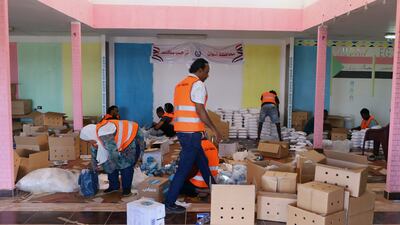
However, rampant looting of humanitarian offices and warehouses has depleted most of the UN's supplies, he said.
“We are exploring urgent ways to bring in and distribute additional supplies,” Mr Griffiths said.
The “obvious solution” would be to stop the fighting, he said.
On Monday, the World Food Programme said it would lift the suspension of operations in Sudan with immediate effect.
The WFP paused operations after the death of three team members on the first day of fighting.
“WFP is rapidly resuming our programmes to provide the life-saving assistance that many so desperately need right now,” executive director Cindy McCain wrote on Twitter.
More than 500 people have been killed and tens of thousands forced to leave their homes for safer locations within the country or abroad.
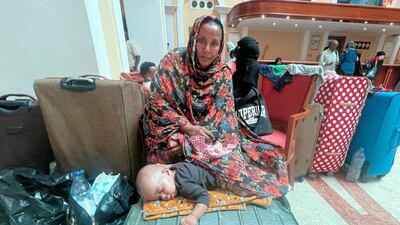
The UN says the fighting had left 75,000 people displaced in Sudan while 20,000 had fled to neighbouring Chad, 4,000 to South Sudan and 3,500 to Ethiopia.
About 6,000 people, most of them women, have sought refuge in the neighbouring Central African Republic over the past two weeks, the UN refugee agency told AFP.
“The number is made up of 70 per cent women, 15 per cent girls, 10 per cent men and 400 repatriated,” said the UNHCR in a tweet on Saturday.
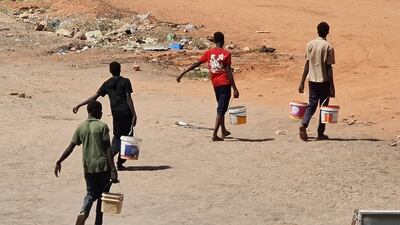
Mr Griffiths said families were struggling to gain access to water, food, fuel and other commodities, with others unable to leave some of the worst-hit areas due to the prohibitive cost of transport.
Urgent health care “is severely constrained, raising the risk of preventable death”, he said.
Five containers of intravenous fluids and other emergency supplies docked in Port Sudan are awaiting clearance by authorities, he said.
The President's Cake
Director: Hasan Hadi
Starring: Baneen Ahmad Nayyef, Waheed Thabet Khreibat, Sajad Mohamad Qasem
Rating: 4/5
David Haye record
Total fights: 32
Wins: 28
Wins by KO: 26
Losses: 4
Recipe: Spirulina Coconut Brothie
Ingredients
1 tbsp Spirulina powder
1 banana
1 cup unsweetened coconut milk (full fat preferable)
1 tbsp fresh turmeric or turmeric powder
½ cup fresh spinach leaves
½ cup vegan broth
2 crushed ice cubes (optional)
Method
Blend all the ingredients together on high in a high-speed blender until smooth and creamy.
Know your cyber adversaries
Cryptojacking: Compromises a device or network to mine cryptocurrencies without an organisation's knowledge.
Distributed denial-of-service: Floods systems, servers or networks with information, effectively blocking them.
Man-in-the-middle attack: Intercepts two-way communication to obtain information, spy on participants or alter the outcome.
Malware: Installs itself in a network when a user clicks on a compromised link or email attachment.
Phishing: Aims to secure personal information, such as passwords and credit card numbers.
Ransomware: Encrypts user data, denying access and demands a payment to decrypt it.
Spyware: Collects information without the user's knowledge, which is then passed on to bad actors.
Trojans: Create a backdoor into systems, which becomes a point of entry for an attack.
Viruses: Infect applications in a system and replicate themselves as they go, just like their biological counterparts.
Worms: Send copies of themselves to other users or contacts. They don't attack the system, but they overload it.
Zero-day exploit: Exploits a vulnerability in software before a fix is found.
Mercer, the investment consulting arm of US services company Marsh & McLennan, expects its wealth division to at least double its assets under management (AUM) in the Middle East as wealth in the region continues to grow despite economic headwinds, a company official said.
Mercer Wealth, which globally has $160 billion in AUM, plans to boost its AUM in the region to $2-$3bn in the next 2-3 years from the present $1bn, said Yasir AbuShaban, a Dubai-based principal with Mercer Wealth.
“Within the next two to three years, we are looking at reaching $2 to $3 billion as a conservative estimate and we do see an opportunity to do so,” said Mr AbuShaban.
Mercer does not directly make investments, but allocates clients’ money they have discretion to, to professional asset managers. They also provide advice to clients.
“We have buying power. We can negotiate on their (client’s) behalf with asset managers to provide them lower fees than they otherwise would have to get on their own,” he added.
Mercer Wealth’s clients include sovereign wealth funds, family offices, and insurance companies among others.
From its office in Dubai, Mercer also looks after Africa, India and Turkey, where they also see opportunity for growth.
Wealth creation in Middle East and Africa (MEA) grew 8.5 per cent to $8.1 trillion last year from $7.5tn in 2015, higher than last year’s global average of 6 per cent and the second-highest growth in a region after Asia-Pacific which grew 9.9 per cent, according to consultancy Boston Consulting Group (BCG). In the region, where wealth grew just 1.9 per cent in 2015 compared with 2014, a pickup in oil prices has helped in wealth generation.
BCG is forecasting MEA wealth will rise to $12tn by 2021, growing at an annual average of 8 per cent.
Drivers of wealth generation in the region will be split evenly between new wealth creation and growth of performance of existing assets, according to BCG.
Another general trend in the region is clients’ looking for a comprehensive approach to investing, according to Mr AbuShaban.
“Institutional investors or some of the families are seeing a slowdown in the available capital they have to invest and in that sense they are looking at optimizing the way they manage their portfolios and making sure they are not investing haphazardly and different parts of their investment are working together,” said Mr AbuShaban.
Some clients also have a higher appetite for risk, given the low interest-rate environment that does not provide enough yield for some institutional investors. These clients are keen to invest in illiquid assets, such as private equity and infrastructure.
“What we have seen is a desire for higher returns in what has been a low-return environment specifically in various fixed income or bonds,” he said.
“In this environment, we have seen a de facto increase in the risk that clients are taking in things like illiquid investments, private equity investments, infrastructure and private debt, those kind of investments were higher illiquidity results in incrementally higher returns.”
The Abu Dhabi Investment Authority, one of the largest sovereign wealth funds, said in its 2016 report that has gradually increased its exposure in direct private equity and private credit transactions, mainly in Asian markets and especially in China and India. The authority’s private equity department focused on structured equities owing to “their defensive characteristics.”
Yemen's Bahais and the charges they often face
The Baha'i faith was made known in Yemen in the 19th century, first introduced by an Iranian man named Ali Muhammad Al Shirazi, considered the Herald of the Baha'i faith in 1844.
The Baha'i faith has had a growing number of followers in recent years despite persecution in Yemen and Iran.
Today, some 2,000 Baha'is reside in Yemen, according to Insaf.
"The 24 defendants represented by the House of Justice, which has intelligence outfits from the uS and the UK working to carry out an espionage scheme in Yemen under the guise of religion.. aimed to impant and found the Bahai sect on Yemeni soil by bringing foreign Bahais from abroad and homing them in Yemen," the charge sheet said.
Baha'Ullah, the founder of the Bahai faith, was exiled by the Ottoman Empire in 1868 from Iran to what is now Israel. Now, the Bahai faith's highest governing body, known as the Universal House of Justice, is based in the Israeli city of Haifa, which the Bahais turn towards during prayer.
The Houthis cite this as collective "evidence" of Bahai "links" to Israel - which the Houthis consider their enemy.
On racial profiling at airports
500 People from Gaza enter France
115 Special programme for artists
25 Evacuation of injured and sick
Karwaan
Producer: Ronnie Screwvala
Director: Akarsh Khurana
Starring: Irrfan Khan, Dulquer Salmaan, Mithila Palkar
Rating: 4/5
MATCH INFO
Uefa Champions League quarter-final, second leg (first-leg score)
Porto (0) v Liverpool (2), Wednesday, 11pm UAE
Match is on BeIN Sports
War
Director: Siddharth Anand
Cast: Hrithik Roshan, Tiger Shroff, Ashutosh Rana, Vaani Kapoor
Rating: Two out of five stars
MOUNTAINHEAD REVIEW
Starring: Ramy Youssef, Steve Carell, Jason Schwartzman
Director: Jesse Armstrong
Rating: 3.5/5
German intelligence warnings
- 2002: "Hezbollah supporters feared becoming a target of security services because of the effects of [9/11] ... discussions on Hezbollah policy moved from mosques into smaller circles in private homes." Supporters in Germany: 800
- 2013: "Financial and logistical support from Germany for Hezbollah in Lebanon supports the armed struggle against Israel ... Hezbollah supporters in Germany hold back from actions that would gain publicity." Supporters in Germany: 950
- 2023: "It must be reckoned with that Hezbollah will continue to plan terrorist actions outside the Middle East against Israel or Israeli interests." Supporters in Germany: 1,250
Source: Federal Office for the Protection of the Constitution
Buy farm-fresh food
The UAE is stepping up its game when it comes to platforms for local farms to show off and sell their produce.
In Dubai, visit Emirati Farmers Souq at The Pointe every Saturday from 8am to 2pm, which has produce from Al Ammar Farm, Omar Al Katri Farm, Hikarivege Vegetables, Rashed Farms and Al Khaleej Honey Trading, among others.
In Sharjah, the Aljada residential community will launch a new outdoor farmers’ market every Friday starting this weekend. Manbat will be held from 3pm to 8pm, and will host 30 farmers, local home-grown entrepreneurs and food stalls from the teams behind Badia Farms; Emirates Hydroponics Farms; Modern Organic Farm; Revolution Real; Astraea Farms; and Al Khaleej Food.
In Abu Dhabi, order farm produce from Food Crowd, an online grocery platform that supplies fresh and organic ingredients directly from farms such as Emirates Bio Farm, TFC, Armela Farms and mother company Al Dahra.
Top financial tips for graduates
Araminta Robertson, of the Financially Mint blog, shares her financial advice for university leavers:
1. Build digital or technical skills: After graduation, people can find it extremely hard to find jobs. From programming to digital marketing, your early twenties are for building skills. Future employers will want people with tech skills.
2. Side hustle: At 16, I lived in a village and started teaching online, as well as doing work as a virtual assistant and marketer. There are six skills you can use online: translation; teaching; programming; digital marketing; design and writing. If you master two, you’ll always be able to make money.
3. Networking: Knowing how to make connections is extremely useful. Use LinkedIn to find people who have the job you want, connect and ask to meet for coffee. Ask how they did it and if they know anyone who can help you. I secured quite a few clients this way.
4. Pay yourself first: The minute you receive any income, put about 15 per cent aside into a savings account you won’t touch, to go towards your emergency fund or to start investing. I do 20 per cent. It helped me start saving immediately.