Sudanese refugees fleeing the violence in the western Darfur Region cross the border into Chad. Reuters

Number of displaced people in Sudan doubles to 700,000 in a week


  • English
  • Arabic

Follow the latest news from the Sudan crisis here

The number of people displaced in Sudan has doubled in a week from 340,000 to 700,000, the UN migration agency said on Tuesday.

This huge increase reported by the International Organisation for Migration comes despite efforts to bring the warring Sudanese army and paramilitary Rapid Support Forces to the negotiating table through Saudi-brokered talks in Jeddah.

According to UN estimates an additional five million people will require humanitarian aid, bringing the total to 21 million people since the conflict began on the April 15.

More than 600 people have been killed and 5,000 injured, since the violence broke out on April 15, according to the World Health Organisation. Many of those are civilians.

Non-governmental organisation the Sudan's Doctors' Union said there were people still uncounted for because of logistical difficulties and security concerns.

The group also highlighted problems faced by hospitals, including in the western city of Geneina, in West Darfur.

“Hospitals and health facilities in Geneina are still out of service to this moment,” the union said on Monday.

Meanwhile, officials reported that negotiations between the warring parties have so far failed to achieve a breakthrough.

“No major progress” has been made at the talks in Jeddah, where the warring sides have sent representatives, a Saudi diplomat told AFP.

“A permanent ceasefire isn't on the table. Every side believes it is capable of winning the battle,” the source said.

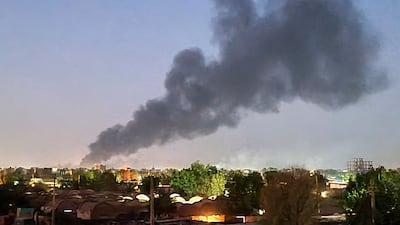
  • Khartoum burns amid fighting between the forces of two rival generals in Sudan. AFP
    Khartoum burns amid fighting between the forces of two rival generals in Sudan. AFP
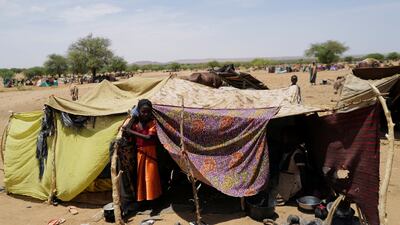
  • A Sudanese girl at her family's makeshift shelter across the border in Koufroun, Chad. Reuters
    A Sudanese girl at her family's makeshift shelter across the border in Koufroun, Chad. Reuters
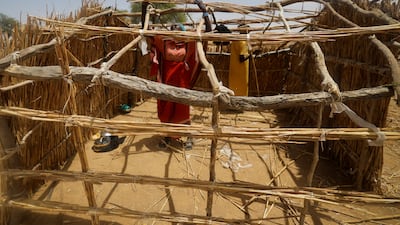
  • Sudanese refugee women build a makeshift shelter in Koufroun, Chad. Reuters
    Sudanese refugee women build a makeshift shelter in Koufroun, Chad. Reuters
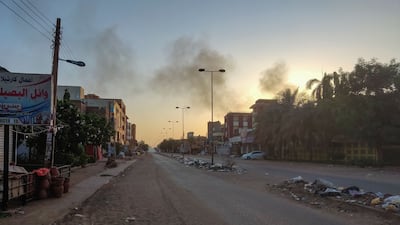
  • Air strikes battered Khartoum as fighting entered a fourth week. AFP
    Air strikes battered Khartoum as fighting entered a fourth week. AFP
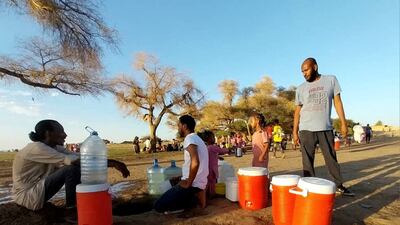
  • People dig holes to get pure water at the banks of the White Nile in Khartoum. Reuters
    People dig holes to get pure water at the banks of the White Nile in Khartoum. Reuters
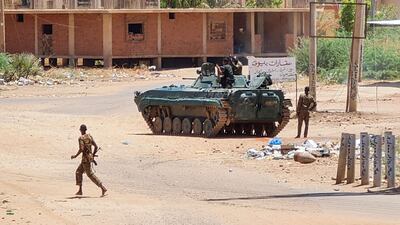
  • Army sodliers and tanks on a street in Khartoum. AFP
    Army sodliers and tanks on a street in Khartoum. AFP
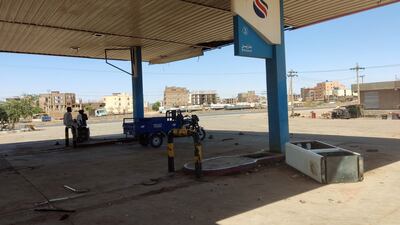
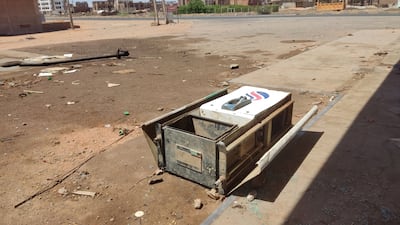
  • A looted petrol station in southern Khartoum. AFP
    A looted petrol station in southern Khartoum. AFP
  • Sudan's warring generals have repeatedly failed to honour multiple agreed ceasefires. AFP
    Sudan's warring generals have repeatedly failed to honour multiple agreed ceasefires. AFP
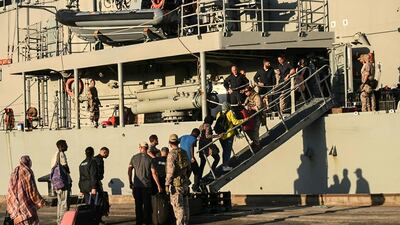
  • People board the Spanish frigate Reina Sofia during an evacuation from Port Sudan to Saudi Arabia. AFP
    People board the Spanish frigate Reina Sofia during an evacuation from Port Sudan to Saudi Arabia. AFP
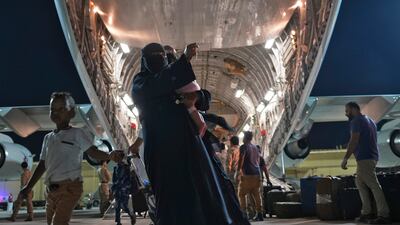
  • Evacuees disembark at Al Udeid Air Base in Qatar. AP
    Evacuees disembark at Al Udeid Air Base in Qatar. AP

Kholood Khair, founder of the Khartoum-based think tank Confluence Advisory, said the delegations “are there mostly to curry favour with the Saudis and the Americans, rather than to credibly use this platform as a means to reach an agreement”.

Several ceasefires have been breached as both sides compete for military gain.

As the humanitarian crisis in Sudan grows, officials have warned that the aid operation in Sudan remains severely underfunded — particularly compared to that in Ukraine, following Russia's invasion last year.

“The only fully funded operation in the world now is in Ukraine. All other operations are catastrophically underfunded,” said Jan Egeland, head of the Norwegian Refugee Council.

On Tuesday, the UN agency that responds to natural disasters said that several UN facilities have been looted.

“Yesterday, a World Food Programme facility — the main one that houses food stocks in Khartoum — were looted,” said United Nations Office for the Co-ordination of Humanitarian Affairs (OCHA) spokeswoman Eri Kaneko.

She added that facilities in the Sudanese capital belonging to OCHA and UN children's agency Unicef had also been looted.

A third of the country needed aid before the recent crisis, said Ms Kaneko.

Last week, senior UN aid envoy Yemen Martin Griffiths visited the Red Sea city of Port Sudan, from where many people are leaving the country.

Mr Griffiths then landed in Jeddah where talks are continuing.

Ms Kaneko said that Mr Griffiths spoke to the opposing leaders — Sudanese army chief Gen Abdel Fattah Al Burhan and Gen Mohamed Dagalo, who leads the RSF — and is hopeful of a “positive response” for humanitarian guarantees from both sides.

“Martin's message in Port Sudan was to ensure that workers are not attacked. We're not asking for the moon just basic guarantees to deliver aid to those who need it.”

Ms Kaneko said OCHA was already running low on funds before the recent fighting broke out and is now in need of funds “now more than ever”.

She said that impact on children is “unfathomable”, expressing a concern for attacks on healthcare facilities.

“Our colleagues in the WHO said that there were at least 28 attacks on health facilities in Sudan.”

On Monday, the UAE sent three transport aircraft carrying 115 tonnes of vital medical and food supplies to Sudan and neighbouring Chad, where some refugees have fled.

The UAE has delivered more than 240 tonnes of medical and food aid to Sudan since the fighting began.


Ten tax points to be aware of in 2026

1. Domestic VAT refund amendments: request your refund within five years

If a business does not apply for the refund on time, they lose their credit.

2. E-invoicing in the UAE

Businesses should continue preparing for the implementation of e-invoicing in the UAE, with 2026 a preparation and transition period ahead of phased mandatory adoption. 

3. More tax audits

Tax authorities are increasingly using data already available across multiple filings to identify audit risks. 

4. More beneficial VAT and excise tax penalty regime

Tax disputes are expected to become more frequent and more structured, with clearer administrative objection and appeal processes. The UAE has adopted a new penalty regime for VAT and excise disputes, which now mirrors the penalty regime for corporate tax.

5. Greater emphasis on statutory audit

There is a greater need for the accuracy of financial statements. The International Financial Reporting Standards standards need to be strictly adhered to and, as a result, the quality of the audits will need to increase.

6. Further transfer pricing enforcement

Transfer pricing enforcement, which refers to the practice of establishing prices for internal transactions between related entities, is expected to broaden in scope. The UAE will shortly open the possibility to negotiate advance pricing agreements, or essentially rulings for transfer pricing purposes. 

7. Limited time periods for audits

Recent amendments also introduce a default five-year limitation period for tax audits and assessments, subject to specific statutory exceptions. While the standard audit and assessment period is five years, this may be extended to up to 15 years in cases involving fraud or tax evasion. 

8. Pillar 2 implementation 

Many multinational groups will begin to feel the practical effect of the Domestic Minimum Top-Up Tax (DMTT), the UAE's implementation of the OECD’s global minimum tax under Pillar 2. While the rules apply for financial years starting on or after January 1, 2025, it is 2026 that marks the transition to an operational phase.

9. Reduced compliance obligations for imported goods and services

Businesses that apply the reverse-charge mechanism for VAT purposes in the UAE may benefit from reduced compliance obligations. 

10. Substance and CbC reporting focus

Tax authorities are expected to continue strengthening the enforcement of economic substance and Country-by-Country (CbC) reporting frameworks. In the UAE, these regimes are increasingly being used as risk-assessment tools, providing tax authorities with a comprehensive view of multinational groups’ global footprints and enabling them to assess whether profits are aligned with real economic activity. 

Contributed by Thomas Vanhee and Hend Rashwan, Aurifer

The%20specs
%3Cp%3E%3Cstrong%3EPowertrain%3A%20%3C%2Fstrong%3ESingle%20electric%20motor%0D%3Cbr%3E%3Cstrong%3EPower%3A%20%3C%2Fstrong%3E201hp%0D%3Cbr%3E%3Cstrong%3ETorque%3A%20%3C%2Fstrong%3E310Nm%0D%3Cbr%3E%3Cstrong%3ETransmission%3A%20%3C%2Fstrong%3ESingle-speed%20auto%0D%3Cbr%3E%3Cstrong%3EBattery%3A%20%3C%2Fstrong%3E53kWh%20lithium-ion%20battery%20pack%20(GS%20base%20model)%3B%2070kWh%20battery%20pack%20(GF)%0D%3Cbr%3E%3Cstrong%3ETouring%20range%3A%20%3C%2Fstrong%3E350km%20(GS)%3B%20480km%20(GF)%0D%3Cbr%3E%3Cstrong%3EPrice%3A%20%3C%2Fstrong%3EFrom%20Dh129%2C900%20(GS)%3B%20Dh149%2C000%20(GF)%0D%3Cbr%3E%3Cstrong%3EOn%20sale%3A%3C%2Fstrong%3E%20Now%3C%2Fp%3E%0A
How to register as a donor

1) Organ donors can register on the Hayat app, run by the Ministry of Health and Prevention

2) There are about 11,000 patients in the country in need of organ transplants

3) People must be over 21. Emiratis and residents can register. 

4) The campaign uses the hashtag  #donate_hope

Updated: May 09, 2023, 3:55 PM