
Live updates: Follow the latest news on Israel-Gaza
The US on Monday imposed a fifth round of sanctions on Hamas since the October 7 attacks on Israel as western countries try to counter the militant group's financial networks around the globe.
The sanctions come as Israel's bombing campaign of the Gaza Strip continues – with 25,000 Palestinians killed so far, according to the enclave's Health Ministry.
The latest financial action, imposed along with Australia and the UK, targets a network of Hamas-affiliated financial exchanges in Gaza, including facilitators who transferred funds via cryptocurrency from Iran to Hamas and Palestinian Islamic Jihad in the enclave.
While sanctions such as these are a key tool for western nations targeting Hamas and other groups, their effectiveness is debated.
In the short term, the sanctions may have a limited effect on the group as it seeks to capitalise on donations from abroad, said Jessica Davis, president of the Canadian group Insight Threat Intelligence.
In parallel, traditional large sources of funding, including taxes and cash from Qatar, are expected to drop due to the high level of destruction in Gaza.
But Hamas has deep financial roots. It draws on taxes in Gaza, Iran, Qatar, Turkey and overseas investments to generate an estimated $1 billion yearly revenue.
“Sanctions will not immediately hurt Hamas’s networks because most of these businesses operate in areas that don’t care about EU or US sanctions,” said Ms Davis.
“It can make it harder for them to operate though, so that’s a good thing.”
Fundraising on the rise
“We are not surprised to see a spike in legitimate and illegitimate fundraising in the weeks since October 7,” Matthew Levitt, a former counter-terrorism official with the FBI and US Treasury Department and one of the world's leading terrorism financing researchers, told The National.
“Whether they're Arab or Muslim or not, those who see the suffering in Gaza are going to want to do something and typically what that involves is to donate some money.
“You go to a website, you see a picture of a suffering child, you give money. And some of those websites are legitimate, others are not. They are Hamas [websites] in some cases.”
Hamas has been listed as a terror organisation by both the US and EU and both Washington and Brussels have issued a series of sanctions against the group since in took power in Gaza in 2007.
Unlike EU sanctions, which apply only inside the bloc, US listings apply overseas, where banks need correspondent American institutions to access US dollars.
Omri Brinner, a Middle East analyst with the International Team for the Study of Security Verona, said he doubted that US sanctions would be effective, as Washington has a long history of designating actors and not enforcing the measures.
“What has happened in the past, mainly with Hezbollah financing operations, is that the US chose to ignore clear violations and actions by sanctioned individuals because they were negotiating terms with Iran,” he noted.
“So when they'll negotiate terms with Hamas or Qatar, they'll probably overlook Hamas terror financing.”
Mr Brinner predicted that Hamas will likely expand its chapters around the world, particularly in East Africa, the Sahel, Turkey and Indonesia. He added that their financial operations will probably become be more global, elusive and efficient in money laundering.
Who was Saleh Al Arouri, the Hamas leader killed in Lebanon?
That is “something that Iran and Hezbollah are already doing”, he told The National.
Tackling a potential rise in fundraising activities comes with its own challenges. Since October 7, Israel has cracked down on cryptocurrency networks used by Hamas to channel funds.
Hamas has largely used cryptocurrency not to generate money but mostly as a means of moving cash from crowdfunding campaigns, said Mr Levitt.
“And the US Department of Justice has seized Hamas wallets,” he said. “It's definitely in the range of hundreds thousands of dollars. So it's nothing to sneeze at.”
But fighting those networks requires resources in terms of monitoring and evidence-gathering, and most governments are still developing regulatory frameworks, said Lucas Webber, co-founder of the specialist website Militant Wire.
“It’s difficult to implement or pursue,” said Mr Webber.
Hamas had, in past decades, been low on US and EU intelligence agencies' radars.
“The reality was, Hamas was not so high up on the priority list,” said Mr Levitt. “The group seemed to be contained in Gaza. It's not an organisation that traditionally carries out terrorist attacks … in the UAE or in America or in Europe.”
Hamas’s wealth and financial foundation might still be largely intact. As a result, the militant group could potentially recover despite the devastation in the enclave, said senior director of the Counter Extremism Project, Hans-Jakob Schindler.
He stressed the need for a global strategy to limit Hamas's finances, including stronger US and EU sanctions, closing regulatory loopholes in countries that had not previously listed the group, such as Switzerland, and globally recognising Hamas as a terrorist organisation.
The US, EU and other western countries have voiced strong opposition to Hamas having a role in governing postwar Gaza, as Israel continues its campaign to root the group out of the enclave.
Former Israeli Intelligence Official Avi Melamed told The National that Hamas is “not going to disappear”.
“It's not about eliminating Hamas … but it's about limiting Hamas's ability to continue to play such a destructive role,” he said.
Shifting strategies?
Hamas's finance networks are likely to continue shifting in the coming months as the war continues in Gaza.
Meanwhile, European countries have signalled they believe that Hamas is expanding its operations to the continent, despite the group traditionally maintaining a low profile in the West.
On December 14, a number of arrests were made in Germany and Denmark, with German prosecutors saying they had detained Hamas operatives plotting to attack Jewish institutions in Europe and attempting to move weapons following instructions from the group’s leaders in Lebanon.
-
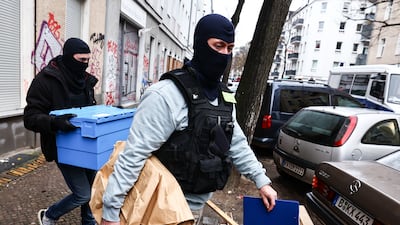
German police remove items during a raid on a property in Berlin over connections to the militant group Hamas and Samidoun, a pro-Palestinian organisation. EPA -
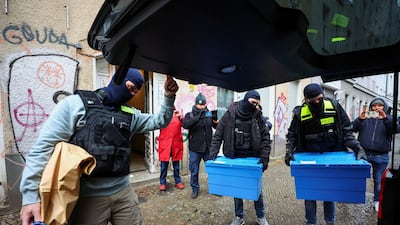
German police officers carry evidence collected during raids. Reuters -
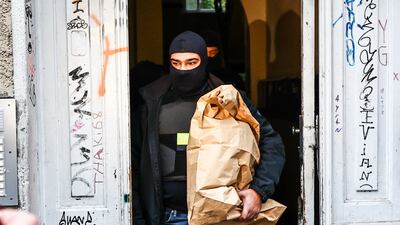
A total of 15 properties in Berlin and three other states were searched. EPA -

A German police vehicle is parked in front an apartment in Berlin during the raids. Reuters -
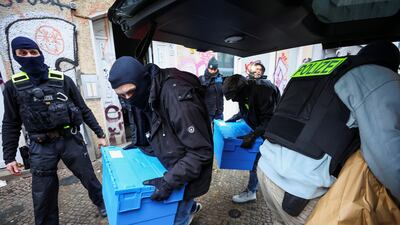
The searches were conducted in Berlin, Lower Saxony, North Rhine-Westphalia and Schleswig-Holstein. Reuters


If proven, this would represent “quite a big departure from Hamas' modo operandum”, said Ms Davis.
She added that the funding for the attacks would likely be coming through European sources “because it's easier to move around money that's already in place”.
In a signal that Israel may have shared intelligence necessary for the arrests, Prime Minister Benjamin Netanyahu on the same day claimed that those detained had links to Hamas. Danish authorities did not confirm this until January 12.
Last week, Israel also accused Hamas of plotting an attack against its embassy in Sweden.
The Swedish Foreign Affairs press office said it could not comment on security aspects pertaining to certain missions. The Swedish Security Police, which has primary responsibility for the security of foreign diplomatic missions, said no arrests had been made.
The National has reached out to Hamas in Lebanon and Israeli security services for comment. The office of the German federal prosecutor’s office said the investigation is continuing and declined to give further details.

