


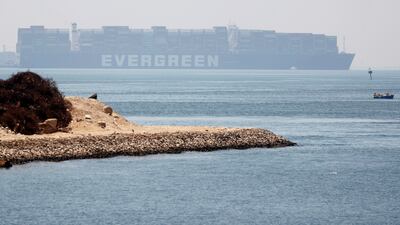
It was an unforgettable image: the 400-metre Ever Given cargo ship wedged diagonally across Egypt’s Suez Canal.
In March 2021, the vast vessel blocked the waterway for six days, disrupting billions of dollars in global trade, before it was freed.
The incident was back in the memory on Monday when a cargo vessel carrying Ukrainian grain to China ran aground in the canal.
Since the incident in 2021, some changes have been made, such as the start of a $10 billion canal expansion project and the Suez Canal Authority’s purchase of two powerful dredgers.
But other things have stayed the same.
In December 2021, the Panama-flagged ship returned through the canal from China to Rotterdam with an even heavier load — a reminder that ultra-large vessels will continue to use the vital transitway.

“Global trade is at worldwide highs right now. Cargo is moving through the Suez Canal at record rates,” said Salvatore Mercogliano, a maritime historian at Campbell University in North Carolina, at the time.
“In many ways, the Suez Canal is the only game in town in terms of these really large vessels going through and because it’s such a substantial shortcut between Europe and Asia,” he said.
About 12 per cent of global trade — $10bn to $12bn a day — goes through the canal.
That year saw daily transit records broken, with 87 ships crossing the waterway on September 29. In November 2021, the canal authority recorded its highest monthly revenue of $571.3 million.
With such successes, it is perhaps even more important to review the lessons learnt to avoid a scenario similar to the Ever Given grounding in the future.
A long history
Opened on November 17, 1869, the canal recently celebrated 152 years in existence. During that time, 1.4 million ships carrying 24.7 billion tonnes of cargo navigated the waterway, paying fees of $147.1bn.
There have been other instances of ships running aground and blocking the canal, but none for as long as the Ever Given. Russian oil tanker Tropic Brilliance got stuck for three days in 2004 and the Hong Kong-flagged Okal King Dor blocked transit for eight hours in 2006.
“[The Ever Given grounding] was a one-off incident, which did cause a drastic disruption to trade. But if we look realistically over the past century of the operation of the canal, there have hardly been any incidents,” said Ranjith Raja, oil research manager at Refinitiv.
In 2015, President Abdel Fattah El Sisi inaugurated the New Suez Canal, a second lane along part of the 193-kilometre waterway to allow for more ships to pass. The canal was also widened and deepened in other stretches.
Further canal expansion a necessity
The Ever Given ran aground during a sandstorm and strong winds in the southern stretch of the waterway, the longest single-lane portion.
“The most important thing is to create more two-lane segments in the canal,” said Mohamed El Wakeel, vice dean of the College of Maritime Transport and Technology at the Arab Academy for Science, Technology and Transport.
In May, the Suez Canal Authority (SCA) announced plans to widen and deepen the 30km stretch of waterway between the city of Suez and the Bitter Lake area by 2023.
Two-directional traffic in the canal lane further north will also be extended by 10km to a total length of 82km.
Container ships aren’t getting any smaller
The Ever Given is one of the largest container ships ever built, nearly as long as the Empire State Building is tall. It is right at the maximum length allowed for transit in the Suez Canal.
While its grounding brought into question whether such vessels are too big to safely operate in many ports and canals, it did not deter the construction of ultra-large ships.
“In the midst of Ever Given being stuck in the Suez, Ever Green, the ship's parent company, ordered vessels even larger than Ever Given at that same time,” said Mr Mercogliano.
As long as major passages can accommodate these larger vessels, shipping companies will continue to build them, and vice versa. In May, the Panama Canal Authority increased the maximum length of ships allowed to pass through the waterway from 367 to 370 metres.
“From a trade perspective, it makes sense to have bigger vessels, which are capable of carrying more cargo and makes the overall cost of trade significantly lower,” said Mr Raja.
-
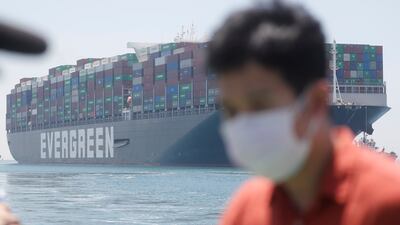
The 'Ever Given', one of the world's largest container ships, sails in the Suez Canal after authorities agreed to a settlement with the vessel's owner and insurers. -
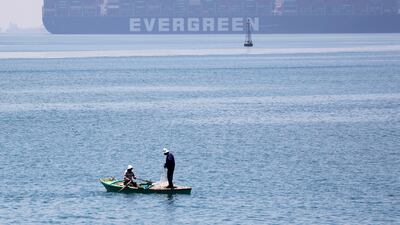
Men fish near the 'Ever Given', which blocked the Suez Canal for six days in March. -

The vessel was not allowed to leave Egyptian waters until an agreement was reached between its owners and the Suez Canal Authority. -
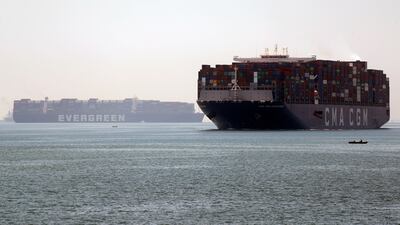
The 'Ever Given' sails in the Suez Canal. -
The blockage caused by the 'Ever Given' caused major disruption to international shipping. -

The 400-metre vessel became grounded while sailing through the Suez. -
The incident caused a logjam of hundreds of vessels waiting to pass through the vital waterway in Egypt. -
The 'Ever Given' was held in the Great Bitter Lake, off the canal, after it was freed. -

Journalists travel to see the 'Ever Given' leave the Suez Canal.


There is no route like the Suez Canal
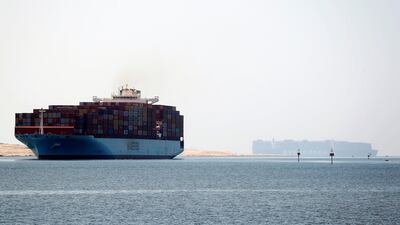
When the Ever Given got stuck, it blocked hundreds of ships on either side of the canal. Most decided to wait, rather than embark on the costlier journey around the Cape of Good Hope.
A journey from Singapore to Rotterdam takes 26 days through the Suez Canal, while the same voyage around the Cape of Good Hope would add 3,400 nautical miles and take an additional 10 days. For a large container vessel, that would mean an additional cost of $400,000 just in fuel.
“The route around Africa is really not one that’s serious because of the delays involved with it. It also exposes the ships to a very long sea voyage in rough waters,” said Mr Mercogliano, who estimates that two dozen ships blocked by the Ever Given chose that option.
Another Europe-Asia shipping route, the Russian Arctic route to the north, was heavily promoted following the Ever Given grounding.
“The Russians are very strongly trying to develop that route as an alternative,” Mr Mercogliano said. “The route is substantially shorter. However, it has limitations.”
Vessels risk hitting ice and many companies are concerned about spillages and polluting the Arctic waters, he explained.
'Complex incident'
SCA chairman Admiral Osama Rabie told students of the Naval Postgraduate Institute in 2021 that the Ever Given accident was a “complex incident”.
Two pilots are required for vessels of more than 80,000 gross tonnage in the Suez Canal. They advise the ship’s captain and guide the vessel during transit, but the ultimate responsibility remains with the captain.
“The ship’s captain doesn’t relinquish command of the vessel in the Suez Canal. In the Panama Canal, they do,” Mr Mercogliano said.
There were allegedly arguments between the pilots and the master on the bridge on the correct course of action.
“We know that this is probably more of a human error … the question is which human is the most directly responsible?” Mr Mercogliano said.
There were questions as to whether there should be crossing limitations amid bad weather.
“It’s not just the responsibility of the captain or the shipping company, but also the responsibility of the canal’s authorities towards determining what is deemed to be safe for transit,” Mr Raja said.
Marwa Maher, a media representative for the SCA, said the event was an accident and investigation results would not be made public.
The authority initially asked for $916m in compensation from the ship’s Japanese owner, Shoei Kisen Kaisha, for loss of revenue, reputational damage and the cost of the salvage operation.
They settled on a reported $540m, although the amount was not officially disclosed, after months of negotiations while the Ever Given remained impounded in the Great Bitter Lake.
In 2021, the Panama registry and insurance companies began their own investigations, which could take years.
“The liability cases against Ever Given have not been resolved yet,” Mr Mercogliano said at the time. “All those vessels that were delayed could levy suit against either the ship or the Suez Canal — whoever’s responsible.”
Mr El Wakeel, a former ship's captain, said the authority had taken corrective measures, such as upgrading its salvage equipment and continuously training pilots through simulation exercises.
“It was an important lesson, so that we are ready for anything,” he said.
This article was originally published on December 21, 2021

