Iranian authorities have thwarted what they called a “sabotage attack” targeting a civilian nuclear facility near the country’s capital, state TV reported Wednesday, as details about the incident remained scarce.
The attempted attack against a building belonging to Iran’s Atomic Energy Organization “left no casualties or damages and was unable to disrupt the Iranian nuclear programme,” Iranian state television reported, adding that authorities were working to identify the perpetrators.
Iranian media offered no details on the kind of attack, saying only that the move targeted a sprawling nuclear centre located in Karaj city, just some 40 kilometres northwest of Tehran.
When asked for comment, an Iranian official referred to the initial report by Nournews, believed to be close to Iran’s Supreme National Security Council.
The International Atomic Energy Agency, the United Nations’ body that monitors Tehran’s atomic programme, did not immediately respond to request for comment.
Iranian authorities did not specify which facility in Karaj had been targeted. There are two sites associated with Iran’s nuclear programme known to be in the area, including the Karaj Agricultural and Medical Research Centre.
Iran’s Atomic Energy Organization describes the Karaj Agricultural and Medical Research Centre as a facility founded in 1974 that uses nuclear technology to improve “quality of soil, water, agricultural and livestock production.”
-
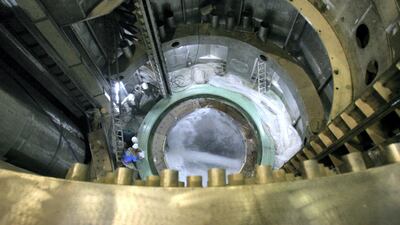
Russian contractors work at the Bushehr nuclear reactor site in 2007. The plant opened four years later. Bloomberg -
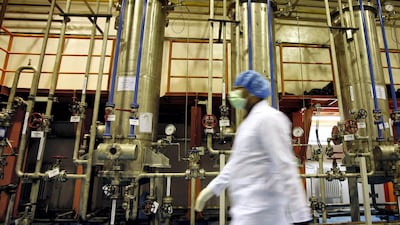
An Iranian technician at the International Atomic Energy Agency inspects the country's Isfahan plant in 2007. Tehran is no longer co-operating with the agency at nuclear sites across the country. EPA -

Workers wait to begin constructing a second reactor at the Bushehr nuclear power plant in 2019. AFP -
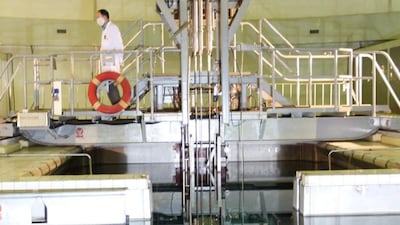
A metal-encased rod with 20 per cent enriched nuclear fuel is inserted into a reactor in Tehran in 2012. AFP -
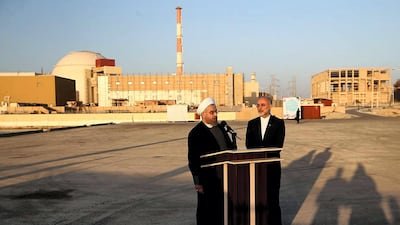
Fomer Iranian President Hassan Rouhani and the country's Atomic Energy Organisation chief Ali Akbar Salehi speak at the Bushehr nuclear site in 2015. AFP -
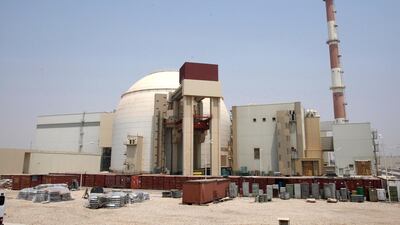
Iran's Bushehr nuclear plant has been restarted. EPA -
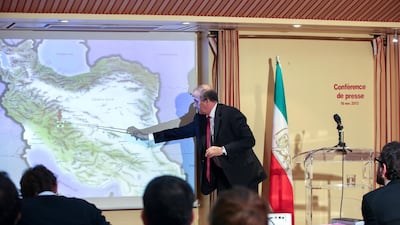
Mehdi Abrichamtchi, chairman of the Peace and Security Committee at the National Council of Resistance of Iran, shows journalists the location of a secret nuclear site in Iran in 2013. AFP -
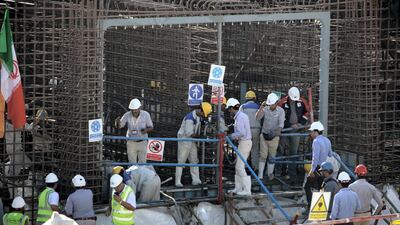
Workers prepare to begin the construction of a second reactor at the Bushehr site. AFP
The area is located near various industrial sites, including pharmaceutical production facilities where Iran has manufactured its domestic coronavirus vaccine.
Earlier on Wednesday, Iranian social media crackled with unconfirmed reports that authorities had prevented an unmanned aerial vehicle from targeting a Covid-19 vaccine production facility.
There are 18 nuclear facilities and nine other locations in Iran under IAEA safeguards. The agricultural nuclear research centre is not listed as a “safeguard facility” with the IAEA, though a nearby nuclear waste facility around Karaj is. The IAEA visited the site in 2003.
The Karaj facility had “been storing waste from the nuclear programme and equipment dismantled from atomic vapour laser isotope separation experiments in the nearby Lashkar Abad,” according to a policy paper by the Washington Institute for Near-East Policy written in March 2015.
The UN Security Council in 2007 sanctioned the Agricultural Centre, identifying it along with other facilities it described as being involved in Iran’s nuclear and ballistic missile programmes. The US Treasury under then-President George W Bush also sanctioned the facility.
The US lifted those sanctions under the 2015 nuclear deal, although reimposed them in 2018 with then-president Donald Trump’s decision to unilaterally withdraw from the accord.
The foiled sabotage attack follows several suspected incidents targeting Iran’s nuclear programme that have heightened regional tensions in recent months, as diplomatic efforts gain traction in Vienna to resurrect Tehran’s tattered atomic deal with world powers.
In April, Iran’s underground Natanz nuclear facility experienced a mysterious power cut that damaged some of its centrifuges. Last July, unexplained fires struck the advanced centrifuge assembly plant at Natanz, which authorities later described as sabotage. Iran now is rebuilding that facility deep inside a nearby mountain.
Israel is widely believed to have carried out the sabotage, though it has not claimed it. Iran also blamed Israel for the November killing of a scientist who began the country’s military nuclear programme decades earlier.
Trump’s decision to withdraw from the nuclear deal has seen Iran, over time, abandon all limitations on uranium enrichment. The country is now enriching uranium to 60%, its highest ever levels, although still short of weapons-grade. Iran has said that its nuclear ambitions are peaceful and that it will return to its commitments once the U.S. lifts its sanctions.
Earlier this week, Iran’s sole nuclear power plant at Bushehr underwent an unexplained temporary emergency shutdown. Authorities earlier this year had warned of the plant’s possible closure because of American sanctions that allegedly prevented Iran from procuring equipment for repairs.
On Tuesday, the IAEA said it was informed of a technical programme striking the Bushehr plant’s electrical generator. The agency said the facility would go back online after being reconnected to the national electric grid.
Iran’s nuclear department said that engineers were working to repair the broken generator.