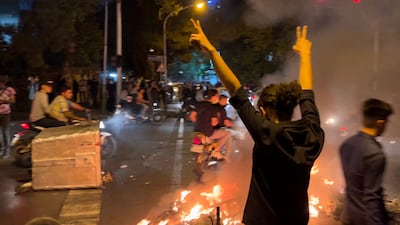
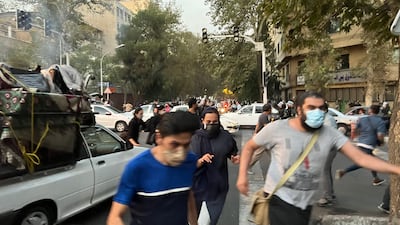
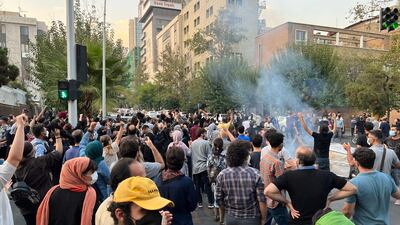
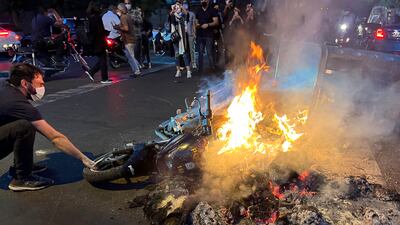
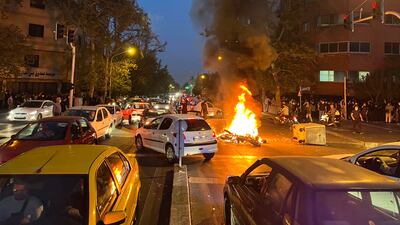
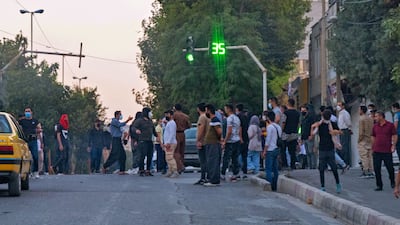
Iran’s crackdown on a protest movement across the country is intensifying, rights groups say, as senior government officials claimed the protests were entering their final days.
The Centre for Human Rights in Iran said that in Tehran province alone, 3,000 people have been arrested in the past six weeks. Other rights groups say arrests across the country have exceeded 12,000.
Nationwide protests sparked by the death of Mahsa Amini, a 22-year-old Iranian Kurd who died after being detained by morality police for allegedly “inappropriate attire”, have posed one of the boldest challenges to the Iranian regime since protests rocked the country in 2009.
Though the protests do not appear close to toppling the government, unrest has swept the whole country and areas home to ethnic minorities with long-standing grievances against the state, including parts of the Kurdish north and Zahedan, the provincial capital of the Sistan-Balochistan province of south-eastern Iran at the border with Pakistan and Afghanistan. The region is home to the Baluch ethnic minority.
Families torn apart
On Sunday, AFP spoke to the husband of a human-rights activist jailed in the country’s notorious Evin prison. Speaking from exile in Paris, Taghi Rahmani described how his imprisoned wife and other detainees were being prevented from having any contact with their families, including their children, and that it amounted to psychological torture.
Mr Rahmani’s wife — prize-winning campaigner Narges Mohammadi — has not seen her 16-year-old twins for seven years and has not seen her husband for a decade.
In a new restriction — an apparent response to the protests, the authorities have now stripped Ms Mohammadi, 50, of her prison telephone cards for the next two months, her husband said.
She had already been blocked by authorities from telephoning her children Ali and Kiana in France for the past seven months: the latest restriction means that she cannot now even speak to her family inside Iran.
“The system of prisons in Iran is torturing families,” Mr Rahmani told AFP in an interview in the French capital.
“It is not just a torture for the prisoner but for the entire family. The children have not heard Narges' voice for the last seven months.”
Crackdown in the south
On Saturday Iran's Revolutionary Guard Corp (IRGC) accused a Sunni cleric of agitating against the government and warned it may cost him dearly after he said officials including the supreme leader were responsible for dozens of deaths in the city of Zahedan last month.
Amnesty International has said security forces killed at least 66 people in a crackdown after Friday prayers in Zahedan, in the south-east, on September 30, some of the deadliest unrest during five weeks of protests following Mahsa Amini's death.
Molavi Abdolhamid, Zahedan's leading Sunni cleric, said during his Friday sermon that officials including Supreme Leader Ayatollah Ali Khamenei, were “responsible before God” for the September 30 killings.
A short statement on Sepah News, the IRGC’s official news site, said: “Mr Abdolhamid, encouraging and agitating youths against the sacred Islamic Republic of Iran may cost you dearly! This is the last warning!”
State media had said that “unidentified armed individuals” opened fire on a police station, prompting security forces to return fire.
After protests erupted in Zahedan again on Friday, the deputy interior minister for security, Majid Mir Ahmadi, said calm had returned, official news agency IRNA reported on Saturday.
He said 150 “thugs attacked public property and even those shops belonging to Sunnis”.
On Friday, at least 57 were arrested after protesters — “rioters” — threw rocks and attacked banks in the city, provincial police chief Ahmad Taheri was quoted as saying by the official news agency IRNA on Friday.
State television said up to 300 protesters marched in the city after Friday prayers. It showed banks and shops with smashed windows.
Mr Abdolhamid, the Sunni cleric, described the September 30 killing as a massacre, saying bullets had been fired at heads and chests. “Scores were killed here. I don't have the exact number. Some have reported 90, some say less, some say more,” he said in the sermon posted on his website.
Rights groups say the government has long discriminated against ethnic minorities including the Kurds, in whose region unrest has also been particularly intense since Amini's death.
The state denies accusations of discrimination.
Iran has blamed unrest on an array of enemies including armed dissidents. The IRGC has attacked bases of armed Iranian Kurdish groups in neighbouring Iraq.
Protesters have sought to stress national unity with chants expressing solidarity between various ethnic groups.
Rights groups Hengaw reported that shopkeepers had gone on strike on Saturday in the provincial capital of Iran's Kurdistan province, Sanandaj, and Saqez — Amini's home town, in addition to Bukan, another north-western city.
The activist news agency HRANA reported on Friday that 244 protesters had been killed in the countrywide unrest, including 32 children. State TV has reported that at least 26 members of the security forces have been killed during the unrest.
UAE currency: the story behind the money in your pockets
Mercer, the investment consulting arm of US services company Marsh & McLennan, expects its wealth division to at least double its assets under management (AUM) in the Middle East as wealth in the region continues to grow despite economic headwinds, a company official said.
Mercer Wealth, which globally has $160 billion in AUM, plans to boost its AUM in the region to $2-$3bn in the next 2-3 years from the present $1bn, said Yasir AbuShaban, a Dubai-based principal with Mercer Wealth.
“Within the next two to three years, we are looking at reaching $2 to $3 billion as a conservative estimate and we do see an opportunity to do so,” said Mr AbuShaban.
Mercer does not directly make investments, but allocates clients’ money they have discretion to, to professional asset managers. They also provide advice to clients.
“We have buying power. We can negotiate on their (client’s) behalf with asset managers to provide them lower fees than they otherwise would have to get on their own,” he added.
Mercer Wealth’s clients include sovereign wealth funds, family offices, and insurance companies among others.
From its office in Dubai, Mercer also looks after Africa, India and Turkey, where they also see opportunity for growth.
Wealth creation in Middle East and Africa (MEA) grew 8.5 per cent to $8.1 trillion last year from $7.5tn in 2015, higher than last year’s global average of 6 per cent and the second-highest growth in a region after Asia-Pacific which grew 9.9 per cent, according to consultancy Boston Consulting Group (BCG). In the region, where wealth grew just 1.9 per cent in 2015 compared with 2014, a pickup in oil prices has helped in wealth generation.
BCG is forecasting MEA wealth will rise to $12tn by 2021, growing at an annual average of 8 per cent.
Drivers of wealth generation in the region will be split evenly between new wealth creation and growth of performance of existing assets, according to BCG.
Another general trend in the region is clients’ looking for a comprehensive approach to investing, according to Mr AbuShaban.
“Institutional investors or some of the families are seeing a slowdown in the available capital they have to invest and in that sense they are looking at optimizing the way they manage their portfolios and making sure they are not investing haphazardly and different parts of their investment are working together,” said Mr AbuShaban.
Some clients also have a higher appetite for risk, given the low interest-rate environment that does not provide enough yield for some institutional investors. These clients are keen to invest in illiquid assets, such as private equity and infrastructure.
“What we have seen is a desire for higher returns in what has been a low-return environment specifically in various fixed income or bonds,” he said.
“In this environment, we have seen a de facto increase in the risk that clients are taking in things like illiquid investments, private equity investments, infrastructure and private debt, those kind of investments were higher illiquidity results in incrementally higher returns.”
The Abu Dhabi Investment Authority, one of the largest sovereign wealth funds, said in its 2016 report that has gradually increased its exposure in direct private equity and private credit transactions, mainly in Asian markets and especially in China and India. The authority’s private equity department focused on structured equities owing to “their defensive characteristics.”
What is blockchain?
Blockchain is a form of distributed ledger technology, a digital system in which data is recorded across multiple places at the same time. Unlike traditional databases, DLTs have no central administrator or centralised data storage. They are transparent because the data is visible and, because they are automatically replicated and impossible to be tampered with, they are secure.
The main difference between blockchain and other forms of DLT is the way data is stored as ‘blocks’ – new transactions are added to the existing ‘chain’ of past transactions, hence the name ‘blockchain’. It is impossible to delete or modify information on the chain due to the replication of blocks across various locations.
Blockchain is mostly associated with cryptocurrency Bitcoin. Due to the inability to tamper with transactions, advocates say this makes the currency more secure and safer than traditional systems. It is maintained by a network of people referred to as ‘miners’, who receive rewards for solving complex mathematical equations that enable transactions to go through.
However, one of the major problems that has come to light has been the presence of illicit material buried in the Bitcoin blockchain, linking it to the dark web.
Other blockchain platforms can offer things like smart contracts, which are automatically implemented when specific conditions from all interested parties are reached, cutting the time involved and the risk of mistakes. Another use could be storing medical records, as patients can be confident their information cannot be changed. The technology can also be used in supply chains, voting and has the potential to used for storing property records.
The specs
Engine: 3-litre twin-turbo V6
Power: 400hp
Torque: 475Nm
Transmission: 9-speed automatic
Price: From Dh215,900
On sale: Now
How much do leading UAE’s UK curriculum schools charge for Year 6?
- Nord Anglia International School (Dubai) – Dh85,032
- Kings School Al Barsha (Dubai) – Dh71,905
- Brighton College Abu Dhabi - Dh68,560
- Jumeirah English Speaking School (Dubai) – Dh59,728
- Gems Wellington International School – Dubai Branch – Dh58,488
- The British School Al Khubairat (Abu Dhabi) - Dh54,170
- Dubai English Speaking School – Dh51,269
*Annual tuition fees covering the 2024/2025 academic year
About Housecall
Date started: July 2020
Founders: Omar and Humaid Alzaabi
Based: Abu Dhabi
Sector: HealthTech
# of staff: 10
Funding to date: Self-funded
If%20you%20go
%3Cp%3E%0DThere%20are%20regular%20flights%20from%20Dubai%20to%20Addis%20Ababa%20with%20Ethiopian%20Airlines%20with%20return%20fares%20from%20Dh1%2C700.%20Nashulai%20Journeys%20offers%20tailormade%20and%20ready%20made%20trips%20in%20Africa%20while%20Tesfa%20Tours%20has%20a%20number%20of%20different%20community%20trekking%20tours%20throughout%20northern%20Ethiopia.%20%20The%20Ben%20Abeba%20Lodge%20has%20rooms%20from%20Dh228%2C%20and%20champions%20a%20programme%20of%20re-forestation%20in%20the%20surrounding%20area.%26nbsp%3B%3C%2Fp%3E%0A%3Cp%3E%3Cbr%3E%3Cbr%3E%3C%2Fp%3E%0A
MATCH INFO
Uefa Champions League semi-finals, first leg
Liverpool v Roma
When: April 24, 10.45pm kick-off (UAE)
Where: Anfield, Liverpool
Live: BeIN Sports HD
Second leg: May 2, Stadio Olimpico, Rome
Living in...
This article is part of a guide on where to live in the UAE. Our reporters will profile some of the country’s most desirable districts, provide an estimate of rental prices and introduce you to some of the residents who call each area home.
Springtime in a Broken Mirror,
Mario Benedetti, Penguin Modern Classics
A list of the animal rescue organisations in the UAE
UAE currency: the story behind the money in your pockets
The biog
Title: General Practitioner with a speciality in cardiology
Previous jobs: Worked in well-known hospitals Jaslok and Breach Candy in Mumbai, India
Education: Medical degree from the Government Medical College in Nagpur
How it all began: opened his first clinic in Ajman in 1993
Family: a 90-year-old mother, wife and two daughters
Remembers a time when medicines from India were purchased per kilo
'THE WORST THING YOU CAN EAT'
Trans fat is typically found in fried and baked goods, but you may be consuming more than you think.
Powdered coffee creamer, microwave popcorn and virtually anything processed with a crust is likely to contain it, as this guide from Mayo Clinic outlines:
Baked goods - Most cakes, cookies, pie crusts and crackers contain shortening, which is usually made from partially hydrogenated vegetable oil. Ready-made frosting is another source of trans fat.
Snacks - Potato, corn and tortilla chips often contain trans fat. And while popcorn can be a healthy snack, many types of packaged or microwave popcorn use trans fat to help cook or flavour the popcorn.
Fried food - Foods that require deep frying — french fries, doughnuts and fried chicken — can contain trans fat from the oil used in the cooking process.
Refrigerator dough - Products such as canned biscuits and cinnamon rolls often contain trans fat, as do frozen pizza crusts.
Creamer and margarine - Nondairy coffee creamer and stick margarines also may contain partially hydrogenated vegetable oils.
Company%20profile
%3Cp%3E%3Cstrong%3EName%3A%3C%2Fstrong%3E%20Belong%3Cbr%3E%3Cstrong%3EBased%3A%3C%2Fstrong%3E%20Dubai%3Cbr%3E%3Cstrong%3EFounders%3A%3C%2Fstrong%3E%20Michael%20Askew%20and%20Matthew%20Gaziano%3Cbr%3E%3Cstrong%3ESector%3A%3C%2Fstrong%3E%20Technology%3Cbr%3E%3Cstrong%3ETotal%20funding%3A%3C%2Fstrong%3E%20%243.5%20million%20from%20crowd%20funding%20and%20angel%20investors%3Cstrong%3E%3Cbr%3ENumber%20of%20employees%3A%3C%2Fstrong%3E%2012%3C%2Fp%3E%0A
Ten tax points to be aware of in 2026
1. Domestic VAT refund amendments: request your refund within five years
If a business does not apply for the refund on time, they lose their credit.
2. E-invoicing in the UAE
Businesses should continue preparing for the implementation of e-invoicing in the UAE, with 2026 a preparation and transition period ahead of phased mandatory adoption.
3. More tax audits
Tax authorities are increasingly using data already available across multiple filings to identify audit risks.
4. More beneficial VAT and excise tax penalty regime
Tax disputes are expected to become more frequent and more structured, with clearer administrative objection and appeal processes. The UAE has adopted a new penalty regime for VAT and excise disputes, which now mirrors the penalty regime for corporate tax.
5. Greater emphasis on statutory audit
There is a greater need for the accuracy of financial statements. The International Financial Reporting Standards standards need to be strictly adhered to and, as a result, the quality of the audits will need to increase.
6. Further transfer pricing enforcement
Transfer pricing enforcement, which refers to the practice of establishing prices for internal transactions between related entities, is expected to broaden in scope. The UAE will shortly open the possibility to negotiate advance pricing agreements, or essentially rulings for transfer pricing purposes.
7. Limited time periods for audits
Recent amendments also introduce a default five-year limitation period for tax audits and assessments, subject to specific statutory exceptions. While the standard audit and assessment period is five years, this may be extended to up to 15 years in cases involving fraud or tax evasion.
8. Pillar 2 implementation
Many multinational groups will begin to feel the practical effect of the Domestic Minimum Top-Up Tax (DMTT), the UAE's implementation of the OECD’s global minimum tax under Pillar 2. While the rules apply for financial years starting on or after January 1, 2025, it is 2026 that marks the transition to an operational phase.
9. Reduced compliance obligations for imported goods and services
Businesses that apply the reverse-charge mechanism for VAT purposes in the UAE may benefit from reduced compliance obligations.
10. Substance and CbC reporting focus
Tax authorities are expected to continue strengthening the enforcement of economic substance and Country-by-Country (CbC) reporting frameworks. In the UAE, these regimes are increasingly being used as risk-assessment tools, providing tax authorities with a comprehensive view of multinational groups’ global footprints and enabling them to assess whether profits are aligned with real economic activity.
Contributed by Thomas Vanhee and Hend Rashwan, Aurifer
COMPANY%20PROFILE
%3Cp%3E%3Cstrong%3ECompany%3A%3C%2Fstrong%3E%20Eco%20Way%3Cbr%3E%3Cstrong%3EStarted%3A%3C%2Fstrong%3E%20December%202023%3Cbr%3E%3Cstrong%3EFounder%3A%3C%2Fstrong%3E%20Ivan%20Kroshnyi%3Cbr%3E%3Cstrong%3EBased%3A%3C%2Fstrong%3E%20Dubai%2C%20UAE%3Cbr%3E%3Cstrong%3EIndustry%3A%3C%2Fstrong%3E%20Electric%20vehicles%3Cbr%3E%3Cstrong%3EInvestors%3A%3C%2Fstrong%3E%20Bootstrapped%20with%20undisclosed%20funding.%20Looking%20to%20raise%20funds%20from%20outside%3Cbr%3E%3C%2Fp%3E%0A
The specs
Engine: Dual 180kW and 300kW front and rear motors
Power: 480kW
Torque: 850Nm
Transmission: Single-speed automatic
Price: From Dh359,900 ($98,000)
On sale: Now
Fight card
1. Bantamweight: Victor Nunes (BRA) v Siyovush Gulmamadov (TJK)
2. Featherweight: Hussein Salim (IRQ) v Shakhriyor Juraev (UZB)
3. Catchweight 80kg: Rashed Dawood (UAE) v Khamza Yamadaev (RUS)
4. Lightweight: Ho Taek-oh (KOR) v Ronald Girones (CUB)
5. Lightweight: Arthur Zaynukov (RUS) v Damien Lapilus (FRA)
6. Bantamweight: Vinicius de Oliveira (BRA) v Furkatbek Yokubov (RUS)
7. Featherweight: Movlid Khaybulaev (RUS) v Zaka Fatullazade (AZE)
8. Flyweight: Shannon Ross (TUR) v Donovon Freelow (USA)
9. Lightweight: Mohammad Yahya (UAE) v Dan Collins (GBR)
10. Catchweight 73kg: Islam Mamedov (RUS) v Martun Mezhulmyan (ARM)
11. Bantamweight World title: Jaures Dea (CAM) v Xavier Alaoui (MAR)
12. Flyweight World title: Manon Fiorot (FRA) v Gabriela Campo (ARG)
Tips from the expert
Dobromir Radichkov, chief data officer at dubizzle and Bayut, offers a few tips for UAE residents looking to earn some cash from pre-loved items.
- Sellers should focus on providing high-quality used goods at attractive prices to buyers.
- It’s important to use clear and appealing photos, with catchy titles and detailed descriptions to capture the attention of prospective buyers.
- Try to advertise a realistic price to attract buyers looking for good deals, especially in the current environment where consumers are significantly more price-sensitive.
- Be creative and look around your home for valuable items that you no longer need but might be useful to others.