Iraqi Army soldiers stand guard on a road between the US Embassy and the International Zone on May 30, 2021 in Baghdad, Iraq. AFP

US air defences destroy explosive drones targeting base in Iraq


  • English
  • Arabic

Two explosive drones were destroyed over a base housing US troops, the Iraqi army said on Sunday.

The attack took place a month after the base was targeted by another armed drone.

The US' counter-rocket, artillery and mortar (C-Ram) defence system was used against the drones above the Ain Al Asad base, located in the Iraqi Western Desert, the Iraqi army said.

The system uses an infrared sensor to detect the drones, before firing a torrent of 4,500 bullets per minute to shoot them down.

Several hours earlier, a rocket was shot down over Baghdad airport, "without causing casualties or damage", said Col Wayne Marotto, a spokesman for the US-led military coalition in Iraq.

The US blames Iran-linked Iraqi factions for rocket attacks against Iraqi installations housing its personnel.

Since the start of this year, there have been 39 attacks against US interests in Iraq.

The vast majority have been bombs against logistics convoys, while 14 were rocket attacks, some of them claimed by pro-Iran factions, who aim to pressure Washington into withdrawing all their troops.

The use of drones against US interests by these factions is a recent tactic, although the US military has accused pro-Iran Iraqi groups of helping Yemen's Houthi rebels carry out attacks using such devices against Saudi interests.

_________________

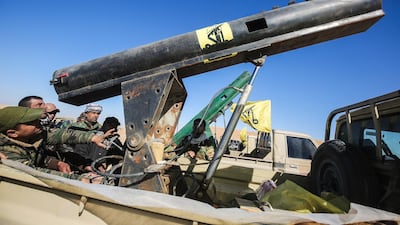
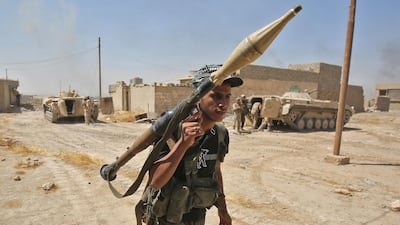
In pictures: Iran's militias in Iraq

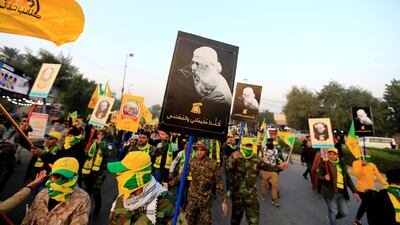
  • Members of the Kataib Hezbollah group gather ahead of the funeral of Iraqi militia commander Abu Mahdi Al Muhandis, who was killed in an air strike at Baghdad International Airport, Iraq, on January 4, 2020. Reuters / Thaier al-Sudani
    Members of the Kataib Hezbollah group gather ahead of the funeral of Iraqi militia commander Abu Mahdi Al Muhandis, who was killed in an air strike at Baghdad International Airport, Iraq, on January 4, 2020. Reuters / Thaier al-Sudani
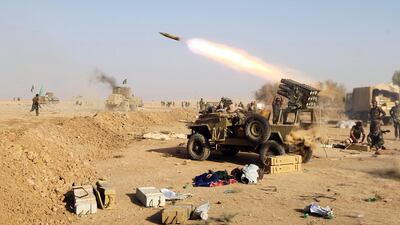
  • Hashed Al Shaabi fighters launch missiles on the village of Salmani, south of Mosul, on October 30, 2016. AFP
    Hashed Al Shaabi fighters launch missiles on the village of Salmani, south of Mosul, on October 30, 2016. AFP
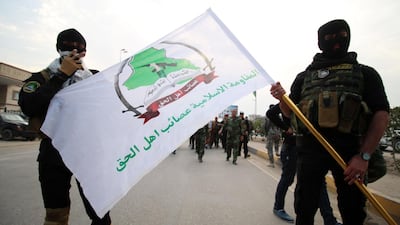
  • Iraqi Shiite members of the Asaib Ahl Al Haq group gather in Basra on December 12, 2015, to demand the withdrawal of Turkish forces from Iraq. AFP
    Iraqi Shiite members of the Asaib Ahl Al Haq group gather in Basra on December 12, 2015, to demand the withdrawal of Turkish forces from Iraq. AFP
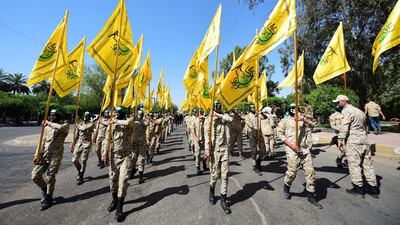
  • Al Nujaba militias carry flags during an anti-Israel rally to mark Jerusalem Day in Baghdad on May 31, 2019. EPA-EFE / Murtaja Lateef
    Al Nujaba militias carry flags during an anti-Israel rally to mark Jerusalem Day in Baghdad on May 31, 2019. EPA-EFE / Murtaja Lateef
  • Hashed Al Shaabi fighters on the outskirts of Tal Afar, west of Mosul, prepare for the offensive retake of the western side of Mosul from Islamic State fighters on February 18, 2017. AFP
    Hashed Al Shaabi fighters on the outskirts of Tal Afar, west of Mosul, prepare for the offensive retake of the western side of Mosul from Islamic State fighters on February 18, 2017. AFP
  • A vast network of Iran-backed militias in operation in Iraq. AFP
    A vast network of Iran-backed militias in operation in Iraq. AFP
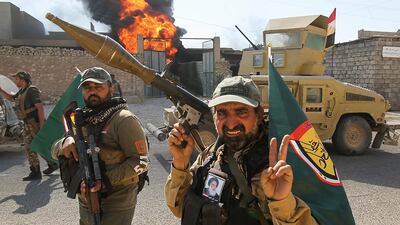
  • Hashed Al Shaabi fighters flash the victory gesture as they advance through the town of Tal Afar, west of Mosul, on August 26, 2017. AFP
    Hashed Al Shaabi fighters flash the victory gesture as they advance through the town of Tal Afar, west of Mosul, on August 26, 2017. AFP

Mercer, the investment consulting arm of US services company Marsh & McLennan, expects its wealth division to at least double its assets under management (AUM) in the Middle East as wealth in the region continues to grow despite economic headwinds, a company official said.

Mercer Wealth, which globally has $160 billion in AUM, plans to boost its AUM in the region to $2-$3bn in the next 2-3 years from the present $1bn, said Yasir AbuShaban, a Dubai-based principal with Mercer Wealth.

Within the next two to three years, we are looking at reaching $2 to $3 billion as a conservative estimate and we do see an opportunity to do so,” said Mr AbuShaban.

Mercer does not directly make investments, but allocates clients’ money they have discretion to, to professional asset managers. They also provide advice to clients.

“We have buying power. We can negotiate on their (client’s) behalf with asset managers to provide them lower fees than they otherwise would have to get on their own,” he added.

Mercer Wealth’s clients include sovereign wealth funds, family offices, and insurance companies among others.

From its office in Dubai, Mercer also looks after Africa, India and Turkey, where they also see opportunity for growth.

Wealth creation in Middle East and Africa (MEA) grew 8.5 per cent to $8.1 trillion last year from $7.5tn in 2015, higher than last year’s global average of 6 per cent and the second-highest growth in a region after Asia-Pacific which grew 9.9 per cent, according to consultancy Boston Consulting Group (BCG). In the region, where wealth grew just 1.9 per cent in 2015 compared with 2014, a pickup in oil prices has helped in wealth generation.

BCG is forecasting MEA wealth will rise to $12tn by 2021, growing at an annual average of 8 per cent.

Drivers of wealth generation in the region will be split evenly between new wealth creation and growth of performance of existing assets, according to BCG.

Another general trend in the region is clients’ looking for a comprehensive approach to investing, according to Mr AbuShaban.

“Institutional investors or some of the families are seeing a slowdown in the available capital they have to invest and in that sense they are looking at optimizing the way they manage their portfolios and making sure they are not investing haphazardly and different parts of their investment are working together,” said Mr AbuShaban.

Some clients also have a higher appetite for risk, given the low interest-rate environment that does not provide enough yield for some institutional investors. These clients are keen to invest in illiquid assets, such as private equity and infrastructure.

“What we have seen is a desire for higher returns in what has been a low-return environment specifically in various fixed income or bonds,” he said.

“In this environment, we have seen a de facto increase in the risk that clients are taking in things like illiquid investments, private equity investments, infrastructure and private debt, those kind of investments were higher illiquidity results in incrementally higher returns.”

The Abu Dhabi Investment Authority, one of the largest sovereign wealth funds, said in its 2016 report that has gradually increased its exposure in direct private equity and private credit transactions, mainly in Asian markets and especially in China and India. The authority’s private equity department focused on structured equities owing to “their defensive characteristics.”

Generation Start-up: Awok company profile

Started: 2013

Founder: Ulugbek Yuldashev

Sector: e-commerce

Size: 600 plus

Stage: still in talks with VCs

Principal Investors: self-financed by founder