Jordanians mourn Covid patients who died in hospital oxygen debacle


Khaled Yacoub Oweis
  • English
  • Arabic

Two months ago, retired civil servant Mohammad Al Hadidi was admitted by his son to the emergency ward in Al Salt public hospital, in central Jordan, with severe chest pain.

“There was only one doctor, a nurse and no medicine,” he said. With a blank face, he recalled how he survived negligence, only for his son, Youssef, to die for the same reason.

Youssef Al Hadidi, an employee of the health ministry’s contagious diseases department, was among at least eight Covid-19 fatalities linked to an oxygen outage at the hospital at the weekend that has sparked widespread anger, forced out the health minister and led to the intervention of King Abdullah.

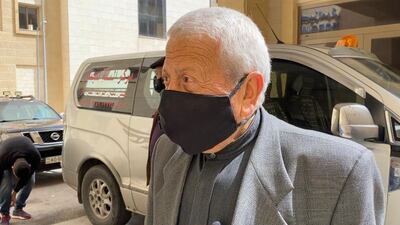
  • Mohammad Al Hadidi, father of Covid-19 patient Yousef Al Hadidi, who died in Al Salt hospital after oxygen supplies ran out.
    Mohammad Al Hadidi, father of Covid-19 patient Yousef Al Hadidi, who died in Al Salt hospital after oxygen supplies ran out.
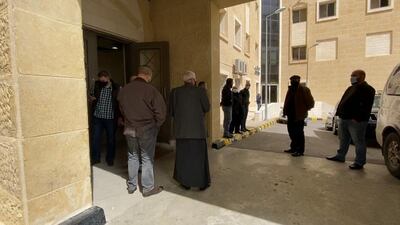
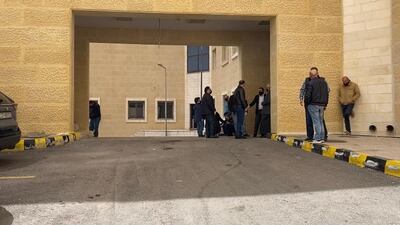
  • Families of the victims wait outside the morgue to collect the bodies of their loved ones.
    Families of the victims wait outside the morgue to collect the bodies of their loved ones.
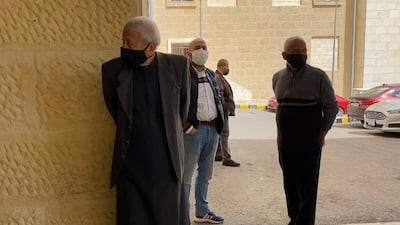
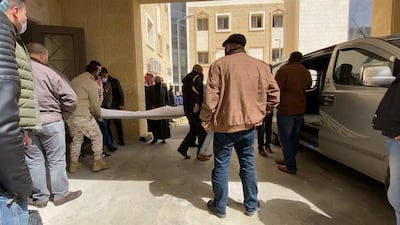
  • Families of the victims wait outside the morgue to collect the bodies of their loved ones.
    Families of the victims wait outside the morgue to collect the bodies of their loved ones.
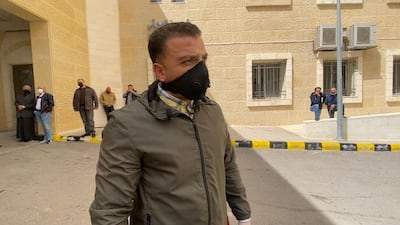
  • Ashraf Al Hadidi, son of Yousef Al Hadidi, says his father was badly affected when oxygen supplies cut out.
    Ashraf Al Hadidi, son of Yousef Al Hadidi, says his father was badly affected when oxygen supplies cut out.
  • Families of the victims wait outside the morgue to collect the bodies of their loved ones.
    Families of the victims wait outside the morgue to collect the bodies of their loved ones.
  • Families of the victims wait outside the morgue to collect the bodies of their loved ones.
    Families of the victims wait outside the morgue to collect the bodies of their loved ones.
  • Families of the victims wait outside the morgue to collect the bodies of their loved ones.
    Families of the victims wait outside the morgue to collect the bodies of their loved ones.
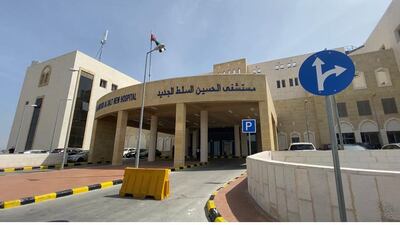
  • King Hussein Hospital in Al Salt, Jordan. Amy McConaghy / The National
    King Hussein Hospital in Al Salt, Jordan. Amy McConaghy / The National

“We are paying the price of incompetence,” said Mr Al Hadidi. “We have qualified people in Jordan, but all these employees were hired because of  nepotism."

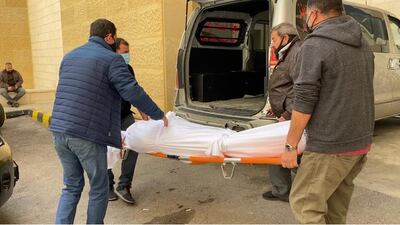
He watched, with emotionless eyes, as his son’s body was washed and placed in a minivan for burial in the hilly region overlooking the Jordan Valley, 20 kilometres north-west of Amman.

The patients died on Saturday after the hospital’s supply of medical oxygen cut out.

On Sunday, construction work was still being carried out on the large, newly built complex, which is the main government medical centre in Al Salt.

It has a training ward for medical students and is perched on a hill overlooking religious sites in Jordan and the West Bank.

Al Salt has a population of 90,000 and is home to several influential Jordanian clans.

The Royal Palace said the king fired health minister Nazir Obeidat and the hospital manager after the incident.

Video footage of a visit by the monarch to the hospital on Saturday shows him angrily telling the hospital director: “How could such a thing happen? This is unacceptable.”

Many members of parliament denounced the government but took no specific action.

The Health Committee said the hospital's negligence and corruption were directly to blame.

The hospital's director and four other officials were detained on Sunday in connection with the incident.

On Sunday, the army started sending vehicles equipped to treat Covid-19 patients to the hospital and other government compounds in Jordan, a move intended to reassure people that competent care existed.

The military is also rushing to build an oxygen bottling plant and produce 600 cylinders within three weeks, said Interior Minister Mazen Al Faraya – who has temporarily taken on the responsibility of the health minister.

Most of the 469,000 cases in Jordan were recorded in or after October 2020. The official death toll from the virus is about 5,300 but health officials say the true figure is far higher.

Last week, King Abdullah replaced the interior and justice ministers in response to reports that the two men attended a large banquet at a restaurant in breach of safety rules they were supposed to enforce.

Youssef Al Hadidi was 48. He was buried at the Yusha Prophet cemetery near the hospital and had two sons and a daughter, all in their twenties.

Mourners prayed around his body on Sunday at a mosque adjacent to the burial ground. His turn was preceded by prayers for another man who also died of Covid-19. The body of another coronavirus patient was taken into the mosque after Hadidi’s was taken from it.

Ashraf, one of Youssef Al Hadidi’s sons, said his father initially survived the oxygen cut, which occurred at about 7am.

“By 2pm his breathing got really weak,” he said. He described his father as a “very kind-hearted man” who was admired by all who knew him.

Another mourning family was at the hospital at the same time. They were there to receive the body of Hashem Hammad, who also died after the oxygen shortage.

“His 70th birthday would have been tomorrow,” one relative said, weeping in front of the slender body placed on the floor of the van before it was taken to its final resting place.

How to avoid crypto fraud
  • Use unique usernames and passwords while enabling multi-factor authentication.
  • Use an offline private key, a physical device that requires manual activation, whenever you access your wallet.
  • Avoid suspicious social media ads promoting fraudulent schemes.
  • Only invest in crypto projects that you fully understand.
  • Critically assess whether a project’s promises or returns seem too good to be true.
  • Only use reputable platforms that have a track record of strong regulatory compliance.
  • Store funds in hardware wallets as opposed to online exchanges.
F1 The Movie

Starring: Brad Pitt, Damson Idris, Kerry Condon, Javier Bardem

Director: Joseph Kosinski

Rating: 4/5

Ten tax points to be aware of in 2026

1. Domestic VAT refund amendments: request your refund within five years

If a business does not apply for the refund on time, they lose their credit.

2. E-invoicing in the UAE

Businesses should continue preparing for the implementation of e-invoicing in the UAE, with 2026 a preparation and transition period ahead of phased mandatory adoption. 

3. More tax audits

Tax authorities are increasingly using data already available across multiple filings to identify audit risks. 

4. More beneficial VAT and excise tax penalty regime

Tax disputes are expected to become more frequent and more structured, with clearer administrative objection and appeal processes. The UAE has adopted a new penalty regime for VAT and excise disputes, which now mirrors the penalty regime for corporate tax.

5. Greater emphasis on statutory audit

There is a greater need for the accuracy of financial statements. The International Financial Reporting Standards standards need to be strictly adhered to and, as a result, the quality of the audits will need to increase.

6. Further transfer pricing enforcement

Transfer pricing enforcement, which refers to the practice of establishing prices for internal transactions between related entities, is expected to broaden in scope. The UAE will shortly open the possibility to negotiate advance pricing agreements, or essentially rulings for transfer pricing purposes. 

7. Limited time periods for audits

Recent amendments also introduce a default five-year limitation period for tax audits and assessments, subject to specific statutory exceptions. While the standard audit and assessment period is five years, this may be extended to up to 15 years in cases involving fraud or tax evasion. 

8. Pillar 2 implementation 

Many multinational groups will begin to feel the practical effect of the Domestic Minimum Top-Up Tax (DMTT), the UAE's implementation of the OECD’s global minimum tax under Pillar 2. While the rules apply for financial years starting on or after January 1, 2025, it is 2026 that marks the transition to an operational phase.

9. Reduced compliance obligations for imported goods and services

Businesses that apply the reverse-charge mechanism for VAT purposes in the UAE may benefit from reduced compliance obligations. 

10. Substance and CbC reporting focus

Tax authorities are expected to continue strengthening the enforcement of economic substance and Country-by-Country (CbC) reporting frameworks. In the UAE, these regimes are increasingly being used as risk-assessment tools, providing tax authorities with a comprehensive view of multinational groups’ global footprints and enabling them to assess whether profits are aligned with real economic activity. 

Contributed by Thomas Vanhee and Hend Rashwan, Aurifer

Kill%20
%3Cp%3E%3Cstrong%3EDirector%3A%3C%2Fstrong%3E%20Nikhil%20Nagesh%20Bhat%3C%2Fp%3E%0A%3Cp%3E%3Cstrong%3EStarring%3C%2Fstrong%3E%3A%20Lakshya%2C%20Tanya%20Maniktala%2C%20Ashish%20Vidyarthi%2C%20Harsh%20Chhaya%2C%20Raghav%20Juyal%3C%2Fp%3E%0A%3Cp%3E%3Cstrong%3ERating%3A%3C%2Fstrong%3E%204.5%2F5%3Cbr%3E%3C%2Fp%3E%0A
Skoda Superb Specs

Engine: 2-litre TSI petrol

Power: 190hp

Torque: 320Nm

Price: From Dh147,000

Available: Now