

Hundreds of retired army and police veterans, joined by angry depositors and other protestors, clashed with security forces in Beirut on Wednesday as they demonstrated against low pensions and deteriorating economic conditions.
The rallies took place against the backdrop of a joint meeting of parliamentary committees nearby, with politicians seeking measures to soothe the Lebanese public's increasing financial hardship and deteriorating livelihoods.
Security forces fired teargas at retired soldiers after the veterans — angry at a lack of action to address the currency crisis and their devaluing pensions — repeatedly attempted to storm the government palace in the capital's city centre.
The retired soldiers demanded all public sector salaries be adjusted to a discounted rate of 28,500 Lebanese pounds to the dollar through the government's Sayrafa exchange platform — meaning their pensions would come close to a liveable wage.
“My pension is worth only 7 million pounds a month,” said Bassam Al Murr, a retired Internal Security Forces officer. “That's only $60 a month to live off after serving my country for 34 years.”
That same amount would be worth $245 should veterans' demands be met. Before Lebanon's economic crisis dragged the national currency into its freefall, his monthly pension had been worth $1,600.
The 61-year-old retired officer hoisted a pair of boxer shorts hanging from a flagpole over his shoulder.
“These boxers symbolise the only remaining thing this state hasn't taken from us,” he told The National. “At least they still haven't taken our underwear.”
“My wife got mad at me for wasting this underwear,” he added. “They cost $3. She said we can't afford to lose them.”
He explained that in the absence of a liveable pension, he had been forced to sell one of their properties to make ends meet.
The protests came as the local currency continues to plunge to record lows against the US dollar on the parallel market. With public sector salaries paid out in Lebanese money, some employees are paid as little as the equivalent of $50.
The central bank's intermittent interventions through the Sayrafa platform, which sells public sector employees a limited amount of dollars on the discounted rate of 70,000 pounds to the dollar, have proven to be little more than temporary stopgaps — doing little to keep pace with the rapid devaluation of the nation's currency.
The Lebanese pound fell as low as 140,000 to the US dollar on Tuesday before another intervention by the central bank saw it recover some of its value. Early on Wednesday afternoon it was trading at about 110,000 to the dollar.
Since the 2019 economic collapse — one of the worst in the modern world, according to the World Bank — more than 80 per cent of the population has been pushed into poverty, with the local currency losing more than 98 per cent of its value on the parallel market. At the beginning of the crisis, Lebanon's commercial banks imposed informal capital control laws that have meant depositors have been locked out of much of their savings, further driving down their quality of life.
At some points of the protest, the wind blew the teargas smoke back at those firing it.
-

Lebanese special forces soldiers help a comrade suffering from the effects of tear gas in Beirut. AP Photo -
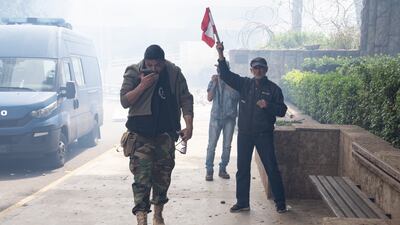
A veteran waves the Lebanese flag as retired soldiers try to storm the government palace in Beirut on March 22. Matt Kynaston / The National -
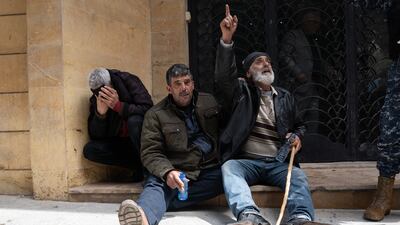
Retired soldiers who tried to storm the government palace. There is widespread anger over Lebanon's economic crisis. Matt Kynaston / The National -

Protesters affected by tear gas in Beirut. Matt Kynaston / The National -

Retired soldiers try to storm government palace in Beirut, Lebanon on 22 March 2023. Matt Kynaston / The National -
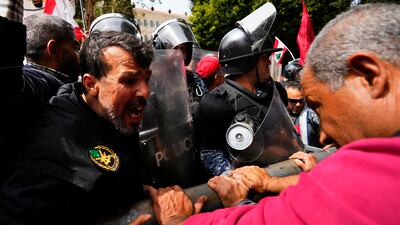
Retired Lebanese soldiers clash with riot police during the protest -
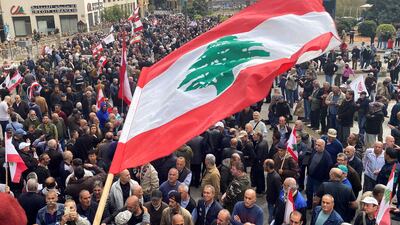
Demonstrators gather in Beirut during a protest over the deteriorating economic situation in Lebanon. Reuters -

A retired soldier, right, is pushed back by riot police. AP -

Lebanese soldiers use tear gas against retired servicemen during the protest. AP -
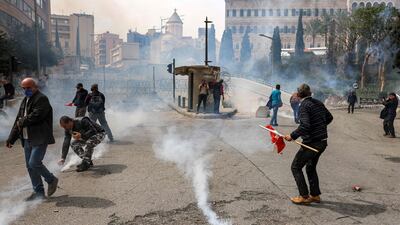
Riot police used force as protesters attempted to storm the government palace in central Beirut. AFP -
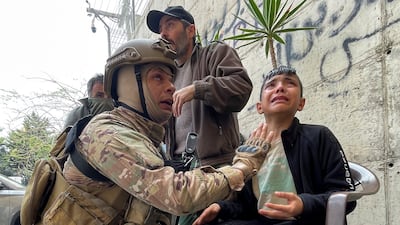
A Lebanese soldier assists a boy affected by tear gas. Reuters -

Lebanese veterans and police in a confrontation during the protest. AP -

The protests came as the local currency plunged to record lows against the US dollar. AP -
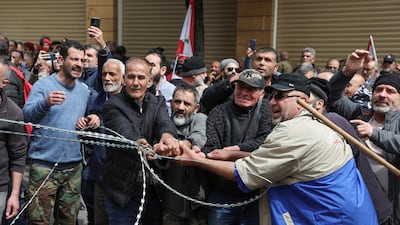
Retired Lebanese soldiers vent their anger during the protest. Reuters -

Lebanese army veterans face the might of riot police AFP -

A demonstrator wearing a bandana eggs on the protesters. AFP -

A protester shouts slogans in front of riot policemen. AP -
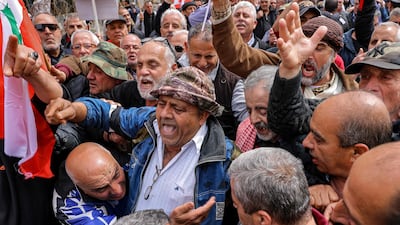
Protesters shout anti-government slogans. AFP -
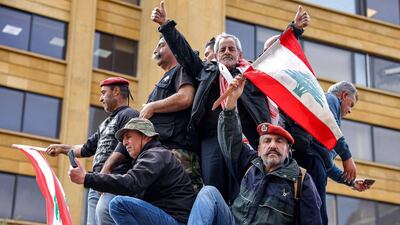
Protesters outside the government palace in Beirut. AFP


Despite the clashes between veterans with active soldiers and police, demonstrators were seen by The National administering first aid to security forces and army soldiers injured by the gas.
A group of men carrying a barely conscious army soldier ran through a thick fog of teargas, looking for a Red Cross ambulance as the Internal Security Forces continued to fire.
They didn't find one, instead laying him on a pavement away from the chaos.
“Onions! We need onions,” a demonstrator called out as the soldier struggled to breathe. Onions are popularly thought to counter the effects of teargas.
“Sorry, no onions,” another demonstrator replied. “They're 100,000 pounds a kilo, we couldn't afford to bring them to this protest. We can't help him.”
Later, veterans could be heard hurling insults as a line of security officers in riot gear stood behind a barbed-wire barrier.
“We're demanding our rights — your rights! And this is what you do to us?” one demonstrator asked in disbelief.
Mostafa Morian — a 64-year-old veteran who served in the Lebanese army for 22 years and currently makes the equivalent of $40 per month — scoffed at the row of young men in uniform.
“They're protecting those thugs,” he said, nodding in the direction of the country's parliament building. “Tomorrow they're going to find those same thugs standing on their necks. Their fate will be the same as ours soon enough.”

