Libya’s troubled peace process is approaching a crunch point, with a decision needed within days if elections planned for December are to go ahead.
If the elections are scrapped, or even delayed, there is a risk the country will return to civil war.
Back in March, Libya’s parliament agreed elections should be held on December 24, the 70th anniversary of Libya’s independence, and it appointed a temporary administration, the Government of National Unity (GNU) to run the country until then.
The GNU has succeeded in becoming the country’s sole government, replacing rival administrations that had existed in west and east Libya. However, its mandate ends in December and, if there are no elections by then, Libya is likely to split again along an east/west axis.
Libya’s factious parliament has failed to agree the kind of government to be elected in December, and election organisers the High National Election Commission say a decision is needed on or around July 1. This is because before it can organise the December vote, it is supposed to organise a referendum to approve whatever constitution parliament decides on.
A draft constitution has already been drawn up by the country’s Constitutional Assembly, but the crucial question undecided is whether Libya should have a president appointed by parliament, or directly elected.
A directly elected president would have considerable power, and in a divided country reeling from six years of civil war, whoever is chosen is likely to be strongly opposed by a sizeable minority.
-
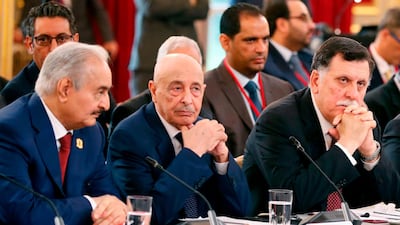
Libyan Field Marshal Khalifa Haftar, House of Representatives speaker Aguila Saleh, and GNA Prime Minister Fayez Al Sarraj attend a peace conference hosted by France in May 2018. AFP -
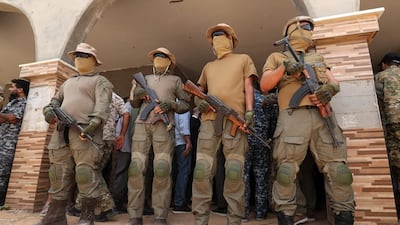
Fighters from the Libyan Government of National Accord (GNA) stand guard on June 20, 2021, in the town of Buwairat Al Hassoun. AFP -
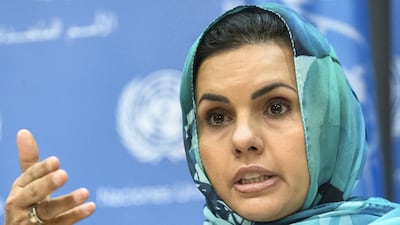
Zahra Langhi and other women have called for changes to the UN Libya peace process. Getty -
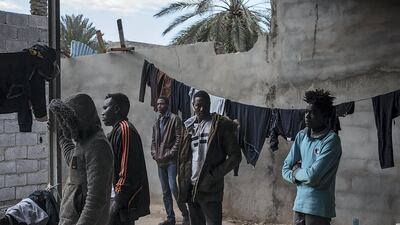
Refugees mostly from Darfur, Sudan are gathered in the courtyard of the place where they live in Gorgi district, south of Tripoli. Migrants and refugees are often living in dire conditions, in dilapidated buildings or small unfinished houses deprived of basic services. -

Turkish President Recep Tayyip Erdogan and Italian Prime Minister Giuseppe Conte speak on the sideline of the conference on Libya at the Chancellery in Berlin in January. ,AP -
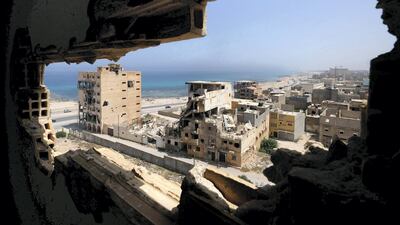
Destroyed buildings are seen through a hole in Benghazi lighthouse after it was severely damaged by years of armed conflict in 2019. Reuters -
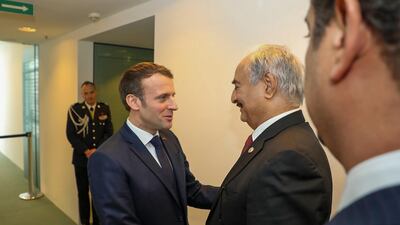
Field Marshal Khalifa Haftar's Haftar greets French President Emmanuel Macron in Berlin in January. AFP -
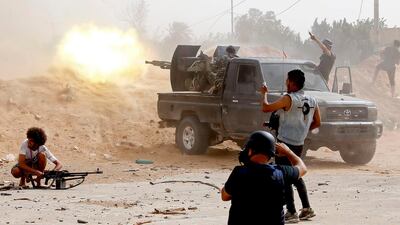
A fighter loyal to the Libyan internationally-recognised Government of National Accord fires a heavy machine gun as a press photographer take pictures of the scene during clashes against forces loyal to Field Marshal Khalifa Haftar. AFP -
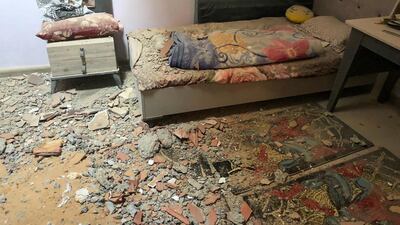
Conflict in and around Tripoli continues. Reuters -
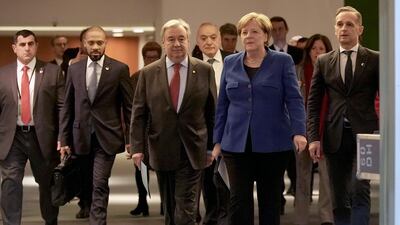
German Chancellor Angela Merkel, German Foreign Minister Heiko Maas and Secretary-General of the United Nations Antonio Guterres leave after a press conference at the end of a Peace summit on Libya at the Chancellery in Berlin on January. AFP -
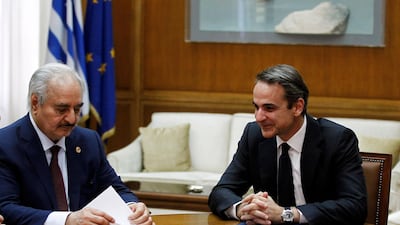
Greek Prime Minister Mitsotakis talks with Commander of the Libyan National Army Khalifa Haftar during their meeting in Parliament, in Athens, Greece in January 2020. EPA -
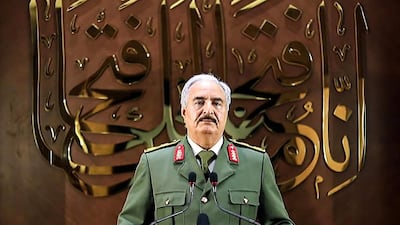
Field Marshal Khalifa Haftar speaking in a video published by the War Information Division of the Libyan National Army on April 28, 2020. AFP PHOTO / LNA WAR INFORMATION DIVISION


Libya’s leaders all say they want the elections held on time. GNU prime minister Abdul Hamid Al Dabaiba reiterated they were essential during a meeting on Friday in London with British prime minister Boris Johnson.
The same day, parliament’s speaker Ageela Saleh, holding talks in Morocco, confirmed the election date must be kept. The Libyan people feel the same way, according to a survey released last week by the US government agency USAID which showed 64 per cent want the elections held on time, even if this means not having a referendum on the constitution.
Outside powers are pushing Libya’s parliament to make a decision before July 1.
Last week US Secretary of State Antony Blinken joined foreign ministers and diplomats from a dozen states, including the UAE, at a conference in Berlin to urge Libya’s parliamentarians to pass an election law. The European Union announced the same week it will consider imposing sanctions on any Libyan leaders obstructing the process.
Meanwhile, the UN’s Libya envoy, Jan Kubis, has suggested a way out of the constitutional labyrinth. If parliament cannot agree the constitution, a mediation group, the Libyan Political Dialogue Forum (LPDF) can do it instead.
The LPDF, composed of Libyan leaders from across the political spectrum, was set up last year by the UN to design the existing GNU. An option being explored is that, if parliament will not make a constitution decision by July 1, the LPDF should do it instead, authorising the constitution as a temporary measure, with whatever parliament is elected deciding later if it wants to make the constitution permanent.
“This could be an interim arrangement to enable the country to go to elections in December and move beyond the current transitional phase,” Mr Kubis said in an address to the LPDF last week.
Foreign fighters
Finding a way out of the constitutional wilderness is seen by diplomats as vital because of a second problem: the failure of foreign forces to withdraw on time.
A key part of the UN-mediated ceasefire agreed last October was that foreign forces withdraw within 90 days. The UN says Libya is home to more than 20,000 foreign military personnel and mercenaries, but none have withdrawn.
The UN’s Panel of Experts, which issues an annual report on Libya’s military situation, reported earlier this year that these forces include Turkish military personnel and mercenaries from Chad, Sudan, Syria and a Russian private military contractor, Wagner. Many of these forces are deployed either side of a ceasefire line running south from the central coastal town of Sirte.
“The Libyans are clear: They want everybody (foreign forces) out,” said US Acting Secretary of State for Near Eastern Affairs Joey Hood at a press briefing on Thursday. “The Libyan ceasefire agreement calls for the withdrawal of all foreign fighters and mercenaries, no exceptions.”
Libya’s foreign minister Najla Mangoush called at the Berlin conference for the removal of these forces “without delay.” However, the military establishments in Libya are outside GNU control, and so far have not ordered their foreign allies out.
Diplomats agree privately that the best way to convince foreign units to quit Libya is by ending the possibility of civil war and hence their reason for being there. For Libya’s peace process, all roads lead to the December elections.