
Iran will not be pressured by sanctions or sabotage and the US must return to the 2015 nuclear deal, Iran's Foreign Minister Javad Zarif said on Tuesday.
The Iranian official said that an apparent attack on an underground nuclear plant in the country on Sunday strengthens Tehran's hand in ongoing negotiations with world powers over the 2015 nuclear deal, officially known as the Joint Comprehensive Plan of Action (JCPOA).
"We have no problem with returning to implementing our JCPOA commitments," Mr Zarif said.
"We will go back to the nuclear deal, we will be all in."
"But the Americans should know that neither sanctions nor acts of sabotage will give them negotiation tools and these acts will only make the situation more difficult for them."
Mr Zarif addressed a joint press conference with Russian Foreign Minister Sergey Lavrov after their meeting in the Iranian capital.
-

Iranian President Hassan Rouhani, right, and the head of Atomic Energy Organization of Iran Ali Akbar Salehi inspect the nuclear technology on the occasion of Iran National Nuclear Technology Day in Tehran in 2019. EPA -
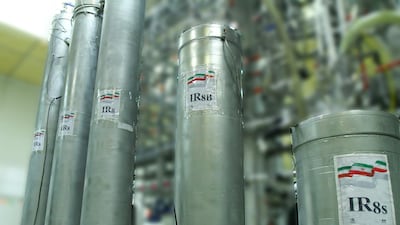
IR-8 centrifuges at Natanz nuclear power plant, some 300 kilometres south of capital Tehran. AFP -
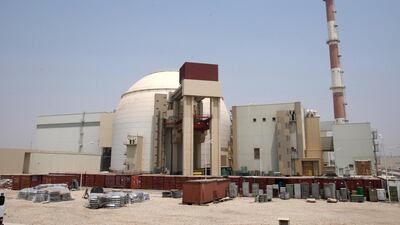
The Iranian nuclear power plant in Bushehr in 2010. EPA -

Salehi speaks with media while visiting Natanz enrichment facility, in central Iran in 2019. Atomic Energy Organization of Iran via AP -
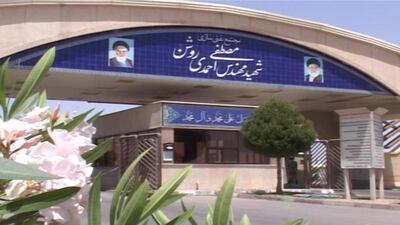
The gate of Natanz nuclear power plant in Natanz , Isfahan province, in 2019. EPA -
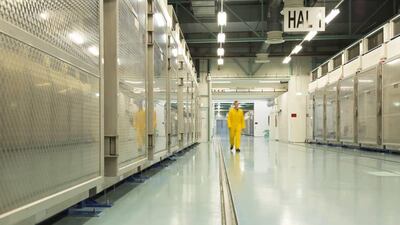
Inside of the Iran's Fordow nuclear facility, in Fordow, Qom province in 2019. EPA -
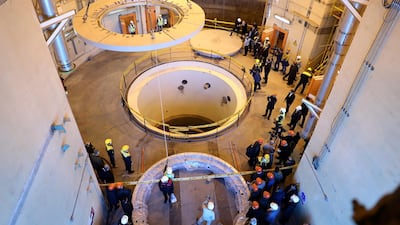
Technicians work at the Arak heavy water reactor's secondary circuit, as officials and media visit the site, near Arak, Iran in 2019. Atomic Energy Organization of Iran via AP -
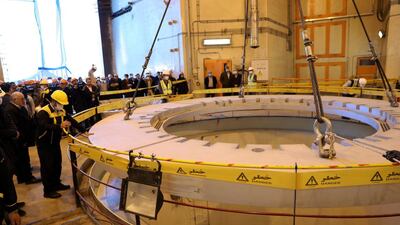
Members of the media and officials tour the water nuclear reactor at Arak in 2019. WANA via Reuters -
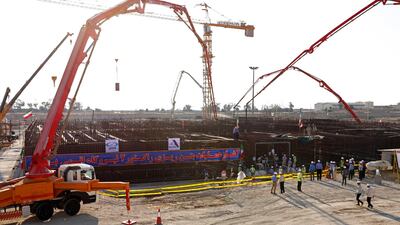
Concrete is poured for the base of the second nuclear power reactor at Bushehr plant in 2019. Atomic Energy Organization of Iran via AP


Mr Zarif said the attack on the Natanz nuclear site, which he blamed on Israel, created an "opportunity" for Iran to rebuild with more advanced technology.
"In the near future, the Natanz facility will be equipped with the latest generation centrifuges."
The US withdrew from the 2015 nuclear deal in 2018, leading Iran to start increasing its enrichment of nuclear material in contravention of the terms of the agreement.
Iran had only three kilos of enriched uranium and was only using first-generation centrifuges when Donald Trump became president, said Mr Zarif.
Now, he claimed, Iran had four tonnes of enriched uranium and was using sixth-generation centrifuges.
Under the 2015 deal, Iran is permitted to only use first-generation centrifuges.
The Iranian foreign minister urged Mr Biden to set a new course for US-Iran relations, while taking a jab at former president Mr Trump.
"This person is at home playing chess with some invisible person and eating fries, this person is history now."
The Russian foreign minister said he expected the Iranian nuclear deal to be saved and condemned Monday's EU sanctions against Iran, saying they could undermine sensitive nuclear talks that began last week in Vienna.
"We expect that it will be possible to preserve the Joint Comprehensive Plan of Action," Mr Lavrov said, adding that there was no alternative to the nuclear deal of which Russia is a co-signatory.
"We are against any attempts to torpedo these [Vienna] talks."
Mr Lavrov said sanctions brought against Iran on Monday over human right's violations sparked "a huge amount of questions".
"The EU is lacking co-ordination. The left hand does not know what the right hand does," said Mr Lavrov.
The EU imposed sanctions on eight Iranian security officials for human rights breaches during a bloody crackdown on protesters in 2019 that left at least 304 dead.
Europe convened talks in Vienna last week with diplomats shuttling between Iran and the US to begin looking at how both sides can return to comply with the deal that prompted the international community to lift sanctions on Tehran in exchange for inspections and strict curbs on the enrichment of uranium.
The US says Iran must return to compliance before it will lift dozens of sanctions brought in by the Trump administration. Iran demands sanctions are lifted before returning to the JCPOA terms.
Talks are set to resume on Wednesday.
Iran and Russia also signed a joint agreement on cultural co-operation on Tuesday and discussed areas of mutual interest, including economics, nuclear energy and regional security.
Mr Lavrov said Russia and Iran's positions on Afghanistan and Yemen were "very close".
Latest Iran stories
Iranian officials ‘face arrest’ travelling abroad as trial nears for 1988 massacre
EU imposes sanctions on Iran’s Revolutionary Guard chief over 2019 crackdown
Iran calls on South Korea to release oil funds frozen under US sanctions

