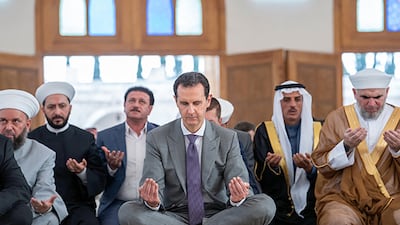
Turkey’s President Recep Tayyip Erdogan expressed a wish to meet President Bashar Al Assad had the Syrian leader attended a summit being held in Uzbekistan, a report in Turkey's pro-government Hurriyet newspaper said on Friday.
The move is the latest sign of shifting relations as Turkey has long been a major backer of rebel and anti-government factions in Syria’s more than a decade-long civil war.
Mr Erdogan has previously called Mr Al Assad a terrorist and said there could be no peace in Syria with him in office, while Mr Al Assad has called Mr Erdogan a thief for stealing Syrian land.
But Mr Erdogan's recent comments are a stark contrast to past opinions.
"I wish Assad had come to Uzbekistan, I would have spoken to him. But he can't come there," Mr Erdogan reportedly said at the party meeting.
"He went to war with rebels to maintain his own power. He chose to protect his own power. He thought to protect the areas he controlled. But he couldn't protect large areas," Mr Erdogan said.
Turkish backing has been vital to sustaining Syrian rebels in their last major territorial foothold in the north-west, after Mr Al Assad defeated the insurgency in the rest of the country, aided by Russia and Iran.
The comments came as reports indicate Turkey's intelligence chief has held several meetings with his Syrian counterpart in Damascus over the past few weeks. The move is a sign of Russian efforts to encourage a thaw between states on opposite sides of Syria's war, sources told Reuters.
A regional source aligned with Damascus told Reuters that Hakan Fidan, head of Turkey's National Intelligence Organisation (MIT), and Syrian intelligence chief Ali Mamlouk met as recently as this week in the Syrian capital.
The contacts reflect a Russian policy shift as Moscow steels itself for a protracted conflict in Ukraine and seeks to secure its position in Syria, where its forces have supported Mr Al Assad since 2015, according to two Turkish officials and the regional source.
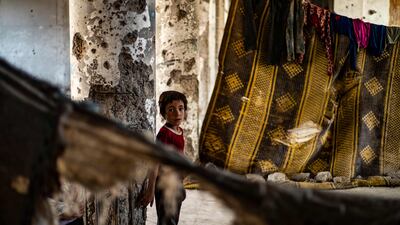
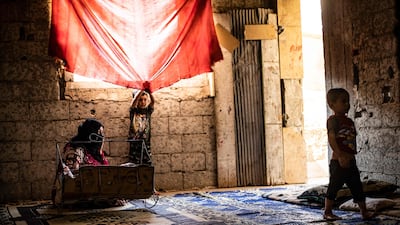
But, rapprochement faces big complications, including the fate of rebel fighters and millions of civilians, many of whom fled to the north-west to escape Mr Al Assad's rule.
Turkey, a Nato member country, has troops on the ground across the area, which Mr Al Assad considers to be occupying forces.
During the meetings, Mr Fidan ― one of Mr Erdogan's closest confidants ― and Mr Mamlouk evaluated how the two countries' foreign ministers could eventually meet, according to a senior Turkish official and a Turkish security source.
"Russia wants Syria and Turkey to overcome their problems and achieve certain agreements ... which are in the interest of everyone, both Turkey and Syria," the Turkish official told Reuters.
One big challenge is Turkey's desire to include Syrian rebels in any talks with Damascus, the official said.
The Damascus-allied source said Russia had nudged Syria to enter talks as Moscow seeks to nail down its position and that of Mr Al Assad in the event it must redeploy forces to Ukraine. Russia has sustained serious losses in Ukraine over the past week.
The senior Turkish official said Ankara does not want to see Iranian or Iran-backed forces ― already widely deployed in government-controlled parts of Syria ― plugging gaps left by Russian withdrawals.
Sheer grandeur
The Owo building is 14 storeys high, seven of which are below ground, with the 30,000 square feet of amenities located subterranean, including a 16-seat private cinema, seven lounges, a gym, games room, treatment suites and bicycle storage.
A clear distinction between the residences and the Raffles hotel with the amenities operated separately.
BUNDESLIGA FIXTURES
Saturday, May 16 (kick-offs UAE time)
Borussia Dortmund v Schalke (4.30pm)
RB Leipzig v Freiburg (4.30pm)
Hoffenheim v Hertha Berlin (4.30pm)
Fortuna Dusseldorf v Paderborn (4.30pm)
Augsburg v Wolfsburg (4.30pm)
Eintracht Frankfurt v Borussia Monchengladbach (7.30pm)
Sunday, May 17
Cologne v Mainz (4.30pm),
Union Berlin v Bayern Munich (7pm)
Monday, May 18
Werder Bremen v Bayer Leverkusen (9.30pm)
Ten tax points to be aware of in 2026
1. Domestic VAT refund amendments: request your refund within five years
If a business does not apply for the refund on time, they lose their credit.
2. E-invoicing in the UAE
Businesses should continue preparing for the implementation of e-invoicing in the UAE, with 2026 a preparation and transition period ahead of phased mandatory adoption.
3. More tax audits
Tax authorities are increasingly using data already available across multiple filings to identify audit risks.
4. More beneficial VAT and excise tax penalty regime
Tax disputes are expected to become more frequent and more structured, with clearer administrative objection and appeal processes. The UAE has adopted a new penalty regime for VAT and excise disputes, which now mirrors the penalty regime for corporate tax.
5. Greater emphasis on statutory audit
There is a greater need for the accuracy of financial statements. The International Financial Reporting Standards standards need to be strictly adhered to and, as a result, the quality of the audits will need to increase.
6. Further transfer pricing enforcement
Transfer pricing enforcement, which refers to the practice of establishing prices for internal transactions between related entities, is expected to broaden in scope. The UAE will shortly open the possibility to negotiate advance pricing agreements, or essentially rulings for transfer pricing purposes.
7. Limited time periods for audits
Recent amendments also introduce a default five-year limitation period for tax audits and assessments, subject to specific statutory exceptions. While the standard audit and assessment period is five years, this may be extended to up to 15 years in cases involving fraud or tax evasion.
8. Pillar 2 implementation
Many multinational groups will begin to feel the practical effect of the Domestic Minimum Top-Up Tax (DMTT), the UAE's implementation of the OECD’s global minimum tax under Pillar 2. While the rules apply for financial years starting on or after January 1, 2025, it is 2026 that marks the transition to an operational phase.
9. Reduced compliance obligations for imported goods and services
Businesses that apply the reverse-charge mechanism for VAT purposes in the UAE may benefit from reduced compliance obligations.
10. Substance and CbC reporting focus
Tax authorities are expected to continue strengthening the enforcement of economic substance and Country-by-Country (CbC) reporting frameworks. In the UAE, these regimes are increasingly being used as risk-assessment tools, providing tax authorities with a comprehensive view of multinational groups’ global footprints and enabling them to assess whether profits are aligned with real economic activity.
Contributed by Thomas Vanhee and Hend Rashwan, Aurifer
Avatar: Fire and Ash
Director: James Cameron
Starring: Sam Worthington, Sigourney Weaver, Zoe Saldana
Rating: 4.5/5
Mercer, the investment consulting arm of US services company Marsh & McLennan, expects its wealth division to at least double its assets under management (AUM) in the Middle East as wealth in the region continues to grow despite economic headwinds, a company official said.
Mercer Wealth, which globally has $160 billion in AUM, plans to boost its AUM in the region to $2-$3bn in the next 2-3 years from the present $1bn, said Yasir AbuShaban, a Dubai-based principal with Mercer Wealth.
“Within the next two to three years, we are looking at reaching $2 to $3 billion as a conservative estimate and we do see an opportunity to do so,” said Mr AbuShaban.
Mercer does not directly make investments, but allocates clients’ money they have discretion to, to professional asset managers. They also provide advice to clients.
“We have buying power. We can negotiate on their (client’s) behalf with asset managers to provide them lower fees than they otherwise would have to get on their own,” he added.
Mercer Wealth’s clients include sovereign wealth funds, family offices, and insurance companies among others.
From its office in Dubai, Mercer also looks after Africa, India and Turkey, where they also see opportunity for growth.
Wealth creation in Middle East and Africa (MEA) grew 8.5 per cent to $8.1 trillion last year from $7.5tn in 2015, higher than last year’s global average of 6 per cent and the second-highest growth in a region after Asia-Pacific which grew 9.9 per cent, according to consultancy Boston Consulting Group (BCG). In the region, where wealth grew just 1.9 per cent in 2015 compared with 2014, a pickup in oil prices has helped in wealth generation.
BCG is forecasting MEA wealth will rise to $12tn by 2021, growing at an annual average of 8 per cent.
Drivers of wealth generation in the region will be split evenly between new wealth creation and growth of performance of existing assets, according to BCG.
Another general trend in the region is clients’ looking for a comprehensive approach to investing, according to Mr AbuShaban.
“Institutional investors or some of the families are seeing a slowdown in the available capital they have to invest and in that sense they are looking at optimizing the way they manage their portfolios and making sure they are not investing haphazardly and different parts of their investment are working together,” said Mr AbuShaban.
Some clients also have a higher appetite for risk, given the low interest-rate environment that does not provide enough yield for some institutional investors. These clients are keen to invest in illiquid assets, such as private equity and infrastructure.
“What we have seen is a desire for higher returns in what has been a low-return environment specifically in various fixed income or bonds,” he said.
“In this environment, we have seen a de facto increase in the risk that clients are taking in things like illiquid investments, private equity investments, infrastructure and private debt, those kind of investments were higher illiquidity results in incrementally higher returns.”
The Abu Dhabi Investment Authority, one of the largest sovereign wealth funds, said in its 2016 report that has gradually increased its exposure in direct private equity and private credit transactions, mainly in Asian markets and especially in China and India. The authority’s private equity department focused on structured equities owing to “their defensive characteristics.”
Off-roading in the UAE: How to checklist
Key figures in the life of the fort
Sheikh Dhiyab bin Isa (ruled 1761-1793) Built Qasr Al Hosn as a watchtower to guard over the only freshwater well on Abu Dhabi island.
Sheikh Shakhbut bin Dhiyab (ruled 1793-1816) Expanded the tower into a small fort and transferred his ruling place of residence from Liwa Oasis to the fort on the island.
Sheikh Tahnoon bin Shakhbut (ruled 1818-1833) Expanded Qasr Al Hosn further as Abu Dhabi grew from a small village of palm huts to a town of more than 5,000 inhabitants.
Sheikh Khalifa bin Shakhbut (ruled 1833-1845) Repaired and fortified the fort.
Sheikh Saeed bin Tahnoon (ruled 1845-1855) Turned Qasr Al Hosn into a strong two-storied structure.
Sheikh Zayed bin Khalifa (ruled 1855-1909) Expanded Qasr Al Hosn further to reflect the emirate's increasing prominence.
Sheikh Shakhbut bin Sultan (ruled 1928-1966) Renovated and enlarged Qasr Al Hosn, adding a decorative arch and two new villas.
Sheikh Zayed bin Sultan (ruled 1966-2004) Moved the royal residence to Al Manhal palace and kept his diwan at Qasr Al Hosn.
Sources: Jayanti Maitra, www.adach.ae
%20Ramez%20Gab%20Min%20El%20Akher
%3Cp%3E%3Cstrong%3ECreator%3A%3C%2Fstrong%3E%20Ramez%20Galal%3C%2Fp%3E%0A%3Cp%3E%3Cstrong%3EStarring%3A%3C%2Fstrong%3E%20Ramez%20Galal%3C%2Fp%3E%0A%3Cp%3E%3Cstrong%3EStreaming%20on%3A%20%3C%2Fstrong%3EMBC%20Shahid%3C%2Fp%3E%0A%3Cp%3E%3Cstrong%3ERating%3A%20%3C%2Fstrong%3E2.5%2F5%3C%2Fp%3E%0A
More from Neighbourhood Watch:
Ukraine%20exports
%3Cp%3EPresident%20Volodymyr%20Zelenskyy%20has%20overseen%20grain%20being%20loaded%20for%20export%20onto%20a%20Turkish%20ship%20following%20a%20deal%20with%20Russia%20brokered%20by%20the%20UN%20and%20Turkey.%3Cbr%3E%22The%20first%20vessel%2C%20the%20first%20ship%20is%20being%20loaded%20since%20the%20beginning%20of%20the%20war.%20This%20is%20a%20Turkish%20vessel%2C%22%20Zelensky%20said%2C%20adding%20exports%20could%20start%20in%20%22the%20coming%20days%22%20under%20the%20plan%20aimed%20at%20getting%20millions%20of%20tonnes%20of%20Ukrainian%20grain%20stranded%20by%20Russia's%20naval%20blockade%20to%20world%20markets.%3Cbr%3E%22Our%20side%20is%20fully%20prepared%2C%22%20he%20said.%20%22We%20sent%20all%20the%20signals%20to%20our%20partners%20--%20the%20UN%20and%20Turkey%2C%20and%20our%20military%20guarantees%20the%20security%20situation.%22%3C%2Fp%3E%0A
More coverage from the Future Forum
The%20Roundup%20%3A%20No%20Way%20Out
%3Cp%3E%3Cstrong%3EDirector%3A%3C%2Fstrong%3E%20Lee%20Sang-yong%3Cbr%3E%3Cstrong%3EStars%3A%3C%2Fstrong%3E%20Don%20Lee%2C%20Lee%20Jun-hyuk%2C%20Munetaka%20Aoki%3Cbr%3E%3Cstrong%3ERating%3A%20%3C%2Fstrong%3E3%2F5%3Cbr%3E%3Cbr%3E%3C%2Fp%3E%0A
The specs: 2018 Maxus T60
Price, base / as tested: Dh48,000
Engine: 2.4-litre four-cylinder
Power: 136hp @ 1,600rpm
Torque: 360Nm @ 1,600 rpm
Transmission: Five-speed manual
Fuel consumption, combined: 9.1L / 100km