Northern Syria's fragile infrastructure will be destroyed if a feared military escalation takes place, a top International Committee of the Red Cross official has said.
This could put tens of thousands of people at risk, said Fabrizio Carboni, the ICRC's Near and Middle East regional director.
“North-east Syria is fragile, unstable, disputed territory, we really hope that the violence won’t escalate there. If it does, you put at risk people and essential services,” he told The National.
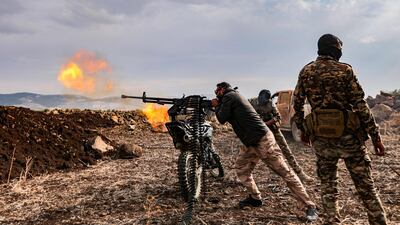
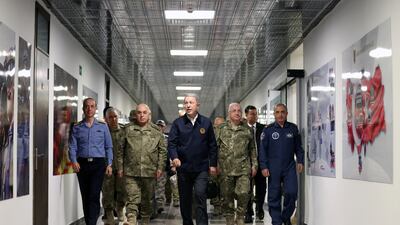
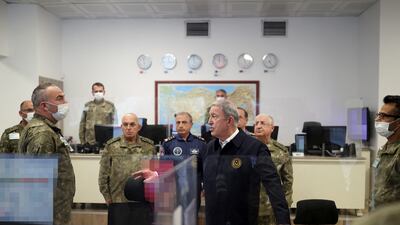
Turkey in recent weeks has warned of a new ground offensive into Kurdish-controlled parts of Syria following a bomb attack in Istanbul last month, which it blames on Kurdish separatists based in Syria and northern Iraq. It has faced growing international calls for restraint.
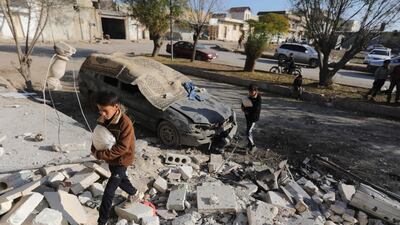
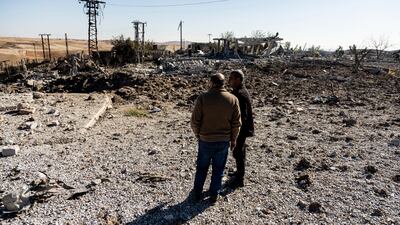
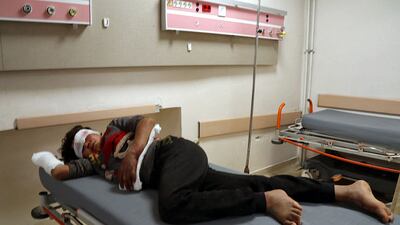
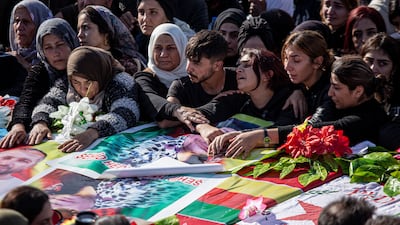
Turkey has launched scores of artillery and air strikes in northern Syria since November 20, reportedly killing nearly 200 people.
The US and other western states have urged against any cross-border operations.
If a military operation does occur then it will “provoke the movement of people, tens of thousands — this is speculation, maybe nothing will happen, but if it does then we could see more destruction” of the country's limited remaining infrastructure, Mr Carboni said.
Violence “will take place in a fragile environment where destruction has been widespread — it’s the worst state in the region that has been affected,” he said.
The main problem is that this is “not happening in an area where there is a healthy population where services are available. I hope there will be a way out of this, a negotiated one,” he added.
Also, the ICRC may not be able to gain access to conflict zones, putting thousands of people in danger.
“I don’t know what the people in Syria will do, it’s really unbearable, I don’t know where people find the strength to go through these difficulties,” he said.
About 14 million Syrians, half of whom are children, require humanitarian assistance — the highest number since the conflict began in March 2011, according to the ICRC.
The country has the highest number of internally displaced people, with more than 2.5 million living without adequate shelter. Years of war have hit the economy, pushing 90 per cent of the population below the poverty line, and unemployment to as high as 50 per cent.
“It's not like the situation is improving, 90 per cent of the population needs humanitarian assistance, it’s really a lot of people,” he said.
If Syria has a harsh winter this year, “it's going to be desperate, really desperate and we'll see less attention to Syria. Funding is under pressure, it’s really bleak,” Mr Carboni said.
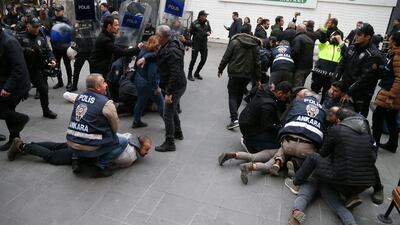
The ICRC official's comments come after a Turkish military vehicle ran over a woman and a child in a northern Syrian town on Monday, killing both and sparking local protests.
Opposition activists said the incident involving two armoured vehicles happened in the town of Atareb, west of the northern city of Aleppo and about 16km from the Turkish border.
More international help is needed
International attention should go beyond a humanitarian response in Syria, Mr Carboni said.
“We regret that a political process is going nowhere. At the end of the day this is the solution, we will not be able as humanitarian actors to compensate for the lack of normality in Syria and around Syria,” he said.
Nine rounds of UN-mediated peace talks — known as the Geneva II process — failed to make progress, with President Bashar Al Assad apparently unwilling to negotiate with political opposition groups that insist he must step down as part of any settlement.
Russia, Iran and Turkey set up parallel political talks, known as the Astana process, in 2017.
An agreement was reached in 2018 to form a 150-member committee to write a new constitution, leading to free and fair elections supervised by the UN.
It took until 2019 to establish the committee and yet little has been achieved so far. The latest round of talks earlier this year found the committee's members unable to find a common path.
Syria’s civil war, which began in 2011 after a violent crackdown on anti-government protesters led to an armed rebellion, has largely ended, although Al Qaeda-linked militants still control the north-eastern governorate of Idlib, an area overcrowded with an estimated 1.7 million displaced Syrians.
The President’s forces have regained most of the country from secular rebel groups, ISIS and an assortment of Islamist militias.
A%20Little%20to%20the%20Left
%3Cp%3E%3Cstrong%3EDeveloper%3A%20%3C%2Fstrong%3EMax%20Inferno%3Cbr%3E%3Cstrong%3EConsoles%3A%3C%2Fstrong%3E%20PC%2C%20Mac%2C%20Nintendo%20Switch%3Cbr%3E%3Cstrong%3ERating%3A%20%3C%2Fstrong%3E4%2F5%26nbsp%3B%3C%2Fp%3E%0A
Ten tax points to be aware of in 2026
1. Domestic VAT refund amendments: request your refund within five years
If a business does not apply for the refund on time, they lose their credit.
2. E-invoicing in the UAE
Businesses should continue preparing for the implementation of e-invoicing in the UAE, with 2026 a preparation and transition period ahead of phased mandatory adoption.
3. More tax audits
Tax authorities are increasingly using data already available across multiple filings to identify audit risks.
4. More beneficial VAT and excise tax penalty regime
Tax disputes are expected to become more frequent and more structured, with clearer administrative objection and appeal processes. The UAE has adopted a new penalty regime for VAT and excise disputes, which now mirrors the penalty regime for corporate tax.
5. Greater emphasis on statutory audit
There is a greater need for the accuracy of financial statements. The International Financial Reporting Standards standards need to be strictly adhered to and, as a result, the quality of the audits will need to increase.
6. Further transfer pricing enforcement
Transfer pricing enforcement, which refers to the practice of establishing prices for internal transactions between related entities, is expected to broaden in scope. The UAE will shortly open the possibility to negotiate advance pricing agreements, or essentially rulings for transfer pricing purposes.
7. Limited time periods for audits
Recent amendments also introduce a default five-year limitation period for tax audits and assessments, subject to specific statutory exceptions. While the standard audit and assessment period is five years, this may be extended to up to 15 years in cases involving fraud or tax evasion.
8. Pillar 2 implementation
Many multinational groups will begin to feel the practical effect of the Domestic Minimum Top-Up Tax (DMTT), the UAE's implementation of the OECD’s global minimum tax under Pillar 2. While the rules apply for financial years starting on or after January 1, 2025, it is 2026 that marks the transition to an operational phase.
9. Reduced compliance obligations for imported goods and services
Businesses that apply the reverse-charge mechanism for VAT purposes in the UAE may benefit from reduced compliance obligations.
10. Substance and CbC reporting focus
Tax authorities are expected to continue strengthening the enforcement of economic substance and Country-by-Country (CbC) reporting frameworks. In the UAE, these regimes are increasingly being used as risk-assessment tools, providing tax authorities with a comprehensive view of multinational groups’ global footprints and enabling them to assess whether profits are aligned with real economic activity.
Contributed by Thomas Vanhee and Hend Rashwan, Aurifer
Company name: Farmin
Date started: March 2019
Founder: Dr Ali Al Hammadi
Based: Abu Dhabi
Sector: AgriTech
Initial investment: None to date
Partners/Incubators: UAE Space Agency/Krypto Labs
Mercer, the investment consulting arm of US services company Marsh & McLennan, expects its wealth division to at least double its assets under management (AUM) in the Middle East as wealth in the region continues to grow despite economic headwinds, a company official said.
Mercer Wealth, which globally has $160 billion in AUM, plans to boost its AUM in the region to $2-$3bn in the next 2-3 years from the present $1bn, said Yasir AbuShaban, a Dubai-based principal with Mercer Wealth.
“Within the next two to three years, we are looking at reaching $2 to $3 billion as a conservative estimate and we do see an opportunity to do so,” said Mr AbuShaban.
Mercer does not directly make investments, but allocates clients’ money they have discretion to, to professional asset managers. They also provide advice to clients.
“We have buying power. We can negotiate on their (client’s) behalf with asset managers to provide them lower fees than they otherwise would have to get on their own,” he added.
Mercer Wealth’s clients include sovereign wealth funds, family offices, and insurance companies among others.
From its office in Dubai, Mercer also looks after Africa, India and Turkey, where they also see opportunity for growth.
Wealth creation in Middle East and Africa (MEA) grew 8.5 per cent to $8.1 trillion last year from $7.5tn in 2015, higher than last year’s global average of 6 per cent and the second-highest growth in a region after Asia-Pacific which grew 9.9 per cent, according to consultancy Boston Consulting Group (BCG). In the region, where wealth grew just 1.9 per cent in 2015 compared with 2014, a pickup in oil prices has helped in wealth generation.
BCG is forecasting MEA wealth will rise to $12tn by 2021, growing at an annual average of 8 per cent.
Drivers of wealth generation in the region will be split evenly between new wealth creation and growth of performance of existing assets, according to BCG.
Another general trend in the region is clients’ looking for a comprehensive approach to investing, according to Mr AbuShaban.
“Institutional investors or some of the families are seeing a slowdown in the available capital they have to invest and in that sense they are looking at optimizing the way they manage their portfolios and making sure they are not investing haphazardly and different parts of their investment are working together,” said Mr AbuShaban.
Some clients also have a higher appetite for risk, given the low interest-rate environment that does not provide enough yield for some institutional investors. These clients are keen to invest in illiquid assets, such as private equity and infrastructure.
“What we have seen is a desire for higher returns in what has been a low-return environment specifically in various fixed income or bonds,” he said.
“In this environment, we have seen a de facto increase in the risk that clients are taking in things like illiquid investments, private equity investments, infrastructure and private debt, those kind of investments were higher illiquidity results in incrementally higher returns.”
The Abu Dhabi Investment Authority, one of the largest sovereign wealth funds, said in its 2016 report that has gradually increased its exposure in direct private equity and private credit transactions, mainly in Asian markets and especially in China and India. The authority’s private equity department focused on structured equities owing to “their defensive characteristics.”
Living in...
This article is part of a guide on where to live in the UAE. Our reporters will profile some of the country’s most desirable districts, provide an estimate of rental prices and introduce you to some of the residents who call each area home.
What the law says
Micro-retirement is not a recognised concept or employment status under Federal Decree Law No. 33 of 2021 on the Regulation of Labour Relations (as amended) (UAE Labour Law). As such, it reflects a voluntary work-life balance practice, rather than a recognised legal employment category, according to Dilini Loku, senior associate for law firm Gateley Middle East.
“Some companies may offer formal sabbatical policies or career break programmes; however, beyond such arrangements, there is no automatic right or statutory entitlement to extended breaks,” she explains.
“Any leave taken beyond statutory entitlements, such as annual leave, is typically regarded as unpaid leave in accordance with Article 33 of the UAE Labour Law. While employees may legally take unpaid leave, such requests are subject to the employer’s discretion and require approval.”
If an employee resigns to pursue micro-retirement, the employment contract is terminated, and the employer is under no legal obligation to rehire the employee in the future unless specific contractual agreements are in place (such as return-to-work arrangements), which are generally uncommon, Ms Loku adds.
Bio:
Favourite Quote: Prophet Mohammad's quotes There is reward for kindness to every living thing and A good man treats women with honour
Favourite Hobby: Serving poor people
Favourite Book: The Alchemist by Paulo Coelho
Favourite food: Fish and vegetables
Favourite place to visit: London
UAE Rugby finals day
Games being played at The Sevens, Dubai
2pm, UAE Conference final
Dubai Tigers v Al Ain Amblers
4pm, UAE Premiership final
Abu Dhabi Harlequins v Jebel Ali Dragons